Serabi Gold: Coringa's Expanding Zone Count Points to a Multi-Mine Underground System


Serabi Gold's March 2026 Coringa update points to a multi-zone underground system, with Serra South and adjacent targets suggesting scope beyond a single mine.
- Serabi Gold's 2025 brownfield drilling programme at Coringa totalled 20,800 metres across 90 diamond holes, with Serra South described by the company as the most notable development of the year.
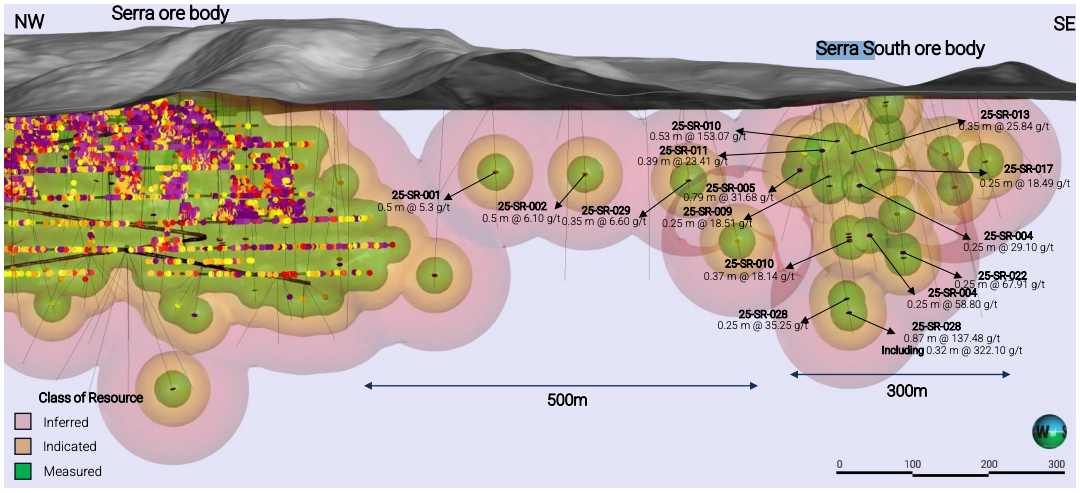
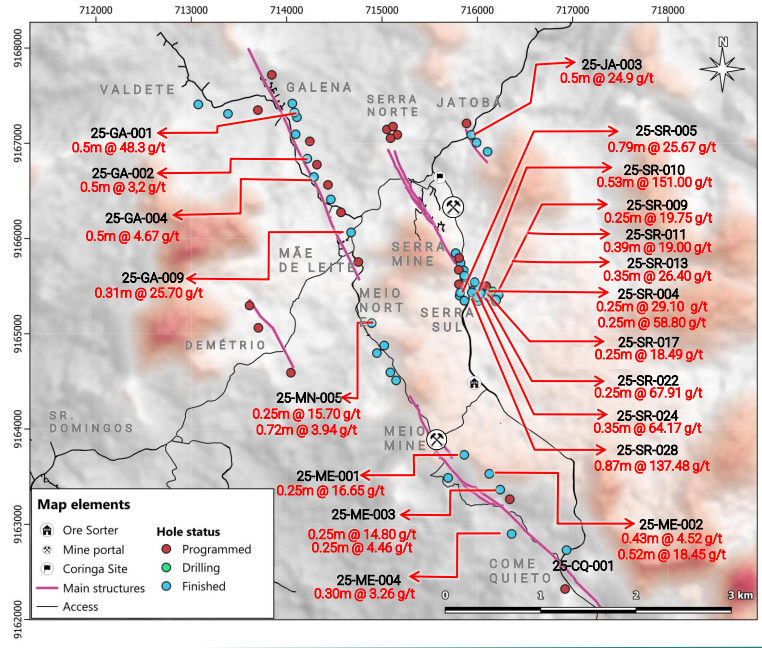
- Serra South, located approximately 500 metres south of the current Serra mine infrastructure, was drilled on a 50-metre grid in the fourth quarter of 2025 and returned intercepts including 0.25 metres at 395.00 grams per tonne gold, with structural interpretation suggesting a zone formed at the intersection of two distinct fault trends.
- Three additional zones, Demétrio, Serra North, and Fofão, add further evidence of a wider underground footprint at Coringa, each at a different stage of evaluation and carrying distinct geological characteristics.
- The transition from selective open stoping to longhole open stoping at Coringa reflects the growing role of ore sorting in the mine's operating model, with the sorter's capacity to manage dilution underpinning a shift toward more mechanised extraction methods.
- NCL Ingeniería y Construcción SpA (NCL) has been engaged to produce updated mineral resource estimates for Palito and Coringa, incorporating the 38,400 metres drilled in 2025, with the updated estimates expected by the end of the first quarter of 2026.
What Has Happened
Serabi Gold published its March 2026 operational and exploration update covering both the Palito Complex and Coringa, including results from the 2025 brownfield drilling programme and a summary of 2026 follow-up plans. At Coringa, Serra South received particular emphasis, described by the company as the most notable development of 2025. Progress at Demétrio, Serra North, and Fofão was also covered; three zones that, alongside Serra South, are beginning to frame a broader underground picture for the project. The company's update stated explicitly that Coringa has "potential for multiple mines," a phrase that goes beyond routine resource-extension commentary and invites closer examination of what the recent drilling is actually showing.
Serra South Changes the Shape of the Coringa Story
Serra South is situated approximately 500 metres south of the current Serra mine infrastructure, a separation that carries practical significance for underground mine development. During the fourth quarter of 2025, the company deployed three drill rigs on a 50-metre grid to complete definition drilling at the target. The headline result, returning 0.25 metres at 395.00 grams per tonne gold alongside 1.09 metres at 17.70 grams per tonne gold, sits at the upper end of what Coringa-style veins have delivered in previous programmes.
The geological interpretation adds structural interest. The company's reading is that Serra South appears to have formed at the intersection of two main structures: one traced from Fofão and the other associated with the Serra and Meio zones. When follow-up drilling tested the corridor between Serra and Serra South for a connecting structure, it found only a narrow, lower-grade zone. That result, while not extending the resource envelope between the two areas, is consistent with the structural-intersection model and reinforces the case that Serra South is a discrete, structurally controlled zone rather than a southern expression of existing mine workings.
The practical implication the company is drawing from this interpretation is significant. Serabi currently envisages that a separate portal may be required to access Serra South, a proposition that, if confirmed by further drilling, would shift the project's development geometry from incremental extension toward something closer to a second discrete mining front.
Demétrio, Serra North & Fofão Point to a Wider Underground Footprint
The three zones beyond Serra South each contribute a different part of the same emerging picture. Demétrio produced a gold-anomalous corridor of approximately 500 metres in strike length through 7 diamond holes totalling 1,397 metres during the fourth quarter of 2025, with vein thickness averaging around 30 centimetres at grades above 10 grams per tonne gold, described as Coringa-style but with higher galena content than other zones. The mineralisation's sharp contrast between vein and host rock, combined with sulphide content, indicates potential compatibility with ore sorting, though testing through the sorter is required before any operational conclusion can be drawn. The target is under evaluation before further 2026 drilling is committed.
Serra North, approximately 800 metres north of the Serra body, returned grades above 9 grams per tonne gold from 3 holes, including results of 15.40, 12.35, and 9.63 grams per tonne, across 1,530 metres of diamond drilling. The mineralised bodies share characteristics with Serra: sharp vein contacts, restricted alteration halos, quartz-sulphide veins dominated by pyrite with some galena, and enclosing granites consistent with shallow-level brittle systems. Results were mixed overall, and drilling was placed on hold pending a revised structural interpretation before further metres are committed.
Fofão emerged from the 2025 Serra South programme rather than from a pre-existing target. Structural data indicate a mineralised trend distinct from the high-angle northwest structures typical of Serra and Meio, with veins showing azimuths of 290-310 degrees. Surface mapping along the extension confirmed multiple artisanal workings, and rock chip sampling returned grades generally above 3 grams per tonne gold with strong oxidation and sulphide development. A scout drilling programme was launched and obtained promising intercepts in narrow quartz-sulphide veins. The company plans approximately 1,500 metres of additional drilling at Fofão in 2026, alongside continued mapping and sampling.
Ore Sorting & Mechanisation Explain Why These Zones Matter Operationally
The significance of multiple zones is not purely geological. Coringa's transition from selective open stoping to longhole open stoping, underway after 12 months of ore sorting results, is changing how the company evaluates potential future mining fronts across the district.
Selective open stoping places a premium on precise extraction and minimal dilution. Longhole open stoping is less labour-intensive and safer than selective open stoping, but it introduces more dilution into the run-of-mine material. The ore sorter bridges that gap, removing diluting material before ore is transported approximately 200 kilometres by road to the Palito Complex for processing. Operating metrics reflect the scale of separation achieved: a feed grade of approximately 6 grams per tonne is upgraded to a product grade above 12 grams per tonne, with more than 98% of the feed rejected at a grade below 0.5 grams per tonne.
Chief Executive Officer of Serabi Gold, Mike Hodgson, is direct about what ore sorting performance means for how the company now thinks about mining selectivity:
"The sorting works so well, it probably allows us to mine badly. We'll get the ore sorted to sort the problem, but frankly, that's exactly what we can do."
Hodgson connects the same dynamic to the practical case for mechanisation:
"We can be a bit more mechanized, which means we can get faster throughput, we can mine safer and quicker, and it can go to the ore sorter."
The operational logic is observable: if ore sorting can reliably handle dilution from wider, more mechanised extraction, then geometrically simpler zones like Demétrio become potentially more viable than they would under a strict selective mining model. The wider and more planar geometry of Coringa's veins, relative to Palito, is already part of the rationale for making this shift at Coringa specifically, and the same characteristic appears in early descriptions of Demétrio.
Broader Context
Drilling at Coringa has been limited to approximately 250 metres of vertical depth, indicating the current resource lies in a relatively shallow portion of the system's likely vertical extent. The resource itself underlies 1.5 kilometres of artisanal workings within an 8-kilometre artisanal trend. The broader mineralised system sits within 30 kilometres of anomalous soil geochemistry, much of which remains untested. Those three figures together indicate that the existing resource base is a fraction of the total anomalous footprint, with substantial untested ground between and around the known zones.
Hodgson frames what Coringa's operating approach has made possible at this stage of development:
"We found a very elegant solution by not having to build a process plant at Coringa which has really taken the heat off the permitting at Coringa."
Coringa operates under a 3-year GUIA licence expiring in January 2027. The full mining licence (LI) requires separate approvals: a land-use change authorisation from the Instituto Nacional de Colonização e Reforma Agrária (INCRA) and an Estudo do Componente Indígena (ECI) approval from the Fundação Nacional dos Povos Indígenas (FUNAI). Processing ore at Palito has allowed the operation to continue advancing without the full permitting requirements that a standalone process plant would trigger. Whether that framework remains sufficient as the potential development footprint at Coringa widens is a question that the updated resource and subsequent mine planning work will help to frame.
What to Watch Next
The immediate validation point for Coringa's multi-zone framing is the updated mineral resource estimate. NCL Ingeniería y Construcción SpA (NCL) has been engaged to incorporate the 38,400 metres drilled in 2025 across both Palito and Coringa. The company targeted the end of the first quarter of 2026 for the estimate. Whether Serra South, Demétrio, or Fofão material is captured in that update, and at what scale, will provide the first quantitative read on the 2025 programme's contribution to the resource base.
On the exploration side, the 2026 programme at Coringa is expected to focus on the south-east extension of Serra South, follow-up work at Serra North once the revised structural interpretation is complete, and the 1,500-metre scout programme at Fofão. The structural-intersection model at Serra South, if confirmed by step-out drilling along strike, would be the most significant single outcome to monitor. A result that extends the zone beyond its current footprint would strengthen the case for the separate-portal scenario and move the multi-zone framing into more concrete mine-planning territory.
Mine planning is the longer-horizon question. If the updated resource validates Serra South as a discrete zone with sufficient scale, and if Demétrio's ore-sorting compatibility is confirmed through testing, the project's layout could begin to reflect a genuinely multi-front underground operation. The company's stated group objective of growing consolidated mineral inventory to more than 1.5 million ounces by 2027 adds context to the pace at which zone-by-zone evaluation will need to proceed.
FAQs (AI-Generated)
Serra South is a target located approximately 500 metres south of Serabi Gold's existing Serra mine infrastructure at Coringa, drilled on a 50-metre grid during the fourth quarter of 2025. Geological interpretation suggests the zone formed at the intersection of 2 distinct fault trends, and the company currently envisages that a separate portal may be required to access it, making it a discrete mining front rather than an extension of existing infrastructure.
Longhole open stoping is less labour-intensive and safer than selective open stoping, but it introduces more dilution into the run-of-mine material. At Coringa, the ore sorter removes that dilution before the ore is transported to the Palito Complex for processing, which makes the shift operationally viable without a standalone process plant at the site.
Four zones are currently under evaluation beyond the existing Serra and Meio mine areas: Serra South, Demétrio, Serra North, and Fofão. Each is at a different stage of drilling and evaluation, with Serra South the most advanced after fourth-quarter 2025 definition drilling and Fofão the most recently identified, having emerged from the Serra South programme itself.
The updated mineral resource estimate incorporating the 38,400 metres drilled across the 2025 programme was expected in the first quarter of 2026, with the end of the first quarter of 2026 cited as the specific target timing. Whether new zones such as Serra South contribute to that estimate, and at what scale, will be a key indicator of the 2025 programme's overall significance for the resource base.
Fofão was identified during the 2025 Serra South drilling campaign, when structural data revealed a mineralised trend with an orientation distinctly different from the high-angle northwest structures typical of Serra and Meio, with veins showing azimuths of 290 to 310 degrees. Surface mapping confirmed multiple artisanal workings along its extension, and rock chip sampling returned grades generally above 3 grams per tonne gold, prompting a scout drilling programme that returned promising intercepts in narrow quartz-sulphide veins.
Analyst's Notes





Subscribe to Our Channel





Stay Informed