




The Corridor Between the Pits: Florida Canyon's Case for Regional Gold Growth


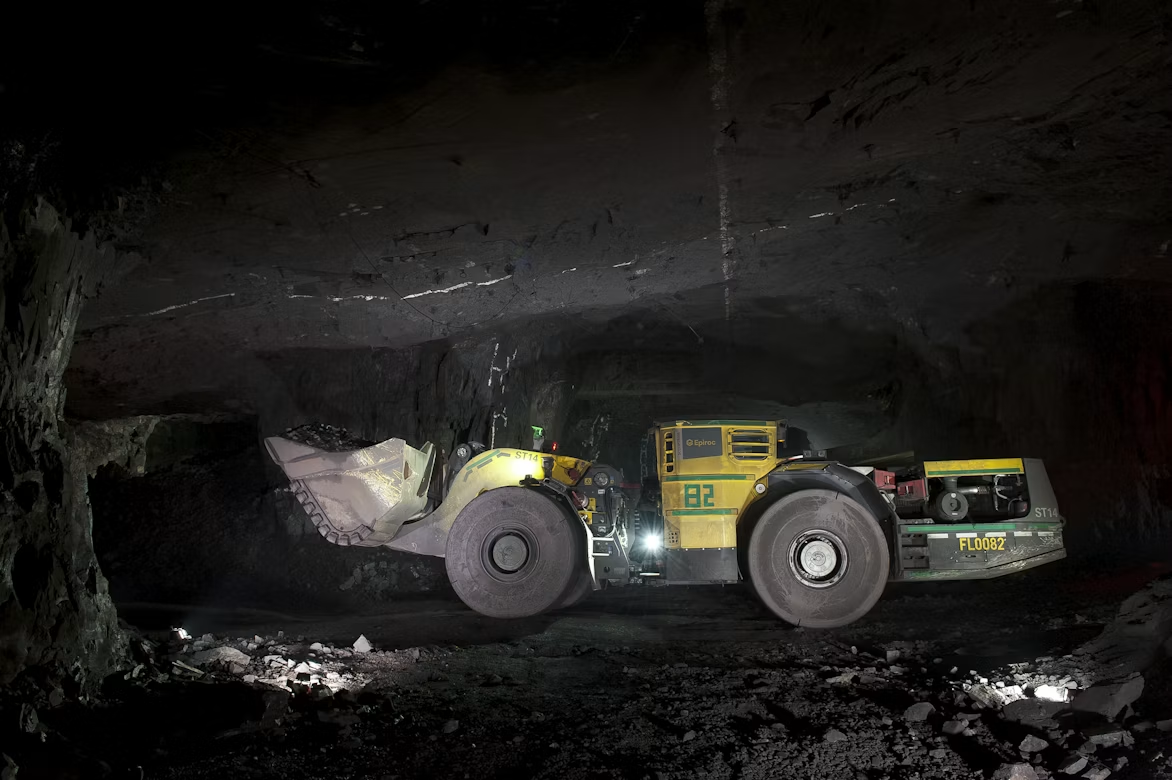
Nevada's Great Basin hosts undrilled ground between producing and historical gold mines, illustrated through Florida Canyon's regional exploration corridor.
- Nevada's Great Basin hosts several major advanced gold operations, but high-quality, advanced assets remain structurally scarce across the region.
- Historical drilling between two structurally connected mine sites within a single Nevada corridor has been limited, leaving inter-pit saddle and ridge zones largely untested.
- A 2026 capitalised waste-stripping campaign, budgeted between $62.0 million and $68.0 million for sustaining capital and leases, plus $7.5 million to $9.5 million for growth capital, provides access to new mining phases rather than to regional exploration drilling.
- Florida Canyon, an operating open-pit heap leach gold mine in Nevada, sits approximately five miles from the historical Standard Mine, which produced more than 220,000 ounces of gold between 2004 and 2015.
- Drilling at the Central and Radio Tower Saddle zones returned broad, near-surface intervals, including 0.48 grams per tonne gold over 76.2 metres, consistent with heap leach oxide growth potential.
In mature gold districts, the easiest deposits to find were generally found decades ago. What remains accessible today is often the ground between existing operations: ridges, saddles, and structural connections that earlier generations of explorers drilled around rather than through, because attention stayed fixed on the pits already producing ore. Nevada's Great Basin is one of the clearest examples of this pattern, and it is reshaping where companies look for incremental ounces.
In several corridors across the state, a producing open-pit mine sits a few miles from a historical mine that worked the same structure decades earlier. The land connecting them has frequently seen far less drilling than either pit itself, simply because exploration budgets followed active mining rather than the geology between the two sites, which were under different ownership at different times. That gap is now drawing renewed attention.
Scarcity of Advanced Gold Assets in the Great Basin
The Great Basin trend in Nevada hosts several of the longest-running and largest gold operations in the United States, including Rochester, operated by Coeur, Round Mountain and Bald Mountain, both operated by Kinross, Turquoise Ridge, Goldstrike, Cortez, and Carlin, all operated through the Barrick and Newmont joint venture, and Marigold, operated by SSR. These operations share a common feature: each sits on ground that has been explored, permitted, and mined for decades, often through multiple changes of ownership.
That depth of history is also why advanced-stage gold projects with established infrastructure are scarce in the region. Most of the ground capable of supporting a new, fully permitted mine has already been claimed and developed by an existing operator. Brownfield exploration around currently producing or formerly producing assets, therefore, represents one of the few categories of new ounces that are still genuinely accessible, since the roads, permits, water rights, and geological baseline already exist on or near the property.
Inter-Pit & Saddle Zone Exploration Methodology
Within a single mineralised structure, a current open-pit mine and a historical pit can lie several miles apart yet share the same geological trend. The ground directly connecting them, sometimes described as inter-pit or saddle ground, is frequently under-drilled relative to the pits themselves, because historical exploration programmes concentrated capital on defining ore directly beneath active or planned mining areas rather than the connective ground between two separately operated sites.
In one Nevada corridor, two such mine sites lie approximately five miles apart within the same productive geological structure. The regional ground between them has seen only limited historical drilling, and the historical mine site itself has had no recent drilling. Nearer to the active operation, inter-pit features such as the Central and Radio Tower Saddle have also historically seen sparse drilling. That combination, an active mine, a historical mine on the same structure, and an undrilled corridor between them, is the specific geological setup this methodology targets.
Capital Intensity of the 2026 Stripping Campaign
Open-pit heap-leach mines require sequential capital outlays to remove overburden and waste rock before mining new ore phases. When a mine has deferred some of this waste removal in earlier years, it can face a concentrated, capital-intensive stripping campaign in a single year to catch up and unlock access to the next mining phase. This type of spending is distinct from exploration capital, even though both can occur at the same operation in the same period.
At one Nevada heap-leach operation, the 2026 stripping campaign is budgeted between United States dollars 62.0 million and 68.0 million for sustaining capital and leases, plus 7.5 million to 9.5 million for growth capital. That spending funds access to new mining phases and is expected to bridge guided 2026 production of 70,000 to 75,000 ounces of gold toward 80,000 to 90,000 ounces in 2027, 2028, and beyond, an increase of approximately 20%.
Florida Canyon's Regional Corridor Opportunity
Florida Canyon illustrates this dynamic directly. Integra Resources (TSXV: ITR | NYSE American: ITRG) acquired the mine in 2024. Florida Canyon is an actively producing, conventional open-pit heap leach gold operation using loader and truck mining with a carbon-in-column recovery process, and it operated continuously from 1986 to 2011, then intermittently until 2015, before passing through Rye Patch Gold from 2015 to 2018, Alio Gold from 2018 to 2020, and Argonaut Gold from 2020 to 2024.
Approximately five miles south of Florida Canyon, within the same geological structure, sits the historical Standard Mine. Standard Mine produced more than 220,000 ounces of gold between 2004 and 2015 and has had no recent drilling. Florida Canyon's stated remaining mine life is 5 years, and that figure carries potential extension through near-mine oxide exploration, including the ground separating it from Standard Mine.
Saddle Zone Drill Results & Oxide Growth Potential
Drilling in inter-pit zones near the active operation, such as the Central and Radio Tower Saddle, has returned several broad intervals. Results include 0.48 grams per tonne gold over 76.2 metres, 0.67 grams per tonne gold over 77.7 metres, 0.40 grams per tonne gold over 91.4 metres, and 0.35 grams per tonne gold over 44.2 metres.
These intervals are characterised as near-surface and consistent in grade along their length, a profile generally associated with oxide mineralisation suited to heap-leach processing rather than higher-grade underground deposits. Separately, growth projections for the mine's North and South waste dumps remain conceptual, with insufficient drilling and metallurgical testing to classify them as defined mineral resources.
Mine Life Extension & Platform Considerations
Florida Canyon's six-year stated mine life is the baseline against which any corridor-driven extension will be measured, and that extension remains an open question rather than a confirmed outcome. Resolution depends on results from a 42,500-metre drill programme planned for 2026, targeting near-mine oxide growth, and on an updated mineral resource and reserve estimate, as well as a life-of-mine plan expected in mid-2026 that incorporates both optimisation studies and growth drilling results.
Mineral resource and reserve estimates of this kind can be affected by a range of factors, including geology, environmental conditions, permitting, legal title, taxation, and sociopolitical or marketing issues, none of which are resolved by drill results alone. As more Great Basin districts reach a similar stage, where the obvious pit-level ore has already been defined and mined, the inter-pit and saddle corridor approach illustrated at Florida Canyon may become a more common avenue for incremental ounces across the region, provided it is supported by the same sequence of confirmatory drilling and technical reporting.
FAQs (AI-Generated)
Analyst's Notes





Subscribe to Our Channel




.png)

Stay Informed






















