Tony M Study Targeted for First Quarter 2027 Gives IsoEnergy a Dated Catalyst


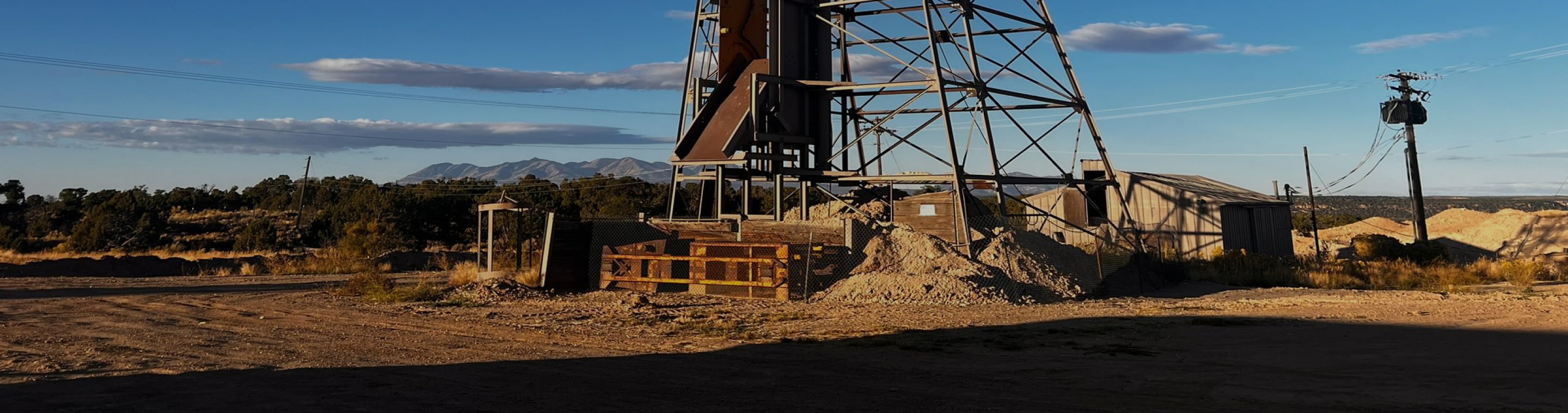
DISA Uranium now targets the updated Tony M economic study by the first quarter of 2027, the step that comes before any decision to restart the Utah mine.
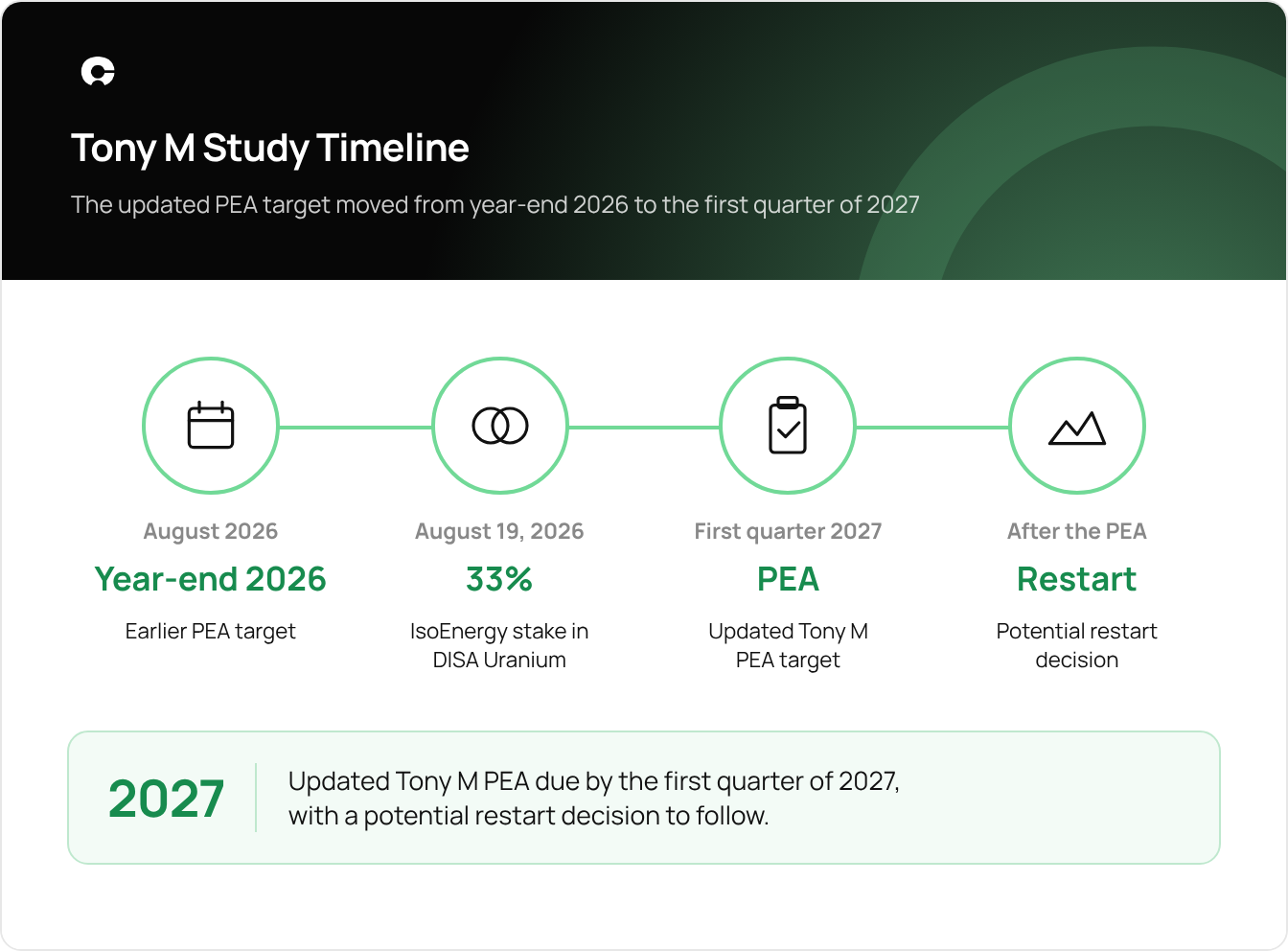
- DISA Uranium now targets the updated Tony M preliminary economic assessment (PEA) by the first quarter of 2027, moved from year-end 2026.
- A potential restart decision on Tony M follows the PEA.
- IsoEnergy's Tony M exposure comes through a 33% stake in DISA Uranium.
- A 2026 leach study at Tony M recovered 88% of the uranium in 22% of the mass.
- DISA Uranium is not disclosing unit costs for its process or a listing date.
The Tony M Study Timeline
IsoEnergy (NYSE American: ISOU | TSX: ISO) owns its interest in the Tony M mine in Utah through DISA Uranium. DISA Uranium now targets completion of the updated preliminary economic assessment (PEA) for Tony M by the first quarter of 2027, moved from an earlier target of year-end 2026. The technical and economic studies on the Utah mines are there to support a potential restart decision.
Tony M has its main state and operating permits in place, along with extensive surface and underground infrastructure. The southeastern Utah mines in the portfolio were in production in the mid-2000s and, before that, in the early 1980s. DISA Uranium's Utah Portfolio groups Tony M with the Daneros and Rim mines and the Sage Plain and Flatiron projects, all listed as past producing in IsoEnergy's portfolio. The work on Tony M's economics predates the move into DISA Uranium. IsoEnergy was running updated economics for the Utah mines ahead of a restart when a test of the DISA process, one of the ways it tried to cut operating costs, led to the transaction.
Chief Executive Officer of IsoEnergy, Philip Williams, set the order of events in August, with the restart decision waiting on the study:
"We're going to have the economic study done on Tony M by the end of the year, and then we take the decision to restart. And that restart could be in 2027 and be generating cash flow next year."
For IsoEnergy holders, the updated Tony M PEA is now the event with a date that opens the restart decision.
Tony M Inside DISA Uranium
IsoEnergy contributed its Utah assets to DISA Uranium in a transaction that closed on August 19, 2026, alongside a concurrent US$105 million financing. IsoEnergy owns 33% of DISA Uranium, is its largest shareholder, and has 2 board seats. DISA Uranium's board includes Williams and the Chairman of IsoEnergy, Richard Patricio.
The proceeds of the financing go toward advancing the Tony M PEA, DISA Uranium's remediation business, consolidation opportunities, and upfront work on a potential new processing facility. The Utah technical team moved across to DISA Uranium with the projects. DISA Uranium also has the exclusive license to use the uranium processing technology, and the technology company spun out of the deal cannot apply it to uranium.
The Utah assets are now advanced and funded off IsoEnergy's balance sheet, and IsoEnergy's share of any Tony M restart comes through its 33% holding and board seats. The stake comes with other rights, and IsoEnergy wants to maintain its position, including the option to invest in DISA Uranium. As of August, when and where DISA Uranium would need its next rounds of capital were still being worked out.
High-Pressure Slurry Ablation Results & the Mine Plan
The integration plan for the Utah Portfolio pairs the first-quarter 2027 PEA target with the incorporation of High-Pressure Slurry Ablation efficiencies into the Tony M mine plan. High-Pressure Slurry Ablation is a fully mechanical process in which particles collide to liberate the target minerals, without the use of grinding media or chemical reagents. Higher-grade concentrate goes on to a processing facility, while clean, low-grade material stays on site. At Tony M, the plan is a fixed installation, possibly 2 or 3 machines working together or separately, while units for waste piles can be mounted on trucks and moved between sites. The process already runs at mines outside uranium, including a unit at the Eagle Mine, across 8 or more countries and 19 or more commodities.
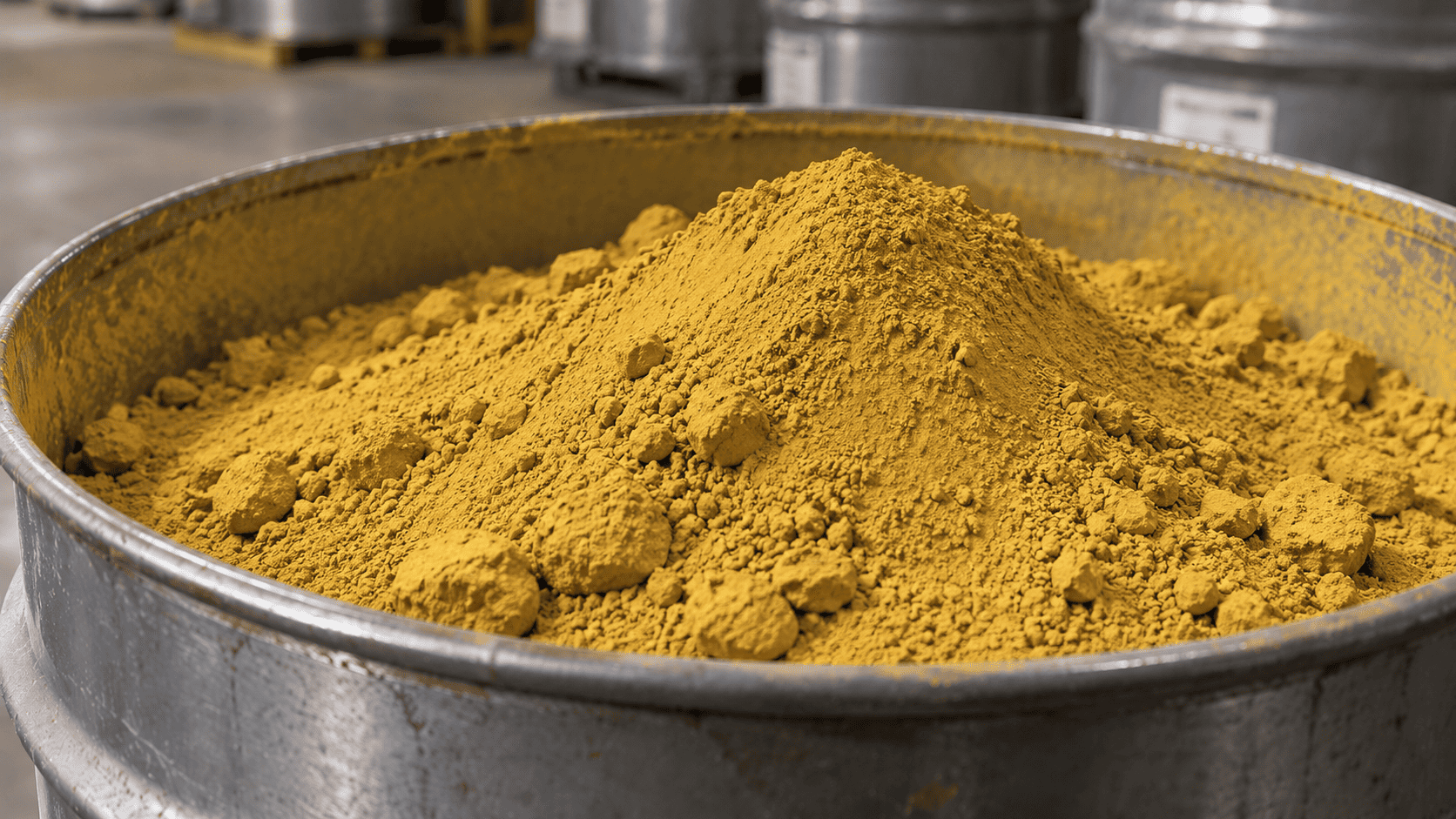
A 2026 leach study at Tony M lifted uranium grade 4.0 times, from 3,500 parts per million to 14,087 parts per million. The concentrate contained 22% of the original mass and recovered 88% of the uranium. Leaching, the chemical step that dissolves uranium out of the rock, took 2 hours after the process, compared with more than 20 hours under conventional methods. IsoEnergy also tested ore sorting, which uses a radiation detector to separate ore from waste, and it did not achieve the same upgrade. Tony M ore travels 127 miles to processing, and, as a general benefit, the process offers haulage cost reductions of more than 70% and mill feed grades that are improved 3 to 5 times. Fewer tons processed per pound of uranium also means fewer tons sent to tailings.
Williams traces the work back to the restart economics themselves:
"So, as part of running the updated economics on these projects in advance of restarting them, we were lucky, and we're always looking at ways that we could optimize operating costs, reduce those costs."
The PEA is the study to incorporate those efficiencies into the Tony M mine plan.
Open Questions Before a Restart
The leach-study figures describe test work, and DISA Uranium is not disclosing cost figures for its process units as a private company. Unit costs and payback do not appear in any of the figures released so far. Results also vary by deposit: the uplift was 4-fold at Tony M and up to 6-fold on other deposits tested, a difference management attributes to mineralogy.
Processing capacity adds a second constraint, with 1 fully licensed conventional uranium mill operating in the US. That facility, White Mesa, is licensed for about 8 million pounds a year, against the 50 million pounds of US production management says the country needs.
DISA Uranium plans a new centralized uranium recycling and processing facility, anchored by the scale of the Utah Portfolio's resources, which would be the first new US conventional uranium mill in more than 4 decades. DISA Uranium has a good idea of the general area for a mill, but no site or construction date has been provided, and building a new mill takes a long time. Information about the facility is to come first, followed by a full execution plan. It also plans continued political and regulatory engagement, including opportunities to pursue public-private partnerships. Political support in the US backs such projects, and the government has fast-tracked permits, though DISA Uranium is not saying the facility would receive that treatment.
Decision Points for IsoEnergy Shareholders
Beyond the Tony M PEA, DISA Uranium's milestones have no dates. They include a first pilot program at a site licensed by the US Nuclear Regulatory Commission and a maiden remediation cleanup at a Navajo Nation site. As of August, the 2026 remediation projects were to serve as test cases for how fast, how many, and in what order such sites can be handled.
DISA Uranium also plans to scale by consolidating regional deposits and expanding remediation resources through site staking and third-party agreements. More than 15,000 abandoned uranium mine sites and more than 4,200 defense-related uranium mines are listed in US databases, and DISA Uranium has more than 100 million short tons in its own pipeline. Access usually comes through agreements that pay the underlying owner a small royalty on the uranium recovered. DISA Uranium has no listing date, and Williams commits to the destination but not the date:
"I mean, this will ultimately be a public company. We're not guiding on timing for that."
At Larocque East, all samples from the summer program had been submitted to SRC Geoanalytical Laboratories as of September 8, 2026. The results are to be reported when available and used to evaluate 2027 drill targets at Hurricane. At Wiluna, the potential next steps include converting the JORC resource to NI 43-101 compliance, infill drilling, and converting the scoping study to a PEA. IsoEnergy had cash of approximately C$70.9 million, based on its June 30, 2026 disclosure and adjusted for the DISA Uranium investment. For shareholders, the Tony M PEA due by the first quarter of 2027 is the event on that list tied to a restart call at a permitted mine.
The Investment Thesis for IsoEnergy
- DISA Uranium now targets the updated Tony M preliminary economic assessment by the first quarter of 2027 instead of year-end 2026.
- A potential restart decision on the permitted Tony M mine follows that study.
- IsoEnergy's Tony M exposure comes through a 33% stake and 2 board seats in DISA Uranium, which is funded separately from IsoEnergy.
- The 2026 Tony M leach study recovered 88% of the uranium from 22% of the mass after High-Pressure Slurry Ablation.
- DISA Uranium is not disclosing process unit costs and is not guiding on the timing of a listing.
The study date now governs when IsoEnergy holders see an updated economic case for a Tony M restart. That case is due to incorporate High-Pressure Slurry Ablation efficiencies from a leach study that recovered 88% of the uranium in 22% of the mass. The first quarter of 2027 is the next date on record for IsoEnergy's US production exposure.
TL;DR
IsoEnergy's route to a Tony M restart now runs through a DISA Uranium PEA targeted by the first quarter of 2027, moved from year-end 2026, with the restart decision following that study. IsoEnergy owns a 33% stake in that separately funded company. The PEA is due to incorporate High-Pressure Slurry Ablation efficiencies from a 2026 leach study that recovered 88% of the uranium in 22% of the mass. Unit costs and a listing date are not yet public, and the first quarter of 2027 is the next scheduled point for the Tony M case.
FAQs (AI-Generated)
Analyst's Notes





Subscribe to Our Channel






Stay Informed