IsoEnergy Ltd. & The Spin-Out of DISA Uranium: What the Joint Venture Signals for US Uranium Production


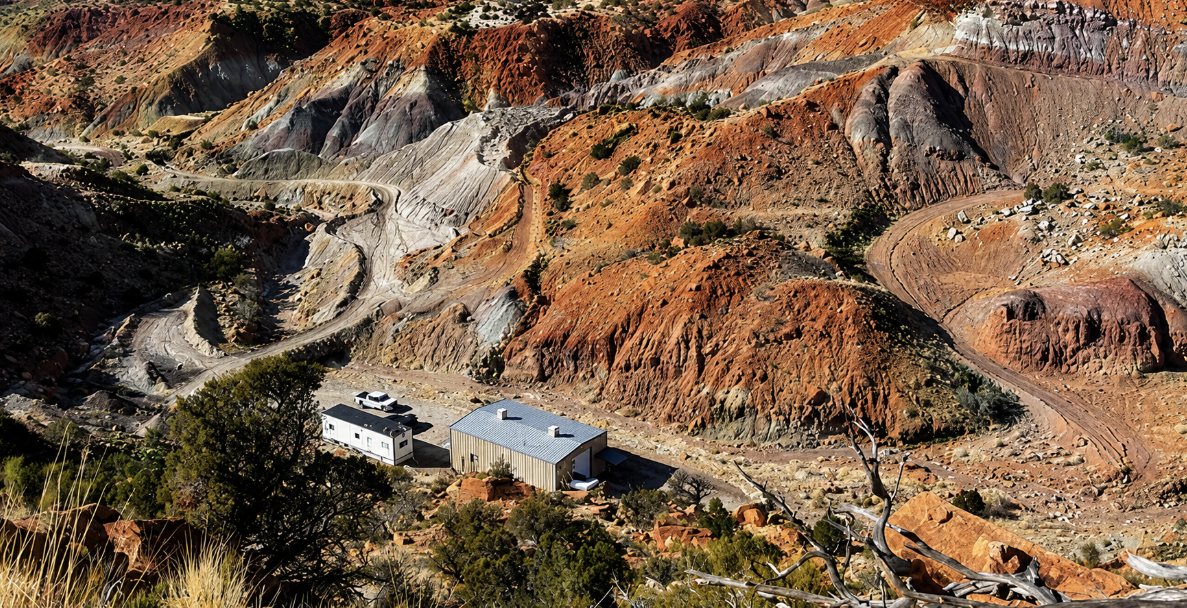
IsoEnergy & DISA Uranium establish a US$505 million US uranium platform that combines Utah assets, HPSA processing, and remediation to secure the US supply chain.
- IsoEnergy and DISA Technologies are creating DISA Uranium with a US$105 million financing and an implied pro forma equity value of approximately US$505 million.
- IsoEnergy contributes its permitted Utah conventional portfolio for 1,677,350 DISA Uranium shares, representing approximately 33% pro forma ownership.
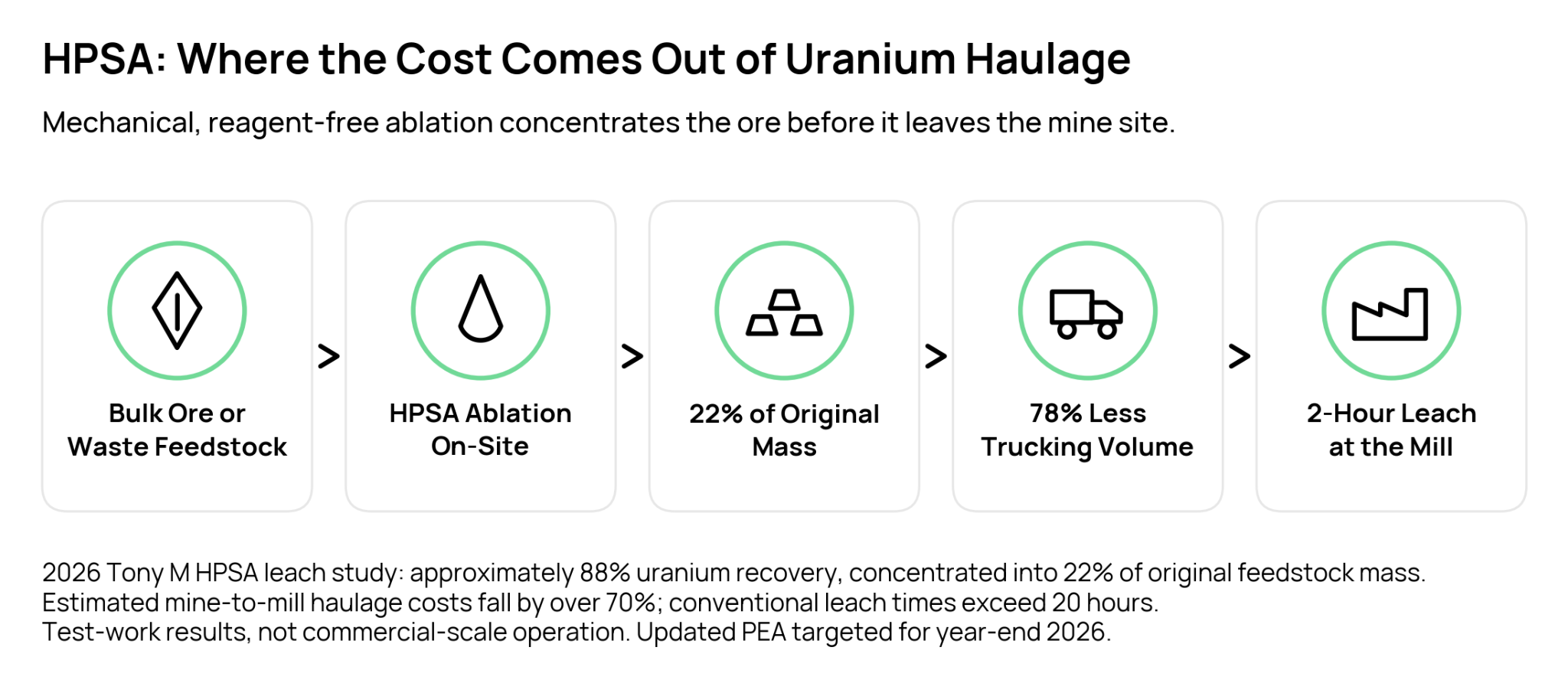
- The High-Pressure Slurry Ablation (HPSA) technology reduced bulk sample feedstock by 78% while achieving approximately 88% uranium recovery, potentially cutting trucking volumes and costs.
- DISA Uranium plans to recover uranium from legacy waste while reducing uranium and radium levels, supported by a multi-site US Nuclear Regulatory Commission (NRC) Source Materials License.
- Commercial-scale HPSA performance, site-access agreements, the updated Tony M Preliminary Economic Assessment (PEA), and the first NRC-licensed pilot will determine whether the platform can scale toward a centralized US uranium processing facility.
What Has Happened
On August 4, 2026, IsoEnergy Ltd. (TSX: ISO | NYSE American: ISOU) entered a definitive agreement with DISA Technologies, Inc. to establish DISA Uranium Corporation (DISA Uranium), creating a technology-enabled US uranium platform. This joint venture (JV) targets a share of a domestic utility market requiring approximately 50 million pounds of annual uranium oxide production. For IsoEnergy, which is advancing its flagship Larocque East project in Canada, this transaction isolates the capital requirements of its standby Utah conventional portfolio while maintaining direct exposure to a specialized domestic technology platform.
Strategic Restructuring & Capital Allocation
Shifting the capital-intensive development of standby US mines onto a separately funded vehicle de-risks IsoEnergy. Under the agreement, IsoEnergy is contributing its permitted conventional Utah portfolio in exchange for 1,677,350 common shares, representing an approximate 33% pro forma ownership interest. Concurrently, DISA Uranium has secured commitments for a US$105 million private placement financing, led by Tembo Capital, BHP Ventures, Galvanize Climate Solutions, and Valor Equity Partners. This concurrent financing directly establishes DISA Uranium's implied pro forma fully diluted equity value of approximately US$505 million, providing an objective post-money valuation benchmark priced by external institutional and strategic capital.
According to an August 4, 2026 research note by Red Cloud Securities, the transaction assigns a pro forma value to the contributed Utah assets that is 2.6 times the target valuation previously modeled by the analyst firm. However, because DISA Uranium will initially operate as an unlisted private entity, this approximate 33% pro forma stake represents an illiquid holding prior to any public listing, meaning this valuation premium remains an unrealized paper gain subject to closing and execution risks.
HPSA Selective Mineral Liberation & Operating Economics
The core technical differentiator of DISA Uranium is High-Pressure Slurry Ablation (HPSA), a 100% mechanical, reagent-free processing technology. HPSA utilizes high-velocity slurry jets to generate particle-on-particle collisions that selectively fracture soft carnotite minerals from hard quartz host grains and orthoclase at coarser grind sizes. This selective mechanical liberation separates barren material from the uranium-bearing fraction, reducing overgrinding and supporting downstream metallurgical processing.
Metallurgical test work conducted as part of the 2026 Tony M HPSA Leach Study demonstrated that HPSA concentrated the target uranium mineral into approximately 22% of the original feedstock mass while achieving approximately 88% uranium recovery. The resulting mass reduction is expected to reduce the amount of material requiring transportation, with company estimates indicating mine-to-mill haulage cost reductions of more than 70%. Post-process leach times were also reduced to approximately 2 hours, compared with more than 20 hours using conventional methods. Tony M holds an Indicated mineral resource of 1,185,000 tonnes grading 0.28% uranium oxide and containing 6,606,000 pounds of uranium oxide as of the September 9, 2022 National Instrument 43-101 technical report. The HPSA test results are expected to inform the updated preliminary economic assessment (PEA), which is targeted for completion by year-end 2026.
Above-Ground Remediation & Licensing Moats
Beyond underground mining, DISA Uranium targets surface-level legacy waste piles. According to databases compiled by the US Environmental Protection Agency (EPA) and the US Geological Survey (USGS), there are more than 15,000 sites associated with abandoned uranium mine waste and more than 4,200 defense-related uranium mines across the western United States, primarily concentrated in the Four Corners region and Wyoming. The HPSA remediation circuit achieves a 98% reduction in uranium levels and a 93% reduction in radium levels in processed waste, while operating at a cost 80% lower than traditional reclamation methods, allowing the cleaned, benign rock to be left on site.
This capital-light, mobile recovery model is authorized under a first-of-its-kind, multi-site US Nuclear Regulatory Commission (NRC) Source Materials License, allowing portable HPSA processing units to treat legacy waste directly on-site across tribal, federal, and private land jurisdictions.
Technical Scale-Up & Infrastructure Capital Execution Risks
HPSA remains subject to technical scale-up risk as IsoEnergy advances the technology from test work toward larger-scale and commercial applications. While testing on Tony M mineralized material has demonstrated uranium upgrading and recovery, commercial-scale operating performance has yet to be established. The broader remediation strategy also requires site access and commercial agreements across multiple jurisdictions, creating execution risk around the timing and availability of material for processing.
The company’s longer-term strategy includes developing a centralized uranium recycling and processing facility in Utah, which management describes as potentially the first new conventional uranium mill constructed in the US in more than 4 decades. Before advancing that strategy, IsoEnergy is targeting additional technical and economic validation, including an updated Tony M preliminary economic assessment (PEA) by year-end 2026 and an initial pilot program at a Nuclear Regulatory Commission (NRC)-licensed site. These milestones provide important tests of whether HPSA and the broader processing model can support subsequent commercial deployment and infrastructure investment.
Key Takeaway for Investors
The establishment of DISA Uranium Corporation represents a capital-allocation pivot for IsoEnergy Ltd., isolating the development expenses of its standby Utah assets in a separately funded corporate vehicle while retaining pro forma equity exposure. By combining permitted, past-producing conventional mines with proprietary HPSA processing technology, the newly formed entity is positioned to address high trucking costs and bypass traditional permitting timelines to capture a share of the domestic United States uranium market. While technical scale-up of the mechanical processing circuit and multi-jurisdictional land access for above-ground remediation present near-term execution risks, the transaction establishes an independent valuation benchmark that re-rates the balance sheet value of IsoEnergy Ltd.'s United States portfolio.
What to Watch Next
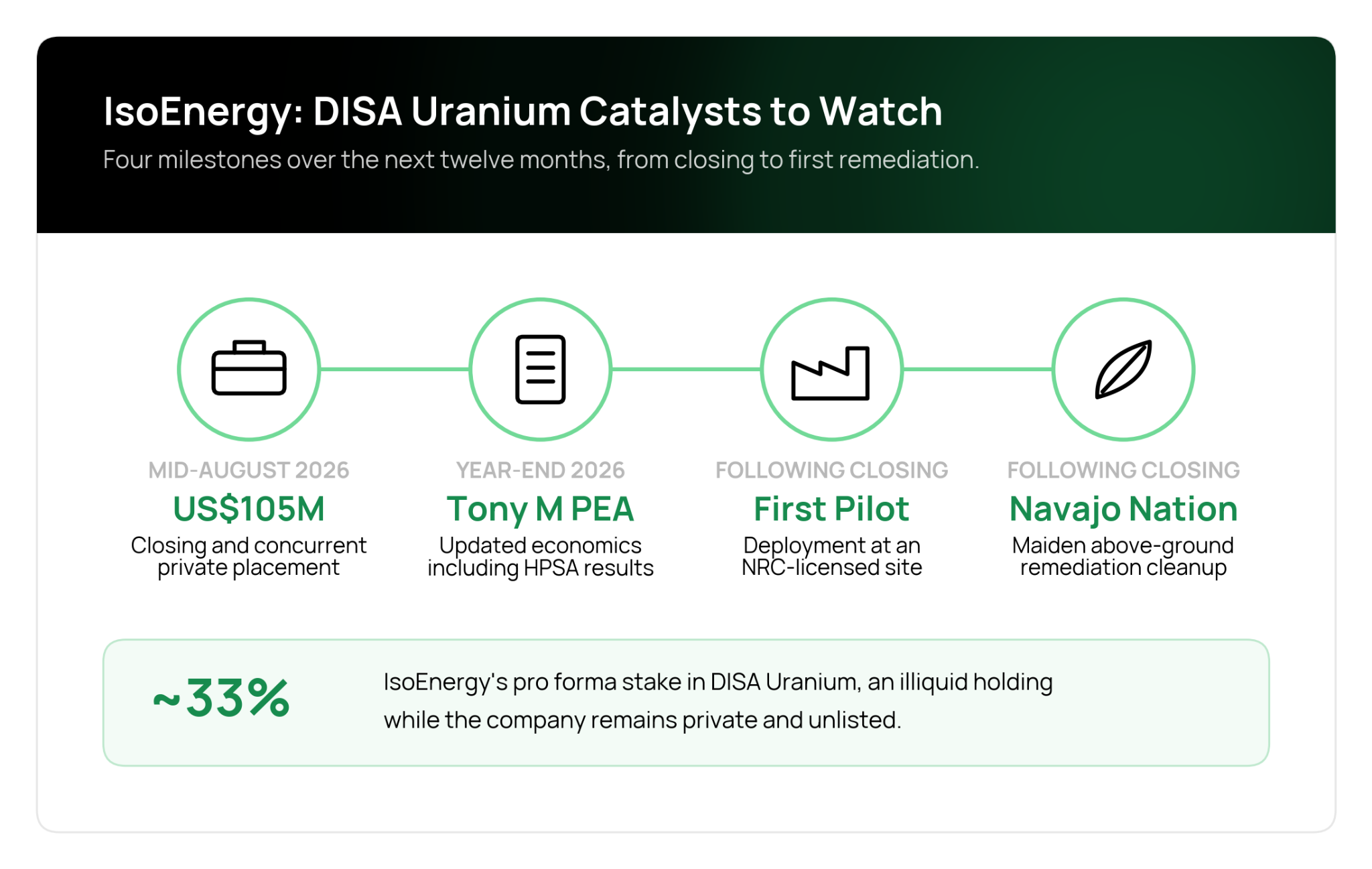
The establishment of DISA Uranium Corporation alters the development timeline and funding structure of IsoEnergy Ltd.’s standby Utah conventional assets, pairing them with proprietary HPSA processing technology and a dedicated, licensed above-ground remediation business. Investors should closely monitor several major catalysts over the next 12 months, including the official closing of the transaction and the concurrent US$105 million financing in mid-August 2026. Following closing, the primary milestones will be the delivery of the updated Tony M PEA by year-end 2026, the deployment of the first pilot program at an NRC-licensed site, and the commencement of the maiden cleanup at the Navajo Nation remediation site.
FAQs (AI-Generated)
Analyst's Notes





Subscribe to Our Channel

.jpg)


Stay Informed