Hauling Rock, Not Uranium: How Pre-Concentration Could Change US Mill Economics


Low grades and 1 operating mill tie US uranium costs to tonnage. Tony M tests show how pre-concentration could cut haulage and milling costs.
- US conventional uranium deposits grade 0.1% to 0.3%, and legacy remediation sites grade below 0.1%, so producers must mine, haul and process large volumes of rock to recover uranium.
- Only 1 fully licensed conventional uranium mill operates in the US, and the domestic industry has historically relied on multiple mines trucking ore to a central processing facility.
- Pre-concentration removes lower-grade material at the mine or waste pile before haulage, with the aim of cutting the tons trucked, milled, and sent to tailings.
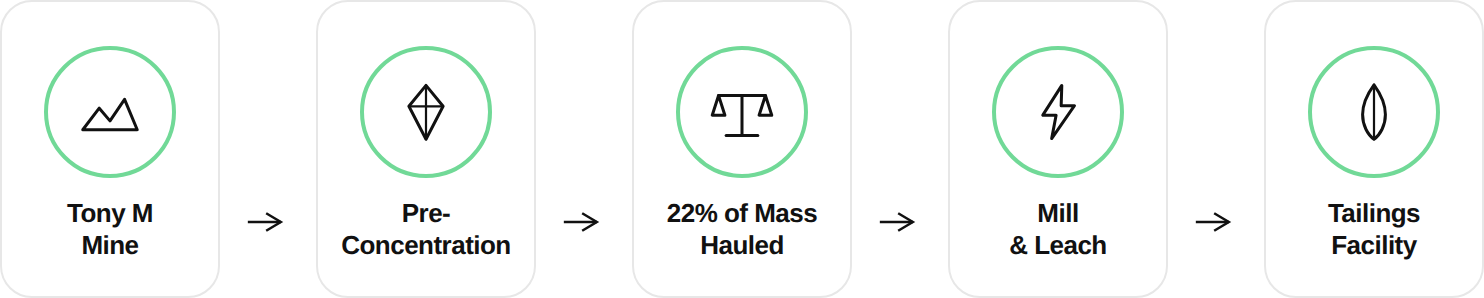
- In a 2026 Tony M leach study, high-pressure slurry ablation (HPSA) lifted uranium grade 4.0x, from 3,500 to 14,087 parts per million, with 22% of the mass reporting to concentrate and 88% uranium recovery.
- Commercial unit costs, sustained throughput, and mine-wide economics remain unproven, with an updated preliminary economic assessment (PEA) for Tony M targeted by year-end 2026.
The Tonnage Problem in US Conventional Uranium
At grades of 0.1% to 0.3%, according to the US Geological Survey, uranium makes up a fraction of 1% of the ore that US conventional producers mine, truck, and feed through a mill. Material on legacy remediation sites grades below 0.1%. Haulage, processing and tailings costs are incurred on every ton moved, whether or not that ton carries recoverable uranium.
That cost base feeds into a narrow processing network. Only 1 fully licensed, operating conventional uranium mill exists in the US. Any restart of past-producing mines in southeastern Utah and the wider Four Corners region would send ore into the same constrained system.
Pre-concentration attacks the problem at the front of the chain. Lower-grade material is separated at the mine or waste pile, and only the upgraded fraction travels to the mill, enters the leach circuit, and ends up in tailings. Test work in Utah in 2026 has produced data on how far that approach can reduce the tons moving through the system, and on what it has not yet demonstrated.
Industry Context
The US uranium industry was built around dispersed underground mines supplying central mills. Utah's past-producing mines operated on that model in the early 1980s and again in the mid-2000s, and any restart inherits the same logistics. Ore from the Tony M mine would travel 127 miles by road to the processing facility.
Chief Executive Officer of IsoEnergy (NYSE American: ISOU | TSX: ISO), Phil Williams, described how haulage and processing costs compound when every tonne of mined rock is treated as mill feed:
"It's the story of the US and uranium: it was always about multiple mines feeding a central processing facility. If you can reduce the amount of material being trucked to that central processing facility, you have tremendous savings. You're processing a lot fewer tons of ore for the same amount of uranium, so processing cost per pound goes down, trucking cost per pound goes down."
Processing capacity is the second constraint. White Mesa is the only conventional uranium mill operating in the US and is licensed to process about 8 million pounds per year. The domestic production requirement is 50 million pounds. Some developers are assessing restarts of older processing facilities, some of which are more than 40 to 50 years old. Tailings are the third cost: the tonnes fed to a mill also set the volume its tailings facility must hold.
Emerging Practices & Industry Progress
Pre-concentration moves part of the separation step from the mill to the mine site. 2 methods have been tested on Tony M ore. The first is ore sorting, which passes mined material under a scintillometer and diverts it by radioactivity. The second is high-pressure slurry ablation (HPSA), a mechanical process developed by DISA Technologies. Williams said ore sorting did not achieve the upgrade HPSA delivered in IsoEnergy's testing.
HPSA uses high-velocity slurry jets to create particle-to-particle collisions. Ore fractures along grain boundaries and hardness contrasts. In carnotite ores, the uranium- and vanadium-bearing mineral breaks into fines that contain 90% of both metals, which can then be separated from liberated quartz. The process uses no grinding media or chemical reagents, and the units are compact enough to be mounted on trucks. HPSA units already operate at US nickel, copper, and phosphate mines, where thousands of tonnes of material have been processed.
Williams linked the benefit to the back end of the flow sheet as well as the haul:
"The more you reduce waste before putting it into the processing plant, the more tremendous implications it has for costs. You're putting fewer tons through, and on the back end, putting fewer tons into the tailings pile. Tailings are a huge issue: very costly to build large tailings facilities and not straightforward to permit them."
Legacy waste piles offer a second application. 15,000 uranium mine waste piles have been identified across the Four Corners region and into Wyoming. For their owners, each is either an environmental liability or a source of contained uranium that cannot be recovered economically. Mobile units can process material at the pile, send the uranium-bearing concentrate to a mill, and leave the cleaner rock in place. DISA holds a first-of-its-kind US Nuclear Regulatory Commission (NRC) license for this work, and access agreements typically pay the underlying owner a small royalty on recovered uranium.
Remaining Challenges
Unit costs are not public. DISA is a private company and is not disclosing equipment cost figures, although Williams described the cost as low relative to the return. The machines need ongoing servicing and part replacement. DISA Uranium's plan for uranium includes a first pilot program at an NRC-licensed site.
Performance also depends on grade and mineralogy. Williams tied recoverable uranium directly to feed grade:
"Ultimately, it's a function of how low you want the residual amount of uranium to get to. The higher the grade, the more uranium you'll get out of it; the lower the grade, the less you're going to get and the more it takes to get to a lower level."
Remediation material grading below 0.1% is at the low end of that range, and residual-uranium cutoffs vary across regulators and regions. Counterparties vary by pile, including the Environmental Protection Agency, private landholders, and other uranium companies, so access terms are negotiated on a case-by-case basis. The first 2 remediation projects, scheduled for 2026, are intended to establish how fast and in what order piles can be processed. A new mill also takes time to build.
Company or Project Examples
Tony M provides the current test case. The 2026 Tony M HPSA leach study reported a 4.0x uplift in uranium grade, from 3,500 to 14,087 parts per million, with 22% of the original mass reporting to concentrate and 88% uranium recovery. Leach time after HPSA was 2 hours, against more than 20 hours for conventional methods. Across its wider sample testing, DISA has recorded uplifts of up to 6x on ore from other deposits. IsoEnergy states that HPSA improves mill feedstock grades 3x to 5x and reduces haulage costs by more than 70%.
The test established concentration and recovery on Tony M ore. It did not establish commercial unit economics, sustained throughput at scale, performance as feed grade declines, or whether the results support a restart. DISA Uranium is targeting an updated preliminary economic assessment (PEA) for Tony M by year-end 2026 that incorporates HPSA efficiencies into the mine plan, and that study will provide a project-level test of the economics. A restart decision could follow, with a restart possible in 2027.
The corporate structure places the test inside a dedicated vehicle. IsoEnergy is combining its Utah portfolio with DISA's uranium business to form DISA Uranium. The portfolio includes the Tony M, Daneros, and Rim mines, as well as the Sage Plain and Flatiron projects. A concurrent US$105 million financing led by Tembo Capital implies a pro forma fully diluted equity value of US$505 million. IsoEnergy will hold 33%, and DISA Uranium holds the exclusive license to the uranium technology. IsoEnergy's Canadian flagship represents the opposite end of the grade spectrum: the Hurricane deposit in Saskatchewan's Athabasca Basin hosts the world's highest-grade indicated uranium mineral resource, meaning less rock needs to be moved per pound of uranium.
Industry Outlook
The next data points fall between year-end 2026 and 2027. The Tony M PEA is targeted by year-end 2026, and the 2026 remediation projects serve as test cases for how quickly piles can be processed. Cash flow could begin in 2027 if a restart proceeds.
The larger implication concerns mill infrastructure. DISA Uranium plans to develop a new centralized uranium recycling and processing facility, anchored by the scale of the Utah portfolio's resources. It would be the first new US conventional uranium mill in more than 4 decades. Williams has said pre-concentration expands the radius from which a mill can draw waste rock or newly mined ore. If the Tony M work shows that the approach can be deployed economically at scale, a mill could draw feed from a wider area, since less material would need to be transported and processed per pound of uranium.
Pre-concentration also works alongside a nearby mill. IsoEnergy previously sought to acquire a mill 3 miles from Tony M. Williams has said the technology would still apply in that case, because removing material before the processing plant reduces tonnage through the mill and into tailings. For the US conventional sector, the Tony M PEA and the 2026 remediation projects will show whether removing lower-grade material at site lowers per-pound haulage and processing costs enough to bring more low-grade deposits and legacy piles into supply.
FAQs (AI-Generated)
Analyst's Notes





Subscribe to Our Channel


Stay Informed