




Trillion Energy Bets Big on 27-Million-Barrel Turkish Light Oil Discovery


Trillion pivots to Turkish onshore oil: 27M barrels net, 80% commerciality, $10/bbl costs, 1-2mo payback. Clean balance sheet. Trades <$0.50/bbl vs peers. 2-well program starts.
- Trillion Energy sold its offshore SASB field eliminating $22M in liabilities and pivoted to the onshore M47 block in Southeast Turkey where a light oil discovery was made on the North Lead with 38 meters of net pay.
- Third-party evaluators confirmed 27 million barrels of oil with an 80% chance of commerciality, translating to 23-24 million barrels on Trillion Energy after risk on a 2C contingent resource basis.
- Production costs estimated at ~$10/barrel (versus $50 in North America), with 40 rigs currently working in the area, abundant service providers, and Turkey as a ready domestic market importing 85%+ of its oil.
- Company drills two wells as work obligation expecting ~1,000 barrels/day initial production with fast payback within 1-2 months enabling cash recycling for further development.
- Onshore location eliminates offshore complexities and government partnership challenges that plagued SASB, with three private partners all goal-aligned and 29% working interest for Trillion.
Trillion Energy International has executed a dramatic strategic pivot, exiting its troubled offshore SASB gas field and repositioning around a light oil discovery in Southeast Turkey's M47 block. The move comes after years of operational challenges working with a government partner on an offshore platform, which President Scott Lower characterised as facing "tremendously long process" to get work done offshore. The company has now emerged with a cleaned-up balance sheet, a substantial contingent resource base, and what management believes represents one of the most undervalued oil plays in the current market on a barrels-per-market-cap basis.
Cleaning Up the Legacy
Trillion Energy's decision to divest the SASB offshore gas field addressed multiple longstanding challenges. The sale agreement transferred $22 million in accumulated Turkish subsidiary liabilities to the purchaser, effectively cleaning 95% of debt from the corporate balance sheet. The company retained a 7% production royalty that crystallises upon any future sale of the project, providing potential upside without operational burden.
The SASB experience highlighted the operational constraints of working as a non-operator with a government partner holding 51% interest. Delays in obtaining approvals for well interventions including an 18-month wait to install pumps exemplified the bureaucratic challenges. Scott Lower explained that despite drilling productive wells during their limited operatorship period,
Additionally, the company settled a $15 million convertible debenture from three years prior, with holders converting to equity in the next prospectus raise, eliminating this debt obligation while bringing in aligned shareholders.
The M47 Discovery: Light Oil in a Prolific Basin
The M47 block sits in Southeast Turkey near the intersection of Turkish, Syrian, and Iraqi borders within the same geological trend as the prolific Zagros Basin that has produced billions of barrels from carbonate reservoirs in Iraq and Syria since the 1970s-80s. The area only opened to exploration recently following resolution of regional conflicts which lead to a discovery boom since 2022.
Trillion's C-1 well on the North Lead encountered light oil in both the Belica and Mardin formations - the same producing formations found in five nearby fields discovered between 2022-2025. The well tested at 32 API oil (light oil category), comparable to the 36 API oil being produced from analog fields 2-11 kilometers away. The well penetrated approximately 38 meters of net pay but was only drilled to 2,450 meters depth, leaving significant Mardin formation unexplored below.
An independent third-party qualified reserves evaluator comprehensively analysed well results, seismic data, modeling, and gravity data to establish contingent resources. The evaluation concluded 27 million barrels of oil net to Trillion Energy (at their 29% working interest) with an 80% chance of commerciality, equating to approximately 23-24 million barrels net after risk on a 2C basis.
Operational Advantages
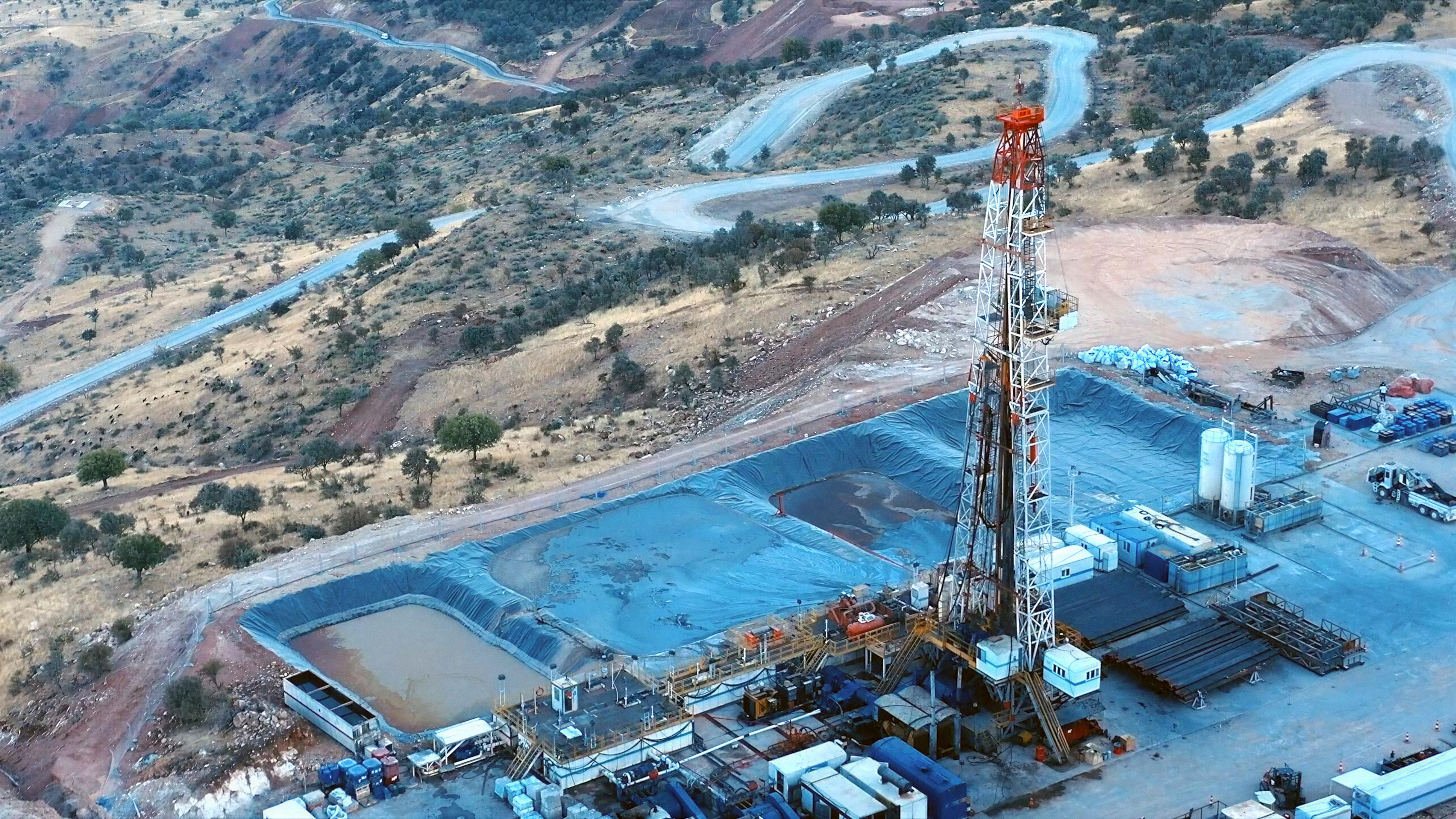
The shift from offshore to onshore operations fundamentally changes Trillion's operational profile. The M47 block benefits from 40 active rigs in the immediate area and abundant service providers including major oilfield services companies (Baker Hughes, Weatherford, Schlumberger) working within a 10-kilometer radius. This contrasts sharply with the offshore environment where equipment had to be imported, barged out, and crane-lifted onto platforms, and processes requiring government approvals at each step.
"There's an abundance of service providers currently working onshore [...] We're looking at hiring some of the best people in the world to deal with the very specific engineering challenges in dealing with carbonate reservoirs in this area."
Lower emphases that the onshore environment eliminates the two-to-three-year capital payback periods that characterised future SASB investments.
The partnership structure also differs fundamentally. Three private entities hold the M47 block as their number one priority and asset, creating goal alignment that was absent in the government partnership.
"Everybody in the project has got goal alignment and a motivation to make this work on a timely basis."
Interview with Scott Lower, President of Trillion Energy
Carbonate Reservoir Management
The primary technical challenge involves managing carbonate reservoirs prone to lost circulation events where drilling mud invades thief zones, potentially damaging productive formations. Trillion is engaging specialised companies with thousands of wells of carbonate experience to employ specific downhole pressure management and logging techniques.
The operational plan involves drilling through 300-meter thick stacked pay environments of limestone and dolomites interbedded with non-productive zones, identifying optimal pay zones above the oil-water contact through comprehensive logging suites, then selectively perforating the best zones in the dual-porosity environment (considering both matrix and fracture porosity). The C-1 well will be sidetracked updip employing this methodology to bring it into production.
Lower emphasised the importance of proper preparation:
"You've got to win the battle before you begin fighting it [...] We're dealing with the challenge by using some of the best companies in the world who have drilled thousands and thousands of these wells to provide specialized equipment."
Fast Payback in a Supply-Constrained Market
Production economics appear highly favourable compared to North American operations. Estimated lifting costs of approximately $10 per barrel compare to $50+ for shale oil or oil sands operations. The 300-meter thick Mardin formation provides multiple stacked pay zones, with analog wells in the area producing an average of approximately 1,000 barrels per day initially (ranging from 500 to a high of 10,000 barrels/day in the Yalcin-Gabar field).
With wells costing approximately $3.5 million to drill and complete, Trillion's 29% working interest translates to roughly $1.5 million per well net. At 1,000 barrels per day gross production, management expects one-to-two-month payback periods after production starts, enabling rapid cash recycling into additional drilling.
Infrastructure advantages accelerate commercialisation. Pipeline tie-ins are under construction in the area but production can commence immediately via trucking to facilities 120 kilometers away with existing road infrastructure supporting 10,000 barrels per day of trucking capacity. Turkey's position as an 85%+ oil importer (previously importing from Russia and Iran) creates strong domestic demand without export logistics.
Two-Stage Growth Strategy
Trillion faces a two-well work obligation to maintain 29% interest, requiring approximately $7 million in capital. Following these obligatory wells, all further development costs are split pro-rata among the three partners. Management outlined a two-stage development approach.
- Stage one focuses on proving commercial production from the North Lead discovery to de-risk the contingent resource and potentially reclassify it as reserves. Success on initial wells generating positive cash flow would enable self-funded expansion drilling. Lower suggested 10 wells could be drilled on the North Lead over two-to-three years.
- Stage two contemplates exploration on the Mid Lead and South Lead. Discovery on either or both prospects would open questions about deployment of one or potentially two rigs working full-time across the block, following the model of neighboring operators running 40 rigs across four-to-five blocks in the region.
The partnership structure designates one partner as operator (a rig owner), while Trillion contributes Canadian technological expertise. Notably, the operator is not the majority partner, creating what management views as favorable checks-and-balances with the majority partner maintaining objective oversight rather than unilateral control.
Valuation and Capital Markets Opportunity
Management argues Trillion represents the most undervalued play in the market right now on a 2C basis on our contingent resource on a barrels-per-market-cap basis. With the company trading at approximately $10 million market capitalisation following the announcement, and 23-24 million barrels net (risk-adjusted 2C), the implied valuation is under $0.50 per barrel - well below typical contingent resource valuations.
Lower noted that even post-debt settlement and post-financing, the company expects to remain 50% undervalued to the lowest valued competitor providing significant upside potential as value accretion milestones are achieved: financing completion, successful well results, commercial production, and potential reserve classification.
The current oil price environment above $100 per barrel and cyclical turn toward resource financing create favorable capital markets conditions. Lower reported positive feedback exceeding expectations on the discovery announcement and resource report, with investors responding favorably to the SASB exit and strategic pivot after years of disappointment.
Macro Thematic Analysis
Turkey's push for energy independence has created a compelling macro backdrop for onshore oil development in Southeast Turkey. Importing over 85% of its oil consumption previously from geopolitically sensitive sources including Russia and Iran, Turkey has strong strategic incentives to maximise domestic production. The resolution of regional conflicts only recently opened Southeast Turkey's Zagros Basin extension for exploration, triggering a discovery boom since 2022 with five major fields found within 11 kilometers of Trillion's M47 block. The Turkish state operator TPAO is actively encouraging international participation, targeting 100,000 barrels per day and beyond.
This represents the intersection of energy security imperatives, proven geological prospectivity, and government support creating what Scott Lower describes as conditions being the most drilled area in the Middle East right now. The convergence of $100+ oil prices, supply chain concerns through the Strait of Hormuz, and Turkey's domestic supply deficit positions onshore Turkish light oil as strategically valuable both commercially and geopolitically.
TL;DR: Executive Summary
Trillion Energy has pivoted from a troubled offshore gas field to a 27 million barrel (net, 2C) onshore light oil discovery in Southeast Turkey, cleaning its balance sheet of $22M in liabilities while positioning in a prolific basin with $10/barrel production costs, 1-2 month payback expectations, and abundant infrastructure. The company trades at under $0.50/barrel despite an 80% chance of commerciality and analog fields producing profitably up to 11 km away, creating significant valuation upside as the $7M two-well work program proves commercial production and enables self-funded expansion.
FAQs (AI Generated)
Offshore operations faced insurmountable delays from government approvals (18 months just for pump installations), limited service providers, and 2-3 year capital paybacks. The sale eliminated $22M liabilities while retaining a 7% royalty, cleaning the balance sheet for the superior M47 opportunity.
Independent evaluators assigned 80% chance of commerciality. The C1 well encountered the same light oil (32 API) in identical formations as five producing fields 2-11km away that have been commercial since 2022, providing strong analog validation.
Carbonate reservoirs require specialised drilling techniques to prevent lost circulation in "thief zones." Trillion is engaging companies with thousands of carbonate wells of experience and using proven downhole pressure management technology to mitigate formation damage risks.
Two-well work obligation requires ~$7M. With well costs of $3.5M and 1-2 month post-drilling payback expectations, initial production could commence within months of successful drilling, enabling cash recycling for expansion rather than continuous equity raises.
M47 is onshore with 40 active rigs nearby, no government partner requiring approvals, three goal-aligned private partners, simpler engineering (not offshore platforms), $10 vs. $50+ production costs, and fast payback enabling self-funding versus multi-year capital lock-up.
Analyst's Notes





Subscribe to Our Channel

.png)


Stay Informed


