Two Assets, Two Paths: How US Gold Corp Plans to Unlock Value from CK


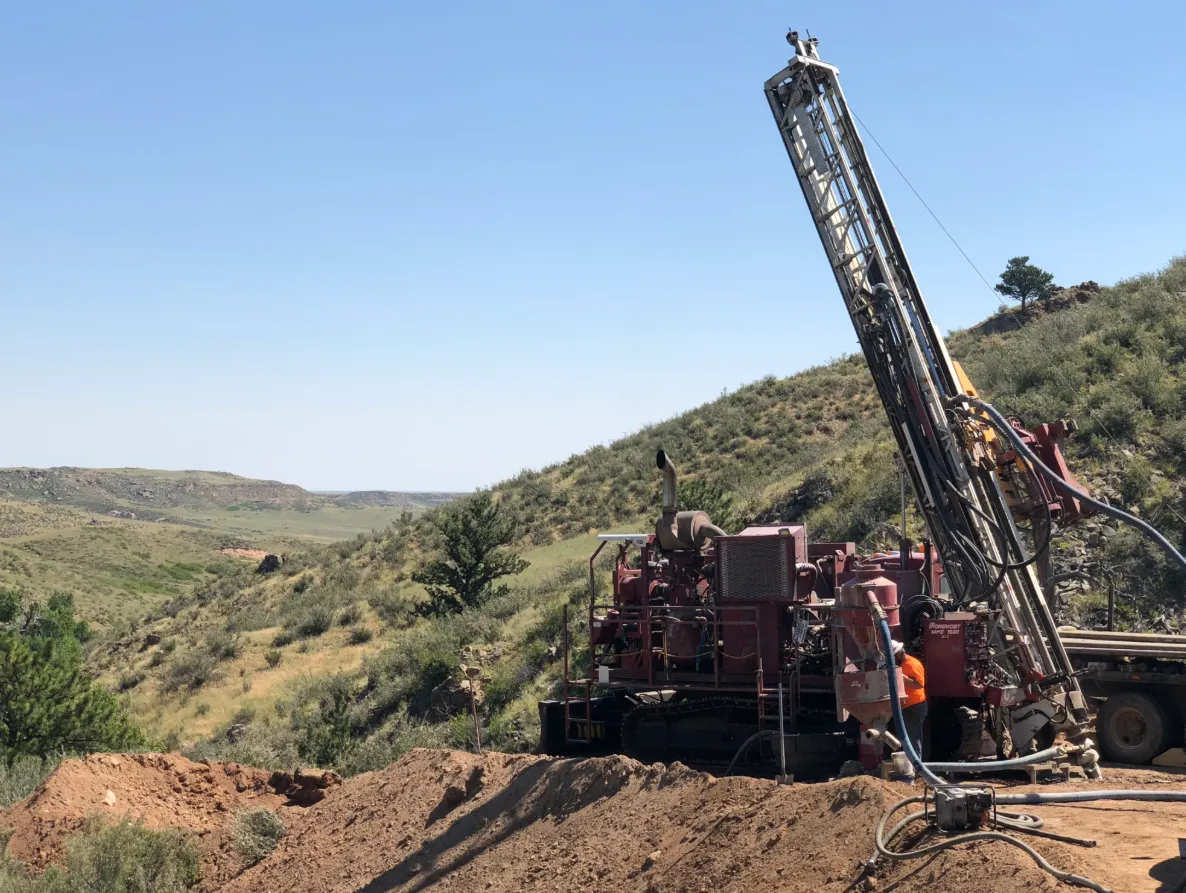
US Gold Corp advances CK Gold toward production with a permitted Wyoming asset, an 80/20 debt-financing target, and a Nevada exploration spin-out on the horizon.
- US Gold Corp completed a feasibility study (FS) for its CK Gold Project in Wyoming in March 2026, confirming an after-tax net present value at a 5% discount rate (NPV5%) of $632 million and an after-tax internal rate of return (IRR) of 27% at a base-case gold price of $3,250 per ounce.
- CK Gold holds fully approved state permits with no federal involvement, an initial capital expenditure (capex) of $394 million, a 2.5-year payback period at base-case prices, and an all-in sustaining cost (AISC) of $1,785 per gold equivalent ounce on a co-product basis - delivering a 35% margin even at $2,700 per ounce gold.
- The company is targeting a project-level financing package of up to 80% debt and 20% equity, with the equity component potentially priced at a premium to market, and is aiming to have a structure in place by August 2026.
- CK Gold's permitted status on Wyoming state land, with no federal nexus and no formal objections received throughout the permitting process, places it among the most de-risked pre-production gold assets in the US.
- The company is planning to spin out the Keystone Gold Project in Nevada as a dividend to shareholders of record, separating its dilution and capital requirements from CK Gold's financing and construction timeline.
The Capital Decision: Build, Partner, or Sell
The completion of a bankable feasibility study (FS) marks the point at which a development-stage company formally hands its asset over to a third party for independent economic evaluation and receives a document that can be presented to lenders, joint venture partners, or acquirers. For US Gold Corp (NASDAQ: USAU), the March 2026 study confirmed an after-tax net present value at a 5% discount rate (NPV5%) of $632 million and an after-tax internal rate of return (IRR) of 27% at a base-case gold price of $3,250 per ounce, with a 2.5-year payback period and an initial capital expenditure (capex) of $394 million. With spot gold prices exceeding $4,500 per ounce at the time of the interview, the payback period compresses to approximately 1.6 years, and the after-tax NPV5% increases to $1,155 million.
That upside sensitivity, combined with the state-permitted status established above, is what draws attention in mergers and acquisitions. The FS by-product cash cost of $1,007 per ounce gold and by-product all-in sustaining cost (AISC) of $1,094 per ounce gold - both of which credit copper and silver revenues against gold cash costs - keep the project economic across a wide range of price scenarios: the after-tax NPV5% remains positive at $2,000 per ounce gold, compressing to $98 million at that level, and turns negative only below $1,500 per ounce gold.
Executive Chairman of US Gold Corp, Luke Norman, addressed the strategic options directly:
“I am the steward as chairman of the company, of our investors, our shareholders. Whatever makes the most sense at the end of the day. I think building this is going to do nothing but create a really impressive cash flow and have a major impact on the equity of the company on the upside. If there's a smart reason to want to partner up with someone who's already developing and producing, and it creates slightly more leverage or early-stage leverage, then we'll consider it. Whatever the best outcome is, you know, relative to the moment in time, that's what we're going to pursue.”
The primary path is project-level financing, targeting an 80/20 debt-led structure - a pivot from the FS base-case assumption of 100% equity funding - with the debt component priced at high single-digit rates and the equity potentially placed at a premium to market. A financing package is being targeted for August 2026, with construction commencing in the second half of 2026 and first production targeted for late 2027 to early 2028. Pursuing project-level financing and building a mine-building team in parallel strengthens the company's negotiating position with any potential acquirer or joint venture partner, and management has been explicit that no outcome is being ruled out.
The Keystone Spin-Out Rationale
The Keystone Gold Project in Nevada occupies a structurally different position within the US Gold Corp portfolio than CK Gold. It is not a development-stage asset with a reserve and an FS; it is a district-scale exploration project covering approximately 20 square miles on the Cortez Trend in Nevada, situated approximately 8 to 10 miles from Nevada Gold Mines' Cortez Complex, which carries a gold endowment of over 70 million ounces. Keystone has never been systematically explored using model-driven, modern-day exploration techniques: 6 to 7 scout holes were drilled in 2017 and 2018, confirming favourable stratigraphy and gold-bearing mineralisation across multiple target areas, but the project has not yet received the capital or dedicated team required to advance it toward a resource estimate.
The plan to separate Keystone through a spin-out - structured as a pro-rata share distribution to existing investors - reflects a deliberate capital allocation logic. Funding exploration at the Keystone level through US Gold Corp's balance sheet would require issuing equity at the parent company level, cross-funding an exploration programme with capital better directed toward CK Gold's construction. By decoupling the two assets into separate vehicles, management can raise exploration capital only at the Keystone level, while existing shareholders receive shares in the new entity directly, retaining exposure to both assets without bearing the dilution required to advance either.
On the spin-out timing and rationale, Norman noted:
“We know there's a lot of undercurrent interest in Keystone right now, and we don't want it to be distracting from all the work and time and effort that's gone through our development team and engineering team.”
Keystone sits adjacent to the geological architecture underpinning the Cortez Complex - the same lower-plate host rocks, Eocene-aged intrusives, and dissolution collapse breccias associated with Carlin-type gold systems in Nevada - and the company has identified multiple priority drill targets through geophysical surveys, surface geochemistry, and geological mapping across the approximately 20-square-mile land package. No formal record date had been announced at the time of the interview, but management's stated priority is to execute the separation before Keystone's interest becomes a distraction from CK Gold's financing process.
Catalysts to Watch Next
The immediate catalyst sequence for US Gold Corp is defined by two discrete events: the announcement of a project-level financing structure for CK Gold, and the formal declaration of the Keystone spin-out record date. Management has indicated a target of having a financing package in place by August 2026, which would trigger the commencement of construction in the second half of 2026. At an 11-year operating mine life with peak production in years 2 to 8 averaging approximately 102,000 gold equivalent ounces per year, an all-in sustaining cost (AISC) of $1,785 per gold equivalent ounce on a co-product basis, and average annual operating net free cash flow of $124 million over the full mine life, the financing decision is one of the major de-risking step before CK Gold transitions from a development asset to a producing one. At $2,700 per ounce gold - $550 per ounce below the base case - the project still delivers a 35% margin.
The Keystone spin-out record date is a secondary catalyst that, once declared, will require assessing the standalone entity independently - its land package, priority targets, proposed exploration budget, and management team. The financing announcement is the proximate re-rating catalyst for the parent company; the Keystone separation is the optionality event that follows. The completion of the FS in March 2026 coincided with heightened geopolitical volatility and sector-wide liquidity compression. Unlike projects on federal land or with a federal nexus - which are subject to federal environmental assessments that can expose approved permits to third-party legal challenge after construction has begun - CK Gold is permitted entirely under Wyoming state law, where a formal challenge requires suing the State of Wyoming directly, effectively bypassing the non-governmental organisation objection routes available under federal processes. Management maintains that despite the delayed market reaction, the project's fundamental value remains unchanged.
Investment Thesis for US Gold Corp.
- US Gold Corp has completed a critical, time-consuming phase of the development cycle - five years of permitting, independent technical validation, and advanced engineering - with all major risk gates now closed at CK Gold.
- Exempt from National Environmental Policy Act review on Wyoming state land, CK Gold bypasses the third-party challenge risks that commonly stall comparable projects.
- The March 2026 feasibility study confirms robust economics across a wide range of metal price scenarios: a 35% margin at $2,700 per ounce gold, compressing to a still-positive net present value at $2,000 per ounce gold, with a by-product all-in sustaining cost of $1,094 per ounce gold that credits copper and silver revenues throughout.
- The Keystone Gold Project will be spun out as an independent entity, ensuring that its exploration budgets do not draw on capital raised for CK Gold and that shareholders retain direct exposure to both assets.
- Management is targeting an 80/20 debt-led financing structure to limit dilution at the CK Gold level - a pivot from the feasibility study's base-case assumption of 100% equity funding.
This bifurcated structure offers investors exposure to near-term production economics at CK Gold, while isolating them from the exploration dilution at Keystone and the federal permitting hurdles typical of comparable development-stage assets.
TL;DR
US Gold Corp has completed its FS for the CK Gold Project in Wyoming, confirming a $632 million after-tax net present value and a 27% after-tax internal rate of return at $3,250 per ounce of gold. With all state permits in hand, no federal involvement, and a 2.5-year payback period, management's focus has shifted entirely to assembling a project-level financing package - targeting up to 80% debt - with a structure expected by August 2026. In parallel, the company is planning to distribute shares of the district-scale Keystone Gold Project to existing investors via a standalone public vehicle, keeping that asset's exploration capital requirements entirely separate from CK Gold's construction financing. The result is a two-track capital allocation strategy: build and finance CK Gold on its own merits while unlocking Keystone's exploration upside through a standalone vehicle.
FAQs (AI-Generated)
Analyst's Notes





Subscribe to Our Channel



Stay Informed