




U.S. Gold Corp Continues to Build CK Gold While Exploring Keystone Spin-Out


.jpg)
US Gold Corp (NASDAQ:USAU) plans to build its permitted CK Gold project and spin out Keystone within weeks, with financing still to be announced.
- CK Gold's March 2026 feasibility study shows a $632 million after-tax NPV5%, a 27% after-tax IRR and a 2.5-year payback at $3,250 gold, with reserves of 1.015 million ounces of gold and 260 million pounds of copper.
- Initial capital of $394 million is about 1.5 times the $266.4 million market capitalisation, so financing is the central catalyst, and Norman pointed to debt, a silver stream and forward gold sales without giving a date.
- Executive Chairman Luke Norman said the company will build CK Gold unless a takeover offer is egregiously beneficial to shareholders, while M&A interest continues.
- The Keystone project, about 20 square miles on Nevada's Cortez Trend, is expected to be spun out by share dividend within six to eight weeks of the interview.
- The 2026 CK study assumes an 11-year mine life, while Norman argues 15 to 20 years is achievable, with 590,000 AuEq ounces of resources outlined for potential conversion to reserves.
Few junior developers reach the stage where the main question is how to build rather than whether they can permit. U.S. Gold Corp (NASDAQ:USAU) is one of them. Its CK Gold Project sits on Wyoming state land close to Cheyenne, and management says it is ready to start construction once financing is in place. Executive Chairman Luke Norman spoke about the build decision, the financing options and the planned spin-out of the company's Nevada exploration asset, Keystone. Each of those topics shapes how investors may value the equity over the next year.
A Permitted Project Close to Cheyenne
CK Gold is about 20 minutes west of Cheyenne and roughly three miles north of Interstate 80. Norman described the deposit as about 70% gold and 30% copper, with mineralisation exposed at surface. The company took the project to a permitted, shovel-ready position in five years.
The Wyoming Department of Environmental Quality approved the mine operating permit in April 2024 and the water discharge permit in May 2024. It approved the air quality permit application in November 2024. The Industrial Siting Council approved the project unanimously in June 2023, and that permit has been updated through June 2027. Construction was initiated in January 2026, beginning with access road works.
Norman said some final advanced engineering remains, and that it will continue through development. He said the metallurgical work has met the company's expectations. He added that the company brought in Jameson cell flotation technology but did not apply those results across the full suite of recoveries, so he believes plant recoveries could exceed the study's assumptions.
Feasibility Economics & Price Sensitivity
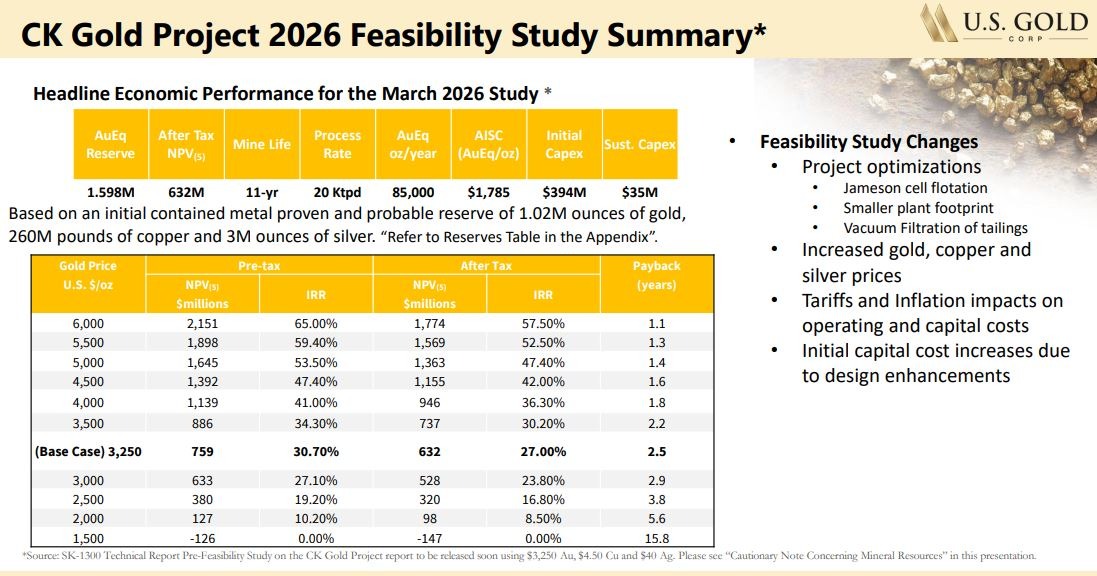
The March 2026 feasibility study (FS) was issued by Halyard Micon International. At base-case prices of $3,250 per ounce gold, $4.50 per pound copper and $40 per ounce silver, it shows an after-tax net present value at a 5% discount rate (NPV5%) of $632 million. The after-tax internal rate of return (IRR) is 27% and payback is 2.5 years. Initial capital is $394 million including contingency. Proven and probable reserves total 74.5 million tons, containing 1.015 million ounces of gold, 260 million pounds of copper and 3 million ounces of silver. That equals 1.598 million gold equivalent ounces (AuEq).
The sensitivity table shows how much the outcome depends on gold. At $4,000 per ounce, after-tax NPV5% rises to $946 million and payback shortens to 1.8 years. At $2,000 it falls to $98 million. At $1,500 it turns negative. Norman said the project pays back well within two years at $3,750. That price sits between the study's 2.2-year payback at $3,500 and 1.8 years at $4,000.
Why Mine Life Is Understated
The study outlines an 11-year mine life. Norman said that figure works against the project in the market. He explained that the company set a minimum mine life of about 10 years in 2020 to create an economic framework that could support permitting. Investors then see a ten-year project and assume the mine closes at the end of it.
He pointed to mineralisation that continues beyond the current design as the deposit extends at depth:
"We continually get the confusion that this is just a 10-year deposit. The deposit itself extends to depth and it has lateral extent. So ultimately, you're really looking at a project that will be a 15-20 year mine life. So you don't get any benefit or credit for that in the marketplace. So built and establish obviously a lot more credit for that."
80% of historical drill holes end in mineralisation or are not closed off laterally. The deposit is open below 800 feet and along 2,900 feet of untested strike to the southeast. The company also identifies potential to convert 590,000 AuEq ounces of measured and indicated resources into reserves. A further 677,000 AuEq ounces of inferred resources could move into measured and indicated. A drill programme is anticipated for the second half of 2027.
Build or Sell
Norman said merger and acquisition (M&A) interest is picked up after the company released the final S-K 1300 technical report in May, and that it continues. This interest made him and chief executive George Bee more aware that the market is not recognising the project's value.
Norman and Bee regularly compare the company's valuation and the FS metrics with what a finished mine would look like after a two-year, roughly $400 million build. He was direct about where that comparison leaves the plan:
"We're going to build this project unless somebody comes over the top with something that's egregiously beneficial to our investor, and shareholders."
The company’s market capitalisation is $266 million against the base-case after-tax NPV5% of $632 million. The company remains undervalued at its current market capitalisation.
Interview with Luke Norman, Executive Chairman of U.S. Gold Corp
Financing Without Heavy Equity Dilution
Financing is the gating item. The company is actively working on it and that it was a major topic at the conference as the project suits debt because it pays back quickly. Silver, which does not weigh heavily on project economics, could be sold through a stream. The company could forward sell some of its first-year gold production.
Norman put first-year output at 130,000 ounces of gold and 24 million pounds of copper. The richest part of the deposit outcrops at surface, so the early years are not dominated by stripping. This gives the company several ways to raise capital without taking the brunt through equity.
The capital structure is tight by design. The company has 16,528,663 shares outstanding at 1 September 2026, along with 2,825,557 warrants and 548,056 options. Cash was $30.7 million at 30 April 2026. Initial capital of $394 million is about 1.5 times the current market capitalisation, so the structure of the financing will matter to existing holders. Norman did not give a timetable for a financing announcement.
The Keystone Spin-Out
Keystone is a district-scale exploration project on Nevada's Cortez Trend. The company controls about 20 square miles there. It is 11 miles south of Nevada Gold Mines' Cortez Complex and says it has never been systematically explored with modern, model-driven techniques.
Norman states Keystone needs active exploration now, and that funding it inside the parent would mean dilution at the development asset. The plan is to spin it out by paying a dividend of shares to US Gold shareholders. Keystone would then raise capital directly and run with its own management team. He said this is expected within the next six to eight weeks.
He also argued that a dividend has a second effect. He said about 12% to 13% of the company's shares are sold short. Short sellers cannot reproduce a dividend share, so he said they would need to cover positions, which could create a squeeze near financing time. That is Norman's view, and the short interest figure is his estimate. It should not be read as an expected outcome.
The Investment Thesis for U.S. Gold Corp
- CK Gold is permitted on state land with no direct federal involvement, and the FS shows a base-case after-tax NPV5% of $632 million.
- The economics are sensitive to gold. NPV5% reaches $946 million at $4,000 per ounce but falls to $98 million at $2,000.
- Financing is the key test. Initial capital of $394 million is about 1.5 times the market capitalisation, and no announcement date has been given.
- Norman says the company will build unless an offer is egregiously beneficial to shareholders, so investors should weigh a build path against a possible takeover.
- A longer mine life and resource conversion are upside cases outside the FS. Drilling is anticipated for the second half of 2027.
- The Keystone spin-out is expected within six to eight weeks of the interview. Watch for the record date, structure and management team.
- Warrants and options equal about 20% of shares outstanding, and Norman's short-squeeze argument is a view rather than a forecast.
Macro Thematic Analysis
US Gold sits at the intersection of several themes in North American mining. Investors are looking for gold and copper projects in stable jurisdictions that can reach production without a federal permitting process. Norman argues that few juniors can offer that. He described the company's position this way:
"We managed to do in a very short period of time (5 years) is take it from a science test to a fully permitted shovel ready project. I think we're one of, if not the only junior I know of, with a fully shovel ready project like this in a bull market."
Jurisdiction is the first theme as CK Gold on Wyoming state land with a 2.1% mineral lease royalty. Nevada produced about 4.47 million ounces of gold in 2021, roughly 78% of US gold production, citing USFunds.com. That figure frames why the company sees Keystone as worth exploring in its own right.
Financing is the second theme. Norman described a strong gold and copper market and said it gives the company more than one route to funding. Debt, a stream and a forward sale are all on his list. His comments show how a company with a small share count is trying to use that flexibility.
The metals mix is the third theme. Reserves include 260 million pounds of copper alongside the gold, so the project has exposure to both markets. The by-product credit from copper and silver is central to the study's by-product all-in sustaining cost (AISC) of $1,094 per ounce of gold.
Consolidation is the fourth. Norman says M&A interest continues and that it followed the release of the final technical report. Spin-outs are a related tool. They separate a development story from an exploration story so that each can raise capital on its own terms.
TL;DR
U.S. Gold Corp says it will build its permitted CK Gold Project in Wyoming unless a takeover offer is egregiously beneficial to shareholders. The March 2026 feasibility study shows a $632 million after-tax NPV5% and a 27% IRR at $3,250 gold against $394 million of initial capital. Executive Chairman Luke Norman pointed to debt, a silver stream and forward gold sales, but gave no financing date. The Keystone exploration project in Nevada could be spun out to shareholders within six to eight weeks. Investors should watch the financing announcement and the Keystone record date.
FAQs (AI Generated)
Analyst's Notes





Subscribe to Our Channel



Stay Informed






















