




Radisson Mining: Agnico Eagle Funds Underground Move as Drilling for Resource Updates Continues


Agnico Eagle's C$57M investment funds an underground ramp at Radisson's O'Brien gold project as drilling targets 3 to 4 million ounces in Quebec.
- Agnico Eagle has closed a C$57 million investment in Radisson and holds about 10.45% of the shares. The placement remains subject to final TSX Venture Exchange acceptance, and it supports an advanced underground exploration programme at the O'Brien Gold Project.
- The proceeds fund an underground exploration ramp to about 300 metres vertical depth at O'Brien. The ramp is designed to test continuity, ground conditions and tonnes per day, with portal groundbreaking targeted for mid-2027 and the ramp in place for 2029.
- The funded 140,000-metre surface programme runs on eight rigs, with a ninth due shortly, and management cites an 83% success rate. A resource update is expected by the end of 2026.
- The 2.3 million ounce resource sits against a management view of 3 to 4 million ounces in total. That view relies on an exploration target of 0.6 to 2.0 million ounces that is yet to be proven.
- Manson puts the valuation at US$191 per ounce against recent takeouts at US$500-600 per ounce. Key risks are narrow vein continuity, ground conditions and legacy tailings issues at the 1920s mine site.
Radisson Mining Resources Inc. (TSXV:RDS) has closed a C$57 million strategic investment from Agnico Eagle Mines Limited, the owner of the LaRonde mine, which sits about 3 km from the company's O'Brien Gold Project in Quebec. The proceeds will fund an underground exploration ramp. A 140,000-metre surface drill programme continues alongside it. President and CEO Matt Manson explains what the stake changes, what the ramp is meant to prove and why he believes the resource still has room to grow. The Abitibi region offers developers a rare advantage in existing shafts, mills and tailings facilities, and O'Brien sits among them
The Ramp Built to Answer Mining Questions
The ramp is designed to answer mining questions rather than to produce ounces. Manson said it will descend to about 300 metres vertical depth, with ore drives through mineralised zones but no stopes or mining panels. Mineralised material will be brought to surface. The company will also set up underground drill platforms and expand its owner's team.
Manson linked the ramp to development timing:
"Once the underground access is in, you're a long way down the path of achieving the mining infrastructure you need to develop the project."
Manson listed the priorities for a high-grade narrow vein deposit as continuity of mineralisation, ground conditions, dilution, mining methods and ground support. He said several recent projects of this type have struggled because underground development did not keep pace with a newly built mill. Radisson does not plan to build a mill. The programme therefore focuses on how the orebody can be mined and how many tonnes per day it can deliver.
Agnico Eagle Takes Stake
Radisson closed the non-brokered placement on 1 September 2026, with no commissions or finder's fees paid. Agnico Eagle bought 53,420,000 units at C$1.07 each for gross proceeds of C$57.2 million. Each unit comprises one common share and one-half of a warrant exercisable at C$1.39 for 60 months. The price was a 19% premium to the 20-day volume-weighted average price and a 6% premium to the prior closing price. Agnico Eagle now holds about 10.45% of the common shares on a non-diluted basis, rising to about 14.90% on a partially diluted basis. The securities are subject to a hold period that expires on 2 January 2027. The placement remains subject to final TSX Venture Exchange acceptance.
The two companies signed an investor rights agreement at closing, and Agnico Eagle's rights depend on it keeping certain ownership thresholds. It can nominate one director, or two if the board grows to eight or more members. It can also take part in certain equity offerings to maintain its stake or build it to 14.9% on a partially diluted basis, and it has a top-up right against certain dilutive issuances. Until 31 December 2028, the agreement restricts specified transactions involving Radisson's mineral properties, including dispositions, royalties, streams, offtakes and secured financings. After that, Agnico Eagle has a 60-day advance notice right on such transactions while it holds at least 5% on a partially diluted basis. None of these restrictions applies to a change of control of the company.
Manson described the structure as a sale of roughly 10% of the company at one price, with a further 5% available later through the warrants. He said Agnico Eagle sees the warrants as a route to about 15%. The investment fits a strategy he has promoted for two years, which is to develop O'Brien within the mining infrastructure that already surrounds it. He added that the two companies will form a technical committee and take a collaborative approach.
Interview with Matt Manson, President & CEO of Radisson Mining Resources Inc.
Timeline Points to 2029
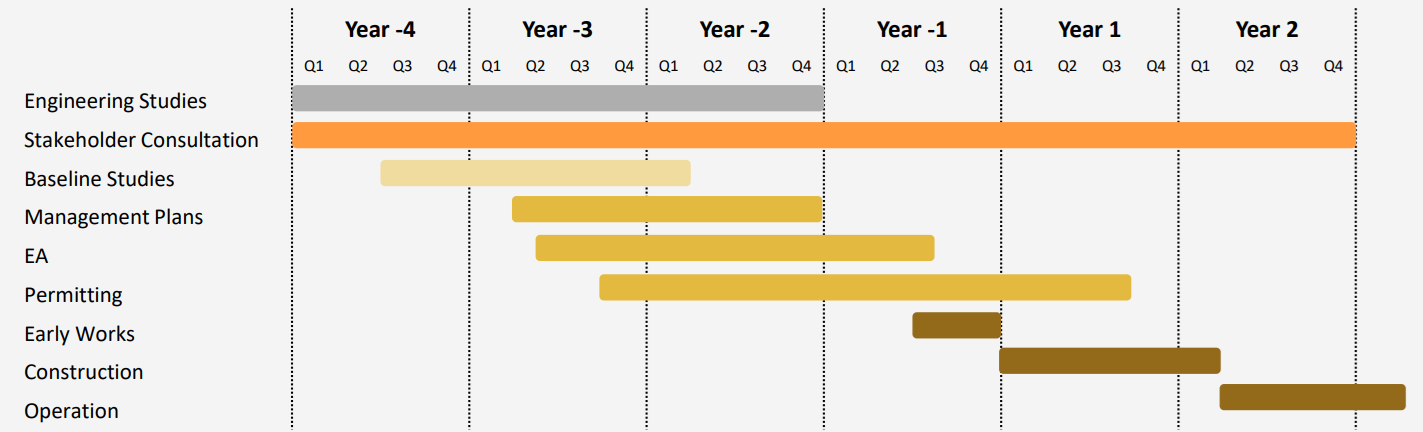
Manson expects to break ground on the portal around the middle of 2027. He estimated 18 months to reach depth and complete the required work, which brings the programme to the end of 2028 or early 2029. The stated objective is to have the ramp in place for 2029. Permitting and preliminary engineering have already started.
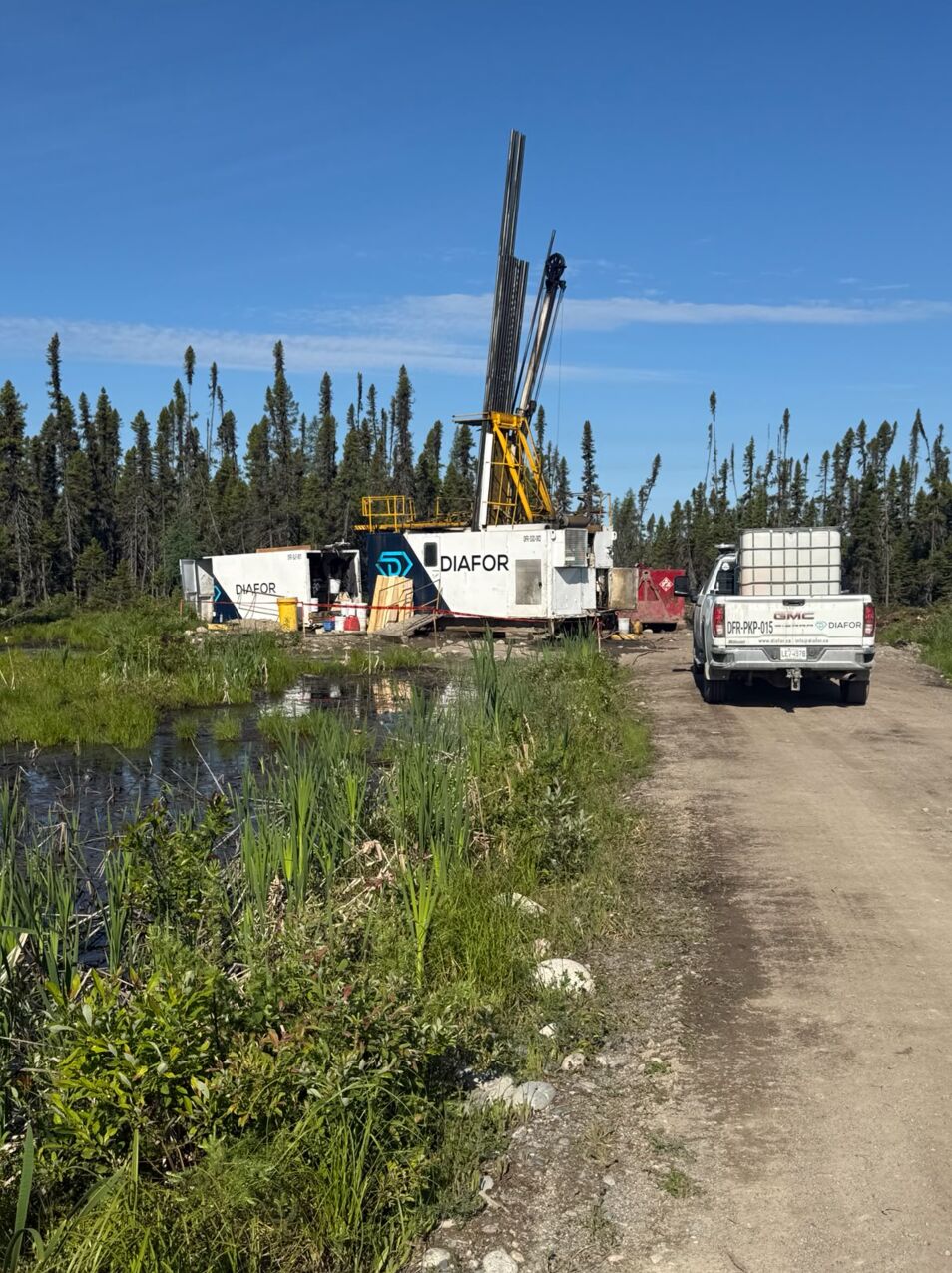
He expects 2027 to be the busiest year the project has seen. Two years ago it had two or sometimes three rigs. It now has eight, and a ninth is due shortly for a hole to 2.5 km depth. Mining contractors, a water treatment plant, a box cut and the portal will follow. Manson also noted that O'Brien is a 1920s mine site with an old tailings facility, so legacy issues must be addressed.
Surface Drilling Keeps Expanding the Resource
Surface drilling continues on eight rigs as part of the 140,000-metre programme, which the company says is funded from existing cash. Manson put cash at about C$100 million with no debt. The resource totals 2.3 million ounces. The company's release lists 0.63 million ounces indicated at 5.59 g/t gold and 1.69 million ounces inferred at 5.08 g/t gold, above a 2.2 g/t cut-off.
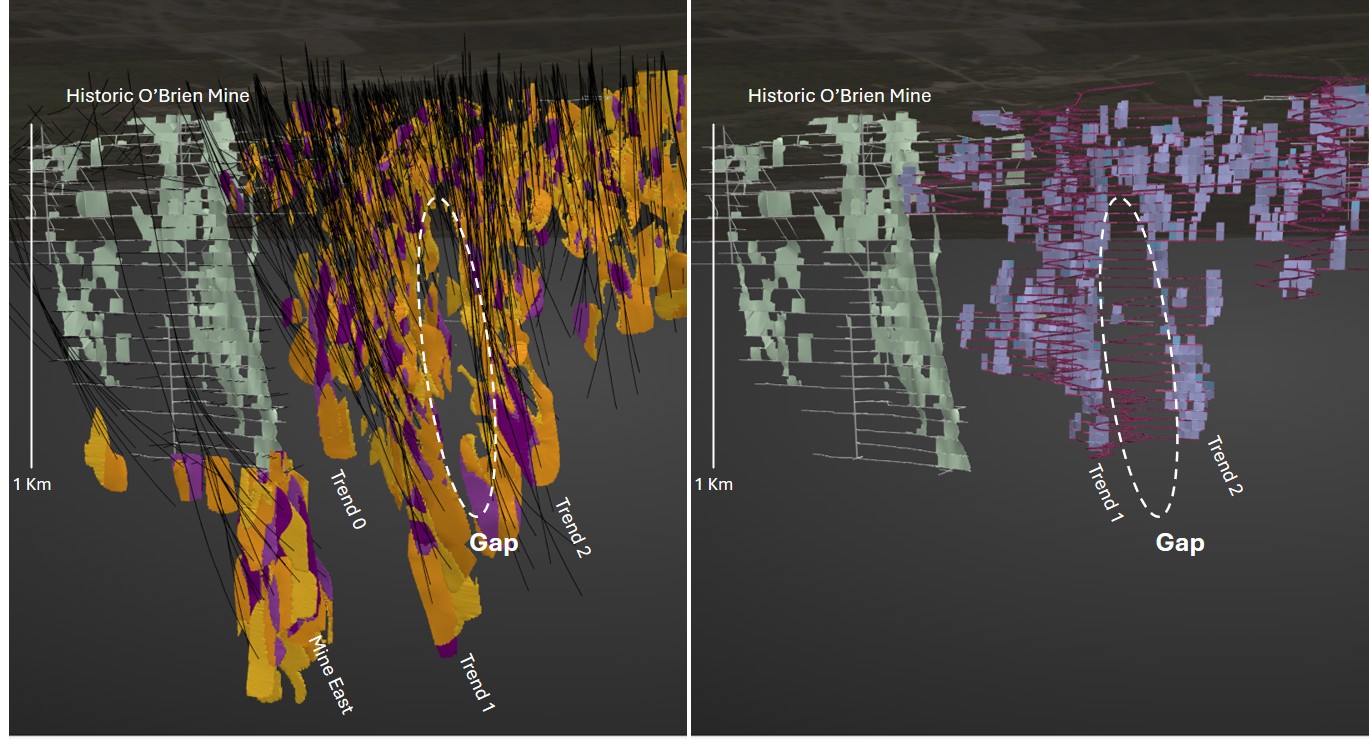
Manson said the deposit would hold 3 to 4 million ounces in total if similar mineralisation continues to a 2 km floor. The company's exploration target adds a conceptual 0.6 to 2.0 million ounces to the resource, and on that basis he sees the deposit reaching upwards of 4 million ounces.
The old mine closed in 1957, and nobody had drilled below its final stope for about 70 years before Radisson began. Manson said that history shaped the approach:
"We are not drilling on geophysical targets and we're not doing small stepouts around other drill holes. We are doing big chunky stepouts into the unknown."
Manson put the success rate at 83%, with 106 hits from 128 holes reported over the past 18 months. The company defines a hit as a vein intercept above 3 g/t over core length. Manson expects such intercepts to dilute to above the resource cut-off. Radisson publishes every hole, whether it hits or not. Manson said the company has rarely, if ever, lost a hole. He attributed this to competent ground on the south side of the Larder Lake-Cadillac Break. The next resource update is likely by the end of 2026, with another in 2027.
Valuation and Development Options
Manson said the shares closed at C$1.17 before the interview. He put that at a valuation of US$191 per ounce on 2.3 million ounces. He cited a discovery cost of US$21 per ounce. He contrasted the valuation with takeouts at US$500 to US$600 per ounce over the past six months. Applying US$200 to US$300 per ounce to upwards of 4 million ounces would imply US$800 million to US$1.2 billion, although that rests on an exploration target.
From a mining point of view, Manson said the best value comes through the existing shafts, mills and tailings facilities. From a corporate point of view, the question is how to deliver that value to shareholders. He called the stand-alone route the default path until an offer changes it. He described development through the LaRonde infrastructure as a future step to be considered. The company's 2025 preliminary economic assessment (PEA) assumed off-site milling at IAMGOLD's Doyon mill instead, and it predates the 2026 resource.
The Investment Thesis for Radisson Mining
- Agnico Eagle's C$57 million investment adds a strategic shareholder that owns the adjacent LaRonde infrastructure, although Manson described any use of that infrastructure as a future step.
- The investor rights agreement restricts asset-level deals such as royalties, streams and property sales until the end of 2028, but it leaves a change of control open.
- The ramp will test continuity, ground conditions, dilution and tonnes per day, which are the inputs for any future mine design.
- Surface drilling is funded on eight rigs, and a resource update is expected by the end of 2026.
- The 2.3 million ounce resource sits against a 3 to 4 million ounce total that management targets, which remains unproven until drilling converts it.
- Manson's US$191 per ounce valuation compares with US$500 to US$600 per ounce takeouts, although precedent transactions reflect different stages, grades and locations.
- Key risks include narrow vein continuity, ground conditions, legacy tailings issues and the final exchange acceptance still outstanding on the placement.
- Watch-items are the year-end resource update, the ninth rig's 2.5 km hole, portal groundbreaking in mid-2027 and ramp access in 2029.
Macro Thematic Analysis
The market values gold projects beside existing shafts, mills and tailings facilities differently from remote greenfield projects. Manson pointed to the LaRonde mine as an example. He described a 3 km deep shaft, two mills and a large permitted tailings facility, all about 3 km from O'Brien. He also called the Lapa mine, just east of O'Brien, the closest analogue. Lapa shares the same geology, was mined underground and had its ore processed through the LaRonde mill.
That backdrop shapes how Manson reads current pricing. He pointed to recent takeouts and a neighbouring IPO at a higher valuation than Radisson's as evidence that the market is repricing ounces. Precedent transactions are imperfect comparisons, because prices reflect project stage, grade and location. Manson nonetheless sees a broader shift:
"I think we are certainly beginning to see generally a revaluation of ounces in the ground with some of these new data points."
For a company with Agnico Eagle on its register and a growing resource, the question is how much of that re-rating applies to O'Brien. The answer depends on two things: whether drilling converts the exploration target into resource ounces, and whether the ramp confirms a workable mining rate. Manson expects both to be tested through 2027.
TL;DR
Radisson Mining Resources (TSXV:RDS) closed a C$57 million placement with Agnico Eagle Mines on 1 September 2026. Agnico Eagle now holds about 10.45% of the shares and 14.90% on a partially diluted basis, with an investor rights agreement that includes board nomination rights. The proceeds fund an underground exploration ramp to about 300 metres vertical depth at the O'Brien Gold Project, while a funded 140,000-metre surface programme continues. CEO Matt Manson targets 3 to 4 million ounces in total against a 2.3 million ounce resource, cites an 83% drilling success rate and expects a resource update by year end. Key watch-items are final exchange acceptance, the 2027 portal start and ramp access by 2029.
FAQs (AI Generated)
Analyst's Notes





Subscribe to Our Channel



Stay Informed






















