6 Signs U.S. Gold Corp's CK Gold Could Outgrow Its 1.6-Million-Ounce Reserve


Project Overview
U.S. Gold Corp (Nasdaq: USAU) is developing CK Gold, a gold-copper project on State of Wyoming land with no direct federal involvement. CK Gold lies about 3 miles north of Interstate 80 and roughly 20 minutes west of Cheyenne. Wyoming approved its Mine Operating Permit in April 2024 on a 10-year renewable term. The Industrial Siting Permit has been updated through December 2027, and construction was initiated in January 2026.
Halyard Micon International prepared the March 2026 feasibility study (FS). It defines a reserve of 1.598 million ounces (Moz) of gold equivalent in 74.5 million tons, comprising 1.015 Moz of gold, 260 million pounds of copper, and 3 Moz of silver. Over an 11-year mine life at 20,000 tons per day, production averages 85,000 ounces (oz) of gold equivalent per year. Initial capital is US$394 million, and the after-tax net present value at a 5% discount rate is US$632 million at a base case of US$3,250 per ounce for gold.
1. A Reserve Sized for a 2020 Drilling Target
CK Gold's reserve boundary dates back to a drill program targeting a 10-year mine in a weak 2020 gold market.
In 2020, CK Gold was a pure exploration project, and the current President and Chief Executive Officer of U.S. Gold Corp, George Bee, joined the company in August of that year. The market was still bearish, so the company set its drilling and engineering work around a reserve large enough for 10 years of mine life and around 100,000 oz of annual production. Step-out reverse circulation drilling in 2020 returned positive results, and the resource is defined by 215 drill holes totaling 136,600 feet. Over the same period, the team took the project from exploration to a fully permitted, shovel-ready development asset.
Non-Independent Chairman and Co-founder of U.S. Gold Corp, Luke Norman, describes which came first, the deposit or the drill plan:
"However, this deposit is not designed around our drilling. Our drilling was designed around it."
The 11-year FS plan is the product of that 2020 brief. Management treats the 1.6 Moz reserve as the part of the deposit the company chose to drill out, with more gold and copper beyond it.
2. Drilling That Ends in Mineralization
Most of CK Gold's historical drill holes end in mineralization or are not closed off laterally, and the deposit is open at depth and along strike.
Of the historical drill holes, 80% end in mineralization or are not laterally closed off. Mineralization is open below 800 feet and along 2,900 feet of untested strike to the southeast, and it persists to the southwest outside the pit design used in the FS.
The deposit is hosted in a shear zone within granodiorite, a coarse-grained igneous rock. A June 2022 interpretation postulated a porphyry origin, a deposit type formed around a body of intrusive rock. It also held that the deposit is not isolated. Other deposits occur locally within the Silver Crown Mining District.
High-grade mineralization is exposed at the surface and surrounded by a large, lower-grade zone with potential for expansion. The mineralogy is clean and simple, with low overall sulfide content. For a reserve drawn at the limit of a target-sized drill program, open mineralization at depth and along strike marks the ground the next round of drilling would test.
3. Resource Already Defined Outside the Reserve
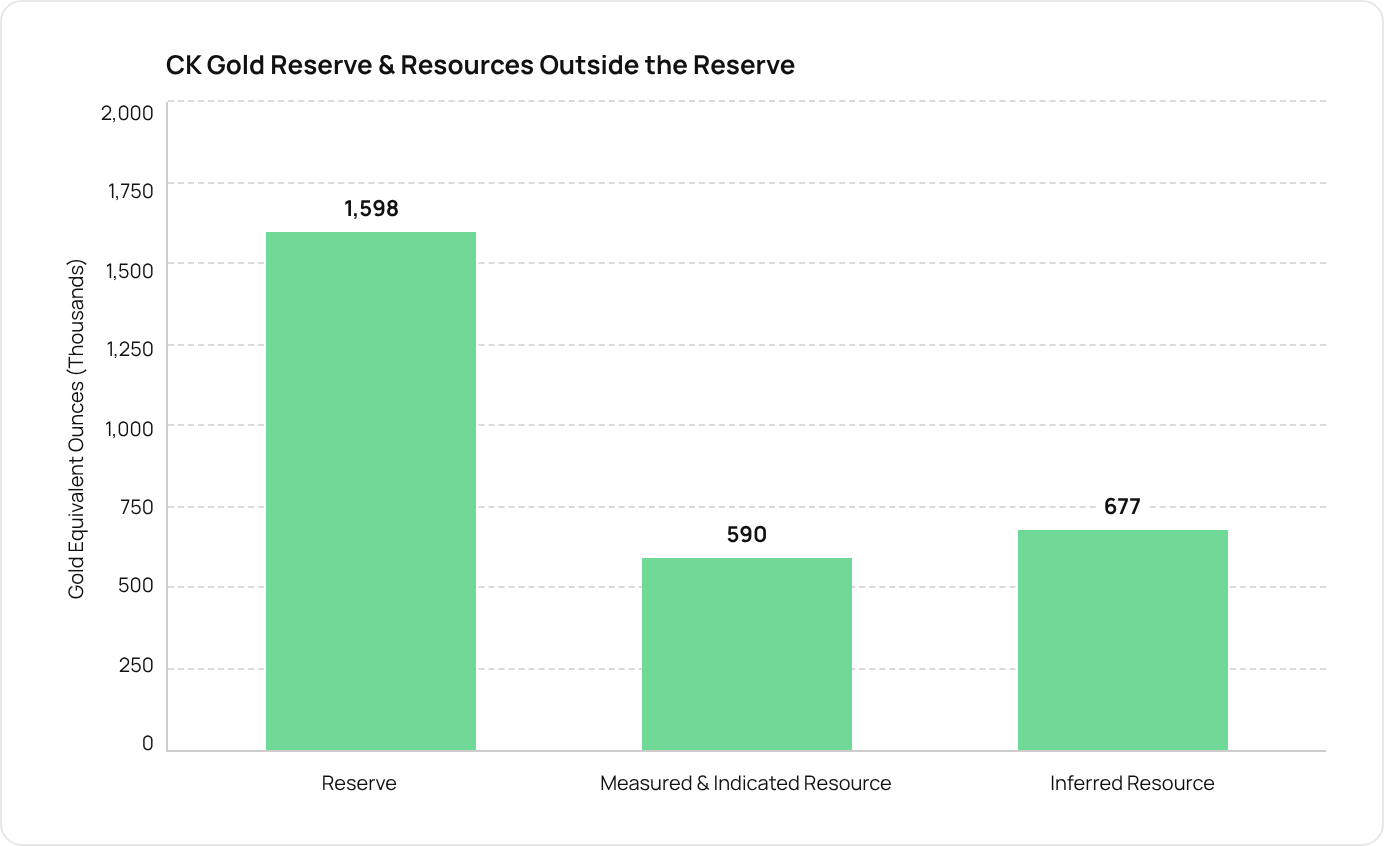
The FS already defines 590,000 oz of measured and indicated resources and 677,000 oz of inferred resources, both in gold equivalent, outside the reserve.
Measured and indicated are the higher-confidence resource categories, and inferred is the lowest. The measured and indicated material within the resource pit shell totals 364,000 oz of gold, 115 million pounds of copper, and 1,884,000 oz of silver. The inferred material contains 407,000 oz of gold, 142 million pounds of copper, and 1,436,000 oz of silver.
Part of the measured and indicated total lies inside the reserve pit itself, below the reserve cut-off grade: 71,000 oz of measured and 235,000 oz of indicated gold equivalent. The company lists conversion of the 590,000 oz to reserves, and of the 677,000 oz of inferred material to measured and indicated, among the exploration potential under investigation. Higher gold and copper prices incorporate much of the mineralization drilled outside the reserve pit, and the project is drill limited.
Converting known resources outside the current mine plan into reserves is the route the company names to extend mine life and improve project economics.
4. Management's Case for a Deposit Twice the Size
Management sees a very good chance that CK Gold proves economic at about twice its reported 1.6 Moz, or around 3 Moz.
The company's published geology gives a separate measure, based on the resource. Depth and strike-length volumetrics are sufficient to double the current gold-copper resource if mineralization extends along strike.
Norman puts a figure on how far he believes the deposit can grow:
"We envisage that there is a very good chance for this deposit to be economically viable at twice the size of what currently is reported at 1.6 million oz. So, we do believe there is great opportunity for this thing to increase to around 3 million oz in size."
No published estimate of tonnage, grade, or ounces yet supports a 3 Moz case, and the drill program anticipated in the second half of 2027 is the step that would put data behind the view.
5. Gold Reporting to Tailings
Close to 300,000 oz of gold reports to tailings under the current plan, by management's estimate, and none of it is counted in planned revenue.
Flotation, a process that separates mineral from waste rock using air bubbles, produces the CK Gold concentrate. The FS assumes a life-of-mine average gold recovery of 71.5%, and any gold that the circuit does not capture goes to dry-stack tailings storage on site.
The company sees potential improved gold recovery through later tailings treatment and an optimized grind size. It has not chosen a method, and carbon-in-leach, a process that dissolves gold and captures it on activated carbon, is an option management has raised.
Norman holds back the economics while committing to the gold that flotation leaves behind:
"I'm not going to get into the economic benefits of it, but clearly we're not going to leave close to 300,000 oz of gold sitting in the tailings."
Management plans to re-enter the tailings at some point during mine operations, likely using a capture step beyond flotation.
6. Exploration Steps Through 2027
The work that tests a larger CK Gold runs from surveys completed in 2026 to a drill program anticipated in the second half of 2027.
A drone magnetic survey and a gravity survey completed in mid-2026 identified new anomalies extending beyond and below the proposed pit. They also pointed to historic high-grade zones in the Silver Crown Mining District for follow-up, and the interpretation has identified new targets requiring investigation. A hyperspectral survey is also complete, and the company is using the VRIFY Dora AI platform to vector toward mineralization.
Exploration also covers the historic London and Louise mines adjacent to the project, as well as porphyries beneath younger rock cover. Management aims to look beyond the reserve and for repeat deposits similar to CK, from the end of 2026 into 2027.
A resource expansion drilling program is being developed to test the geophysical targets and evaluate whether more resources can be converted to reserves.
Key Takeaways for Investors
- U.S. Gold Corp sized its 2020 drilling for a 10-year mine producing around 100,000 ounces a year, and the reserve reflects that target.
- The feasibility study defines 590,000 ounces of measured and indicated and 677,000 ounces of inferred gold equivalent outside the reserve.
- Management sees a very good chance of an economic deposit about twice the reported 1.6 million ounces.
- Close to 300,000 ounces of gold reports to tailings by management’s estimate and sits outside planned revenue.
- A resource expansion drilling program is being developed, and a drill program is anticipated in the second half of 2027.
Bottom Line
CK Gold's 1.598 Moz gold-equivalent reserve is the result of a 2020 drill brief for a 10-year mine, and the published geology indicates mineralization extends beyond it. Most historical drill holes end in mineralization or are not closed off laterally, and the deposit is open below 800 feet and along 2,900 feet of untested strike. The FS already defines 590,000 oz of measured and indicated and 677,000 oz of inferred gold equivalent outside the reserve. Close to 300,000 oz of gold in tailings, by management's estimate, adds a separate pool of ounces the plan does not count. Management's view of a deposit around 3 Moz has no estimate behind it yet, and the mid-2026 survey targets feed the drill program anticipated in the second half of 2027. The 11-year plan is the base case, and resource conversion is the route the company names to extend it.
Analyst's Notes





Subscribe to Our Channel






Stay Informed