




US Hybrid Growth Sustains Platinum, Palladium Demand as Europe Electrifies


.png)
US hybrid growth preserves platinum and palladium catalyst use as Europe electrifies, supporting a regional approach to PGM demand and project valuation.
- Hybrid vehicles retain combustion engines and exhaust catalysts, sustaining an automotive use for platinum group metals (PGMs) as battery-only vehicles gain market share.
- US hybrid sales rose 23% year over year through September 2026, reaching 15.6% of total vehicle sales and supporting continued use of platinum and palladium in exhaust catalysts.
- European Union (EU) battery electric vehicle (BEV) registrations reached 21.7% of new-car registrations through August 2026, up from 15.8% a year earlier, increasing the share of new cars that do not require PGM exhaust catalysts.
- Hybrid electric vehicles (HEVs) and plug-in hybrid electric vehicles (PHEVs) retain exhaust catalysts, but substitution between platinum and palladium changes how automotive demand is divided between the two metals.
- The value of platinum and palladium exposure for producers, developers, and explorers depends on recoverable metal, production costs, and metal prices, because regional hybrid growth alone does not establish higher global PGM demand.
Regional Hybrid Growth Preserves Automotive Uses for PGMs
US hybrid sales growth supports continued use of platinum and palladium in exhaust catalysts, while rising BEV shares in Europe increase the proportion of new cars without that equipment.
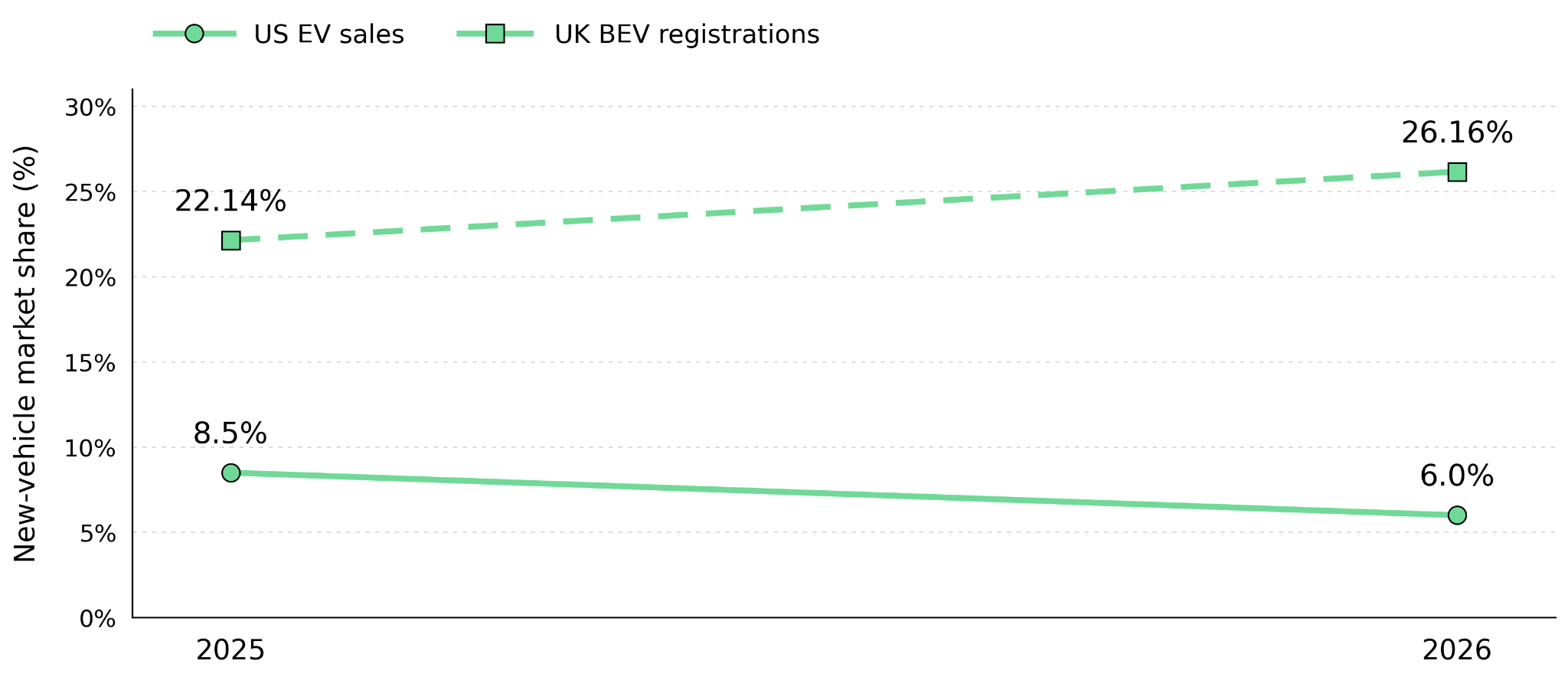
The investment implication depends on the resulting vehicle-production mix and catalyst metal content, because regional sales trends alone cannot establish global PGM consumption.
US Hybrid Sales Growth Sustains PGM Catalyst Use
US federal electric vehicle (EV) purchase tax credits are unavailable for vehicles acquired after September 30, 2025, according to the Internal Revenue Service (IRS). Removing the subsidy can make HEVs more competitive on upfront price relative to previously eligible plug-in vehicles, while their fuel-efficiency benefits do not require plug-in charging. The sales figures do not isolate the policy’s contribution from vehicle prices, model availability, or household budgets.
US EV sales fell 30.7% year over year through September 2026, accounting for 6% of total vehicle sales. Hybrid sales rose 23% over the same period and reached 15.6% of total sales, retaining a market for PGM exhaust catalysts because hybrids still use combustion engines.
European BEV Growth Reduces the Share of New Cars Using PGM Catalysts
BEVs accounted for 21.7% of EU passenger-car registrations from January through August 2026, up from 15.8% a year earlier, according to the European Automobile Manufacturers’ Association (ACEA)’s September 24, 2026 release. HEVs represented 36.6% and PHEVs 10%; together with gasoline and diesel vehicles at 29%, these combustion-engine categories accounted for 75.6% of registrations. The figures show that BEV adoption is reducing the catalyst-equipped share of new cars while hybrids retain a substantial vehicle market requiring exhaust treatment.
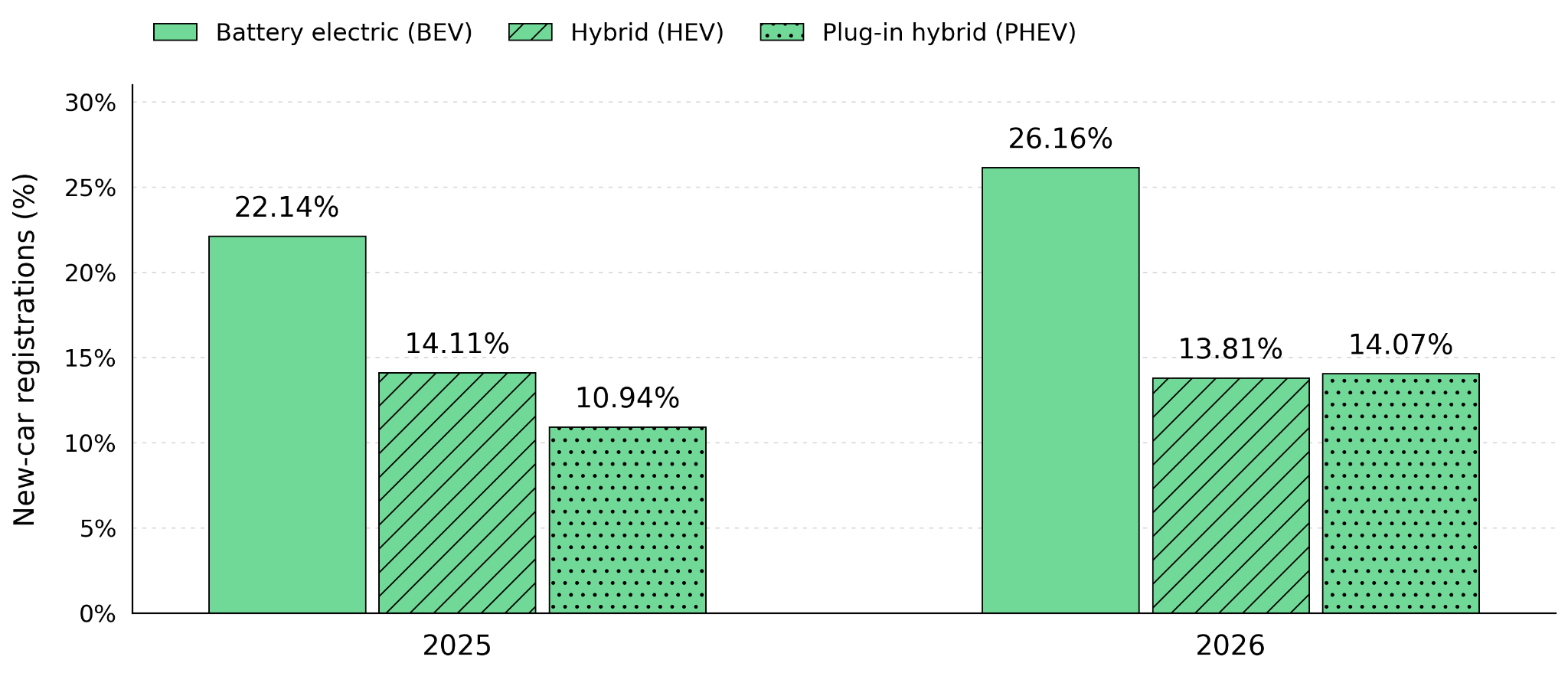
In the United Kingdom (UK), BEV registrations rose 30.2% year over year to 454,947 from January through September 2026, reaching 26.16% of new-car registrations, according to the Society of Motor Manufacturers and Traders (SMMT)’s October 5, 2026 release. PHEV registrations also rose 41.8% to 244,769. The US Department of Energy (DOE) confirms that PHEVs retain combustion engines and exhaust catalysts, keeping a PGM application within the plug-in vehicle market.
The EU figures cover January-August 2026, whereas the US and UK figures cover January-September. The reporting periods and the distinction between sales and registrations limit direct comparisons; these percentages describe vehicle choices rather than quantities of metal consumed.
Catalyst Substitution Shifts Automotive Use From Palladium to Platinum
The World Platinum Investment Council (WPIC) describes gasoline three-way catalysts as mainly palladium-based, with rhodium also used and platinum replacing some palladium. Catalyst design and emissions requirements affect the amount of each metal used per vehicle, so hybrid sales growth does not establish an equivalent increase in platinum or palladium consumption.
For prospective mining output, potential revenue depends on the recoverable quantity and assumed selling price of each metal. Separate metal assumptions therefore provide a clearer basis for assessment than combined resource ounces alone.
Hybrid Catalyst Demand Supports Economic Assessment of PGM Resources
For platinum and palladium exploration projects, processing tests help determine how much contained metal could become a saleable product. Engineering studies assess the costs and scale of potential production, connecting resource exposure to the economics of supplying catalyst markets.
ValOre Metals is advancing processing and engineering studies at its fully owned Pedra Branca platinum, palladium and gold project, targeting a Preliminary Economic Assessment (PEA) in the fourth quarter of 2026. Building on its 2022 inferred resource of approximately 2.2 million ounces, the assessment is intended to clarify project economics and development options, providing a clearer basis for evaluating its commercial potential.
Nick Smart, Chief Executive Officer of ValOre Metals, explains why hybrids and combustion-engine vehicles keep a steady automotive market open for PGEs:
“The principal demand driver for the PGEs is still catalytic converters… Hybrid vehicles also have a significant PGE use in the catalytic converter, and we’re seeing a steady and ongoing demand. So, as we see continued new vehicles hitting the road that are still either hybrids or internal combustion engine vehicles, that gives a pipeline of future demand for the PGEs.”
Hybrid Growth Limits the Forecast Decline in Automotive Platinum Demand
WPIC’s September 9, 2026 Platinum Quarterly, based on independent Metals Focus research, forecasts full-year 2026 automotive platinum demand rising 4% year over year to 474,000 ounces in North America, which includes markets beyond the US. It forecasts declines of 8% to 875,000 ounces in Europe, 9% to 489,000 ounces in China, and 4% to 2.904 million ounces globally. The outlook assumes global light-duty vehicle production of 91.7 million units, down 1% from 2025, with hybrid growth insufficient to offset declining production of combustion-only vehicles.
WPIC’s October 9, 2026 commentary reports a decline of more than 10% in China’s year-to-date production of vehicles fitted with exhaust catalysts, reducing the number of vehicles requiring automotive PGMs. This reinforces why US hybrid growth alone cannot establish higher global platinum or palladium demand.
The Investment Thesis for PGMs
- Producers should disclose platinum and palladium output separately so regional catalyst-demand assumptions can be linked to potential revenue. Comparing revenue with operating costs under lower metal-price scenarios helps assess whether production could continue generating operating profits.
- Developers should disclose dated project studies and the metal prices, recoveries, costs, and production schedules behind projected returns. Sensitivity tests should show how those returns change under lower-price scenarios consistent with weaker automotive demand.
- Explorers’ platinum and palladium resources provide potential exposure to continuing catalyst use. Resource classifications and processing tests help assess confidence in the contained metal and how much could ultimately be recovered and sold.
- Infrastructure access and permitting requirements affect development costs and when projects could supply catalyst metals. Documented access to power, water, and transport, together with approval requirements and dated milestones, should support cost and schedule assumptions.
- Capital spending should prioritize milestones that clarify recoverable output or project economics, because regional hybrid growth does not guarantee higher global PGM demand. Valuations should test metal-specific prices, recoveries, and costs instead of relying solely on combined resource ounces or US vehicle-sales growth.
Hybrid adoption retains an automotive market for platinum and palladium, while regional differences in BEV adoption require separate demand assumptions. Assess PGM exposure through recoverable output, costs, and potential production timing, using metal-price scenarios that distinguish continuing catalyst use from the ability to supply that market profitably.
TL;DR
US hybrid sales rose 23% year over year through September 2026, preserving automotive uses for platinum and palladium because hybrids retain exhaust catalysts. Europe’s rising battery-only vehicle share reduces the proportion of new cars requiring those metals, while hybrid registrations retain a catalyst market. These regional differences support metal-specific demand analysis rather than a single global electrification assumption. ValOre Metals is advancing processing and engineering studies at Pedra Branca, targeting a PEA in the fourth quarter of 2026. Potential mining returns still depend on recoverable metal, prices, costs, and production timing, because regional hybrid growth does not establish higher global PGM consumption.
FAQs (AI-Generated)
Analyst's Notes





Subscribe to Our Channel










.png)
Stay Informed


