




ValOre's Pedra Branca PEA Puts an Anglo American Operator's Record to the Test


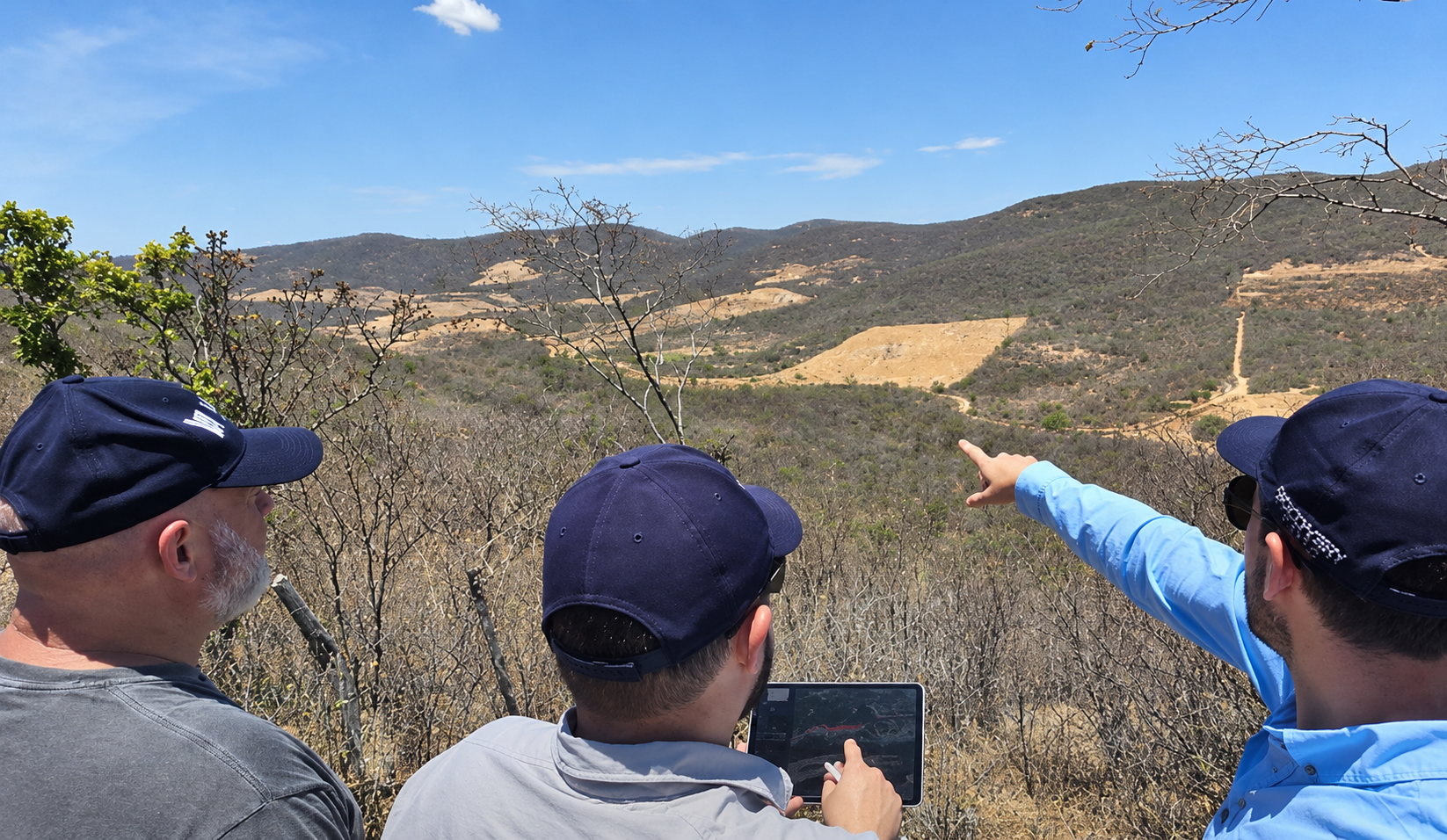
ValOre Metals' Pedra Branca PEA, targeted for the fourth quarter of 2026, tests Nick Smart's Anglo American record on leach route, Phase 1 size and recovery.
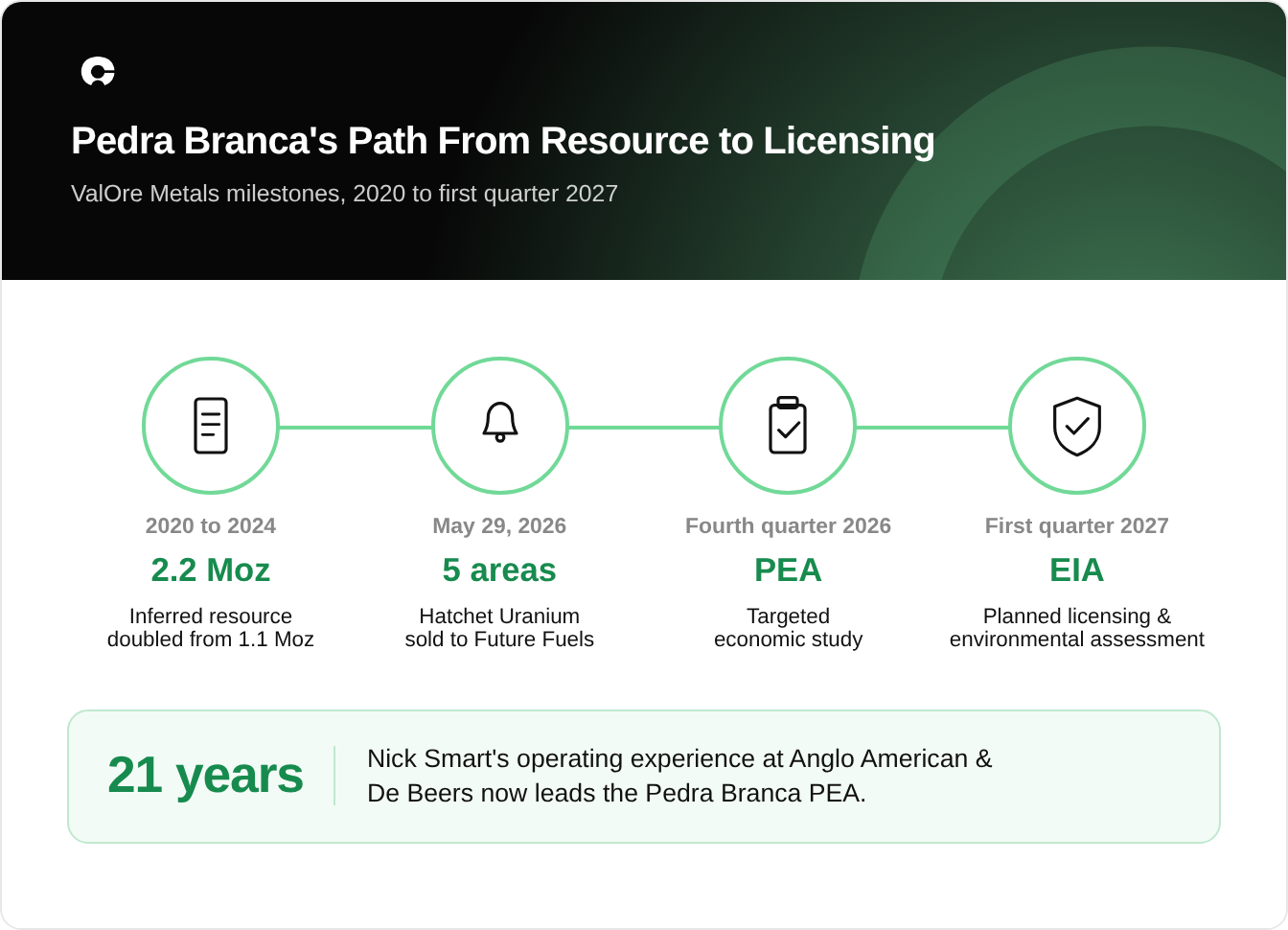
- ValOre Metals has moved Pedra Branca from resource growth to engineering choices, with a preliminary economic assessment (PEA) targeted for the fourth quarter of 2026 and licensing and an environmental impact assessment planned for the first quarter of 2027.
- Chief Executive Officer Nick Smart, a chemical engineer with 21 years at Anglo American and De Beers, has experience designing, building and operating more than $3 billion of large-scale mining projects, including platinum in South Africa and nickel in Brazil.
- The PEA will weigh vessel leaching against lower-capital heap leaching for weathered material, which holds about 40% of the contained ounces, with recovery targeted in the high-70% range.
- Future Fuels completed its acquisition of Hatchet Uranium Corp. on May 29, 2026, and ValOre now presents itself as a Brazil-focused precious metals developer built around a 100%-owned, 2.2-million-ounce inferred platinum, palladium, and gold resource.
- With cash below $0.8 million and a market capitalization of $16.5 million as of October 1, 2026, the PEA's capital estimate will be the first measure of the funding required for the next phase.
From Resource Growth to Engineering Choices
ValOre Metals (TSXV: VO | OTCQB: KVLQF) spent 2020 to 2024 establishing scale at Pedra Branca, its 100%-owned platinum, palladium and gold project in Ceará State, Brazil. The company drilled 23,534 meters on top of 30,000 meters completed by historic operators and doubled the inferred resource from 1.1 million to 2.2 million ounces. The current NI 43-101 estimate, effective March 8, 2022, totals 2,198 thousand ounces of platinum, palladium and gold in 63.3 million tonnes grading 1.08 grams per tonne, across 7 near-surface resource zones.
The 2026 work program moves the emphasis from how much metal is in the ground to how it will be mined, processed and sold. ValOre appointed an engineering company for its preliminary economic assessment (PEA) in the fourth quarter of 2025, has flotation and leaching testwork underway with the University of Cape Town, and is targeting publication of the PEA in the fourth quarter of 2026. Licensing and an environmental impact assessment (EIA) are planned for the first quarter of 2027.
The next stage adds engineering and economic risk to geological uncertainty that remains open. The resource is inferred; the company is re-logging historical core; and 5 zones drilled in 2023 are not included in the current estimate. The PEA will test whether the resource supports a viable initial mine plan, whether the proposed processing routes can deliver acceptable recoveries and costs, and how much capital a first phase would require.
An Operator's Background for a Processing-Led Project
ValOre's Chief Executive Officer, Nick Smart is a chemical engineer who spent 21 years at Anglo American and De Beers, with experience in the design, construction and operation of more than $3 billion of large-scale mining projects. His operating record covers platinum and zinc in South Africa, nickel in Brazil, and diamonds in Canada, alongside corporate roles in the UK and start-up ventures. He also lived in Brazil for 6 years.
The fit is specific to Pedra Branca's processing work, which has been a major focus for the company. About 40% of contained ounces sit in the weathered, oxidized horizon, which is harder to float, and ValOre is developing a hydrometallurgical route for that material. The remaining 60% is fresh rock, for which the company is developing a standard flotation process to produce a concentrate. Testwork on the weathered material has scaled up from 1-liter shake flasks to stirred-tank vessels and columns, and the company is targeting recovery in the high-70% range, with room to improve as the flowsheet is optimized.
Pedra Branca was previously owned by Anglo American and Anglo Platinum, which completed an extensive drilling campaign before ValOre added its own. The 2026 plan includes re-logging historical drill core across the Curiu, Esbarro and Cedro deposits to refine geological and mineralization controls and mine planning assumptions.
Heap Leach or Vessel Leach: The First Capital Decision
The column tests exist to answer a capital question. Heap leaching and vessel leaching deliver different combinations of upfront spend and metal recovered, and the choice feeds directly into both the PEA's capital estimate and its recovered ounces.
Smart described the trade-off the study is weighing:
"With heap leaching, generally there's a trade-off: lower capital intensity generally, with lower recoveries versus doing it in vessels. That's certainly something we're evaluating: is going down vessels the right route with higher capex intensity and larger recoveries, or do you go with a lower capex setup with slightly lower recoveries overall and see what makes the most sense."
For a company valued at $16.5 million on October 1, 2026, a lower-capital route reduces the size of the first construction financing, while a higher-recovery route increases the ounces sold from the same resource. Neither is superior by default. The capital cost, operating cost, recovery and production scale attached to it, and the project economics that result, are the figures that will allow the trade-off to be judged.
Phasing Pedra Branca Around Infrastructure
The management’s approach to scale is staged. ValOre is targeting a stepwise development: prove the process, secure licensing for a Phase 1 operation, and keep the option to add Phases 2 and 3. Plant throughput is being traded off against infrastructure investment, water availability and energy availability, and the 2026 plan includes continued preliminary water and power supply studies. Because the deposit is near surface, the company is planning open-pit mining, with no deep-level underground development required.
Smart outlined how the study will handle the range of throughput cases:
"We'll look at options at this scoping stage, make a recommendation in terms of one which we feel is ideal, and then that gets optimized in subsequent study levels like pre-feasibility."
The PEA will therefore present a recommended case selected from several plant sizes, with further optimization left to later study levels. The current resource remains the 2022 inferred estimate. ValOre is targeting growth beyond 2.2 million ounces and plans to bring the 5,000 to 6,000 meters drilled since that estimate into its updated resource economics when the PEA is published. On scale, Smart's view is that a 2 million ounce resource of platinum group elements (PGEs) is roughly comparable to 1 million ounces of gold, given the price difference between the metals.
Corporate Focus & In-Country Experience
The corporate structure has narrowed in parallel. Future Fuels Inc. (TSXV: FTUR) completed its acquisition of Hatchet Uranium Corp. on May 29, 2026 through a three-cornered amalgamation, taking in 5 uranium project areas in northern Saskatchewan covering about 97,674 hectares. ValOre's Chairman, Jim Paterson, stated that ValOre would become a significant shareholder of Future Fuels, and Hatchet's obligations passed to the amalgamated entity, not to ValOre.
ValOre now bills itself as a Brazil-focused precious metals developer, with Pedra Branca as its 100%-owned asset and a growth strategy aimed at advanced-stage gold projects in northeast Brazil. Alongside Smart, Vice President of Exploration Thiago Diniz, a geologist with an M.Sc. in economic geology from Queen's University, brings more than 15 years of experience on fertilizer, base and precious metals projects in Brazil and Canada.
Smart described the policy direction management sees in Brazil:
"Brazil is also developing its own critical minerals frameworks, looking at how they're going to fast-track permitting and licensing and support incoming corporate investments."
A supportive framework may help project advancement, but ValOre still has to secure its own approvals. Licensing and the EIA, targeted for the first quarter of 2027, are the milestones that will show how Pedra Branca moves through that process.
A Small Balance Sheet Raises the Stakes for the PEA
As of October 1, 2026, ValOre held less than $0.8 million in cash, had 255 million shares outstanding and 304.2 million fully diluted, including 20 million options at $0.12 and 29.2 million warrants at $0.10, and had a $16.5 million market capitalization at a $0.065 share price. Insiders and advisors hold 20% of the company, resource and mining funds 25%, close associates 10%, and retail and other holders 45%.
The board brings relevant capital markets experience. Paterson is co-founder and principal of Discovery Group, with 28 years of executive leadership, and has been a director or officer of companies that have raised more than $300 million in equity and participated in more than $ 1 billion in mergers and acquisitions (M&A) transactions. Valore's directors have driven $1.7 billion in M&A, including sales to Rio Tinto for $650 million and to Goldcorp for $520 million.
That experience is relevant to the next raise, and the PEA's capital estimate for Phase 1 will be the first published input into ValOre's funding requirements, alongside the costs of licensing, the EIA, and later study levels. The strength of the study's economics will shape the financing options open to the company.
What the PEA Will Test
The fourth-quarter study is the first public measure of how ValOre's operating leadership translates into numbers: which leach route it selects, what recovery it uses in the economic model, how large Phase 1 is, and what that plant costs to build. After publication, the plan moves to licensing, the EIA, and the next phases of study and exploration.
Several questions will remain open after the PEA: how much of the inferred resource converts to higher confidence at later study stages, whether targeted recoveries hold at commercial scale, and the terms on which development capital can be raised.
About 90% of the world's PGE supply comes from South Africa, Zimbabwe, and Russia, and automotive demand accounts for about 40% of platinum demand and about 80% of palladium and rhodium demand. ValOre describes Pedra Branca as one of the few near-surface PGE deposits outside southern Africa.
The Investment Thesis for ValOre Metals
- ValOre Metals is moving Pedra Branca from resource definition to development planning, with a preliminary economic assessment targeted for the fourth quarter of 2026 and licensing and an environmental impact assessment planned for the first quarter of 2027.
- Chief Executive Officer Nick Smart brings 21 years at Anglo American and De Beers and experience designing, building and operating more than $3 billion of large-scale mining projects, including platinum in South Africa and nickel in Brazil.
- The preliminary economic assessment will set the processing route for a deposit split about 40% weathered and 60% fresh by contained ounces, with recovery targeted in the high-70% range and a choice between heap leaching and vessel leaching.
- The 2.2 million ounce inferred platinum, palladium and gold resource grades 1.08 grams per tonne, and the company is targeting a stepwise open-pit development that begins with a Phase 1 operation.
- The completed acquisition of Hatchet Uranium Corp. by Future Fuels leaves ValOre focused on Brazilian precious metals, with its Chairman stating that ValOre would become a significant shareholder of Future Fuels.
- With less than $0.8 million in cash and a $16.5 million market capitalization as of October 1, 2026, the capital estimate in the preliminary economic assessment will define the scale of funding the company needs to advance toward licensing.
ValOre's investment case now depends on whether Pedra Branca's resource and processing testwork can support a credible initial development plan. Smart's experience is relevant to the decisions ahead, but the fourth-quarter 2026 study must establish the plant configuration, recovery assumptions, capital requirements and project economics. With less than $0.8 million in cash as of October 1, 2026, those results will also define the scale of the funding task as the company advances toward licensing and further studies.
TL;DR
ValOre Metals is targeting a PEA on its 2.2 million-ounce inferred Pedra Branca platinum, palladium, and gold resource in the fourth quarter of 2026, led by Chief Executive Officer Nick Smart, a chemical engineer with 21 years of experience at Anglo American and De Beers. The study will choose between heap and vessel leaching for weathered ore, size a Phase 1 plant, and test a recovery target in the high-70% range. Cash stood below $0.8 million on October 1, 2026, so the PEA's capital estimate will frame the next financing, with licensing and an EIA planned for the first quarter of 2027.
FAQs (AI-Generated)
Analyst's Notes





Subscribe to Our Channel


.png)





.png)
Stay Informed


