




World Bank’s $19 Billion Plan Could Advance Battery Metals Projects


Public financing could help competitive graphite, lithium and nickel projects secure infrastructure and advance toward commercial supply.
- The World Bank Group (WBG) is targeting US$19 billion in metals and minerals support over fiscal 2026-2030, combining its own financing with private capital it seeks to attract, according to its October 16, 2026 announcement.
- Reliable electricity and export arrangements can help graphite developers secure financing by giving lenders a clearer basis for assessing operating costs and delivery schedules.
- Funded engineering, permitting and commercial preparation can help preproduction lithium companies advance toward construction decisions.
- Targeted public risk sharing can improve financing conditions when it addresses specific infrastructure or development constraints.
- Competitive projects offer exposure to future battery-metals supply without requiring a sector-wide price rally to underpin their investment case.
World Bank Support Could Advance Battery-Metals Supply
On October 16, 2026, the WBG announced it is targeting a fivefold increase in metals and minerals support to US$19 billion over fiscal 2026-2030, combining its own financing with private capital it seeks to attract. The announcement does not specify how much of that total would fund battery-metals projects.
For graphite and lithium projects, financing power connections, transport links, and processing facilities can help resolve constraints that delay construction and revenue. The investment case depends on whether that spending supports profitable production at the metal prices assumed in project studies.
Public Risk Sharing Could Mobilize Battery-Metals Capital
The World Bank provides public financing and policy advice, the International Finance Corporation (IFC) invests and mobilizes private capital, and the Multilateral Investment Guarantee Agency (MIGA) provides guarantees against covered risks. These complementary tools could improve investment conditions by addressing obstacles that individual project sponsors cannot readily resolve alone.
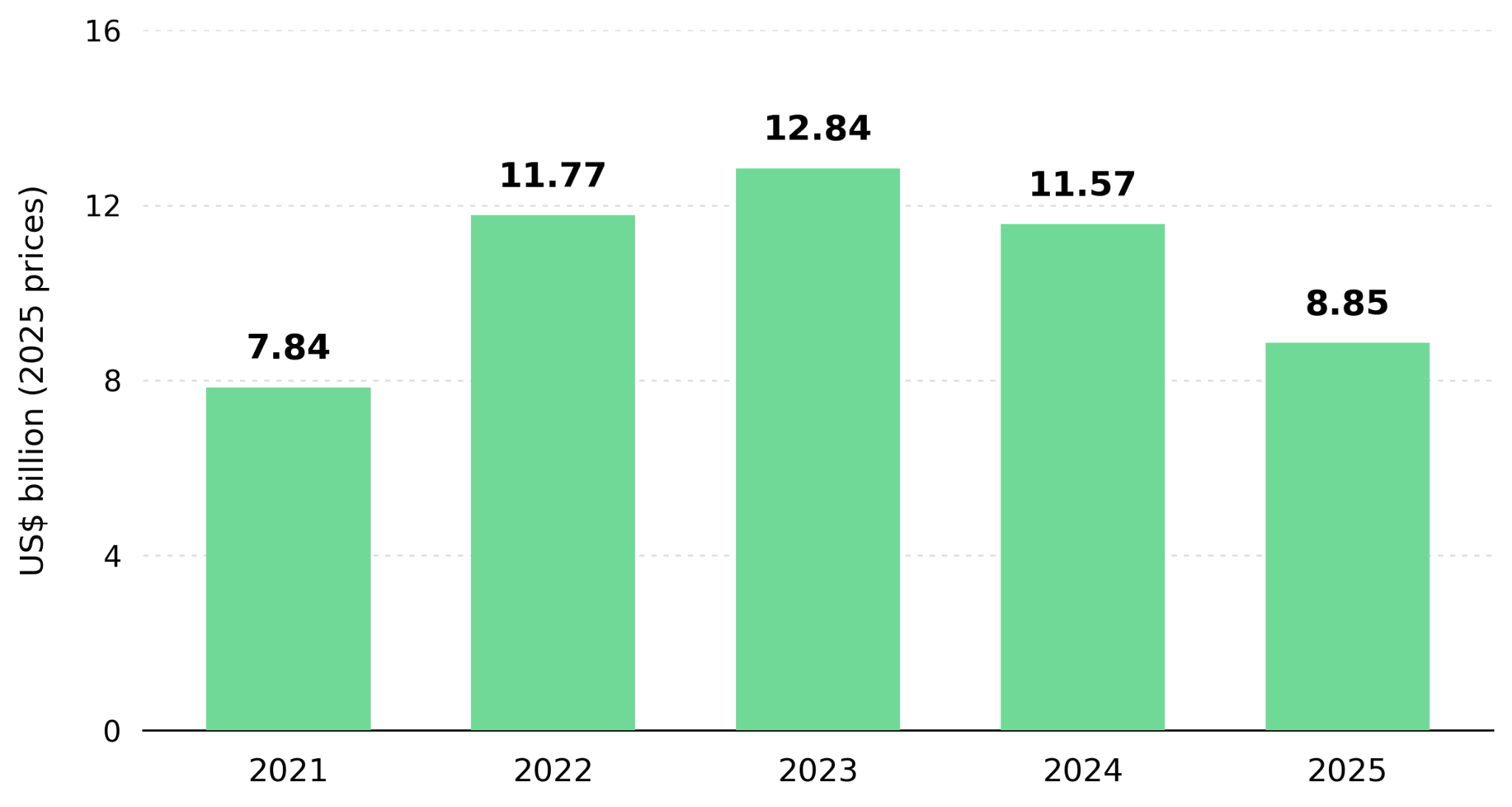
Battery-metals investment in the International Energy Agency (IEA) sample rose from US$7.84 billion in 2021 to US$12.84 billion in 2023, before declining 31.1% to US$8.85 billion in 2025, measured at constant 2025 prices. The WBG’s proposed support could complement company spending by funding shared infrastructure and covering specific risks that affect access to private capital.
Argentina’s partnership includes lithium development, provincial coordination and strategic infrastructure, while Malawi’s compact prioritizes energy, transport and mining-sector governance. The investment significance lies in connecting these public commitments with commercially viable projects. Reliable infrastructure and predictable approvals can give lenders greater confidence in development schedules, while project financing still requires individually approved commercial terms.
Infrastructure Investment Could Advance Graphite Supply
Malawi’s October 2026 compact targets investment in 140 megawatts (MW) of additional generation capacity for mining demand by 2029, alongside long-term electricity agreements and transport improvements. Together, these commitments address the infrastructure needed to move graphite projects toward commercial supply. Their value to individual projects will depend on reliable delivery schedules, competitive electricity prices and workable export arrangements.
Sovereign Metals targets steady-state graphite concentrate production of 275,000 metric tons annually at Kasiya. Its completed definitive feasibility study (DFS) provides a technical basis for financing discussions, while its IFC collaboration agreement supports environmental and social preparation and includes debt and equity financing rights. Potential institutional investment remains subject to bankability and applicable requirements.
Sapan Ghai, Chief Commercial Officer of Sovereign Metals, describes industrial graphite demand and competitive supply costs:
“70% of our graphite is what's called refractory grade or industrial grade graphite that ends up lining the insides of your electric arc furnaces for smelting copper, steel, aluminum… Currently, it all comes from China and we can produce it at a lower cost than China today.”
Processing Investment Could Expand Commercial Lithium Supply
India’s critical-minerals roadmap for 2026–2035 proposes processing parks with shared utilities, testing laboratories and logistics. This approach could expand commercial options for lithium suppliers whose products meet processors’ technical requirements. Because processing capacity develops over several years, preproduction companies also need sufficient capital to advance engineering, permitting and commercial preparation before operating revenue begins.
Lithium Ionic received US$30 million when it closed the sale of its Salinas property, raising capital without issuing new shares. The proceeds provide additional funding capacity to advance Bandeira toward a construction decision, supporting preparatory work before larger construction commitments.
Public Risk Sharing Could Strengthen Nickel Project Financing
The framework announced by the European Investment Bank (EIB) links project preparation, infrastructure coordination and potential long-term funding. For nickel developers, meeting lender standards and advancing infrastructure arrangements can strengthen the case for the equity and debt financing needed to begin construction.
Lifezone Metals says its Kabanga nickel project in Tanzania has undergone due diligence by the United States International Development Finance Corporation. Management reports that supporting infrastructure is in place as the company works to finalize equity and debt financing. These preparations could strengthen the project’s readiness to secure development capital and proceed toward construction.
By-Product Credits Could Strengthen Nickel Project Financing
A credible financing plan rests on project economics that remain workable under conservative price and cost assumptions. For nickel developers, revenue from other metals can lower net production costs and help sustain cash generation across market cycles.
Canada Nickel is targeting a full financing package for Crawford in the first quarter of 2027, combining tax-credit financing, strategic participation and debt to advance the project toward construction. Projected life-of-mine all-in sustaining costs (AISC) of approximately US$1.54 per pound of nickel, after credits from other metals, could help sustain cash generation at lower nickel prices.
Supply Growth Favors Competitive Battery-Metals Projects
In its October 13, 2026 release, the International Nickel Study Group (INSG) forecasts primary nickel surpluses of 19,000 metric tons in 2026 and 70,000 metric tons in 2027, based on production estimates that exclude adjustments for possible disruptions. INSG also reports that competition from lithium iron phosphate (LFP) batteries has slowed growth in nickel’s battery-market role. These forecasts reinforce the need to test whether new projects can recover construction and operating costs without relying on higher nickel prices.
For graphite and lithium projects, infrastructure contracts, processing arrangements, and customer approvals help establish when planned production could generate revenue. Per-share valuations must account for the remaining development costs and any new shares needed to fund them.
The Investment Thesis for Battery Metals
- Developers with reliable electricity and export arrangements offer a clearer pathway from mineral resources to prospective battery-material supply.
- Explorers and other preproduction companies with funded technical programs can advance essential preparation while infrastructure and processing capacity develop.
- Targeted institutional participation can strengthen financing structures by matching long-term capital and risk-sharing tools with specific development requirements.
- Competitive delivered costs, demonstrated metallurgical recovery and customer acceptance support resilience across commodity cycles.
- Jurisdictions that implement predictable permitting rules and infrastructure commitments provide greater visibility for long-term project investment.
Public support can strengthen the long-term investment case for battery metals by improving the conditions needed to develop competitive supply. The opportunity lies in well-prepared projects that combine resource quality with reliable infrastructure, disciplined capital allocation and commercially suitable products. Selecting businesses capable of advancing these requirements provides exposure to future supply growth while keeping investment decisions grounded in project economics and execution.
TL;DR
The World Bank Group (WBG) targets US$19 billion in broader minerals support over fiscal 2026–2030, combining its financing with private capital mobilization. For battery metals, the opportunity lies in funding infrastructure, sharing specific risks and advancing the preparation needed to bring competitive supply to market. Reliable electricity, export access, processing capacity and funded technical programs can strengthen project financing prospects. Benefits depend on approved transactions, realistic development schedules and sustainable economics. The investment case favors well-prepared projects with commercially suitable products and costs that remain workable under conservative commodity-price assumptions.
FAQs (AI-Generated)
Analyst's Notes





Subscribe to Our Channel






Stay Informed


