Shrinking Discovery Budgets Raise the Value of Funded Explorers



Junior miners raised US$21.43B in 2025 as their exploration budgets fell by 13%, boosting the value of funded explorers even as major gold and copper finds shrink.
- Junior and intermediate miners raised US$21.43 billion in 2025, more than double the previous year. Junior exploration budgets fell 13% to US$4.39 billion over the same period, as capital went to building mines rather than finding new ones.
- Grassroots exploration fell to a record low of 21% of global budgets, while major gold and copper discoveries are becoming rarer and smaller.
- Explorers with enough cash to reach their next technical milestone can keep drilling through setbacks without raising money at depressed share prices.
- Major miners are paying cash for early-stage ground, taking equity stakes in juniors and funding exploration through earn-ins as they work to replace depleted reserves.
- Preserved core and historical drill records cut the cost of finding and defining deposits. Metallurgy, capital costs, offtake and permits decide which discoveries become financeable mines.
Financing Doubles While Exploration Budgets Shrink
Mining finance improved materially in 2025, yet the share of capital directed at finding new deposits contracted. Funding construction advances known deposits, while funding discovery builds the inventory from which future mines emerge. Reading any financing headline correctly requires separating the two.
According to S&P Global, junior and intermediate mining companies raised US$21.43 billion in 2025, up 109%, while junior exploration budgets fell 13% to US$4.39 billion over the same year. The datasets cover different activities and company populations, but together they show capital raised and capital allocated to discovery moving in opposite directions. Minesite exploration reached a record 45% of global budgets. Grassroots exploration, the search for new deposits before substantial resources exist, fell to a record low of 21% share.
Across all companies, global exploration budgets fell for a third consecutive year to US$12.40 billion, as junior spending fell faster than the total.
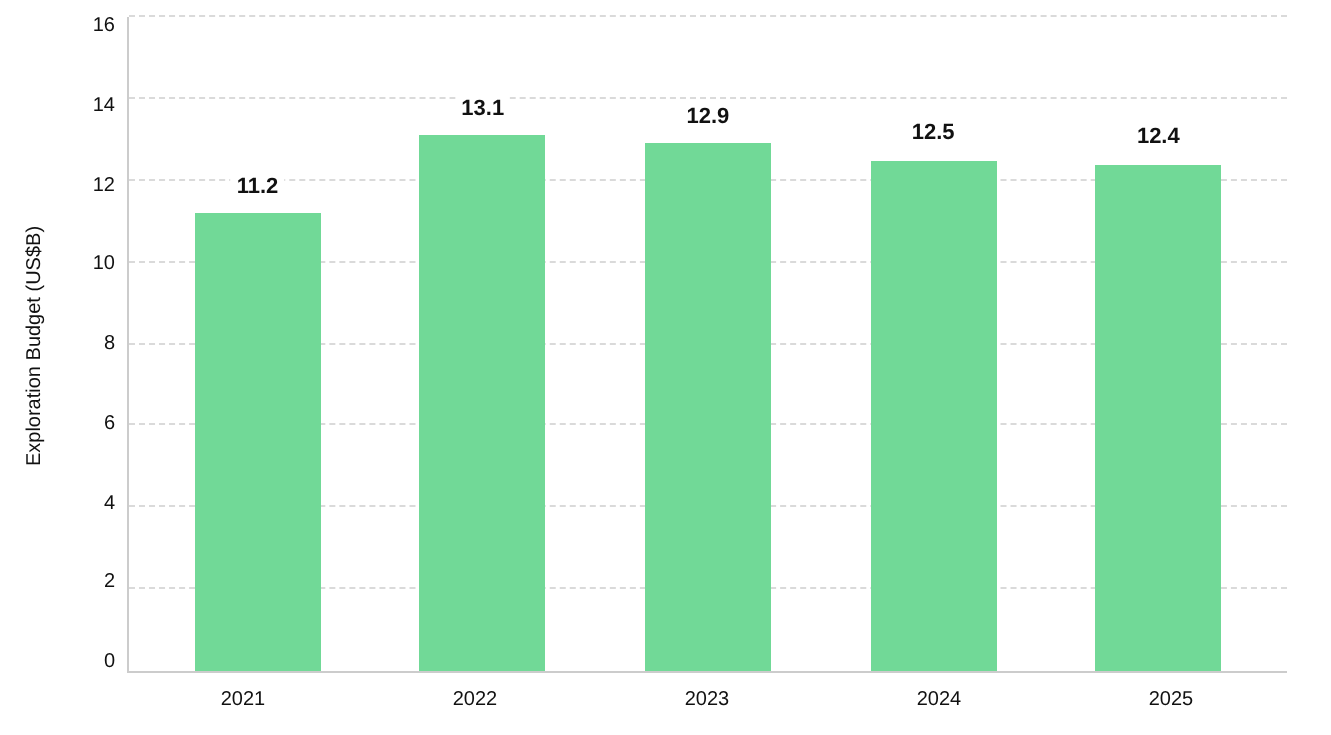
Extensions around operating mines leverage existing infrastructure, technical teams, and processing routes, improving near-term capital efficiency for producers. The cost is a thinner pipeline of independent discoveries. Supply outcomes for any single commodity also depend on demand, recycling, reserve conversion and projects already in development.
Why Reserve Replacement Creates Strategic Demand
Producers replacing depleted reserves have three routes: buy prospective ground, fund an exploration option or acquire a defined deposit. Each route secures a different level of geological confidence at a different price. Transactions completed in 2026 point to acquisition interest in funded early-stage ground, without establishing a universal premium.
Cash Runway Determines Who Can Keep Testing
Exploration rarely moves in a straight line from the first hole to discovery. A funded company can revise its geological model after disappointing results and drill in line with the new interpretation. A cash-constrained company must first raise equity, often at a depressed share price. Financial resilience, therefore, shapes both technical execution and shareholder dilution.
Measure Funding Against the Next Technical Milestone
Funding runway is the period during which available cash can support planned exploration, corporate overhead and contractual commitments. A practical calculation takes unrestricted cash, less committed liabilities and a contingency reserve, and divides it by expected net monthly spending. Marketable securities and restricted balances belong on a separate line.
Nine Mile Metals, a copper-polymetallic explorer in New Brunswick, reported C$4.9 million in cash at June 30, 2026. Management describes a runway of two to almost three years, with a maiden mineral resource estimate at the Wedge project as the next milestone.
Major Partnerships Fund Discovery at an Economic Price
Ridgeline Minerals, a Nevada explorer, collects a 10% management fee as operator on qualifying partner spending. The company sold its Swift, Black Ridge, Bell Creek and Atlas projects to Nevada Gold Mines for about C$32.7 million in cash, a 26% premium to its 20-day volume-weighted average price. CEO Chad Peters highlights that the company can fund growth without issuing new shares:
"Being able to do a non-dilutive $33 million deal, that's a huge deal for us. We've cut dilution; the business model is working."
In August, Mogotes Metals closed a US$15 million placement from Rio Tinto, giving the major 5% of the company and 15 months of exclusivity at the Filo Sur project. Mogotes also holds an option to earn a 51% interest in Rio Tinto’s Copper Cliffs project in Montana by spending US$16 million. The company reports a C$75 million treasury, which funds roughly 80,000 meters of drilling across three projects.
Historical Data Lowers Exploration Cost When it Survives Verification
Past exploration spending keeps its value after the original owner changes strategy. Preserved core and reliable records let a new team ask different geological questions without repeating every drill meter. The value depends on the condition, coverage and verifiability of the data.
Silver Acadia, a silver explorer in New Brunswick's Bathurst Mining Camp, holds about 50,000 meters of preserved core from roughly 125,000 meters of historical drilling. About half of that drilling was never assayed for silver because earlier operators focused on base metals. The company is re-assaying part of the historical core to generate new silver data at a fraction of the cost of fresh drilling.
Nine Mile Metals applies similar logic to roughly 300 historical Cominco drill holes from the 1950s and 1960s, combined with 3D borehole geophysics. Geophysical conductors identify targets, while only verified mineralized intercepts establish grade.
Verdera Energy, a uranium explorer in New Mexico's Grants district, holds about 90% of the state's historical uranium data, including 250,000 drill hole logs. Verdera holds 28.8 million pounds of current NI 43-101 resources and about C$23 million in cash and securities, and an updated technical report on West Largo is underway. Janet Lee Sheriff, Chief Executive Officer of Verdera Energy, highlights the recovered original West Largo drill logs for its NI 43-101 report:
“We have about 90% of all the historic data ever produced in the state of New Mexico for uranium… We’ve spent the past two months scanning those to include them in the 43-101 technical report. We have about 250,000 drill hole logs… Kerr-McGee had so much data that we actually have wellfield plans and designs for projects.”
Western Exploration validated more than 800 historical drill holes at Doby George, Nevada, a Homestake discovery from the 1980s. Its 2025 PEA shows a US$211 million after-tax NPV and a 62.2% IRR on US$115.2 million of initial capital at US$3,000 per ounce of gold. Western has started federal permitting, and Agnico Eagle holds 10%.
District Programs Broaden Opportunity & Demand Capital Discipline
Multiple targets reduce dependence on a single drilling outcome, yet a larger land position does not automatically improve an investment. Value comes from systematically ranking targets and funding decisive tests without spreading spending too thin.
Astra Exploration has expanded its La Manchuria footprint in Argentina from one to about 16 square kilometers. It plans a 10,000 to 20,000-meter drill campaign, drawing on a C$15 million placement closed in April 2026.
Resource Extensions & New Discoveries Serve Different Roles
South Pacific Metals is pursuing both routes in Papua New Guinea. At Osena, beside K92 Mining’s Kainantu mine, the new Megabe discovery returned 5 meters at 12.46 g/t gold, and step-outs extended it past 300 meters of strike. At Kili Teke, the company is generating drill targets outside a 237-million-tonne copper-gold inferred resource.
Resource Growth Must Survive Metallurgy, Capital Costs & Permitting
Discovery value depends on the prospect of economic extraction. Recoveries, processing requirements, infrastructure and development timing determine whether geological progress produces a credible mine.
ValOre Metals has spent US$10 million and drilled 23,500 meters at Pedra Branca in Brazil. The work doubled the inferred resource to 2.2 million ounces of platinum, palladium and gold, in seven near-surface deposits along an 80-kilometer trend. Flotation tests recovered 83% of the platinum, and the company is completing a resource review and PEA in the fourth quarter.
Lithium Ionic has advanced its Bandeira lithium project in Brazil to a feasibility study showing US$191 million in initialcapital, aUS$1.45 billion after-tax NPV and a 61% IRR. Binding offtakes carry a US1,000-per-tonne price floor and a US$20 million prepayment. The company is targeting permits by the end of 2026.
Major Discoveries Are Getting Rarer & Smaller
S&P Global counts only nine gold deposits discovered since 2020 that reached its major-discovery threshold of 2 million ounces, holding 38 million ounces of gold in reserves, resources and past production combined. Major discoveries made between 1990 and 1995 contain 1.3 billion ounces, and finds from 2000 to 2005 contain 496 million ounces, more than ten times the post-2020 total. New gold is still being found in smaller deposits.
S&P Global identified 263 major copper discoveries made between 1990 and 2025, holding 1.402 billion metric tons of copper in reserves, resources and past production. All the copper discovered since 2000 still falls short of the volume found in the 1990s alone, and no major copper deposit meeting its threshold was discovered in 2025.
Future supply will increasingly depend on modest initial discoveries that, as follow-up drilling grows, become deposits large enough to interest producers. Explorers able to keep drilling after a first resource announcement, rather than pausing for the next raise, decide whether a modest find becomes a major one. A sustained rise in grassroots budgets would be the first signal of a recovery in the discovery record.
The Investment Thesis for Mineral Exploration
- Measuring cash against the cost of the next technical milestone, not the headline treasury figure, separates explorers able to absorb a failed drill program from explorers forced to raise money in weakness.
- Cash paid by majors for ground with no defined resource shows reserve-replacement demand now reaching the earliest stage of exploration, which favours juniors holding prospective land in established mining districts.
- Strategic placements and earn-ins carry value beyond the cash raised, since exclusivity rights and partner spending commitments decide who controls a discovery and on what terms.
- A partner-funded interest is worth the cash that reaches shareholders after carry terms and repayment obligations, not its headline ownership percentage.
- Data inherited from past operators lowers the cost of each new answer. Re-assaying, recovered drill logs and confirmation drilling turned sunk spending into current resources.
- With major discoveries shrinking, follow-up drilling to grow a modest first resource is the main route to a deposit large enough to attract producer interest. Funded step-out programs are, therefore, a leading catalyst.
- Thin trading, placement discounts, warrants and concentrated ownership add downside risk, and failed exploration can result in substantial or total capital loss.
- Recoveries, capital intensity, binding offtake and permit timing decide which resources convert into financeable projects.
Capital returned to mining in 2025, but most of it went to building and extending known deposits rather than finding new ones. Grassroots discovery was left at a record-low share of budgets just as major gold and copper finds grow rarer and smaller. The shortfall shifts strategic value toward explorers with funded programs, verifiable data and a credible route from discovery to a financeable mine. Producers are already paying for early-stage ground and taking stakes to secure access. The discovery pipeline will keep thinning unless grassroots budgets recover, and any recovery would take years to show in the discovery record. Until then, cash measured against the next milestone, data that survives verification and the economics left after partner terms will decide which explorers supply the next generation of mines and which depend on the next raise.
TL;DR
Junior and intermediate miners raised US$21.43 billion in 2025, more than double the previous year, yet junior exploration budgets fell 13% to US$4.39 billion, and grassroots exploration dropped to a record-low 21% of global budgets. Capital went to building and extending known deposits, while major gold and copper discoveries grew rarer and smaller. Explorers with enough cash to reach their next technical milestone can keep drilling without raising money at depressed share prices. Major miners are buying early-stage ground, taking equity stakes and funding earn-ins to replace depleted reserves. Verified historical core and drill records cut discovery costs, while metallurgy, capital costs, offtake and permits decide which discoveries become financeable mines.
FAQs (AI-Generated)
Analyst's Notes





Subscribe to Our Channel

















Stay Informed