




Lifezone's Kabanga Combines 2%+ Nickel Grade With Indonesia's Rising Cost Floor


Lifezone Metals' 2%+ grade Kabanga nickel sulfide project faces a US$ 18,000 to US$ 19,000 nickel price outlook, with US$930 million capex financing next.
- Indonesia's shift to supply management, through 1-year quotas, royalty changes, capacity caps, and revised minimum-price formulas, supports Lifezone management's outlook for nickel prices of US$ 18,000 to US$ 19,000, which it identifies as the break-even point for Indonesian projects.
- The Kabanga nickel project in Tanzania averages more than 2% nickel, with copper and cobalt as byproducts, compared with Indonesian saprolite ore grades of 1.3% to 1.6%, a grade profile that suggests a potential cost advantage.
- Indonesian mixed hydroxide precipitate output has fallen about 37% from its peak due to sulfur supply constraints, a vulnerability in the competing supply chain.
- Kabanga requires about US$800 million in procurement packages, and closing project equity and debt financing is a precondition for a final investment decision (FID).
- The Tanzanian government is a 16% shareholder, Lifezone holds a special mining license for the life of the asset, and an independent review in October 2026 confirmed that the resettlement plan remains materially aligned with the International Finance Corporation standard.
Indonesia's Supply Discipline Lifts the Expected Nickel Price Range
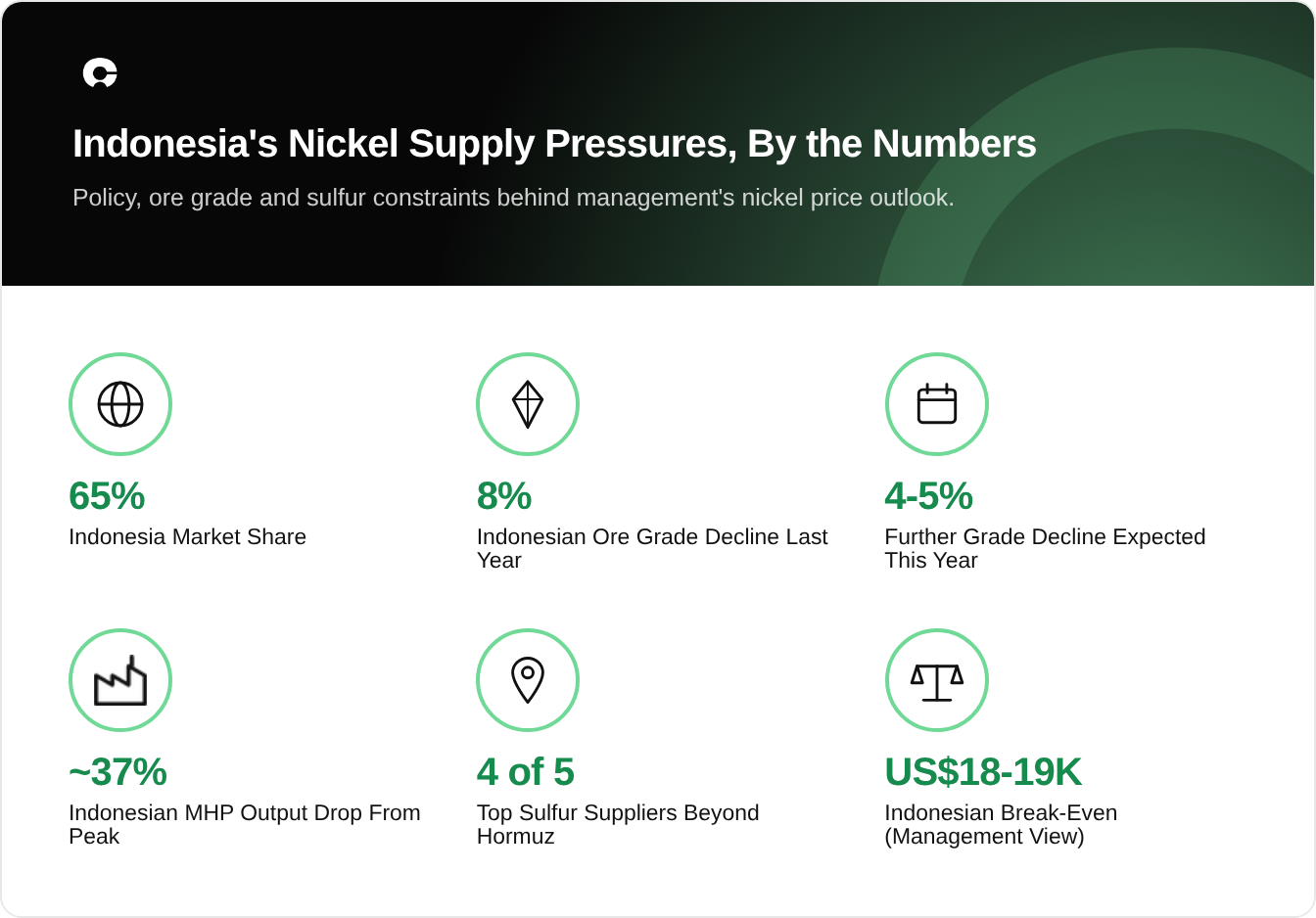
For most of the past decade, Indonesian expansion set the nickel price. Indonesia and the Philippines together dominate the mine supply; Chinese companies control most Indonesian smelting and refining; and the growth came from low-cost, coal-powered, high-pressure acid leach and nickel pig iron capacity built with Chinese capital and technology. Lifezone Metals (NYSE: LZM) puts Indonesia's market share at 65%, and over that period very few new nickel sulfide projects advanced in the Western world.
The company owns one of the exceptions: the Kabanga nickel project in Tanzania, a high-grade, development-ready sulfide deposit. The company's market case depends on Indonesia's move from volume growth to supply management, a change in direction management dates to the end of 2025.
Chief Financial Officer of Lifezone Metals, Ingo Hofmaier, described that change as the new base case for nickel pricing:
"There is a noticeable fundamental reversal of the trends that we have seen until the end of 2025. Indonesia is getting its act together to control supply better. It's very clear that this shift has taken place and is the new base case: we will not see prices like $15,000 again; we will most likely see prices of $18,000 to $19,000, which is the break-even point for even Indonesian projects."
The policy tools behind it are in use: royalty changes, quotas limited to 1 year, capacity caps and revised minimum-price formulas. Chief Executive Officer of Canada Nickel, Mark Selby, cites an 8% fall in Indonesian ore grades last year, with a further 4% to 5% decline expected this year, and sees scope for Indonesia to push prices higher step by step over the next 4 to 5 years. Hofmaier says nickel prices have risen 20% from their 2025 low point and have lifted project margins.
Grade & Byproduct Credits Point to a Potential Cost Advantage
Sulfide producers with byproduct credits dominate the first quartile of the nickel cost curve. Kabanga has that profile. The deposit averages more than 2% nickel with copper and cobalt byproducts, and Lifezone states that certain years in the feasibility study (FS) schedule average 2.4%. Indonesian saprolite ore grades 1.3% to 1.6%.
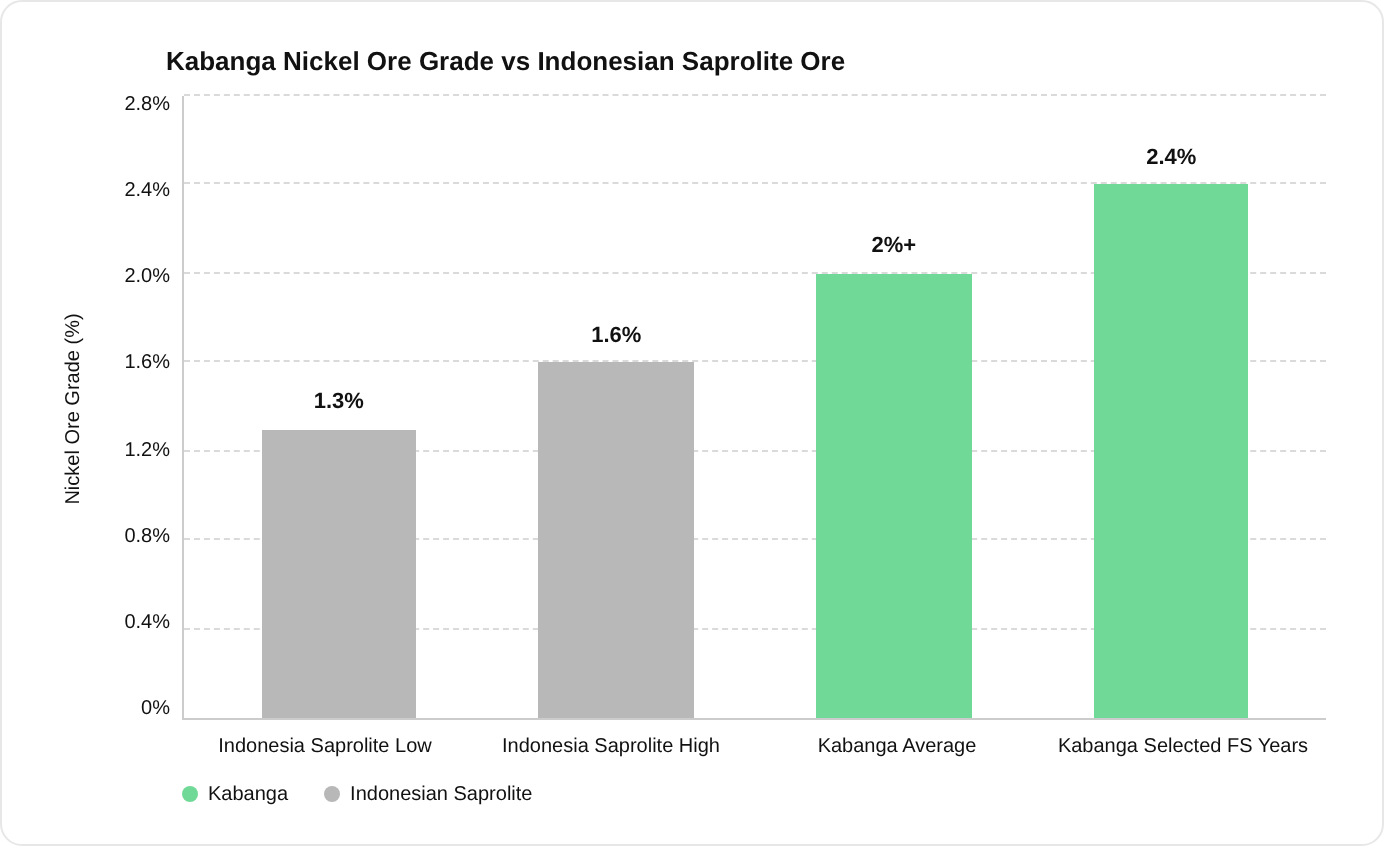
The comparison establishes a geological difference. A higher grade delivers more contained nickel per tonne of ore mined and processed, and copper and cobalt sales offset part of the cost of each tonne of nickel produced. It does not by itself establish Kabanga's production cost. Production cost also depends on metallurgical recovery, mining and processing costs, capital intensity, and the payability of each product, and sulfide and laterite ores follow different processing routes. Placing the project on the cost curve requires Kabanga's operating cost net of byproduct credits.
Hofmaier tied the grade profile to Kabanga's ability to compete for buyers outside the Indonesian and Chinese supply chain:
"There is plenty of demand outside Indonesia and China. If you are on the right side of the cost curve with a high-grade sulfide deposit, you will compete. There is strong product demand and strong investment demand for our company."
If US$ 18,000 to US$ 19,000 is break-even for Indonesian projects, that range is the benchmark against which a high-grade sulfide deposit is measured, and Kabanga's grade and byproducts give it a potential edge on that measure. Confirming the edge requires the project's own cost estimate.
Sulfur Constraints Expose the Competing Supply Route
The Indonesian production route carries its own input exposure. Indonesian mixed hydroxide precipitate (MHP) production requires sulfuric acid, and MHP output has already fallen about 37% from its peak due to sulfur supply constraints. The decline has already happened. The forward risk is separate: of the top 5 sulfur suppliers to Indonesia, 4 are located beyond the Strait of Hormuz, which Hofmaier identifies as an upside risk to nickel prices.
How much further Indonesian output could fall, and for how long, is not quantified. The sulfur constraint is best treated as a vulnerability in the competing supply chain, not as proof that prices must rise. Indonesian supply growth has also not stopped, as the back end of the country's project pipeline will still lift its market share over the next couple of years, while production from Madagascar and Cuba is not expected to return soon.
Hofmaier points to a strong consensus that the nickel market will be in deficit in 2026, and says lenders and investors now treat Indonesia's policy shift as permanent. For a developer seeking project debt, the lender view bears directly on the financing package.
Demand Growth Meets a Thin Western Project Pipeline
Both executives see demand growth outrunning new non-Indonesian supply. Selby puts nickel demand growth at 5% or more a year, almost 200,000 tonnes annually, and Hofmaier puts stainless steel demand growth at 4.6% to 4.8% a year, a rate he says requires large volumes of nickel from outside Indonesia. These are management estimates, and the definitions behind them were not specified.
On the supply side, Selby says Western world nickel supply has shrunk by almost half since the middle of the last decade, and that fewer than a handful of Western sulfide projects could come online by 2030, Kabanga and Canada Nickel's Crawford project among them.
Carbon footprint is a secondary differentiator. Kabanga will draw on hydro-generated power in Tanzania, which minimizes lifecycle emissions. Hofmaier says a direct green premium on nickel is minimal for now due to electric-vehicle price competition, but low carbon footprints remain a differentiator in long-term offtake discussions.
Financing Is the Next Gate for Kabanga
Several jurisdictional items are in place. The Tanzanian government is a 16% shareholder, Lifezone holds a special mining license for the life of the asset, and power generation infrastructure has been built. On October 7, 2026, Lifezone reported that an independent review by Ed O'Keefe of Synergy Global Consulting, conducted during August and September 2026, confirmed the resettlement action plan remains in material alignment with International Finance Corporation Performance Standard 5.
The project requires about US$ 930 million in capital expenditure (capex), and more than US$ 800 million of procurement packages have been released. Released packages show engineering and procurement readiness, but they are not the same as awarded or funded contracts. The funding position is the open item: Lifezone holds US$ 37 million in cash and a US$ 18.3 million standby facility against capex of about US$930 million, and the equity and debt package has not been reported as secured. Closing that package is the precondition for a final investment decision (FID), and construction follows only after FID.
Hofmaier described the preparation carried out while nickel was out of favor:
"We didn't slow down during 2024-2025 when nickel was out of favor. We built out our execution team and attracted backing from institutions like BHP."
The financing also sets the timing of a deferred obligation. Under the July 2025 agreement through which Lifezone acquired BHP's 17% interest in Kabanga Nickel Limited, a fixed US$10 million payment falls due on the earlier of 12 months after FID or Lifezone raising US$250 million in aggregate funding. Hofmaier argues that concrete financing news flow will drive a valuation rerating once it lands.
The Investment Thesis for Lifezone Metals
- Indonesian supply management through 1-year quotas, royalty changes, capacity caps and minimum-price formulas supports Lifezone management's outlook for nickel prices of US$ 18,000 to US$ 19,000, though that range is not a guaranteed floor.
- The Kabanga nickel project averages more than 2% nickel, with copper and cobalt as byproducts, compared with 1.3% to 1.6% for Indonesian saprolite ore, suggesting a potential cost advantage that the project's own cost estimate would need to confirm.
- Indonesian mixed hydroxide precipitate output has fallen about 37% from its peak due to sulfur supply constraints, and 4 of the top 5 sulfur suppliers to Indonesia are located beyond the Strait of Hormuz.
- The Tanzanian government is a 16% shareholder, Lifezone holds a special mining license for the life of the asset, and an independent review confirmed that resettlement remains aligned with the International Finance Corporation Performance Standard 5.
- Kabanga requires about US$37 million in cash and a US$18.3 million standby facility, so closing project equity and debt financing is a precondition for a final investment decision.
Kabanga's high-grade sulfide deposit, development plan, and released procurement packages are established. The nickel price outlook, the extent to which the grade translates into competitive costs, and the availability of project financing remain conditional. The next change to the investment case is a complete equity and debt package that enables Lifezone to make a final investment decision.
TL;DR
Lifezone management's outlook puts nickel at US$ 18,000 to US$ 19,000, its estimate of Indonesia's break-even price, on the strength of Indonesian supply controls. Kabanga's more than 2% nickel grade, with copper and cobalt byproducts, compared with 1.3% to 1.6% for Indonesian saprolite, points to a potential cost advantage that its cost estimate would need to confirm. With about US$800 million in procurement packages released, closing project equity and debt financing is a precondition for FID.
FAQs (AI-Generated)
Analyst's Notes





Subscribe to Our Channel






Stay Informed


