




17.9-Year Discovery-to-Mine Timeline Leaves Little New Supply Before 2030


Mine development now averages 17.9 years, making advanced critical mineral projects the main source of new Western supply before the 2030s.
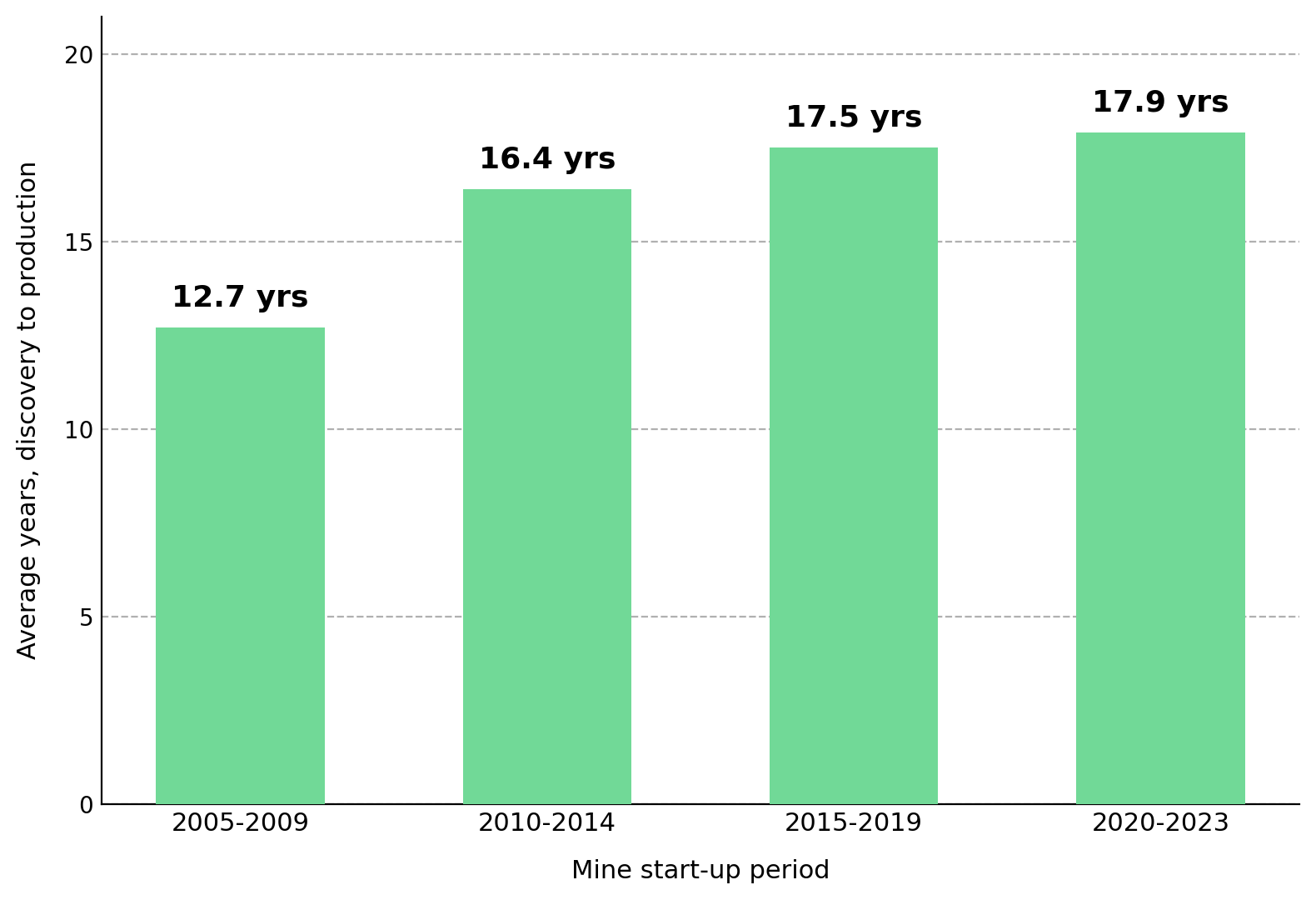
- Average time from mineral discovery to first production increased from 12.7 years in 2005-2009 to 17.9 years in 2020-2023, a 40% increase, according to S&P Global, extending the timeline for new critical mineral supply as defense, electrification, and grid demand compete for the same projects.
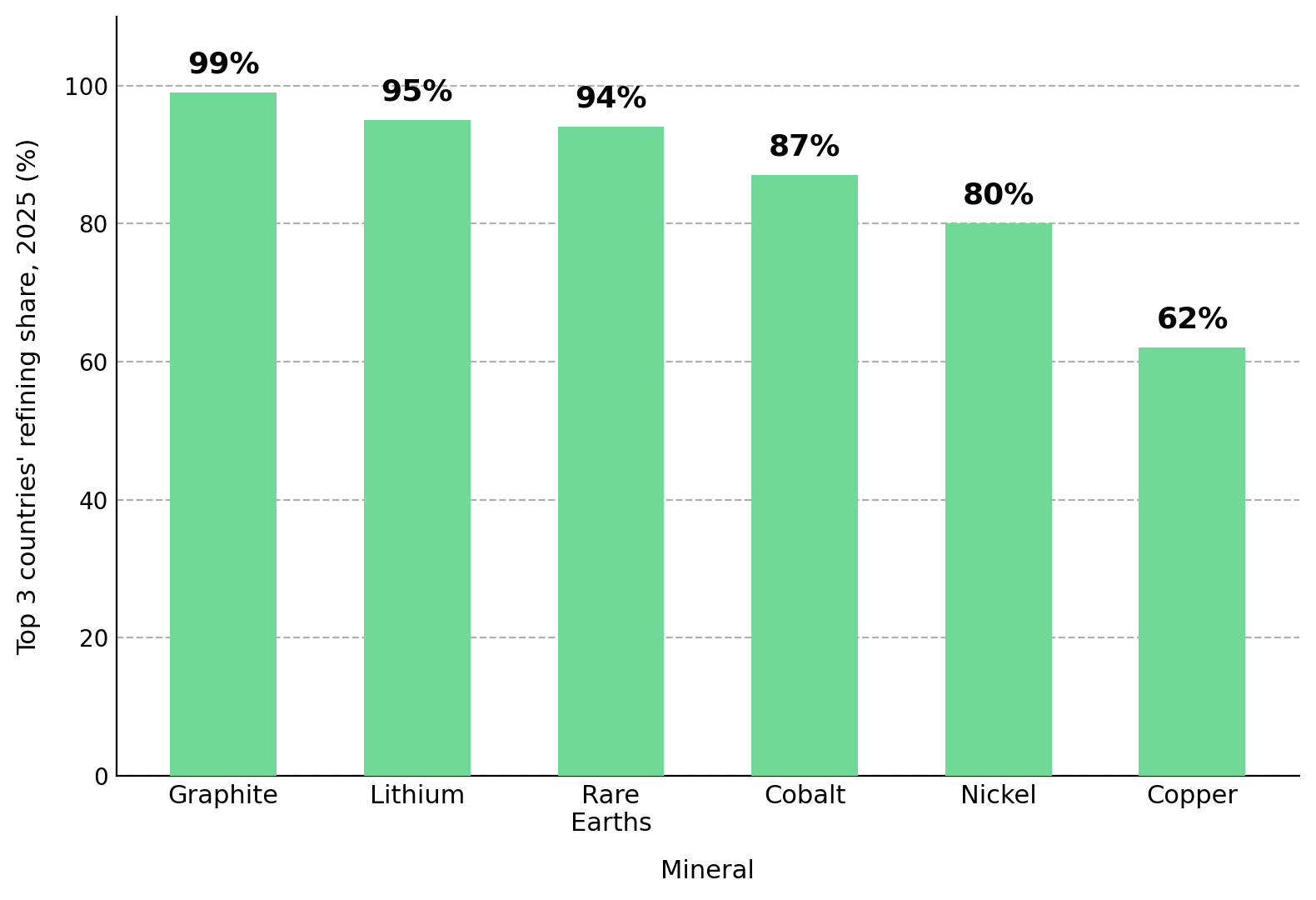
- China accounts for an average 70% of refining across 19 of the 20 strategic minerals and controls 95% of heavy rare earth output, according to the International Energy Agency (IEA). That concentration prompted the July 20, 2026 executive order requiring US defense contractors to eliminate Chinese-sourced critical minerals from national security procurement by January 1, 2027.
- The World Platinum Investment Council (WPIC) forecast a 297,000-ounce platinum deficit for 2026, marking the fourth consecutive annual supply shortfall. Bank of America targets platinum at $3,000 per ounce from Q4 2026 through H1 2027 as tightening supply reduces available above-ground inventories.
- With an average 17.9-year build cycle, new primary mine supply is unlikely to enter production before the 2030s. Additional non-Chinese supply before the January 1, 2027 sourcing deadline is largely limited to projects with a completed definitive feasibility study (DFS), under construction, commissioning, or already in production.
- Projects that have completed feasibility studies, secured key permits, and are located outside China are among the few capable of adding new Western supply before the 2030s. That scarcity could support higher valuations as governments and industry compete for advanced critical mineral assets.
Mine Development Timelines Stretch to 17.9 Years, Increasing the Value of Advanced Critical Mineral Supply
S&P Global shows average mine development time increased in every five-year window: 12.7 years for 2005-2009, 16.4 years for 2010-2014, 17.5 years for 2015-2019, and 17.9 years for 2020-2023. Across the dataset, the 16.3-year average comprises 12.3 years for discovery, exploration, and studies, 1.7 years between feasibility and construction, and 2.3 years from construction to first production. Most of the delay occurs before construction, particularly after feasibility studies. The IEA Global Critical Minerals Outlook 2026 illustrates the consequence: European heavy rare earth prices are around five times Chinese domestic prices, while germanium prices are nearly three times higher because supply outside China's processing base remains limited. Longer permitting, community consultation, and environmental review are extending Western mine development timelines even as governments seek faster critical mineral supply.
The IEA reports prices for several strategic minerals more than doubled between 2024 and early 2026, with tungsten up sixfold and cobalt rising around 130% following Democratic Republic of the Congo export restrictions. Defense stockpile replenishment, data center expansion, and electrification are increasing critical mineral demand faster than new supply can be developed under today's 17.9-year average mine build timeline. Projects that have already completed five to ten years of permitting, drilling, and engineering are among the few capable of adding new non-Chinese supply before the early 2030s.
China's Rare Earth Dominance Forces 2027 Sourcing Deadline, Raising Integrated Processing Capacity Value
China accounts for an average 70% of refining across 19 of the 20 strategic minerals and controls 95% of global heavy rare earth output. On July 20, 2026, the Trump administration signed an executive order requiring US defense contractors to trace every critical mineral to its raw material origin and banning Chinese-sourced materials from national security procurement beginning January 1, 2027. The order follows a sharp drawdown in US missile inventories during the Iran war, with the Center for Strategic and International Studies (CSIS) estimating on July 29, 2026 that fewer than 827 Patriot and fewer than 278 Terminal High Altitude Area Defense (THAAD) interceptors remained in US stockpiles. Every Patriot Advanced Capability-3 Missile Segment Enhancement (PAC-3 MSE), THAAD interceptor, and Tomahawk missile requires samarium-cobalt or neodymium-iron-boron magnets containing dysprosium and terbium, with CSIS estimating replenishment will take four to five years for Tomahawks and three years for Patriot interceptors, supporting multi-year demand for heavy REEs.
Energy Fuels is expanding US heavy REE processing capacity through a brownfield expansion rather than a new build. Construction began on July 29, 2026 at the White Mesa Mill in Utah, allowing heavy REE processing to expand at an already-permitted facility rather than requiring approvals for a new site. The expansion adds commercial-scale heavy REE processing capacity alongside its existing 1,000 tonnes per annum (tpa) of separated neodymium-praseodymium (NdPr) oxide capacity, positioning the company to supply the market ahead of the January 2027 sourcing deadline. The $104 million expansion is backed by a conditional US government loan commitment and approximately $0.96 billion of working capital as of March 31, 2026, reducing reliance on equity financing as defense demand grows.
Mark Chalmers, President and Chief Executive Officer of Energy Fuels, outlines the integrated rare earth processing advantage:
"To compete with China, you have to have all those steps. You can't be missing a step in the middle. We've got the hydromet skills, the heavy mineral sands skills, the mining skills, and the metal alloy skills. That critical mass doesn't happen overnight."
Platinum's Fourth Straight Deficit Widens to 297,000 Ounces, Increasing Demand for New PGM Supply
The WPIC raised its 2026 platinum deficit forecast from 240,000 ounces to 297,000 ounces in its May 18, 2026 Platinum Quarterly, the fourth consecutive annual shortfall. Above-ground stocks are forecast to fall to 1.747 million ounces by year-end 2026, equivalent to less than three months of demand. Bank of America targets platinum at $3,000 per ounce from Q4 2026 through H1 2027, reflecting tightening supply and declining above-ground inventories.

Global Platinum Supply-Demand Balance, 2022-2026F. Source: WPIC; Crux Investor Analysis.
ValOre Metals is advancing the Pedra Branca project in Ceará State, Brazil, one of only a handful of PGM development assets outside Russia and South Africa. Brazil's established mining approval process can shorten early project development compared with jurisdictions where permitting takes years, reducing one of the biggest risks to bringing new PGM supply online. Pedra Branca hosts an NI 43-101 Inferred Resource of 2,198 koz of platinum, palladium, and gold (2PGE+Au) across 63.3 Mt at 1.08 g/t, with a preliminary economic assessment (PEA) targeted for Q4 2026, a key milestone toward advancing the project into development.
Thiago Diniz, Vice President of Exploration at ValOre Metals, highlights the limited global sources of PGM supply:
"ValOre is advancing one of the very few palladium-platinum assets outside Russia and South Africa. Palladium and platinum are produced only in certain regions of the globe, so being able to advance a project outside that small space is an opportunity."
Long Mine Build Timelines Increase the Value of Advanced Critical Mineral Projects
Within a 17.9-year build cycle, a project at DFS stage has typically absorbed ten to fourteen years of permitting, drilling, and engineering. That progress gives advanced-stage projects a significant time advantage over projects still in exploration.
Low-Cost Rutile & Graphite Projects Gain Advantage After DFS Completion
Sovereign Metals completed the DFS for its Kasiya project in Malawi during the June 2026 quarter and submitted a Mining License application in the same period, moving the project from technical studies into the permitting stage required before construction can begin. The DFS outlines a pre-tax NPV8 of $2.2 billion against initial capex of $727 million, with planned annual production of 222,000 tonnes of rutile and 275,000 tonnes of graphite, positioning Kasiya as the world's largest producer of both. An operating cost of $450 per tonne free on board (FOB) Nacala places Kasiya among the industry's lower-cost producers, allowing the project to remain economically attractive even if rutile or graphite prices moderate.
Ben Stoikovich, Chairman of Sovereign Metals, outlines Kasiya's low-cost graphite production advantage globally:
"Our incremental cost to produce a ton of graphite as a byproduct from the Kasiya project is $241 per ton, putting us at the very bottom of the industry cost curve where other projects can't make money in the current market."
Permitted Copper Projects Gain Value as Large Development Assets Remain Scarce
Marimaca Copper has already secured the key environmental approval for its Marimaca Oxide Deposit (MOD) in Chile's Antofagasta region and is now advancing the remaining construction permits, reducing permitting risk before development. The DFS outlines a post-tax NPV8 of $1.1 billion, a 39% IRR, and a 2.2-year payback, reflecting a project that has largely moved into execution. Existing infrastructure near the Port of Mejillones further supports construction.
Hayden Locke, President and Chief Executive Officer of Marimaca Copper, frames today's shortage of viable copper projects:
"There aren't any juniors with significant-scale development assets that can come into production. They're either too small in terms of production, too big to finance, or they're not permitted."
Early-Stage Rare Earth Projects Progress Through Studies Toward Future Supply
Cobra Resources is advancing the Wudinna Heavy Rare Earth project in South Australia, which is Australia's only rare earth project suitable for in-situ recovery (ISR) mining. The company says South Australian regulators are familiar with ISR mining, and the small-scale production study will use the government-backed Australian Nuclear Science and Technology Organisation (ANSTO) pilot facility, reducing both development costs and permitting risk before a construction decision. A maiden Mineral Resource Estimate is expected in the coming weeks, followed by a scoping study, a small-scale production study in H1 2027, and a Bankable Feasibility Study targeted for Q4 2027, providing a pathway to commercial heavy REE production.
Rupert Verco, Chief Executive Officer and Managing Director of Cobra Resources, outlines the project's next development milestones:
"We're working through our resource estimate, and it's not far away. We've got an extensive met program underway to support that resource estimate and enable economic studies, including scoping and PFS-level assessments."
Financing Bottlenecks & Long Development Timelines Are Supporting Critical Mineral Prices
Fastmarkets' July 29, 2026 commentary stated that the West has identified plenty of lithium, copper, nickel, graphite, and rare earth projects but has failed to finance them, a conclusion supported by S&P Global data showing that 1.7 years of the 16.3-year average from discovery to production fall between a completed feasibility study and construction, making financing and permitting, rather than technical work, the primary barriers to development. Government-backed financing is helping advanced critical mineral projects reduce reliance on public equity and move toward construction. Development finance institutions play a similar role outside the US. In Malawi, eligible mining projects can access a World Bank and International Finance Corporation (IFC) collaboration framework that could help secure project financing, reducing reliance on equity financing and helping advanced projects move toward construction.
A 17.9-year build cycle leaves little opportunity for newly discovered projects to supply critical minerals before the 2030s. Governments seeking to meet the January 1, 2027 sourcing deadline must therefore rely on advanced projects already in development rather than new discoveries. Projects that have already secured key permits, completed a DFS, and obtained government-backed financing are among the few with a credible path to production before the 2030s, making them the most likely sources of new non-Chinese supply as governments and industry compete to diversify critical mineral supply chains.
The IEA reports that heavy rare earth prices in Europe are around five times higher than Chinese domestic prices, reflecting the limited availability of supply outside China's processing industry. Bank of America's $3,000 per ounce platinum target and the IEA's reported sixfold increase in tungsten prices show how commodities with long development timelines can remain supported when new supply cannot respond quickly to rising demand.
The Investment Thesis for Critical Minerals
- Producers with existing processing capacity and government-backed financing are well positioned to supply critical minerals ahead of the 2027 defense sourcing deadline while reducing reliance on equity financing.
- Developers with a completed DFS, secured environmental approvals, and operations in stable mining jurisdictions have already advanced ten to fourteen years into the 17.9-year mine development timeline, positioning them among the few capable of supplying the market before the 2030s.
- Explorers advancing rare earth and PGM assets outside the traditional Chinese, Russian, and South African supply base can expand the long-term supply pipeline, but bringing those projects into production will still require years of permitting, technical studies, and financing.
- Projects with predictable permitting, existing infrastructure, and access to government or development finance institution support are better positioned to reach production than projects with larger resources but less certain development pathways.
- Defense procurement, electrification, and grid expansion are competing for the same limited pipeline of advanced critical mineral projects, increasing the importance of assets already progressing through permitting, feasibility, and financing.
- Low-cost projects with strong economics are more likely to attract financing and advance toward production, while higher-cost projects depend more heavily on sustained commodity prices to justify development.
The 40% increase in discovery-to-production timelines has become a major constraint on expanding Western critical mineral supply because new projects cannot be developed quickly enough to meet near-term demand. The more important question is how far a project has advanced through permitting, feasibility, and financing because those factors determine how quickly new supply reaches the market. Projects that have already advanced through permitting, completed feasibility studies, and secured government or development finance institution support are among the few with a credible path to adding new non-Chinese critical mineral supply before the 2030s.
TL;DR
Mine development timelines have increased 40% to an average of 17.9 years, making it unlikely that newly discovered critical mineral projects will reach production before the 2030s. As defense procurement, electrification, and grid expansion accelerate demand, governments are prioritizing advanced projects that have already completed permitting, feasibility studies, or construction. China's dominance in rare earth processing, tightening platinum supply, and financing bottlenecks further strengthen the outlook for advanced non-Chinese projects in rare earths, PGMs, rutile, graphite, and copper that can deliver new supply within this decade.
FAQs (AI-Generated)
Analyst's Notes





Subscribe to Our Channel














.jpg)



Stay Informed



