




Beyond Rutile & Graphite: Kasiya's Emerging Rare Earth Opportunity



Sovereign Metals' Kasiya project adds heavy rare earth potential beyond its US$2.2B DFS, creating possible upside through a low-cost monazite by-product.
- Sovereign Metals' June 2026 quarterly report confirms heavy rare earths, dysprosium, terbium and yttrium across 4 planned pits at Kasiya, including pits scheduled for Year 1 production.
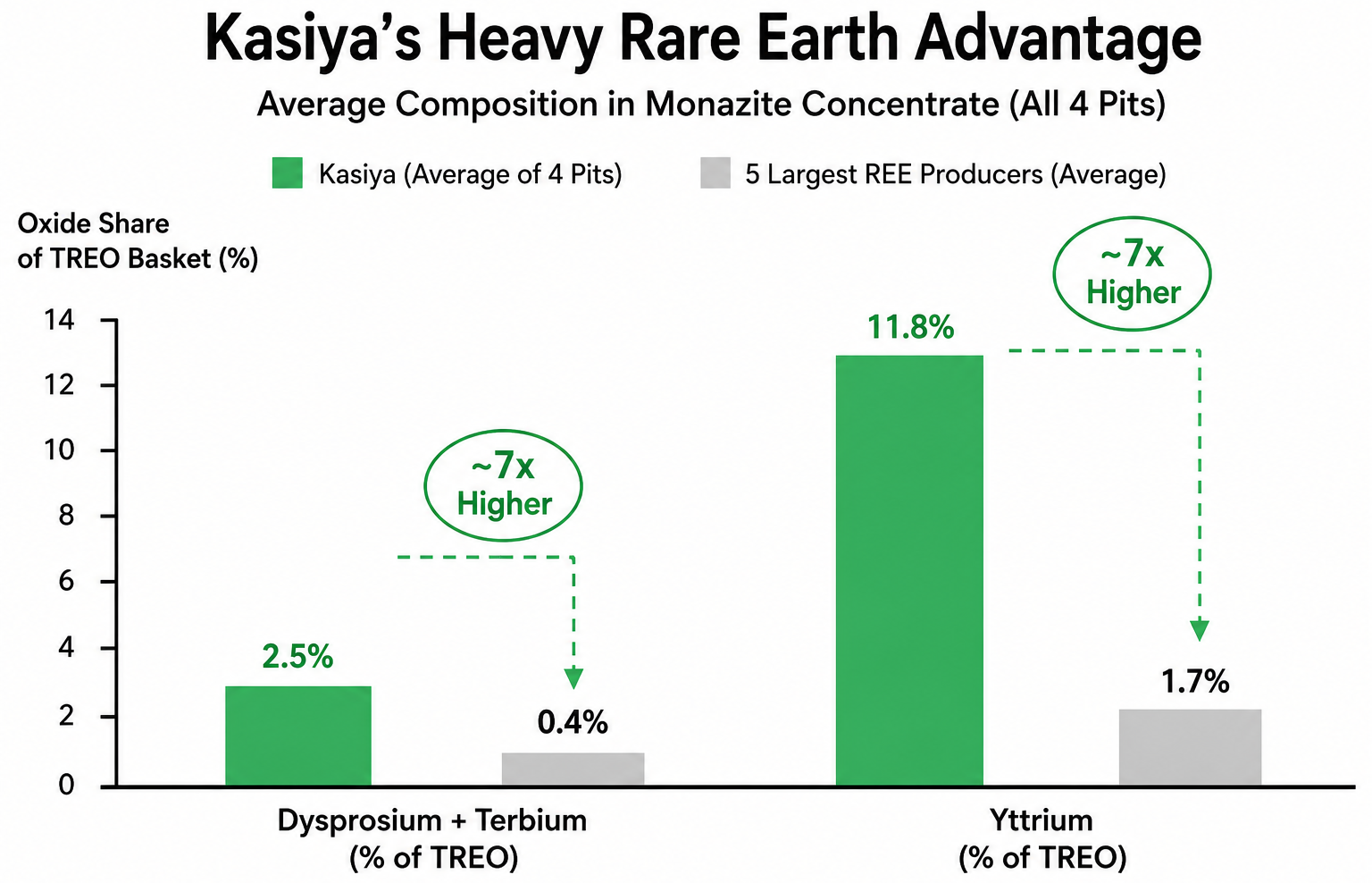
- Dysprosium, terbium, and yttrium oxide ratios within the total rare earth oxide (TREO) basket average approximately 7 times higher than those of the world's five largest rare earth producers.
- The rare earth opportunity sits entirely outside the Definitive Feasibility Study (DFS), which valued Kasiya's rutile and graphite business alone at a pre-tax net present value at an 8% discount rate (NPV8%) of US$2.2 billion.
- Sovereign says the monazite by-product could potentially be recovered from an existing tailings stream at low incremental cost, pending confirmation from a forthcoming technical-economic study.
- Next steps are a dedicated technical-economic study with a maiden rare earth mineral resource estimate (MRE); no offtake or sales agreement for monazite concentrate has yet been signed.
What Has Happened
Sovereign Metals (ASX: SVM | AIM: SVML | OTCQX: SVMLF) has confirmed heavy rare earths across 4 pits already built into Kasiya's mine plan, a disclosure that adds a potential third revenue stream to a project whose US$2.2 billion valuation was set without it. The June 2026 quarterly report, released July 30, 2026, shows monazite concentrate carrying dysprosium, terbium, and yttrium, present in pits scheduled for Year 1 production. Because the Definitive Feasibility Study (DFS) excluded any rare earth contribution, this is upside layered onto an already-approved plan rather than a new project requiring separate justification. Sovereign says a dedicated technical-economic study, including a maiden rare earth mineral resource estimate (MRE), is now underway to quantify it.
What the DFS Already Locked In
The DFS confirmed Kasiya as a 25-year operation processing 536 million tonnes of ore. Annual production is set at 222,000 tonnes of rutile and 275,000 tonnes of graphite once the second processing plant comes online in Year 5. Steady-state annual earnings before interest, taxes, depreciation and amortisation (EBITDA) came in at US$476 million, on total revenue of US$16.2 billion over the initial mine life. Capital expenditure to first production was US$727 million, an NPV-to-capex ratio of 3.0 times.

None of these figures includes any contribution from heavy rare earths. That framing matters: the rare earth disclosure should be read as potential upside to an already costed, already financed plan, not as a standalone development requiring its own capital and processing infrastructure.
The Monazite Numbers, Pit by Pit
Testwork was conducted on monazite concentrate from 4 pits in the DFS mine plan: Babbler, Kingfisher, Sparrow and Mousebird. The results show a consistent pattern rather than an isolated anomaly. Across the 4 pits, the average TREO basket carried 2.5% dysprosium and terbium combined and 11.8% yttrium. That compares with an average of 0.4% dysprosium and terbium combined and 1.7% yttrium across the world's five largest rare earth producers, a ratio roughly 7 times higher.
Grade is not uniform with depth. Near-surface material, from 0 to 6 metres, averaged 2.9% dysprosium and terbium combined and 15.4% yttrium. That is materially richer than the 2.3% dysprosium and terbium combined and 10.3% yttrium average recorded below 6 metres. For a project already sequencing early production through these same pits, that near-surface enrichment is a scheduling detail worth tracking: it determines how early any monazite revenue could realistically begin.
Why Dysprosium, Terbium & Yttrium Carry Strategic Weight
Dysprosium and terbium are used in high-temperature permanent magnets for defence systems, precision weapons, aerospace components and electric drivetrains. Yttrium is used in aerospace thermal barrier coatings, radar and laser systems, and semiconductor manufacturing. On February 24, 2026, the US Assistant Secretary of War for Industrial Base Policy, Michael P. Cadenazzi Jr., testified before the Senate Armed Services Committee that China controls 95% of global heavy rare earth output. The US imports almost 100% of what it consumes, 90% of that from China, a situation he described as a clear and present danger to national security.
Policy has moved in step with that testimony. China imposed export controls on dysprosium, terbium and yttrium in April 2025, then extended controls on dual-use items to Japan in January 2026. MP Materials, the only fully integrated rare earth producer in the US, reports no measurable dysprosium, terbium or yttrium, and the US remains entirely import-dependent for yttrium.
Chief Commercial Officer of Sovereign Metals, Sapan Ghai, framed the discovery in these terms:
“We found these heavy rare earths as a monazite concentrate coming out of the rutile tailings. There's zero domestic supply of that as well in the US.”
By-Product Economics: The Case for Low Incremental Cost
The commercial case rests on where the monazite sits in the flowsheet, not on grade alone. The concentrate reports from the non-conductor tailings stream of the processing circuit already specified in the DFS, material that would otherwise be discarded. Sovereign says recovery could potentially require no additional mining, no new primary processing circuit and no additional reagents beyond what the DFS already accounts for.
Ghai described the potential this way:
“Only recently are we even talking about having chemistry sets to isolate yttrium, dysprosium, terbium. But hey, guess what? The heavy rare earth concentrate that we found in our waste stream has all three of those and has them in more abundance than most people on this planet. And they're coming out with no more capex and hardly any opex.”
This potentially low incremental cost framing is a company estimate, not yet a costed outcome. Further work is required to assess the capital and operating cost implications of any downstream separation or refining, and to characterise the mineralogy, deportment and radioactive element handling requirements of the monazite. The claim will only be tested once the technical-economic study and maiden resource estimate are published; until then, it should be treated as indicative rather than confirmed.
Pricing Context and What Comparable Deals Signal
Independent market intelligence firm Project Blue produced a 2026 base-case price forecast of US$16,000 per tonne, with a high case of US$19,000 per tonne, for a monazite concentrate containing 60% TREO with a distribution similar to Sovereign's testwork. That compares with an April 2026 Shanghai Metals Market benchmark of approximately US$6,142 per tonne for monazite concentrate at 54% to 55% TREO grade, reflecting the premium ex-China buyers are currently paying for non-Chinese supply. Sovereign has not entered into any offtake or sales agreement for monazite concentrate. Realised prices will depend on negotiation, market conditions at the time of sale, and the specifications of any concentrate actually produced.
Two recent transactions show how Western capital is currently pricing this scarcity. On April 20, 2026, Nasdaq-listed USA Rare Earth agreed to acquire Brazil's Serra Verde Group for approximately US$2.8 billion, backed by a 15-year offtake agreement guaranteed 100% by the US Government, with price floors of US$575 per kilogram for dysprosium and US$2,050 per kilogram for terbium. On January 20, 2026, Energy Fuels announced a US$299 million acquisition of ASX-listed Australian Strategic Materials. Both deals point to the same conclusion: capital is being committed to secure non-Chinese heavy rare earth supply at valuations well above where similar assets traded 18 months ago. Kasiya's monazite is now being tested against that same benchmark.
What to Watch Next
There are 3 milestones that will determine whether this opportunity converts into disclosed value. The technical-economic study, including Sovereign's first rare earth MRE, is the point at which grade and tonnage claims move from testwork to a reportable resource, and where the low incremental cost claim gets its first real test. Progress on rutile and graphite offtake discussions with Mitsui and Traxys, from non-binding arrangements toward binding agreements, would de-risk the base-case DFS economics independently of any rare earth contribution. The pending mining licence application with Malawi's Mining and Minerals Regulatory Authority, alongside continued engagement with the International Finance Corporation on project financing, remains the gating item for the underlying project.
None of these has yet been finalised. The rare earth opportunity remains at an early evaluation stage relative to the DFS-stage rutile and graphite business, and the gap between a favourable grade comparison and a costed, contracted revenue stream is where the next disclosures will need to close.
FAQs (AI-Generated)
Analyst's Notes





Subscribe to Our Channel







Stay Informed


