




1911 Gold Targets 2027 Restart of Fully Permitted True North Mine in Manitoba


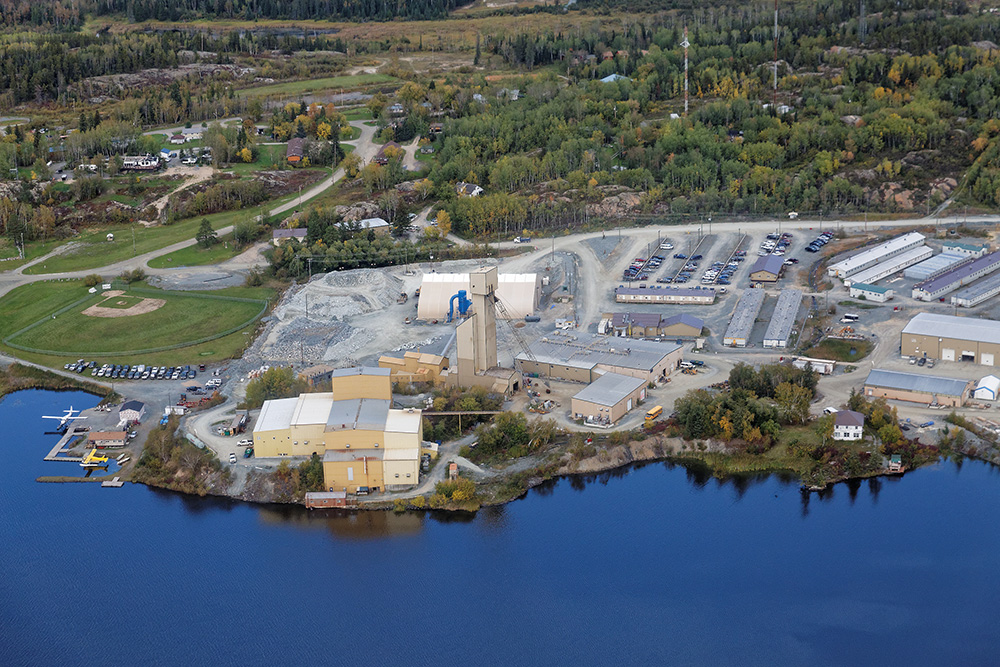
1911 Gold's CEO on True North's high-grade restart, PEA economics, Auramet financing and district-scale growth across Manitoba's Rice Lake belt.
- 1911 Gold is targeting a return to production at its fully permitted True North mine in Manitoba, with test mining underway across two zones and a formal production decision anticipated in 2027.
- The 2026 Preliminary Economic Assessment models an after-tax NPV5% of $391 million and an IRR of 105% at a base case gold price of $3,000 per ounce, with all-in sustaining costs of $1,897 per ounce.
- A $30 million credit facility with Auramet International is funding the remaining mill and underground development spend, though management is now working to refinance the debt ahead of its April 2027 amortisation start.
- Resource expansion drilling has confirmed a high-grade link between zones, feeding a global mineral resource update expected in the fourth quarter of 2026 alongside the newly estimated Ogama-Rockland deposit.
- Management is pursuing organic growth toward a 100,000 ounce annual run rate by linking True North's four underground mines to a single shaft and mill, rather than acquiring additional production.
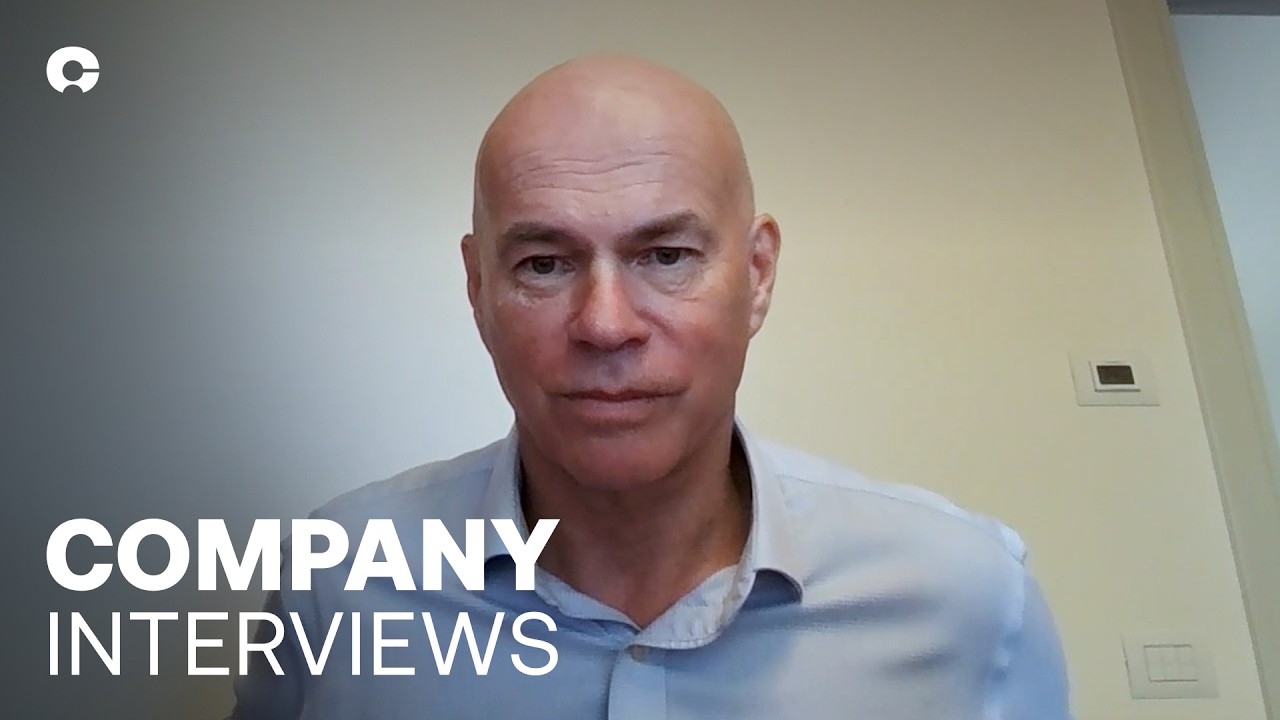
Gold trading near multi-year highs has revived interest in past-producing underground mines that can restart with limited new capital. Manitoba-based 1911 Gold Corporation (TSXV:AUMB) controls one of the more advanced examples, the fully permitted True North Gold Project, a former producer sitting on existing mill and shaft infrastructure in the Rice Lake Greenstone Belt. President and CEO Shaun Heinrichs sat down to explain why a smaller, high-grade underground restart can still be profitable in the current gold price environment, and what the company has changed since a difficult operating history under previous owners.
A Restart Built On A Rebuilt Resource
Heinrichs took over as CEO in mid-2022 with a financial rather than technical background, and his first move was to test whether the roughly one million ounce historical resource actually stood up to scrutiny. He brought in advisor Gary O'Connor, now Executive Chairman, and built a new geology team led by Vice President of Exploration Michele Della Libera, who spent more than 30 years at New Gold drilling out mines including Blackwater, New Afton and Rainy River. Lions Gate Geological Consulting rebuilt the resource independently arriving at the company's own estimate before any mine planning began.
The 2024 Mineral Resource Estimate stands at 499,000 ounces indicated (3.5 million tonnes at 4.41 g/t Au) and 644,000 ounces inferred (5.5 million tonnes at 3.65 g/t Au), and it underpins the Preliminary Economic Assessment 1911 Gold published earlier this year.
Interview with Shaun Heinrichs, President and CEO of 1911 Gold
Learning From True North's Difficult History
True North has produced roughly 2 million ounces since the 1930s but last ran, briefly before shutting down again in 2015. Heinrichs was candid about why: previous operator (Klondex) used oversized equipment inherited from the project's history, running roughly 25% dilution, while an earlier operator mined without sufficient delineation drilling and diluted some veins by 80-100%, turning a 6 g/t resource into 1-2 g/t delivered to the mill.
The company has recruited technical leadership including COO Éric Vinet, who previously worked at Sigma Lamaque specifically to avoid repeating those mistakes. Chief Engineer Seok Joon Kim's team has grown from one person to four engineers since joining just over a year ago.
Test Mining & The Path To Steady-State Production
Rather than restart at scale immediately, 1911 Gold is running what it calls test mining: smaller equipment (2.5 yard scoops rather than 5 yard scoops), narrower development (4 to 4.5 metre ramps rather than 8 metres) and a target dilution rate of 15%, matching the 2026 PEA's own guidance. Two mine crews are currently developing into the Level 16 shaft mine and the Hinge ramp mine, with production from those two zones expected to contribute around 20,000 ounces in 2027.
"To get from San Gold to Klondex, it's discipline, it's drilling, it's carefully stepping into these zones. And then to get from Klondex to 1911, it's equipment, it's technique, and it's the methodology that we're going to be using in the underground and the leadership in there."
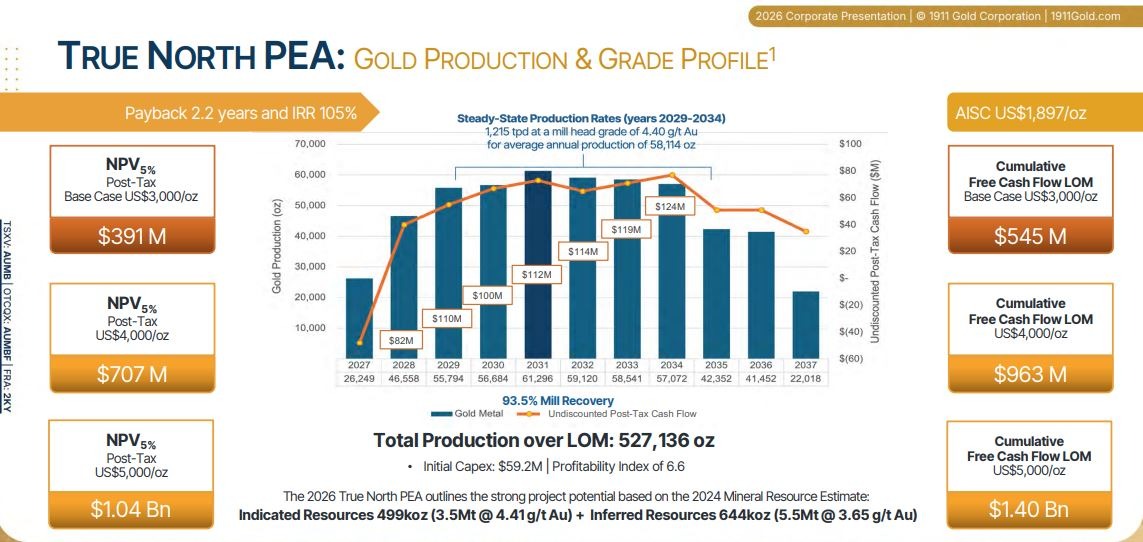
The PEA outlines a steady ramp: roughly 26,000 ounces in the first partial year, rising to around 46,000 ounces in 2028 and reaching a steady-state run rate of approximately 58,000 ounces annually from 2029, once a third and fourth zones are brought online through the existing shaft and underground rail system. At that steady state, the mill is modelled to process 1,215 tonnes per day at a 4.40 g/t Au head grade with 93.5% recovery, for all-in sustaining costs of $1,897 per ounce. Initial metallurgical testwork returned 93.4% recovery on a low-grade 1.4 g/t sample from the Hinge zone and 96.3% on a higher-grade Ogama-Rockland sample, confirming the value of the regrind circuit reinstated during the mill refurbishment.
Funding The Final Stretch To Startup
The company drew the first $15 million tranche of a $30 million Auramet International credit facility in March 2026, with a second $15 million tranche now extended to be available through to December 2026. The facility carries a 12% per annum interest rate, with arrangement and drawdown fees paid partly in shares and warrants; no interest accrued on the first tranche for its initial six months. Heinrichs said the roughly $15-20 million of remaining mill spend, largely the final payment on a new crushing circuit due for delivery through October 2026, is funded from cash on hand and the facility already in place, without needing to draw the second tranche immediately.
The bigger near-term task is refinancing: the first tranche begins amortising in April 2027, just as the mine is ramping up production, and management is exploring options to extend that repayment schedule rather than face it during startup. A resource update due in October 2026 is expected to add a new zone, Sam Southeast, close enough to existing workings that the company is weighing whether to accelerate its development, which would require additional funding beyond what is currently in place.
District-Scale Growth Beyond True North
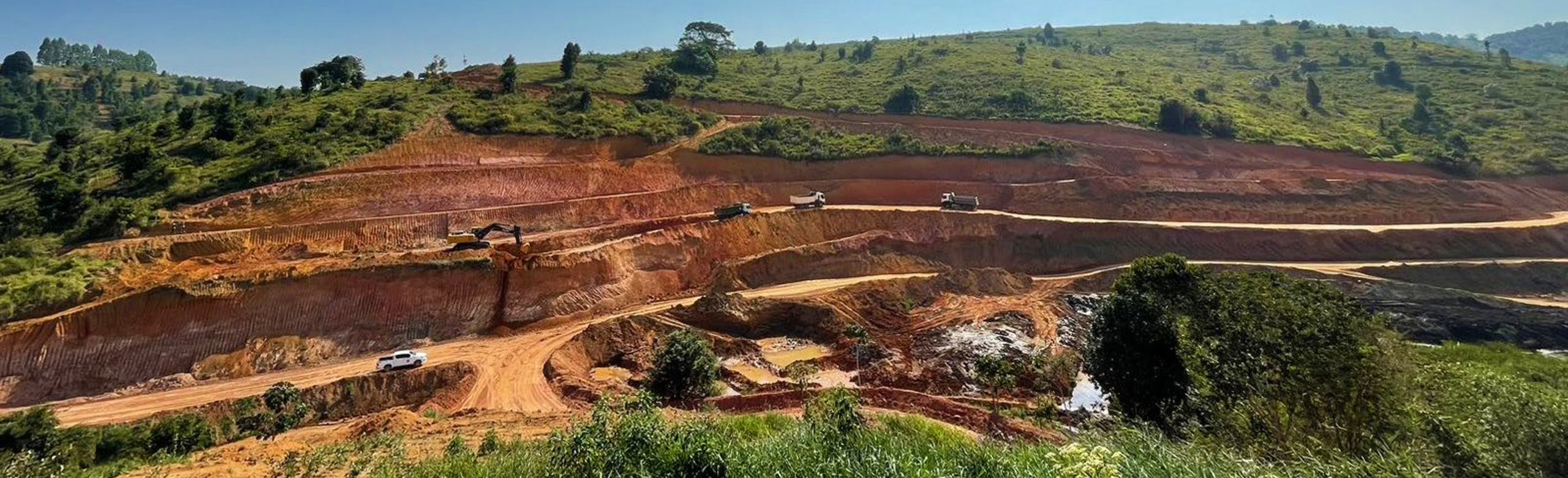
1911 Gold controls the entire Rice Lake Greenstone Belt land package, over 61,000 hectares along a 90 km gold belt that has historically produced around 2.0 million ounces from True North alone, alongside smaller past producers including Ogama-Rockland, Central Manitoba and Gunnar. The company reported assay results confirming a high-grade link between the L10 zone and the larger, deeper 710-711 zone, including 10.73 g/t Au over 8.90 metres and 50.61 g/t Au over 1.60 metres, with results outside the current 2024 resource.
The company's 2026 inferred resource update for Ogama-Rockland, 45 km from True North by provincial road, now stands at 712,000 ounces at 6.68 g/t Au. Both feed into a global mineral resource update expected in the fourth quarter of 2026, alongside surface exploration on new targets including Shore, SAM Southeast, SAM West and a newly named Baker target. Because the existing mill can be expanded and the underground infrastructure already connects several of the historical mines, management's stated aim is to grow production toward 100,000 ounces a year on the same footprint rather than acquire a second, smaller producer that would itself need development capital.
Investment Thesis for 1911 Gold
- True North is fully permitted with existing mill, shaft and camp infrastructure, reducing the capital intensity of a restart relative to a greenfield project.
- The 2026 PEA models a 2.2 year payback and 105% IRR at $3,000 per ounce gold, with meaningfully higher NPV at spot prices near $4,800 per ounce.
- Test mining is targeting 15% dilution, materially below the roughly 25% experienced under the previous operator, and management has changed equipment and technique specifically to address that gap.
- A formal production decision has not yet been made and is targeted for 2027, pending the outcome of 2026 trial mining and bulk sample processing - monitor progress on the crushing circuit delivery through October 2026 as a near-term proof point.
- The Auramet credit facility's first tranche begins amortising in April 2027; watch for a refinancing announcement given management's stated intent to defer that repayment schedule.
- The Q4 2026 global resource update, combining True North's L10/710-711 complex link and Ogama-Rockland's 712,000 ounce inferred resource, is a concrete near-term catalyst for the district-scale growth story.
- Regional exploration, SAM West, SAM Southeast, Shore and the new Baker target, offers organic ounce growth without additional acquisition risk, supporting management's stated path to a 100,000 ounce per year operation.
Macro Thematic Analysis
The broader thesis behind True North sits inside a wider pattern across the Red Lake-Rice Lake gold camp: high-grade, narrow-vein underground mines that struggled during the previous gold cycle are being re-examined now that gold trades at levels that better reward the higher per-ounce costs those operations typically carry. Heinrichs pointed to comparable restarts along the same greenstone belt as case studies in both the opportunity and the difficulty of bringing a past-producing narrow-vein mine back into operation. What distinguishes True North, in management's own framing, is the scale of the surrounding land position: 1911 Gold holds the entire Rice Lake Greenstone Belt, an under-explored extension of the more heavily drilled Red Lake belt to the east, where more than 200 million ounces have historically been produced across the wider Superior Province.
"I see this as a starter mine, a starter operation of significance, that was not treated very well in the last cycle because of circumstances that hit the operator towards the last part of it. So I see massive opportunity for the mine itself. I see we can mine this, we can mine this profitably. We have the right team in place to do it."
That framing matters for how investors should size the opportunity. A single 50,000 to 60,000 ounce underground restart, on its own, carries meaningful operating leverage to the gold price but fairly capped upside relative to its market value. What 1911 Gold is proposing is different: using one centrally located, expandable mill as the hub for multiple past-producing mines across a 90 km belt, funding regional exploration from restart cash flow rather than repeated equity raises. If execution matches that plan, the addressable resource base - and the multiple the market assigns to it - looks less like a single small mine and more like a district-scale platform still in its early innings.
TL;DR
1911 Gold's CEO Shaun Heinrichs expounds the fully permitted True North mine in Manitoba is now test mining two zones ahead of a targeted 2027 production decision. The 2026 PEA models a $391 million post-tax NPV and 105% IRR at $3,000 per ounce gold, with all-in sustaining costs of $1,897per ounce once production reaches a roughly 58,000 ounce annual run rate by 2029. A $30 million Auramet International credit facility is funding the remaining mill spend, though management is now working to refinance ahead of an April 2027 amortisation start. A Q4 2026 global resource update, combining new True North discoveries with the 712,000 ounce Ogama-Rockland deposit, is the next major catalyst.
FAQs (AI Generated)
Analyst's Notes





Subscribe to Our Channel





Stay Informed






















