




50% US Aluminum Tariff Risks Backfiring as Canada Turns to Europe


Canadian aluminum heads to Europe as US buyers pay record premiums and new US smelters stall, giving the edge to low-cost hydro smelters free to sell anywhere.
- Canadian aluminum shipments to Europe rose 77% year on year through August, as the 50% US tariff pushed US prices to a record premium over global benchmarks, The Wall Street Journal reported.
- Cheap Quebec hydropower keeps Canadian metal competitive, so the tariff changes where it sells rather than where aluminum is made, and EU carbon taxes add pull toward Europe.
- Smelters relying on regional premiums face two outcomes: diverted metal keeps European premiums falling, or a fresh Gulf outage tightens supply again.
- The tariff is set by presidential proclamation and cannot be timed, which leaves position size as the variable a retail holder controls.
- A restored Canadian exemption would send metal back to the US and cut the premium US buyers now pay.
US Tariff Drives a Record Aluminum Premium as Global Prices Fall
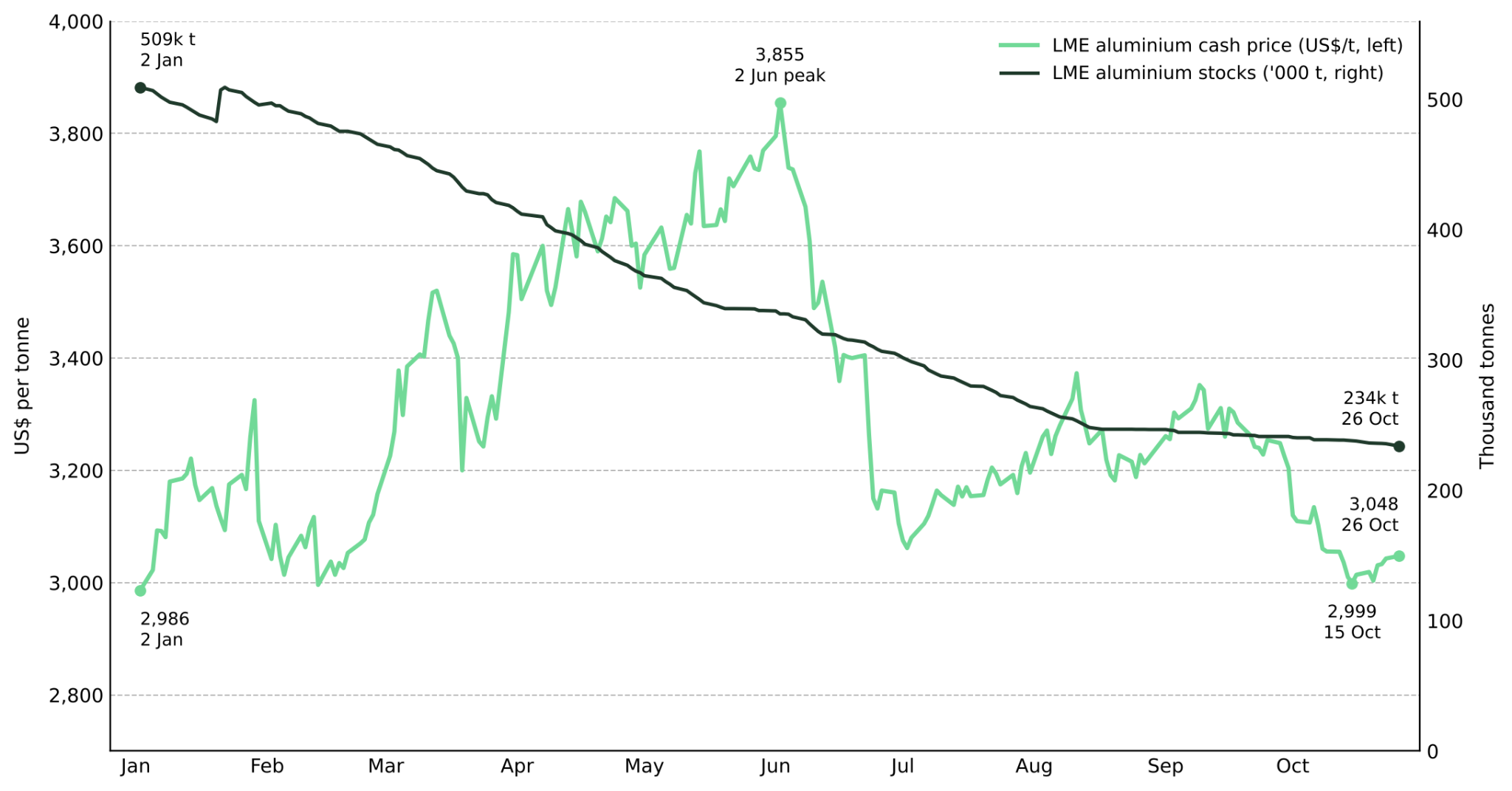
Canadian aluminum shipments to Europe rose 77% year on year through August, as the 50% US tariff pushed US prices to a record premium over global benchmarks, per the Wall Street Journal (WSJ). The global benchmark fell instead, to $3,043.65 per tonne on 26 October, down 6.4% in a month, per Trading Economics.
The split matters because the US has no domestic substitute for Canadian supply. Canada supplied about 70% of US aluminum imports in recent years, and the US produces less than 20% of the primary aluminum it uses. Each tonne sent to Europe leaves US buyers bidding harder for the rest; Ford has forecast up to $2 billion in higher commodity costs for 2026.
Cheap Hydropower and EU Carbon Rules Pull Canadian Metal Toward Europe
Electricity makes up about 40% of the cost of producing aluminum, per WSJ. Rio Tinto generates more than 90% of the power its Saguenay smelters in Quebec use from its own hydro stations, while only four US smelters still run, against 24 in 2000. The tariff leaves the Canadian cost edge intact and changes only where the metal sells. On a tonne valued near the $3,044 benchmark, a 50% duty adds roughly $1,500 at the US border, a Crux Investor calculation, giving any smelter with access to Europe a strong reason to ship there. Exchange stocks offer little cushion for buyers short of metal: LME aluminum inventories fell 54% this year, to 234,050 tonnes on 26 October from 509,250 tonnes on 2 January, according to LME.
The redirection is set to deepen. Karen Norton, associate director at S&P Global Energy, told WSJ that EU carbon taxes may steer more Canadian metal to European buyers seeking low-carbon supply. Canada is building trade ties with Europe, and the EU’s top official has pledged to make Canada the bloc’s first associate member, drawing threats of further US tariffs on Europe.
Stalled US Smelter Projects Leave the Tariff Without a Supply Response
The tariff was meant to rebuild US smelting; new capacity sits years away. A planned $4 billion-plus smelter in Inola, Oklahoma, from Emirates Global Aluminum and Century Aluminum faces a permit freeze and a landowner lawsuit. Jérôme Pécresse, who runs Rio Tinto’s aluminum, lithium and Canadian businesses, told WSJ no US power source comes close to Canada’s on cost.
Two outcomes follow for smelters whose margins rest on regional premiums. Diverted Canadian metal joins returning Middle East volumes in Europe. Goldman Sachs cut Norsk Hydro to neutral from buy on 26 October on falling premiums, and Hydro guided its fourth-quarter realized premium to $550 to $600 per tonne, from $673. The other is a fresh Gulf outage, the main upside risk Goldman named.
Hydro's 2027 outlook at its November capital markets day signals which is running, over a horizon to the first quarter of 2027, when Emirates Global Aluminum is targeting a full Al Taweelah restart. The reversal trigger is a restored Canadian tariff exemption by White House proclamation, sending Canadian metal back south and cutting the US premium.
US Manufacturers Foot Aluminum Tariff Bill as Protected Smelters Carry Hidden Risk
US manufacturers are paying the bill first. Applied Materials, Allison Transmission and Ball have told shareholders they are passing higher aluminum costs on to customers, WSJ reported. Passing costs on protects profit only for as long as customers keep paying.
For smelters, the question is whether a plant can choose where to sell or depends on the tariff to stay open. Century Aluminum’s Goose Creek plant in South Carolina, the last smelter built in the US, was at risk of closing before the tariff, and is now back at full production. A plant whose profits rest on the tariff has the most to lose when it goes. A Canadian smelter running on its own hydropower can sell to the US or Europe, whichever pays more.
Shareholders in US smelters face a sharp drop if Canada wins back its exemption. The White House would grant it by proclamation, and no one outside it can predict when. Retail holders cannot control the timing, but they can control how much they own. Shareholders in producers selling into Europe face lower premiums for as long as diverted Canadian metal keeps arriving.
Smelters Able to Sell Anywhere Hold Their Edge Beyond the Tariff
The 50% tariff has not brought new smelters to the US. Expensive power and local opposition keep new American capacity years away. The tariff has changed where Canadian aluminum goes and who collects the premium.
Value has shifted to low-cost hydropower smelters that can pick their buyer, while US manufacturers carry the bill and producers selling into Europe give up the premium. Regional premiums now belong in a smelter valuation as a policy-set line.
Lower premiums have reduced the value of producers whose cheap power and low-carbon metal keep their worth through any trade truce, and a US market short of aluminum still needs new supply backed by reliable power.
Analyst's Notes





Subscribe to Our Channel


Stay Informed


