




Hormuz at 54% of Prewar Flows Inflates Brent, Capping WTI Downside



Middle East crude exports exceed prewar levels despite shipping disruptions, while the $83.74 Brent forecast for 2027 tests oil producer valuations.
- Brent futures for December delivery rose 0.9% to $116.85 a barrel, while West Texas Intermediate (WTI) gained 0.9% to $102.73 on October 27, 2026.
- Hormuz oil flows ran at 9.34 million barrels per day, about 54% of the 17.15 million prewar baseline, while non-Iranian Middle East crude exports averaged 16.7 million so far in October against 16.3 million prewar.
- The $14.12 benchmark gap runs $6.43 wider than the $7.69 implied by the US Energy Information Administration (EIA) fourth-quarter base case published October 6, 2026.
- With no date or terms agreed for the talks, Brent’s $12.16 premium over the EIA base case could reverse in a single session.
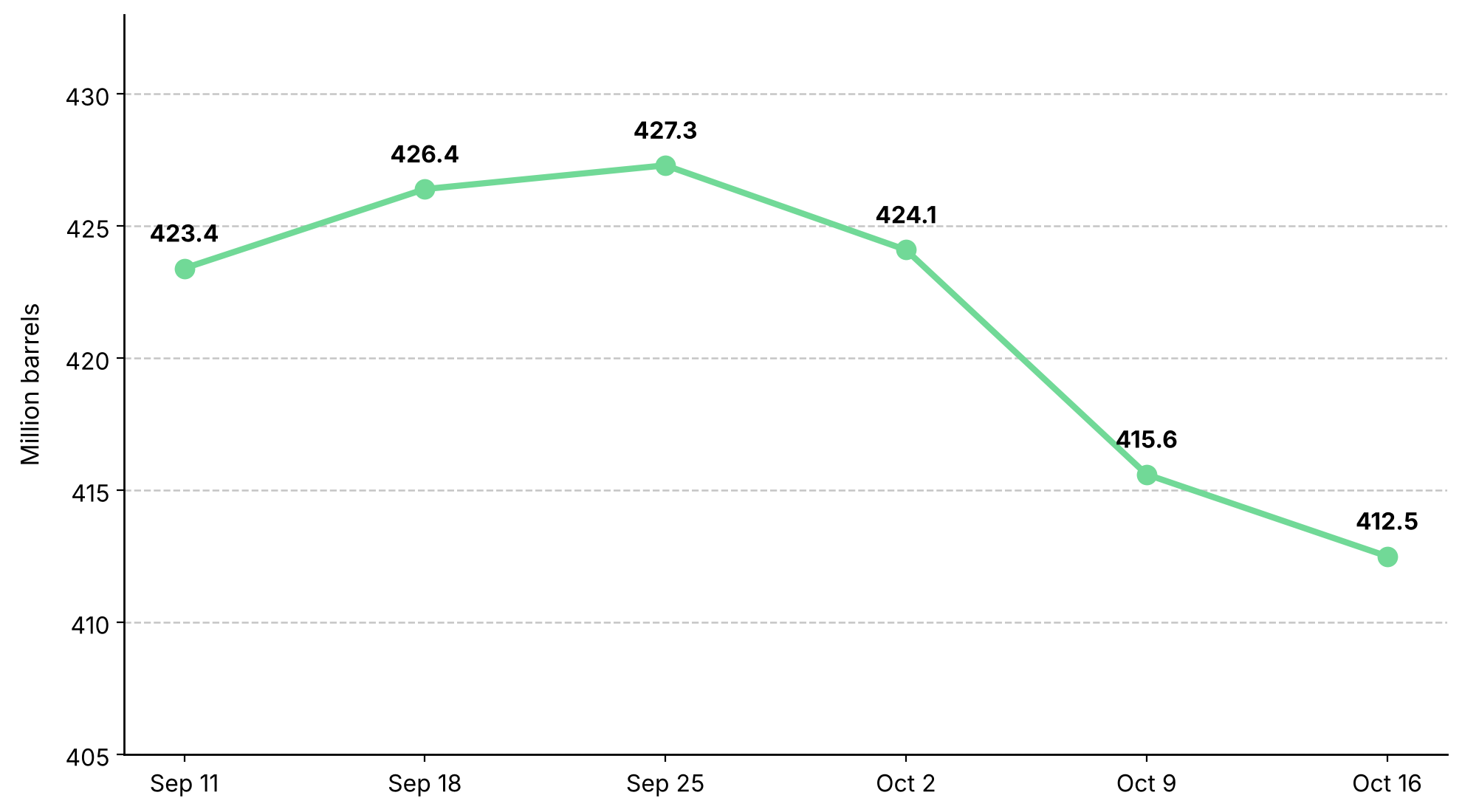
- A rise in US commercial crude inventories from 412.5 million barrels on October 16, 2026 to 424.1 million could weaken WTI prices.
Tehran Talks Help Brent Recover to Nearly $117
Brent crude futures for December delivery rose 0.9% to $116.85 a barrel, while WTI gained 0.9% to $102.73, recovering from an earlier 1% decline. The rebound followed talks in Tehran among Saudi Arabian, Turkish, Pakistani, and Iranian officials, who agreed to continue discussions without setting terms.
Brent traded $12.16 above the EIA's $104.69 fourth-quarter base case, partly reflecting concerns over war-related supply disruptions. Meanwhile, US commercial crude inventories stood at 412.5 million barrels, 3% below the five-year average, supporting WTI prices independently of the Hormuz risk premium.
Bypass Routes Sustain Crude Exports
Oil flows through the Strait of Hormuz averaged 9.34 million barrels per day over seven days, or 54% of the 17.15 million prewar level. Despite reduced Hormuz traffic, non-Iranian Middle East crude exports averaged 16.7 million barrels per day in October, up from 16.3 million before the war.
International Energy Agency (IEA) reported East-West pipeline bypass exports of 5.6 million barrels per day in September, helping sustain crude shipments as Hormuz flows recovered to 10.9 million barrels per day. Despite September pipeline attacks and renewed Houthi strikes on Saudi Arabia, October crude exports remained above prewar levels.
Gasoil Restocking Delays Support Fuel Prices Into 2027
Diplomatic progress could reduce Brent's war premium, but depleted fuel inventories may limit price declines. IEA reported OECD gasoil stocks at 565 million barrels in July, their lowest since November 2023, and global on-land oil inventories near their lowest since at least 2016. Gasoil restocking beyond seasonal changes is unlikely before the second half of 2027, potentially supporting fuel prices even after a settlement.
Sugandha Sachdeva, Founder of SS WealthStreet, attributed earlier oil profit-taking to hopes of progress in US-Iran talks but said geopolitical uncertainty continued to support elevated prices. Saxo Bank analysts also identified elections in the US and Israel as additional sources of uncertainty, potentially prolonging Brent's geopolitical premium.
US Crude Inventories 3% Below Average Limit WTI Downside
US refinery utilization reached 93.4%, while distillate inventories stood 9% below the five-year average, limiting capacity to rebuild fuel stocks. The $14.12 Brent-WTI spread favors refiners buying WTI-priced crude over those paying Brent-linked prices, assuming comparable refining costs and product revenues.
Benchmark exposure determines how much of Brent's war premium producers capture. With WTI near $103 a barrel against Brent near $117, WTI-priced North American producers face less direct downside from a settlement that reduces the Hormuz risk premium.
Saudi Arabia, Turkey, Pakistan, and Iran agreed to continue talks without setting a date, while October crude exports remained above prewar levels. Brent's $12.16 premium over the EIA's fourth-quarter base case remains vulnerable to a reversal if negotiations succeed. Limiting exposure to that premium could reduce losses if prices decline following a settlement.
How Does $84 Brent Affect Valuations
Brent's $14.12 premium over WTI partly reflects Hormuz disruption risks, while US crude inventories 3% below the five-year average support WTI. A settlement could narrow that gap without eliminating WTI's inventory-based price support.
WTI-priced North American producers offer oil revenue exposure less dependent on Brent's Hormuz premium. The EIA's $83.74 Brent forecast for 2027 provides a lower-price scenario for assessing their valuations after accounting for the Brent-WTI spread.
WTI-priced North American producers could offer a contrarian opportunity where valuations remain attractive under lower oil-price assumptions, without relying on Brent's war premium.
Analyst's Notes





Subscribe to Our Channel








Stay Informed


