7 of 8 Sullivan Holes End in Gold-Copper Ahead of P2 Gold's Gabbs Resource Update


P2 Gold's 8 new Sullivan holes extended the zone southwest and hit its new hangingwall unit, with 7 of the 8 ending in mineralization.
- P2 Gold reported results from 8 reverse circulation (RC) holes drilled on the down-dip extension of the Sullivan Zone at its Gabbs gold-copper project in Nevada.
- One hole returned 0.28 grams per tonne (g/t) gold and 0.20% copper over 59.44 meters (m), including 13.72 m at 0.78 g/t gold and 0.39% copper.
- Another hole ended in 13.72 m grading 0.99 g/t gold and 0.15% copper, the highest grades in the hole.
- The hangingwall unit has now been intersected by 5 holes and appears to be in an area modeled as waste in the 2025 preliminary economic assessment (PEA).
- An updated mineral resource estimate (MRE) for Gabbs is targeted for later this quarter and will form the basis of a feasibility study (FS) expected in the first quarter of 2027.
Company Overview
P2 Gold (TSXV: PGLD | OTCQB: PGLDF) is a mineral exploration and development company focused on its gold-copper Gabbs Project on the Walker Lane Trend in Nevada, where work to support a feasibility study (FS) is underway. A positive preliminary economic assessment (PEA) outlined a long-life, mid-size mine at Gabbs. It would produce an annual average of 109,000 ounces (oz) of gold and 33 million pounds of copper, processing 9 million tonnes per year over a 14.2-year mine life. The project has access via paved Highway 361, with power and water on site.
Sullivan Zone Extended Southwest
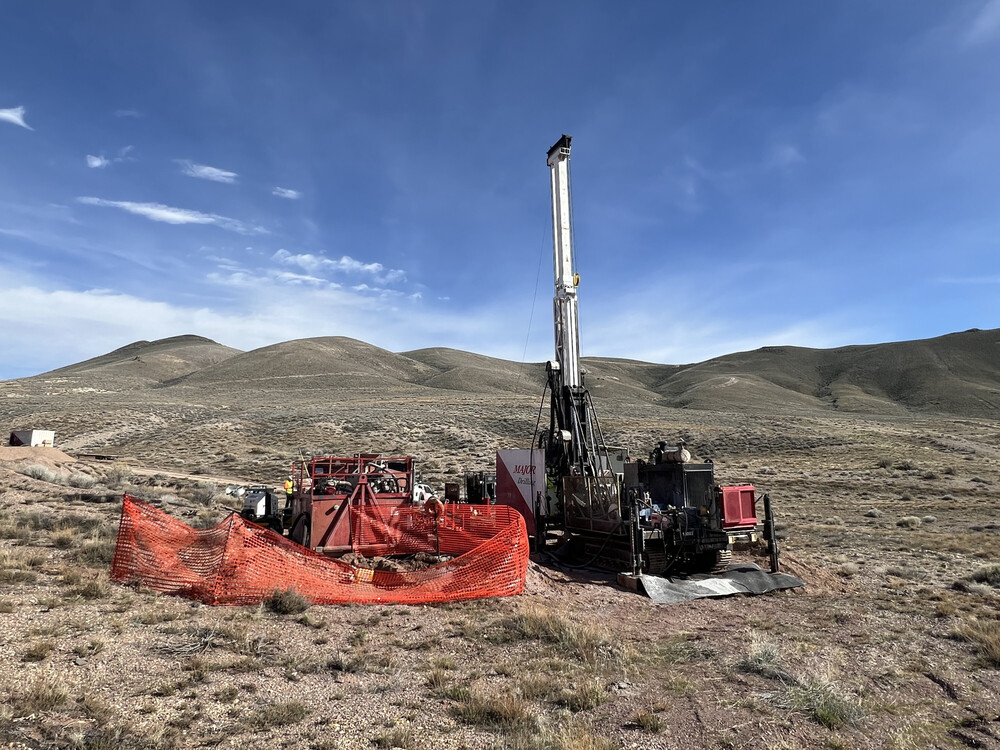
P2 Gold reported results from 8 reverse circulation (RC) holes drilled on the down-dip extension of the Sullivan Zone as part of the infill and expansion drill program at Gabbs. The drilling confirmed the extension of the Sullivan Zone to the southwest and intersected the new unit of hangingwall gold-copper mineralization first found in 2 holes reported on October 14, 2026.
Six holes were drilled from 2 pads 50 meters (m) apart, and 2 more from a pad 350 m to the northwest, all testing the gold-copper mineralization down-dip. Seven of the 8 holes ended in mineralization. The Sullivan Zone remains open at depth and appears to be thickening to the southwest.
Drill Results
One hole drilled from the northwestern pad returned 0.28 grams per tonne (g/t) gold and 0.20% copper over 59.44 m from 99.06 m downhole. That interval includes 13.72 m grading 0.78 g/t gold and 0.39% copper from 111.25 m, and the hole ended in mineralization. A second hole from the same pad returned 0.27 g/t gold and 0.25% copper over 82.30 m from 146.30 m.
Among the holes from the 2 pads 50 m apart, one returned 0.16 g/t gold and 0.23% copper over 44.20 m from 176.78 m downhole. Deeper, it cut 13.72 m grading 0.99 g/t gold and 0.15% copper from 300.23 m and ended in mineralization, with the highest grades at the bottom of the hole. Another hole from the same pad returned 0.26 g/t gold and 0.27% copper over 80.77 m from 222.50 m, including 19.81 m at 0.40 g/t gold and 0.47% copper.
The longest interval came from a third hole on that pad, at 0.15 g/t gold and 0.18% copper over 173.74 m from 144.78 m downhole. On the neighboring pad, 1 hole returned 0.30 g/t gold and 0.16% copper over 80.77 m of footwall mineralization from 140.21 m. True thickness of all intervals is still to be determined.
Hangingwall Unit
The newly identified hangingwall unit has now been intersected by 5 holes. It is interpreted as a tabular, or flat and sheet-like, body of gold-copper mineralization hosted in gabbro, a dark igneous rock, with thin interbeds of pyroxenite, a related rock type.
The hangingwall mineralization appears to be in an area modeled as waste in the Gabbs 2025 PEA. It therefore has the potential to reduce the strip ratio for the Sullivan Zone. The strip ratio is the amount of waste rock moved for each tonne of ore, and a lower ratio could add to the economics of the FS currently underway.
Sampling & Assays
All samples were prepared and analyzed by ALS Global at its facilities in Reno, Nevada, with analysis also completed in North Vancouver, British Columbia. Gold was measured by fire assay, and samples over 10 parts per million gold were fire assayed with a gravimetric finish. One in 20 samples was a blank, 1 in 20 a standard sample, and 1 in 20 a field duplicate cut from assay rejects.
Updated Resource & Feasibility Study
An updated mineral resource estimate (MRE) for Gabbs is targeted for completion later this quarter, based on drilling completed to October 31, 2026. At Car Body, that drilling totals 6 diamond holes for 780 m. At Sullivan, it totals 14 diamond holes for 2,023 m and 43 RC holes for 9,359 m, and at Lucky Strike, 19 diamond holes for 3,283 m and 72 RC holes for 13,612 m.
The updated MRE will form the basis of an FS on placing Gabbs in production, expected to be completed in the first quarter of 2027. The FS is advancing on a nominal production rate of 12 to 14 million tonnes per year. It targets average annual production of 150,000 oz of gold and 45 to 50 million pounds of copper.
Next Steps
Key next steps for the Gabbs project include completing the updated mineral resource estimate targeted for later this quarter, which will serve as the foundation for the feasibility study on placing Gabbs in production, expected in the first quarter of 2027. Additionally, P2 Gold plans to continue infill and expansion drilling, as all target zones across the property remain open.
FAQs (AI-Generated)
Analyst's Notes





Subscribe to Our Channel









Stay Informed