



Dune Oil Models a 69%-of-Brent Netback Under Türkiye's 12.5% Royalty: 6 Things to Weigh


Under Türkiye's 12.5% royalty and world-parity crude prices, Dune Oil models a US$47.46 netback for M47, 69% of Brent, ahead of the C-1 sidetrack.
Project Overview
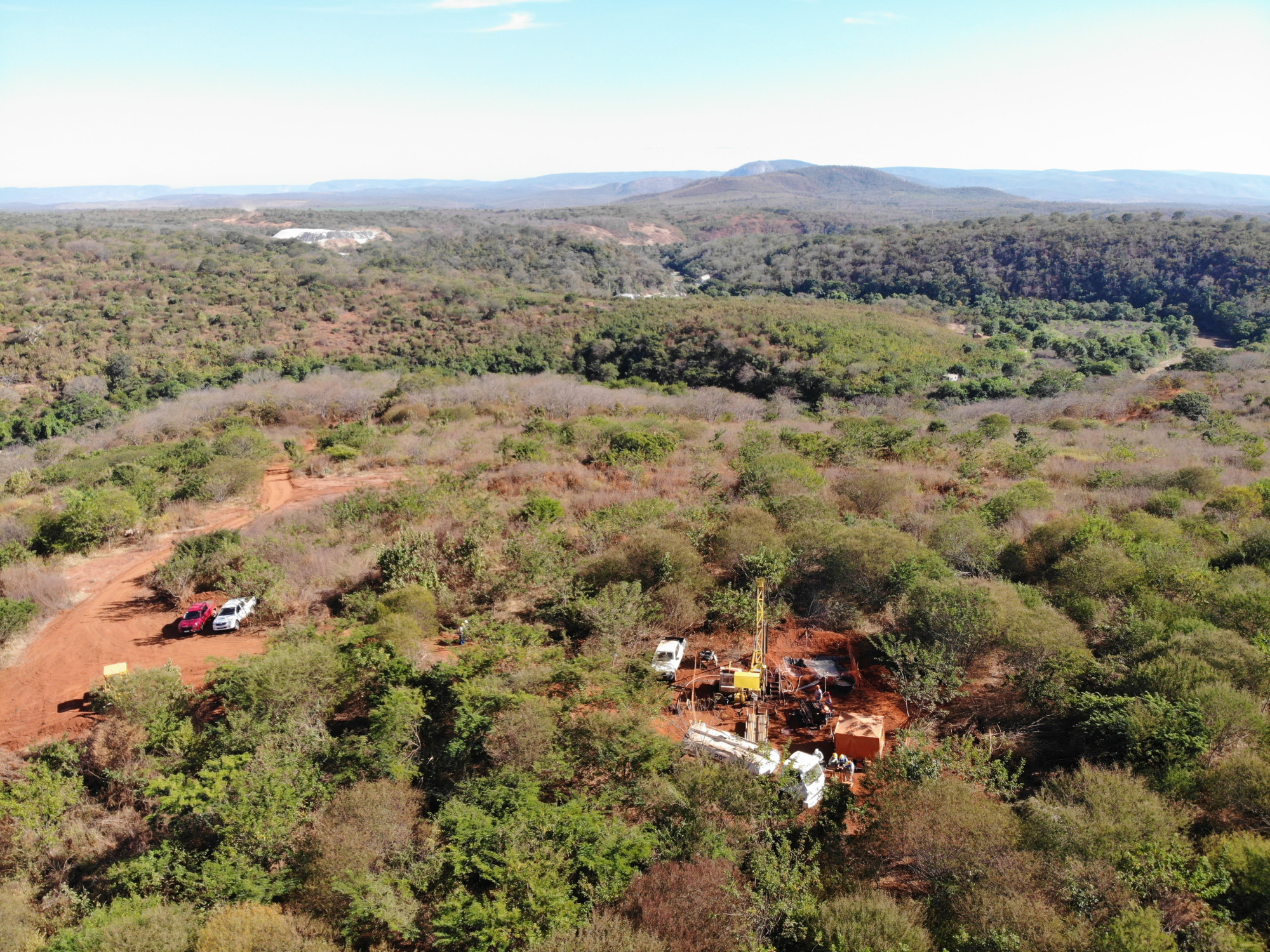
Dune Oil (CSE: DUNE | OTCQB: DUNXF) has the right to earn a 29% interest in Block M47 in southeastern Türkiye, where 2025 drilling made a conventional light oil discovery in the Zagros Basin's Gabar region. North Field oil measures 32.4° API, a light grade. An evaluation by Chapman Hydrogen and Petroleum Engineering Ltd. puts its best-estimate contingent resource at 27.6 million barrels, company gross to the 29% working interest and unrisked, effective December 31, 2025. The evaluator gives that resource an 81% chance of development. Contingent resources are not reserves.
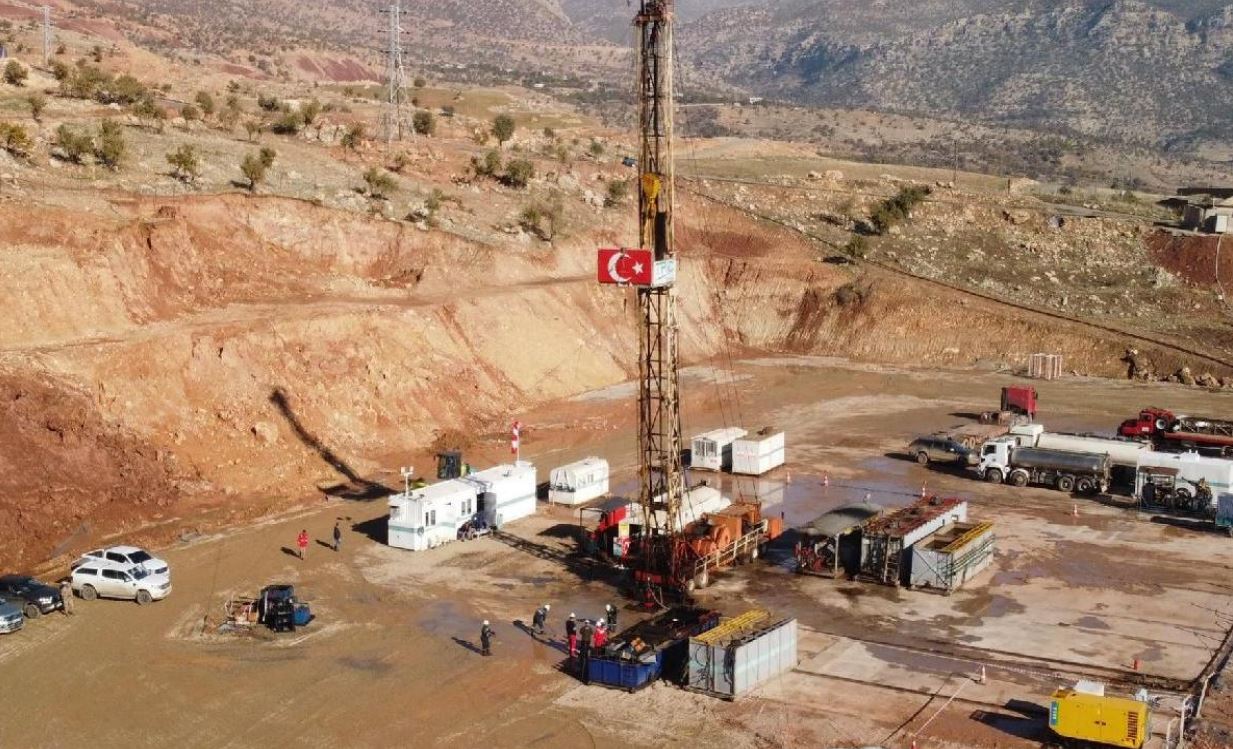
No well on M47 is producing yet. Every M47 netback figure, meaning the price left per barrel after royalty, operating cost, and transport, is therefore a company model or estimate built on Türkiye's fiscal and market terms. The first well planned for production is a sidetrack drilled from the C-1 discovery well, scheduled with a re-entry of C-2 for early 2027.
1. A 12.5% Royalty Is the Only Charge Before Income Tax
Türkiye takes a 12.5% royalty on M47 oil, and that royalty is the only charge ahead of income tax. The corporate tax rate is 25%.
In parts of the Middle East and Africa, governments usually take 50% to 70% of the oil off the top, and some take 80% while the operator still pays all development costs, by management's account. It names Kazakhstan, Uzbekistan, Egypt, and Syria as places where junior producers rarely turn a profit after the state's share is deducted.
President and Chief Executive Officer of Dune Oil, Scott Lower, puts a number on the gap he sees between those regimes and Türkiye:
"But in Turkey, it's only 12.5% royalty. The government's not taking 60%, they're taking 12.5%, and the difference between 12.5 and 60% is a huge amount of profit for the company."
On M47, that 12.5% is the deduction the state makes from every barrel in the company's netback model, alongside operating and trucking costs.
2. Domestic Crude Sells at World-Parity Prices
Domestic crude in Türkiye is sold at world-parity prices and, in the company's comparison, carries no price discount compared with other countries in the region. The country imports more than 85% of its oil to meet domestic demand of more than 1 million barrels a day, spending about US$35 billion a year on oil imports. Only about 1 in 10 barrels the country uses is domestic, and Russia supplies about 56% of its crude imports, with Iraq at about 16%.
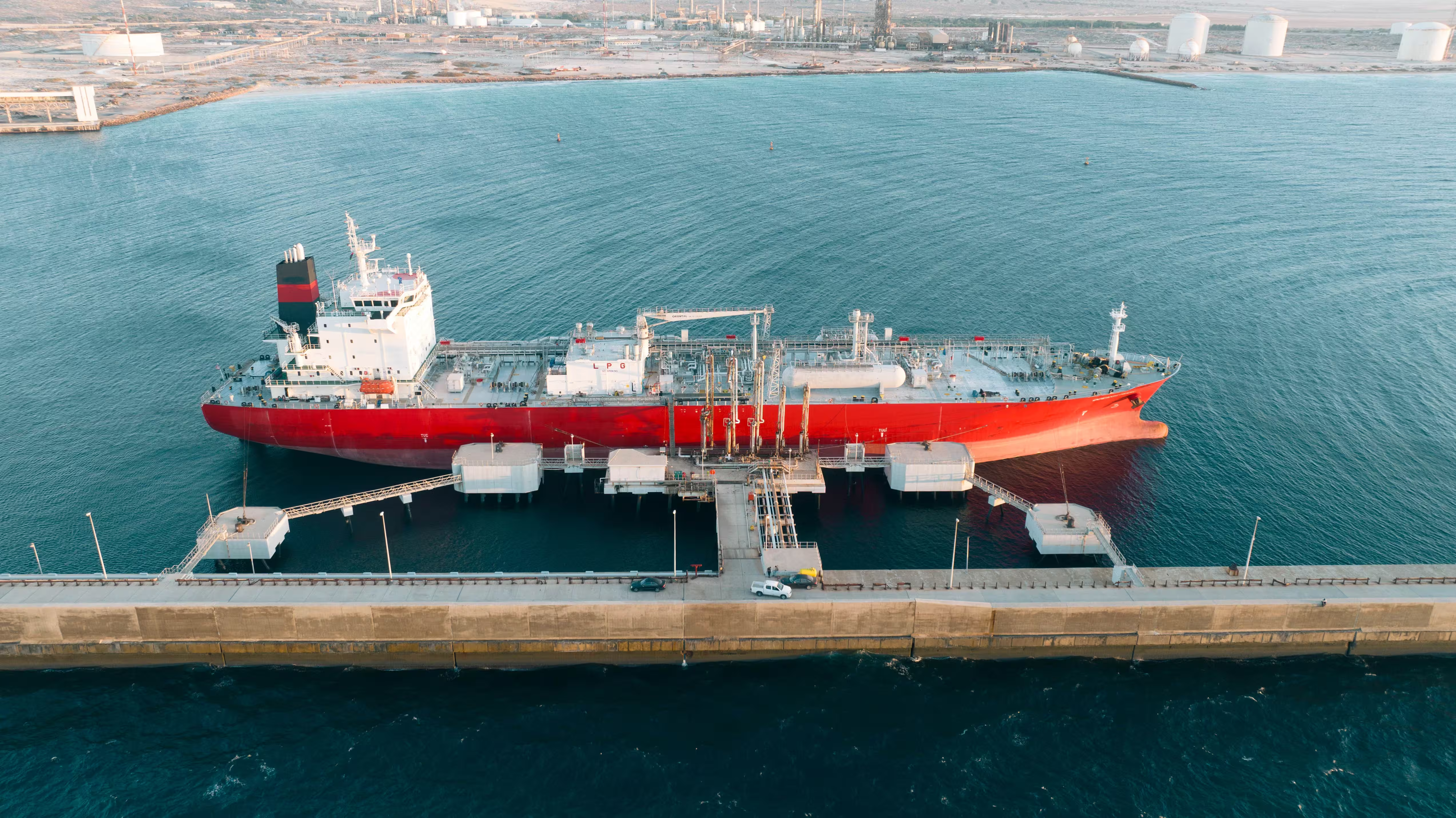
Production with no local buyer often has to be exported, at the cost of a hard-to-find market or a large discount to the oil price in countries such as Argentina and Colombia, by management's account. Türkiye has domestic demand and in-country refining capacity. Dune Oil plans to haul oil in 250-barrel tanker trucks to the Tüpraş refinery in Batman, 130 kilometers away, with no early water separation needed. A pipeline completed in 2026 into the Esma Çevik field provides capacity.
Lower ties the absence of a discount to having the buyer inside the country:
"And so that's another big benefit of this project is we have the customer, and you get full price for the oil. No discounts here."
With no discount line, the deductions in the company's model for oil at US$72 per barrel come down to royalty, operating costs, and trucking.
3. Dune Oil's Peer Comparison Puts M47 at 69% of Brent
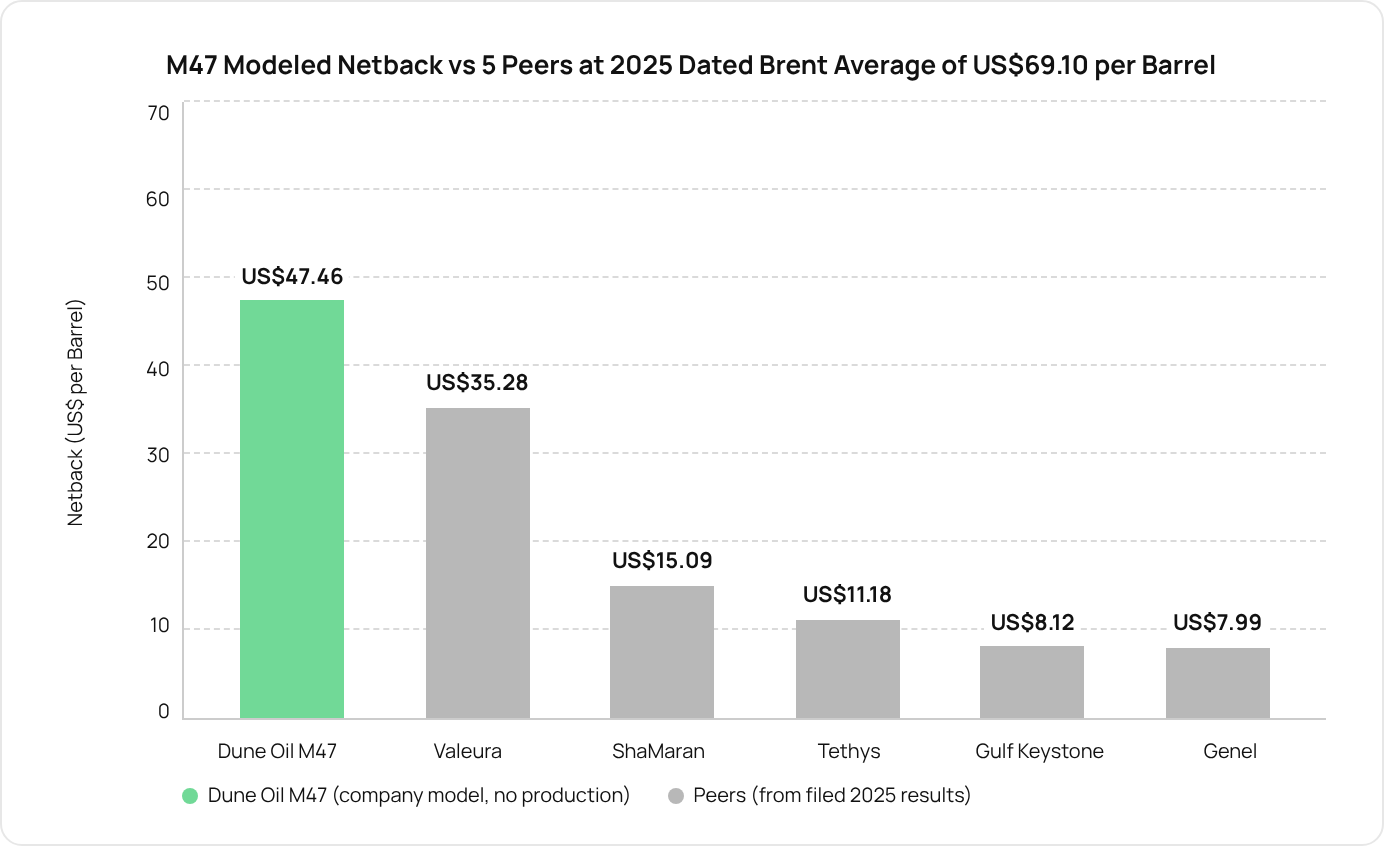
Measured against Dated Brent's 2025 average of US$69.10 per barrel, Dune Oil models a netback of US$47.46 for M47, or 69% of Brent, against 12% to 51% for 5 international peers.
Valeura, in Thailand, shows US$35.28 a barrel, or 51%, and sells at a US$1.10 premium to the benchmark. In Iraq, ShaMaran shows US$15.09, or 22%; Gulf Keystone US$8.12, or 12%; and Genel US$7.99, or 12%. Tethys shows US$11.18, or 16%, on its Kazakhstan oil. TAG Oil shows a minus US$22.01, or minus 32%, at BED-1 in Egypt, where it produces 84 barrels per day from 2 test wells and operating costs exceed revenue.
The comparison is dated November 12, 2026, and draws each peer's figure from its filed results for 2025. In the company's chart, every peer except Valeura loses part of the barrel to price discounts, while M47 shows none. Its figure is a company model at the 2025 benchmark, using a 12.5% royalty, US$8.00 in operating costs, and US$5.00 in trucking costs, for a block with no production. In the chart, government takes and discounts are the benchmark price minus the revenue that reaches the holder. That covers royalties, state production shares, production taxes, and below-benchmark in-country pricing, and excludes operating costs and income tax.
4. The US$50 Netback Build at US$72 per Barrel
At US$72 per barrel for oil, Dune Oil estimates a netback of US$50 per barrel after deducting the US$9 royalty, US$8 operating costs, and US$5 trucking charge. According to the same estimate, a well pays back in about 2 months and generates US$5.5 million in netback in its first year.
The estimate rises with the oil price. With Brent at US$75 per barrel, the company puts the netback at US$53 per barrel. With Brent at US$85 per barrel, it is US$61, and with Brent at US$100 per barrel, it is US$75.
The US$50 build and the US$47.46 peer figure use the same cost lines, applied at 2 different oil prices. The company defines operating netback per barrel of oil equivalent as the sales price less transportation and quality discount, royalties, operating costs, and pipeline transportation, measured from the Brent forecast. This measure has no standardized meaning under accounting rules.
5. Fixed Royalty & Trucking, Shared Operating Cost
Operating cost per barrel is the line Dune Oil expects to fall as M47 adds production, with the 12.5% royalty and the trucking charge unchanged. After a producing C-1, the plan is to twin the well, put another well beside it, and build a small well battery. A well battery is a shared set of tanks serving several wells, so the tanks are paid for once and the trucks collect from a single site.
Lower expects the trucking line to stay put while the operating line is shared out:
"Your trucking costs are always going to be the same. But you're spreading the operating costs across a number of wells, right?"
For the wider field, the company schedules development of the whole North Field for 2027 and later, with an early production facility and trucks hauling to the refinery.
6. C-1 & C-2 Production & Testing Is Scheduled for Early 2027
M47 has no production, and the first well scheduled to produce is the C-1 sidetrack. C-1 found more than 70 meters (m) of gross oil pay and 38 m of net pay in 2025, but 3 failed cement jobs made it impossible to isolate the zone and produce it.
The repair is to mill a window in the casing above the damaged zone and drill a parallel wellbore beside the original. The new wellbore is then completed with a pump and water management tools. C-2, an 1,800 m well that stopped short of its target, is to be deepened by 200 m and tested. Dune Oil plans the C-1 sidetrack and the C-2 re-entry, with production and testing from C-1 and C-2 in early 2027.
Key Takeaways for Investors
- Türkiye takes a 12.5% royalty on M47 oil as the only charge ahead of income tax, with corporate tax at 25%.
- Domestic crude in Türkiye is sold at world-parity prices with no price discount in the company's comparison.
- Dune Oil models a netback of US$47.46 for M47, or 69% of Brent, at the 2025 average of US$69.10 per barrel, against 12% to 51% for 5 international peers.
- At US$72 per barrel for oil, the company estimates a netback of US$50 per barrel and a well payback of about 2 months.
- M47 has no production, and testing of C-1 and C-2 is scheduled for early 2027.
Bottom Line
Dune Oil's margin case for M47 is a fiscal one. Türkiye's 12.5% royalty is the only charge ahead of income tax; domestic crude is sold at world-parity prices; and trucking to the Tüpraş refinery costs US$5 per barrel in the company's model. On those terms, the company estimates a netback of US$50 a barrel at US$72 per barrel for oil. It models US$47.46, or 69% of Brent, at the 2025 benchmark, against 12% to 51% for 5 international peers in Iraq, Kazakhstan, and Thailand. M47 has no production, so each M47 figure is modeled. The C-1 sidetrack, scheduled with C-2 for production and testing in early 2027, is the first M47 well planned for production.
Analyst's Notes




Subscribe to Our Channel


Stay Informed


