




$93.50 Brent Defies Normalized Crude Stocks as Distillates Stay 13% Below Average


Brent holds near $93.50 as distillates stay 13% below average, keeping refined fuels tight despite normalized US crude inventories.
- Brent fell 0.3% to $93.50 and West Texas Intermediate (WTI) 0.5% to $86.42 on August 21, 2026, yet both remained on track for roughly 5% weekly gains.
- US crude inventories rose 4.4 million barrels to 428.8 million and reached the five-year average in the week ending August 14, while distillate inventories fell 1.5 million to 105.6 million, about 13% below average, keeping refined-product supply tighter than crude.
- New York Harbor ultra-low sulfur diesel reached $4.332 per gallon on August 14, up from $2.280 a year earlier, while WTI rose to $83.99 from $63.78, showing diesel prices outpaced crude.
- US Gulf Coast jet fuel reached $3.766 per gallon on August 14, up from $2.024 a year earlier, increasing fuel-cost pressure on remote mining operations.
- US refineries ran at 97.2% of operable capacity in the week ending August 14, yet distillate inventories remained about 13% below the five-year average, keeping refined-product supply tight.
Hormuz Risk Supports Brent’s 5% Weekly Gain Despite 0.3% Pullback
Oil prices slipped but remained on track for roughly 5% weekly gains after President Donald Trump threatened measures aimed at further isolating Iran’s economy. Brent fell 0.3% to $93.50, while WTI declined 0.5% to $86.42 after five consecutive sessions of gains.
The pullback has not removed the geopolitical premium because a diplomatic resolution and reopening of the Strait of Hormuz remain distant. Saxo Bank analysts said further disruption to regional energy flows could support both crude and refined-product prices. The stronger signal is in refined products, where supply remains tighter than crude.
Crude Stocks Reach Five-Year Average While Low Distillates Support Refined Prices
US crude inventories rose 4.4 million barrels to 428.8 million, reaching the five-year average even as production hit 13.83 million b/d and exports rose 1.01 million b/d to 4.07 million b/d, weakening the case for domestic scarcity.
Refined products remain tighter than crude, with lower distillate inventories supporting higher fuel prices. WTI rose to $83.99 from $63.78 a year earlier, while New York Harbor diesel climbed to $4.332 per gallon from $2.280 and heating oil reached $4.172, up $2.039. Distillate inventories remain at 105.6 million barrels, about 13% below the five-year average, supporting the refined-product premium.
Sanctions Escalation Extends Oil Risk Premium as Diplomacy Stalls
Paolo Broccardo, Chief Executive Officer of BankPro, said fading hopes for a diplomatic breakthrough remained the dominant source of uncertainty, while Washington’s planned sanctions escalation increased the risk of further regional tension and supported oil’s geopolitical premium.
Jet Fuel Hits $3.766 Despite Weaker Demand, Raising Mine Cost Risk
Higher middle-distillate prices raise mining costs through both haulage and aviation. Remote mines using chartered aircraft face aviation costs tied more directly to jet fuel than crude. US Gulf Coast jet fuel rose to $3.766 per gallon from $3.445 a week earlier and $2.024 a year earlier, increasing cost pressure on remote operations.
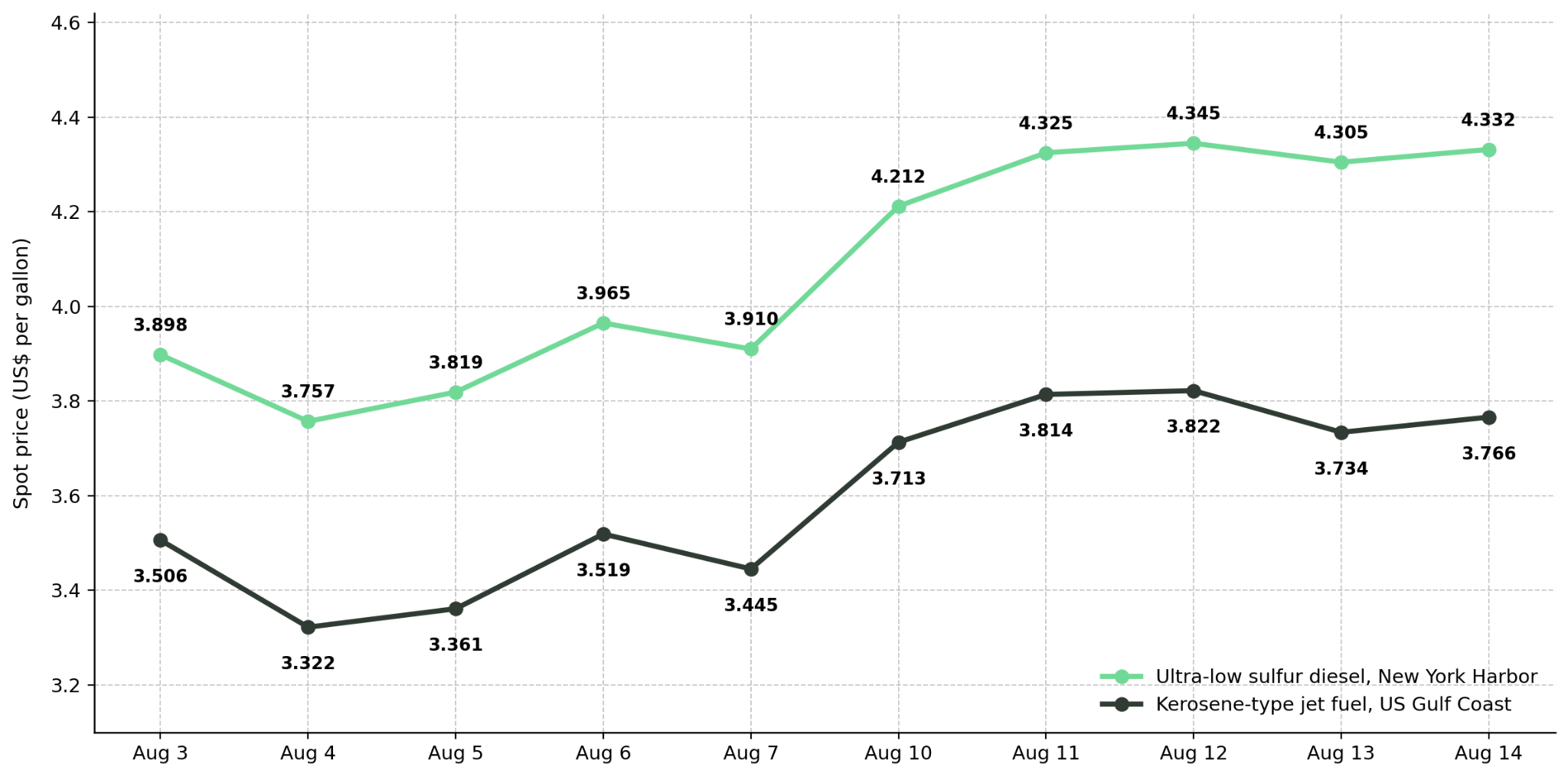
Jet fuel prices are rising despite weaker apparent demand and higher inventories. Four-week product supplied fell 6.3% year over year, while inventories rose to 46.2 million barrels from 43.3 million. Yet jet fuel prices nearly doubled, indicating that demand weakness alone is not enough to lower refined-product prices.
105.6M Distillate Stocks Set Two-Week Test for Mining Fuel Costs
Distillate inventories remain at 105.6 million barrels, about 13% below the five-year average, even with refineries running at 97.2% of operable capacity. Until inventories rebuild, refined-product tightness can support fuel prices even as crude inventories sit at the five-year average.
The key reversal signal is a sustained distillate inventory build while refinery utilization remains above 96%. Two consecutive weekly builds under those conditions would strengthen the case that refined-product tightness is fading and reduce support for diesel and jet fuel prices.
Read the August 26 EIA report and compare distillate inventories with the 105.6 million-barrel baseline before changing the refined-product outlook. Use two consecutive distillate builds as the trigger to revise fuel and charter cost assumptions.
Analyst's Notes





Subscribe to Our Channel






Stay Informed


