




Crude Exports Recovered to 98% of Pre-War Levels, Diesel Did Not



Refining outages keep diesel supply tight and margins elevated even as crude exports recover, shifting value toward distillate-focused capacity.
- December Brent fell 3.1% to $99.13 and November West Texas Intermediate (WTI) fell 4% to $89.18 on October 2 after reports that EU states were considering a 50 million barrel diesel reserve release.
- Middle East crude exports hit 98% of pre-war levels in September, with up to 3 million barrels per day of regional refining capacity unavailable.
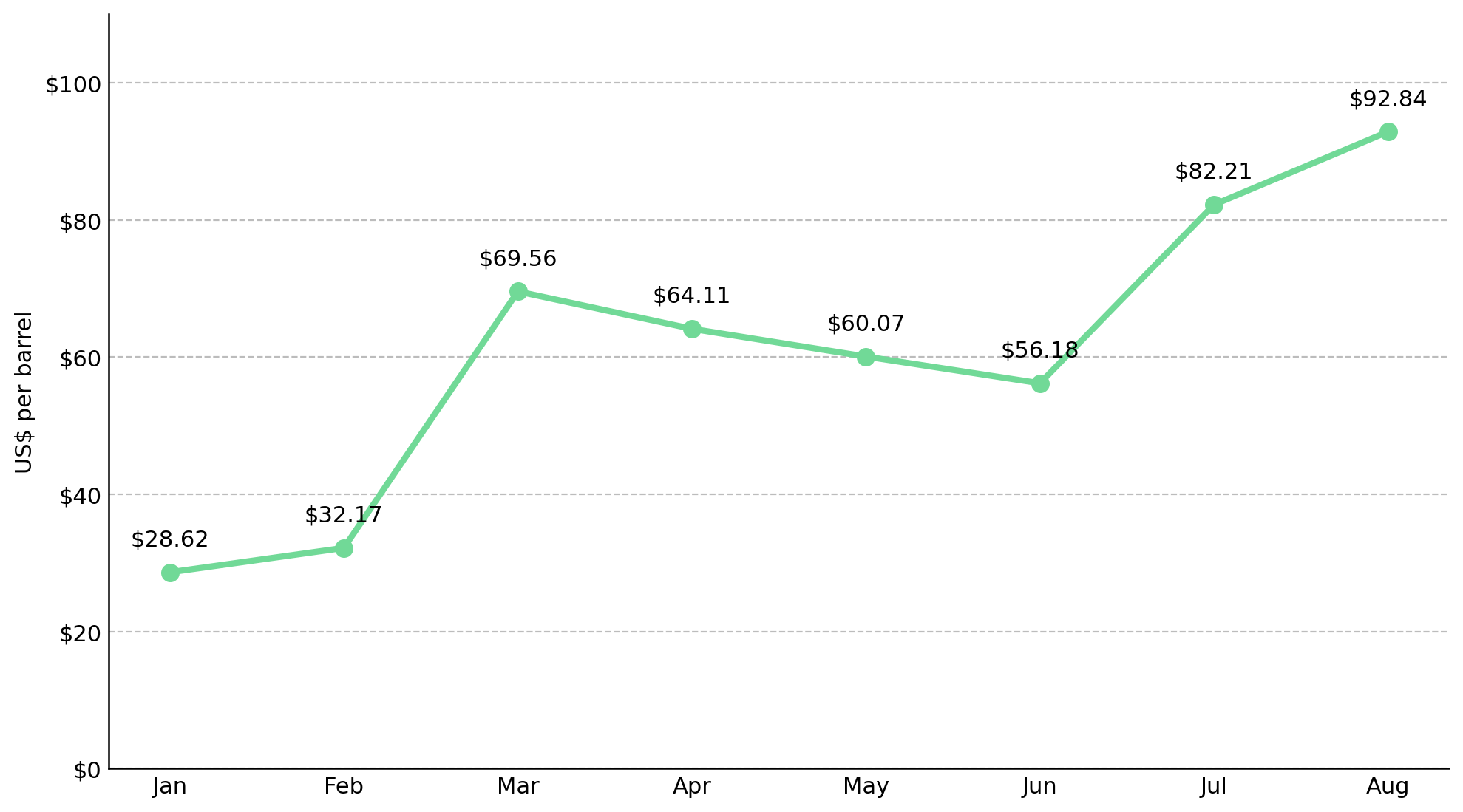
- The US Gulf Coast ultra-low sulfur diesel (ULSD) crack spread averaged $110.97 per barrel in the week ending September 25 against $28.62 in January.
- The 50 million barrels under discussion equal roughly half of US distillate inventories of 105.2 million barrels, which sat 14% below the five-year average on September 25.
- A ULSD crack spread below $60 per barrel across four consecutive weekly EIA releases, the May 2026 average, would reverse the direction.
EU Diesel Reserve Plan Pulls Brent Below $100
Oil prices fell after reports that EU states were discussing a French proposal to release 50 million barrels of diesel reserves alongside a 50 million barrel crude release by tue International Energy Agency (IEA) members. December Brent fell 3.1% to $99.13 per barrel and November WTI fell 4% to $89.18, showing how proposed reserve releases can pressure crude prices before refining capacity recovers.
Brent’s decline reversed part of the previous session’s 4.4% rise to $102.31. The move reflects anticipation of a reserve release rather than restored refining capacity, while record EU diesel pump prices show refined product supply remains constrained.
Hormuz Rerouting Restores Crude Exports Despite Refinery Outages
J.P. Morgan put Middle East crude exports at 98% of pre-war levels in September. Barrels moved through the partly restored Saudi East-West pipeline to Yanbu, the UAE pipeline to Fujairah, and shuttle tankers along the Omani coast under US Navy patrol, restoring crude exports despite continued regional disruption.
Refining capacity cannot be rerouted like crude shipments. Up to 3 million barrels per day of Middle East refining capacity remains unavailable, compared with 3.3 million barrels per day of regional refined-product exports in 2025. Middle East diesel exports are about 25% of preconflict levels, while Russian diesel exports are about 20% of May levels after Ukrainian strikes prompted an export ban, keeping global diesel supply constrained.
Refinery Outages Keep ULSD Crack Spread Above $100
Crude logistics adapted within weeks, but refining capacity did not. US refineries ran at 95.3% of operable capacity on a four-week average, up from 93.1% a year earlier, leaving little spare capacity to offset the Middle East outage. Richard Meade, Chief Editor of Lloyd's List, told RFE/RL:
"Higher exports do not necessarily mean that the Strait of Hormuz has become safe. They simply show that the oil industry has become accustomed to working around that danger."
70% Diesel Price Surge Widens Refiner Margins
US on-highway retail diesel averaged $6.382 per gallon, up 70% year on year, raising fuel costs for freight operators and airlines while widening margins for refiners.
The key constraint is whether diesel can be redirected when policy closes an export route. The US supplied about half of EU diesel imports in August, making a US export ban a major risk to replacement supply. US Treasury Secretary Scott Bessent argues that American farmers, truckers, and businesses should not bear the cost of a global diesel shortage.
The EU reserve release, a US export ban, and further Hormuz strikes remain unresolved and could quickly reset refining margins. Using the diesel crack spread rather than crude prices better captures that risk, while positions entered at September margins could lose value if a reserve release and ceasefire occur together.
What Keeps Diesel Prices Elevated
The main constraint is refining capacity, not crude supply. Crude exports recovered to within 2% of pre-war levels while diesel pump prices reached record highs, showing that scarcity remains in fuel conversion.
Value shifted from crude production to refining, favoring complex distillate-focused capacity outside the conflict zone. Crude prices and fuel costs are no longer moving in lockstep, making refining margins a core valuation driver rather than a secondary risk factor.
The refining constraint extends beyond the conflict. Global refineries were already operating near capacity before the war, and a ceasefire would not add conversion capacity. Over a multi-year horizon, refining capacity remains scarcer than crude supply.
Analyst's Notes





Subscribe to Our Channel







Stay Informed


