




8 Signals Tudor Gold's Perfectstorm Could Be a Second Deposit



Tudor Gold's September Perfectstorm drilling tests whether Treaty Creek, with 1 deposit defined, can host a second along the Sulphurets corridor.
Project Overview
Tudor Gold (TSXV: TUD) holds an 80% interest in the 17,913-hectare Treaty Creek Project in the Golden Triangle of northwestern British Columbia. The project borders Seabridge Gold's KSM property to the southwest and Newmont Corporation's Brucejack Mine property to the southeast. Goldstorm is the only deposit defined on Treaty Creek to date, and the CBS, Eureka, and Perfectstorm zones are separate gold discoveries nearby.
On September 17, 2026, Tudor Gold reported results from 10 drill holes at the Perfectstorm Zone. The drilling expanded a copper-gold-silver-molybdenum porphyry system, known as the PSP Zone, and confirmed the potential for continuity of near-surface, gold-dominant mineralization in an epithermal system, known as the PSE Zone. A porphyry is a large body of copper and gold mineralization formed around an intrusion of igneous rock, and an epithermal system forms at shallow depths from hot fluids, typically as veins that carry gold and silver.
The results are the latest drill evidence on whether Treaty Creek can host a second deposit.
1. One Deposit Defined on a Corridor That Hosts Several
The case for a second deposit starts with the structure Treaty Creek shares with its neighbor. Seabridge Gold's KSM project hosts 5 deposits: Mitchell, Mitchell East, Sulphurets, Kerr, and Iron Cap. Treaty Creek has 1.
Management says the KSM deposits all lie along the Sulphurets Fault, that the fault runs through Tudor Gold's property, and that Goldstorm is on it. President and Chief Executive Officer of Tudor Gold, Joseph Ovsenek, points to gold found elsewhere along the structure:
"We have other prospects where we've discovered gold. We haven't had the ability to follow up on it, but we've discovered gold in other spots along the fault on our claims."
Perfectstorm's September drilling now tests that argument on Tudor Gold's own claims.
2. Perfectstorm Lies Between Goldstorm & Iron Cap
Perfectstorm is within 4 kilometers of a defined deposit on Treaty Creek and of another on the neighboring property. The PSP Zone lies approximately 1 kilometer (km) southwest of Goldstorm at its closest point and 4 km northeast of Seabridge Gold's Iron Cap Deposit.
The PSP Zone lies on the northeast-southwest-trending Sulphurets corridor, which hosts multiple porphyry deposits and prospects.
As of October 2026, Perfectstorm had seen 21,119 meters (m) of drilling, against more than 190,000 m at Goldstorm. The other 2 named discoveries had less, with 5,078 m at CBS and 3,659 m at Eureka. Perfectstorm's drill record is still far smaller than the one behind the defined deposit 1 km away.
3. Six Holes Return Consistent Porphyry Values
Six holes into the PSP Zone returned consistent gold, silver, copper, and molybdenum values hosted within a potassic-altered diorite, an intrusive rock changed by potassium-rich fluids, which forms the porphyry.
One porphyry interval returned 0.26 grams per tonne (g/t) gold, 2.13 g/t silver, 0.25% copper, and 23.05 parts per million molybdenum over 100.30 m from 166.50 m depth, including 0.30% copper over 57.60 m and 0.48% copper over 12.00 m. Another hole returned 0.21 g/t gold and 0.26% copper over 89.65 m from 178.00 m, including 0.45% copper over 18.65 m, and a third returned 0.26 g/t gold and 0.29% copper over 76.55 m from 211.15 m, including 0.44% copper over 23.70 m.
The system is open in all directions. The intervals are drilled lengths, and true widths have not been determined.
4. Gold-Dominant Intervals Repeat the Goldstorm Layout
The higher gold grades at Perfectstorm come from gold-dominant intervals around the porphyry. As with the neighboring Goldstorm Deposit, the new porphyry intrusive lies between higher-grade intervals of gold-dominant mineralization.
One hole returned 0.98 g/t gold and 9.39 g/t silver over 101.00 m from 293.50 m, including 2.01 g/t gold over 25.50 m and 5.15 g/t gold and 171.68 g/t silver over 4.50 m. Another returned 3.51 g/t gold over 11.50 m from 173.00 m, and 1.12 g/t gold and 7.04 g/t silver over 66.70 m from 377.00 m, including 44.38 g/t gold and 440.00 g/t silver over 0.80 m. A third hole returned 0.89 g/t gold over 32.00 m from 411.00 m, including 3.60 g/t gold over 2.00 m. All assays are uncut, meaning no high values were capped.
Continued intercepts of higher-grade material show early continuity of a high-grade, gold-dominant overprint on the porphyry, a later layer of gold mineralization laid over the earlier system. For the second-deposit case, the best gold grades sit in the part of the system that matches the Goldstorm layout.
5. A Near-Surface Epithermal Zone Alongside the Porphyry
The PSE Zone adds gold near the surface in a vein-hosted epithermal system.
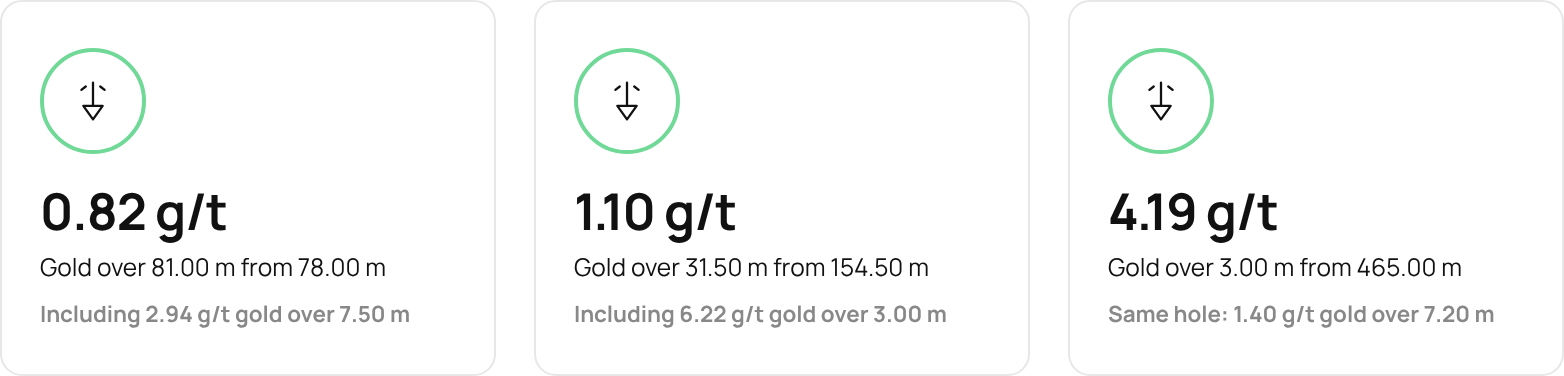
One PSE hole returned 0.82 g/t gold and 2.52 g/t silver over 81.00 m from 78.00 m, including 2.94 g/t gold over 7.50 m, a broad zone of near-surface, gold-dominant mineralization that adds to the volume of the system identified earlier. Other holes returned 1.10 g/t gold over 31.50 m from 154.50 m, including 6.22 g/t gold over 3.00 m, and 4.19 g/t gold over 3.00 m from 465.00 m, with 1.40 g/t gold over 7.20 m from 432.80 m in the same hole.
Higher-grade gold-dominant intervals in 3 of the holes confirm the potential continuity of the vein-hosted system. Perfectstorm now has a second style of gold mineralization to test alongside the porphyry.
6. Surface Samples 1.2 Kilometers Northwest Expand the Potential Footprint
The pending Perfectstorm results cover ground outside the drilled area. Surface sampling 1.2 km northwest of current drilling returned up to 13.54 g/t gold, which expands the potential mineralized footprint of the system.
Tudor Gold has drilled 4 near-surface holes to follow up on those samples, with results to be reported on receipt. As of September 17, 2026, 2 drills were active at Perfectstorm, focused on priority target areas identified by recent results.
Completing the 2026 exploration drill program is among the company's plans for the year, and prioritizing exploration and drilling of additional high-grade targets is part of its stated strategy. The 4 pending holes are the nearest test of whether mineralization continues beyond the zone drilled so far.
7. A Maiden Resource Is the Test Management Set
Developing a mineral resource estimate for an additional deposit is among Tudor Gold's 2026 plans for Treaty Creek. In April, Ovsenek put a season and a meterage on it:
"Exploration drilling, I have every expectation of coming up with a maiden resource for another zone on our property this summer with our 10 to 15,000 meters of drilling. Again, that's another catalyst to increase our share price."
As of October 2026, that estimate remained an open objective for the year, as did completing a preliminary economic assessment (PEA) for Goldstorm. Tudor Gold did not set a date for the estimate with the September 17 results.
8. Goldstorm Is the Development Base
Perfectstorm's exploration runs alongside Goldstorm's development program. Goldstorm hosts an indicated resource of 24.9 million ounces (Moz) of gold, 148.7 Moz of silver and 3.048 billion pounds of copper, from 912.3 million tonnes grading 0.85 g/t gold, 5.07 g/t silver, and 0.15% copper.
The PEA for placing Goldstorm into production as an underground mine is underway, and a permit application has been filed to construct an underground ramp to drill the high-grade gold SC-1 Zone. Goldstorm itself is open in all directions. Tudor Gold's President and Chief Executive Officer previously led the executive team at Pretium Resources that advanced the Brucejack Mine from discovery to commercial production in under 8 years. A second deposit at Perfectstorm would add to that base rather than replace it.
Key Takeaways for Investors
- Treaty Creek has 1 defined deposit, while Seabridge Gold's neighboring KSM project hosts 5.
- The Perfectstorm porphyry lies between higher-grade, gold-dominant intervals, the same pattern as at the Goldstorm Deposit, approximately 1 kilometer away at its closest point.
- Four near-surface holes testing surface samples of up to 13.54 grams per tonne gold, 1.2 kilometers northwest, have results pending.
- Further drilling is required to determine the orientation and true widths of the Perfectstorm mineralization.
- Management set a maiden resource on a second zone as a 2026 catalyst for Treaty Creek.
Bottom Line
Tudor Gold's September drilling provides a broad test of the second-deposit case at Perfectstorm. Six holes returned consistent porphyry values; the porphyry lies between higher-grade gold-dominant intervals as at Goldstorm, and a single interval returned 0.98 g/t gold over 101.00 m. A near-surface epithermal system adds a second style of gold, with 0.82 g/t gold over 81.00 m from 78.00 m. The system is open in all directions; 4-hole testing of surface samples of up to 13.54 g/t gold is pending 1.2 km northwest, and 2 drills were active at Perfectstorm as of September 17, 2026. Goldstorm's indicated resource of 24.9 Moz of gold is the development base. The 4 pending holes and the drilling that fixes orientation and true widths are the measures of whether Perfectstorm can move from an open drill zone toward the resource goal management has set for 2026.
Analyst's Notes





Subscribe to Our Channel







Stay Informed






















