




Aging Oil Fields’ 5.6% Yearly Decline Keeps Exploration in Demand


Appraisal results, development costs, and funding determine which oil discoveries can deliver profitable replacement supply across price cycles.
- Brent futures reversed an earlier decline to settle 0.42% higher at US$104.72/barrel on October 9, reinforcing the need to assess project returns across oil-price scenarios.
- Declining output from existing fields requires replacement production to maintain supply, supporting conventional exploration even when demand growth slows.
- Reduced oil investment makes recoverable volumes, affordable development costs, and funding capacity central to whether discoveries can reach commercial production.
- The value of an onshore discovery depends on appraisal establishing how much oil can be recovered, at what production rate, and with what capital requirement.
- Nearly 90% of annual upstream oil and gas investment since 2019 has gone toward offsetting production declines, showing that maintaining supply absorbs most upstream spending.
Oil Price Swings Leave Replacement Projects Facing Lower Prices at Startup
Brent futures reversed an earlier decline to settle 0.42% higher at US$104.72/barrel on October 9 as hurricane-related shutdowns curtailed US Gulf production. Such price changes affect projected revenue, but an exploration project’s development case depends on the prices available when it begins producing.
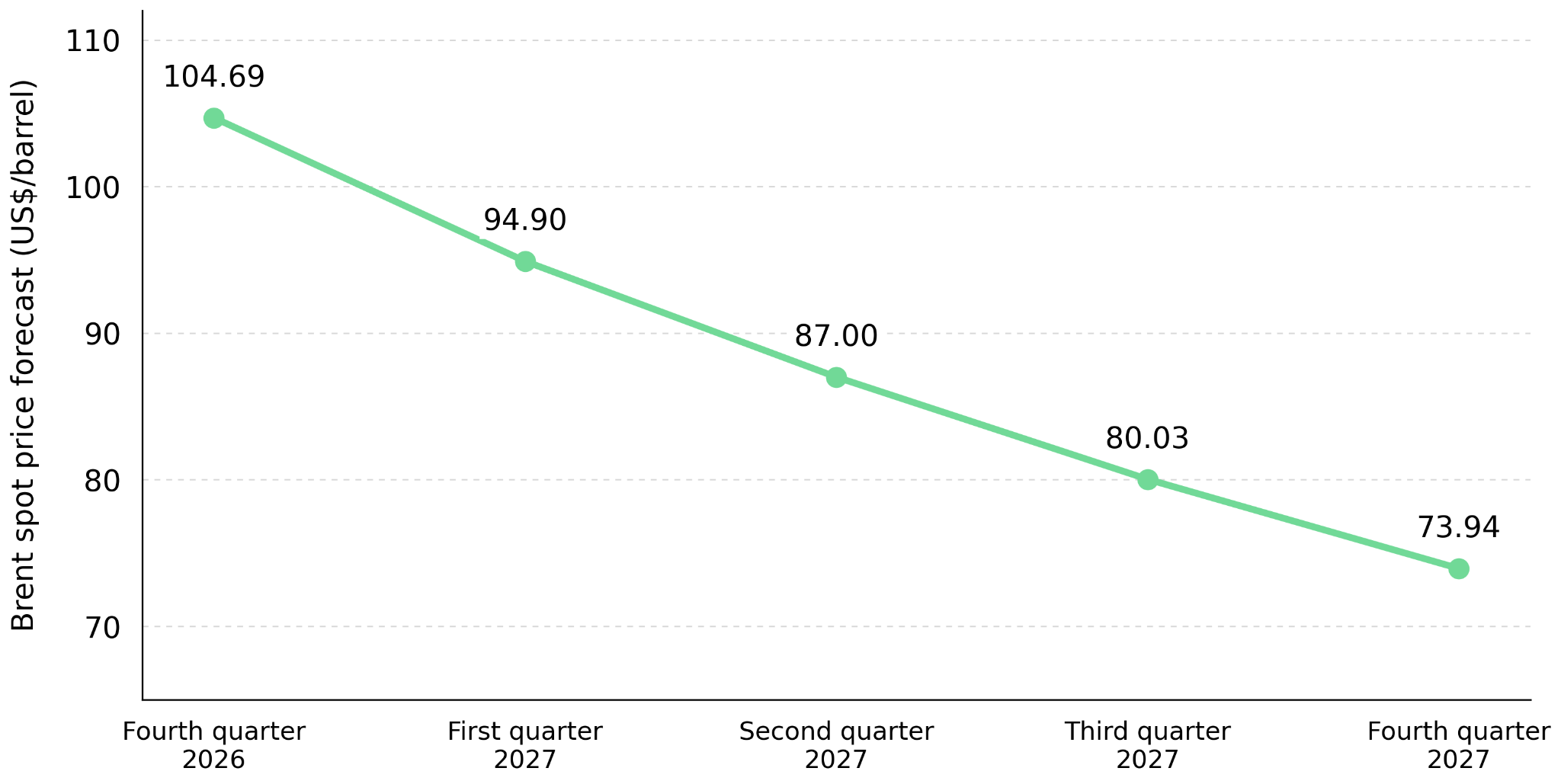
The US Energy Information Administration (EIA), in its October 6, 2026, Short-Term Energy Outlook (STEO), forecasts Brent spot prices averaging US$104.69/barrel in the fourth quarter of 2026, followed by US$94.90, US$87.00, US$80.03, and US$73.94 across the four quarters of 2027. The forecast assumes most Middle Eastern production returns to pre-conflict averages by the end of the second quarter of 2027. Completed on October 1, it excludes later events and provides a conditional lower-price scenario for testing replacement-project economics.
Depleting Oil Fields Preserve the Need for New Production
The International Energy Agency (IEA), in its September 2025 study, The Implications of Oil and Gas Field Decline Rates, analyzed approximately 15,000 oil and gas fields and found an average annual post-peak decline of 5.6% for conventional oil. The calculation measures compounded declines since each field’s production peak, gives greater weight to fields with larger cumulative output, and includes ongoing investment to slow declines. These losses require replacement output to maintain supply, but the figure does not predict a 5.6% annual decline in total global production.
Even if oil demand remains flat, declining production from mature fields creates replacement needs. New discoveries can help meet those needs when development timelines and costs support profitable production, competing for capital with field redevelopment, improved recovery, and other sources of supply.
Lower Oil Investment Makes Project Costs Central to Replacement Supply
In its September 2025 decline-rate study, the IEA estimates that nearly 90% of annual upstream oil and gas investment since 2019 has been allocated to offsetting production declines, including spending on existing fields and replacement supply. Separately, its May 28, 2026, release of World Energy Investment 2026 projects oil investment alone below US$500 billion in 2026, marking a third consecutive annual decline.
The IEA identifies uncertainty over how long higher oil prices will last, lengthy project lead times, supply-chain constraints, and limited offshore rig availability as barriers to a rapid increase in oil investment. These constraints can delay new production despite higher crude prices, extending the time between capital spending and revenue. New replacement projects should therefore be assessed on the capital required before first production and projected returns after development, operating, and financing costs.
Mature Oil Basin Declines Increase the Need to Develop Discoveries
The Norwegian Offshore Directorate (NOD), in its August 20, 2026, Resource Report 2026 release, states that discoveries made in recent years are too small to replace production from operating fields on the Norwegian continental shelf (NCS). It warns that output may fall steeply after 2030 without significant discoveries. Limiting those losses requires investment in new wells, improved recovery, and faster development of discoveries.
The NOD reports more than 90 NCS discoveries awaiting development decisions, many of which need connections to existing infrastructure to become profitable. Shared facilities can reduce new construction requirements and spread fixed costs across additional production, but connection costs, modifications, and available capacity determine the benefit. Development timing also matters because those facilities must remain available when the discoveries begin producing. The Norwegian Offshore Directorate
Offshore Discovery Concentration Makes Decline Rates Central to New Supply
S&P Global Energy’s High Impact Wells 2026 research records 132 conventional oil and gas discoveries by early December 2025, totaling more than 8.2 billion barrels of oil equivalent (boe) in recoverable resources. Deepwater and ultradeepwater wells accounted for approximately 70% of newly discovered recoverable resources, despite representing 19% of new-field exploration wells started that year. These oil-and-gas resource volumes require commercial development before they contribute to production.
Field Decline Rates Shape Replacement Production Requirements
The IEA’s September 2025 study reports average annual observed post-peak declines of 4.2% for onshore oil fields and 10.3% for deepwater and ultradeepwater fields. Lower decline reduces the replacement output needed to maintain a given production level, although these averages do not forecast individual discoveries. Türkiye’s reliance on imported crude provides a potential market for additional domestic production, making appraisal-supported production rates and development costs central to assessing onshore opportunities.
Dune Oil’s October 2026 presentation outlines planned seismic surveys, re-entry and testing of the C-1 discovery, and further drilling at Block M47 in Türkiye under a farm-in arrangement for a 29% interest in conventional onshore light oil. The program targets initial production and additional discoveries, with defined milestones to assess potential revenue and further development.
Scott Lower, Chief Executive Officer of Dune Oil, lines up further exploration targets:
“We have four other defined structures that we intend to drill that can also potentially result in new discoveries that we're very excited about drilling in the future.”
Appraisal Evidence Shapes the Economics of Replacement Oil Supply
The Canadian Securities Administrators (CSA), in its June 9, 2023, revised glossary, defines contingent resources as potentially recoverable petroleum from known accumulations whose commercial development depends on resolving outstanding conditions. These include economic viability, a market for production, suitable facilities, required approvals, and a reasonable development timetable. Resolving these conditions establishes the commercial basis needed for resources to progress toward reserves classification.
Appraisal tests help establish sustainable production rates by examining flow-test duration, reservoir pressure, water produced alongside oil, and the proposed recovery method. The results inform estimates of recoverable volumes, production over time, and facility requirements, allowing projected revenue to be compared with the spending needed to reach and sustain production.
Net present value (NPV) discounts projected net cash flows to today’s value. Its assumptions should specify production rates, oil prices, royalties, tax treatment, development and operating costs, closure obligations, and the discount rate. Testing lower prices alongside different production outcomes shows how combined changes affect cash flow and whether the proposed development can justify its capital requirement.
Supply Recovery Raises Competition for Replacement Oil Projects
The IEA’s Oil Market Report (OMR), published September 11, 2026, forecasts global oil demand declining by 2.5 million barrels per day in 2026 before recovering by 2.6 million barrels per day in 2027. It projects supply rebounding by 8 million barrels per day in 2027 as Gulf production recovers.
Restoring temporarily shut-in output addresses a supply interruption, while replacing mature-field decline addresses continuing production losses. Both can occur at the same time, so new projects must compete on development costs and the timing of first production. Exploration retains a role in supplying replacement barrels, while demand and competing output determine the commercial opportunity.
The Investment Thesis for Oil
- Producers whose operating cash flow covers reinvestment at lower oil prices can finance replacement activity with less reliance on new debt or equity.
- Developers with defined recovery plans, credible construction budgets, and a clear path to approvals provide a basis for assessing development costs and the timing of first revenue.
- Explorers can strengthen the development case through focused appraisal that supports estimates of recoverable volumes, sustainable production rates, and required spending.
- Clear fiscal terms, workable permitting requirements, and enforceable contracts reduce uncertainty around taxes, development timing, and future sales arrangements.
- Replacement investment should reflect petroleum demand and competing supply because field depletion alone does not guarantee profitable sales.
- Testing returns at lower oil prices, using disclosed costs and staged spending plans, helps establish whether projects can justify funding across commodity cycles.
- Sustainable production deserves greater weight than resource size alone because project returns depend on revenues covering development, operating, financing, and closure costs.
Declining field output sustains the need for replacement supply even when oil demand is flat, giving conventional exploration a continuing commercial role. The investment opportunity lies in projects that can progress from appraisal to funded development and profitable production across oil-price cycles. Prioritizing realistic production estimates, transparent costs, and staged spending ties capital commitments to potential cash flow, supporting exposure to future supply without relying on permanently elevated crude prices.
TL;DR
Declining output from mature oil fields creates a need for replacement production even when demand is flat. This supports a continuing role for conventional exploration, with commercial value depending on recoverable volumes, sustainable production rates, development costs, and funding. Lower oil investment makes staged spending important, while returning supply means new projects must compete on costs and production timing. Onshore discoveries offer potential replacement supply when appraisal supports viable economics. The investment case centers on turning evidence into funded, profitable production across oil-price cycles without relying on temporary price strength.
FAQs (AI-Generated)
Analyst's Notes





Subscribe to Our Channel




Stay Informed


