




Atlas Salt: North America's Next Major Salt Producer


Atlas Salt advances North America's first new salt mine in 30 years with $920M NPV, targeting import-reliant de-icing markets from strategic Newfoundland location.
- Atlas Salt targets North America's structurally undersupplied de-icing salt market, which imports 8 to 10 million tonnes annually and represents USD 2.3 billion to USD 2.9 billion in annual value.
- The Great Atlantic Salt Project in Newfoundland will be North America's first new salt mine in nearly three decades, with 4 million tonnes per annum nameplate capacity and proven reserves of 95 million tonnes.
- The 2025 Updated Feasibility Study demonstrates after-tax NPV of $920 million, 21.3% IRR, and 4.2-year payback period, with average annual post-tax cash flow of $188 million over a 24.3-year mine life.
- Atlas Salt has secured environmental assessment approval, completed feasibility studies, and established strategic partnerships with Scotwood Industries for offtake, Sandvik for equipment supply, and Hatch for engineering leadership.
- Trading at $72.3 million enterprise value against $920 million NPV represents approximately 0.08x price-to-NAV, with clean balance sheet, no warrant overhang, and over 40% insider ownership signaling management conviction.
North America's road salt infrastructure faces a generational supply challenge. Legacy mines dating to the early 1900s operate at depths exceeding 600 meters below surface, several beneath the Great Lakes, while the continent imports millions of tonnes annually from Chile, Egypt, and Mexico. Atlas Salt Inc. (TSXV:SALT) has positioned itself to address this structural deficit with the Great Atlantic Salt Project in Newfoundland.
The global salt market, valued at USD 26.92 billion in 2025 according to Fortune Business Insights, is forecast to reach USD 39.38 billion by 2034, growing at a 4.4% compound annual rate. De-icing applications account for approximately 13.3% of global demand and are expected to grow at 4.27% annually. Atlas Salt's strategic location positions the company to displace overseas imports serving Atlantic Canada, Quebec, and the U.S. East Coast.
The investment case centers on three pillars: a world-class resource with 95.9% average grade and shallow mining depth; compelling project economics validated by independent feasibility studies; and a structural market opportunity supported by legacy mine challenges and persistent import dependence.
Company Overview
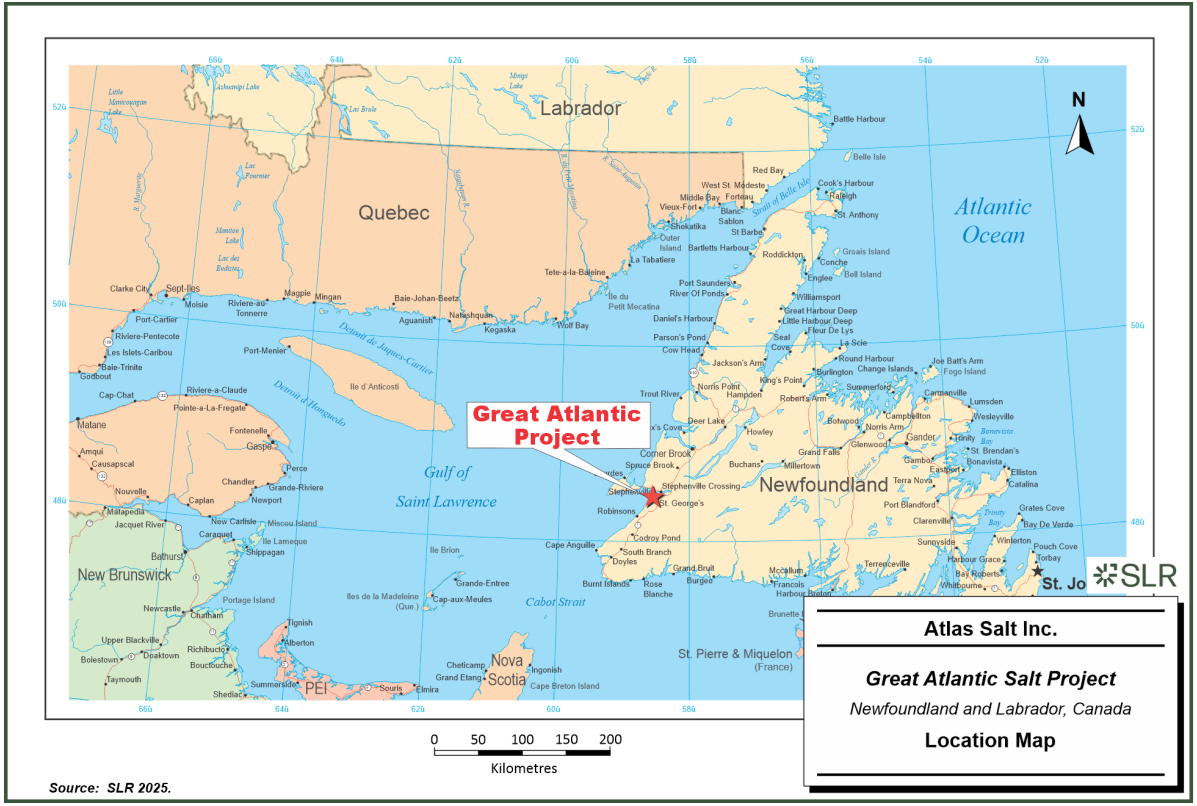
Atlas Salt Inc. operates as a development-stage mining company focused exclusively on the Great Atlantic Salt Project, located near St. George's in western Newfoundland. Founded by Patrick Laracy, who brings three decades of resource exploration experience, the company listed on the TSX Venture Exchange in 2019 and has systematically advanced the project through exploration, feasibility studies, and permitting.
The company's management team combines mining development expertise with operational experience from major producers. CEO Nolan Peterson brings 20 years in mine development and finance, including leadership of World Copper where he advanced over $1 billion in assets. Project Director Andrew Smith contributed to over $500 million in underground mine construction projects, while VP of Engineering Robert Booth delivered $1.5 billion in mine builds for Newmont and Hudbay Minerals.
Board composition reflects both local knowledge and industry depth. Rowland Howe managed Compass Minerals' Goderich mine to record 7.5 million tonnes annual production, while Bob Kelly served as Teck Resources vice president with 40 years in senior mining roles. The board's salt industry expertise, particularly Howe's operational background at North America's largest salt mine, provides strategic guidance as Atlas Salt transitions from development to construction.
Market Opportunity
North America's de-icing salt market presents a structural supply-demand imbalance that Atlas Salt is positioned to exploit. The continent imports 8 to 10 million tonnes of de-icing salt annually despite hosting significant domestic resources. Fortune Business Insights estimates the North American de-icing salt market at 28.5 to 36 million tonnes annually, representing USD 2.3 billion to USD 2.9 billion in value at current pricing.
Regional demand concentration amplifies the opportunity. Atlantic Canada, Quebec, and the U.S. East Coast consume 11 to 16 million tonnes of road salt annually, according to Atlas Salt's 2025 Updated Feasibility Study. This demand cluster lies within three days' shipping from the Great Atlantic Salt Project's Turf Point port facility, compared to over 14 days from major import sources in Egypt and Chile.
Legacy mine challenges underscore supply vulnerability. American Rock Salt's New York operation, opened in 2001 as the last major North American salt mine development, produces over 3 million tonnes annually. Cargill's Avery Island mine in Louisiana ceased production in 2021, removing 2.5 million tonnes of annual domestic supply. Cargill's remaining assets in New York and Cleveland have remained unsold since 2023 due to environmental concerns. Atlas Salt's 4 million tonnes nameplate capacity would be readily absorbed into this supply-constrained market.
Project Economics & Development Status
The Great Atlantic Salt Project's economics improved substantially in the 2025 Updated Feasibility Study, which shortened mine life to 24.3 years from the 2023 study's 34 years while pulling forward production to achieve 4 million tonnes annual nameplate capacity. This restructuring increased after-tax NPV at 8% discount rate by 66% to $920 million and raised IRR from 18.5% to 21.3%.
"The 2025 Updated Feasibility Study significantly de-risked the project with substantial improvements to economics and design, pulling forward production and cash flow realization to achieve nameplate production of 4 million tonnes per annum."
Pre-production capital requirements total $589 million, covering mine development, processing facilities, port infrastructure, and the 2-kilometer enclosed conveyor system. Life-of-mine sustaining capital adds $609 million. Operating costs are estimated at $28.20 per shipped tonne, with all-in sustaining costs at $34.90 per tonne FOB Turf Point.
The project's resource base provides both near-term production certainty and long-term optionality. Probable reserves total 95.0 million tonnes at 95.9% sodium chloride grade, supporting the 24.3-year base case mine plan. Indicated resources of 383 million tonnes and inferred resources of 868 million tonnes offer potential mine life extensions beyond the current feasibility study scope.
Strategic Location & Competitive Advantages
Newfoundland's position on Canada's Atlantic coast delivers multiple competitive advantages for Atlas Salt. The Fraser Institute ranked Newfoundland and Labrador ninth globally for mining investment attractiveness in 2025 based on mineral potential and policy framework. The province hosts active development by major producers including Equinox Gold's Valentine Gold Project acquisition and Eldorado Gold's Golden Rose joint venture.
Existing infrastructure reduces both capital requirements and execution risk. The Trans-Canada Highway passes 2 kilometers from the mine site. St. George's electrical substation, located 1.4 kilometers from the project, provides access to Newfoundland's hydroelectric grid, enabling the planned all-electric mine design. Turf Point port, 2 kilometers from the mine site, offers deep-water vessel access and requires only conveyor infrastructure rather than new port construction.
The 95.9% average sodium chloride grade in proven reserves, with significant concentrations exceeding 98% in higher-grade zones, meets ASTM Designation D632-12 specifications for road salt without requiring extensive processing. The homogeneous, 200-meter average thickness deposit supports efficient room-and-pillar mining with minimal waste generation and no tailings production.
Environmental Performance & Community Impact
Atlas Salt received environmental assessment approval with conditions from Newfoundland's Environmental Minister in April 2024 after approximately two months of review. The all-electric mine design, powered by provincial hydroelectricity, generates Scope 1 greenhouse gas emissions of just 79 tonnes annually, equivalent to four Newfoundland households. This 950 tonnes CO2-equivalent per million tonnes ore production intensity ranks among the lowest in global mining.
The project's environmental advantages extend beyond emissions. Underground salt mining generates no tailings or processing chemicals, with salt extracted mechanically and screened to size specifications. The enclosed conveyor system minimizes fugitive dust emissions during transport to port. Surface infrastructure occupies a compact footprint given the deposit's shallow depth and decline access method.
Economic impact modeling projects $4.8 billion in GDP contribution, 170-plus long-term jobs, and $2.5 billion in local wages over the mine life. Provincial and municipal governments would receive $2.7 billion in tax revenue, with $90 million directed to municipalities. The project has secured community benefits agreements addressing local hiring, procurement preferences, and gender-diversity-equity-inclusion workforce participation commitments.
Strategic Partnerships & Development Progress
Atlas Salt has established partnerships with industry-leading firms that both validate the project and provide execution capability. In August 2024, the company signed a memorandum of understanding with Scotwood Industries for targeted offtake volumes of 1.25 to 1.5 million tonnes annually. Scotwood operates as the largest distributor of packaged retail de-icing salt in the United States.
Equipment supply and financing agreements further de-risk development. Sandvik, the global mining equipment supplier, committed to a $73 million equipment provision and engineering support package in September 2024. In November 2025, Hatch Ltd. was appointed as lead engineering partner and integrated project delivery partner, bringing proven experience delivering large soft-rock mines and existing Newfoundland presence.
The 2025 Updated Feasibility Study incorporated feedback from the environmental assessment process, optimized mine design including drift engineering, updated capital and operating cost estimates, and refined the production schedule. The study drew upon operational data from Irish Salt Mining's Kilroot Mine, which employs similar room-and-pillar methods at comparable scale.
Capital Structure & Valuation
Atlas Salt's balance sheet reflects a development-stage company approaching financing decisions. As of November 30, 2025, the company reported 108.2 million basic shares outstanding and 116.5 million fully-diluted shares including 5.2 million options and 3.1 million equity-linked units. At the current $0.71 share price, fully-diluted market capitalization totals $82.7 million. Net cash of $10.4 million yields enterprise value of $72.3 million.
Trading metrics highlight valuation opportunity. The $72.3 million enterprise value represents approximately 0.08 times the $920 million after-tax NPV calculated in the 2025 Updated Feasibility Study. Price sensitivities demonstrate leverage to assumptions: at $73.50 per tonne salt price, NPV falls to $500 million; at $89.84 per tonne, NPV rises to $1.5 billion.
Average three-month daily trading volume of approximately 157,000 shares provides reasonable liquidity for a TSX Venture-listed development story. Insider ownership exceeding 40% signals management conviction. The company's October 2025 financing through a Listed Issuer Financing Exemption offering raised $8.7 million, demonstrating continued access to development capital.
The Investment Thesis for Atlas Salt
- North America's 8-10 million tonnes annual de-icing salt imports and aging legacy mine base create immediate market absorption for new production.
- Enterprise value of $72.3 million against $920 million after-tax NPV represents significant discount to net asset value as project advances toward construction decision.
- Environmental approval, completed feasibility study, strategic partnerships with Scotwood, Sandvik, and Hatch reduce development uncertainty relative to earlier-stage projects.
- 4.2-year payback period and $188 million average annual post-tax cash flow over 24.3-year mine life provide clear return profile once production commences.
- 868 million tonnes inferred resources at 95.2% grade, excluded from base case mine plan, support potential production increases or mine life extensions.
- Over 40% insider ownership and experienced team with track record advancing $1 billion-plus mining assets demonstrate commitment and expertise.
Atlas Salt represents a pure-play investment in a rare asset class: a large-scale, advanced-stage salt development in a top-tier jurisdiction targeting a structurally undersupplied market. The convergence of North America's import dependence, legacy mine challenges, and Atlas Salt's strategic Newfoundland location creates a compelling supply-demand setup. The project's shallow depth, high grade, and homogeneous mineralization support efficient, low-cost mining.
The 2025 Updated Feasibility Study's 66% NPV increase demonstrates how production schedule optimization and design refinements enhance value. After-tax IRR of 21.3% and 4.2-year payback provide attractive returns in a bulk commodity sector. Strategic partnerships with Scotwood for offtake, Sandvik for equipment, and Hatch for engineering both validate the opportunity and position the company for construction execution.
Key risks center on financing execution, construction cost inflation, and market dynamics. The $589 million pre-production capital requirement necessitates a financing package likely combining project debt, strategic equity, and potentially government support programs. Development timelines remain subject to permitting, contracting, and construction variables common to large mining projects.
For investors comfortable with development-stage mining risk, Atlas Salt offers exposure to industrial minerals with defensive demand characteristics, improving supply-demand fundamentals, and a specific asset trading at substantial discount to feasibility study valuations. As North America's first new salt mine in 30 years, the Great Atlantic Salt Project represents both scarcity value and strategic significance in critical infrastructure commodities.
TL;DR
Atlas Salt (TSXV:SALT) is developing North America's first new salt mine in 30 years in Newfoundland, targeting the continent's structurally undersupplied de-icing salt market that imports 8-10 million tonnes annually. The Great Atlantic Salt Project offers 4 million tonnes annual production capacity, $920 million after-tax NPV, 21.3% IRR, and 4.2-year payback. With environmental approval secured and strategic partnerships established, the company trades at $72.3 million enterprise value, approximately 0.08x NPV. Production is estimated by 2030.
FAQs (AI-Generated)
The company estimates production commencement by 2030, subject to securing project financing and completing construction over an estimated 3-4 year period.
Operating costs of $28.20 per shipped tonne and all-in sustaining costs of $34.90 per tonne FOB compare favorably to legacy mines hampered by 600-meter-plus depths.
The Scotwood Industries MOU targets 1.25-1.5 million tonnes annually, representing approximately 31-38% of the 4 million tonnes nameplate production capacity.
Pre-production capital requirements total $589 million covering mine development, processing facilities, conveyor infrastructure, and port improvements, with additional $609 million life-of-mine sustaining capital.
The shallow 180-meter depth, high 95.9% average grade, 200-meter average thickness, and homogeneous mineralization support efficient low-cost mining with no tailings generation.
Analyst's Notes





Subscribe to Our Channel



.jpg)

Stay Informed


