




Atlas Salt’s Great Atlantic Project & the Supply Gap in North America’s US$2.6B De-Icing Market



Aging mines and limited new supply are tightening North America’s de-icing salt market. Atlas Salt’s Great Atlantic project offers shallow, high-purity reserves positioned as replacement capacity for infrastructure-driven demand.
- North America’s de-icing salt market is estimated at roughly US$2.6B annually, driven by non-discretionary transportation and municipal safety budgets.
- Regional supply is constrained by aging underground mines and a lack of major greenfield developments over the past three decades.
- Logistics, reserve depletion, and operational depth at legacy mines are shaping replacement capacity requirements in Eastern North America.
- Atlas Salt’s Great Atlantic project outlines feasibility-stage economics of US$920M after-tax NPV8, a 21.3% internal rate of return, and a 4.2-year payback period.
- Environmental approval, shallow underground geometry, and more than 40% insider ownership position the company to advance potential new supply into a structurally stable market.
The Structural Drivers Behind North America’s De-Icing Salt Market
North America’s road salt market is tied directly to infrastructure maintenance and public safety. Municipalities and state transportation agencies must ensure winter road conditions remain passable, creating recurring demand for de-icing materials regardless of economic cycles.
This demand structure differs from most mining commodities. Metals such as copper or gold are influenced by industrial output, financial markets, or macroeconomic expectations. De-icing salt, by contrast, is procured through public budgets that prioritize safety and continuity of transportation networks.
The North American de-icing salt market is estimated at approximately US$2.6B per year. Demand is determined primarily by winter severity, treated road mileage, and inventory policies. Procurement is typically conducted through regional contracts, with supply reliability and logistics often outweighing marginal price differences.
This creates a defensive demand profile. Even during economic downturns, governments continue to purchase de-icing salt because it is a critical input for road safety.
Weather volatility is an additional driver. Severe winter events can lead to sudden increases in procurement volumes, particularly in the northeastern United States and Eastern Canada. At the same time, urbanization and highway expansion are increasing the number of lane-kilometers requiring treatment, supporting steady long-term consumption.
Supply Constraints & the Absence of New Greenfield Capacity
While demand remains stable, supply growth has been limited. Many of North America’s major underground salt operations were developed decades ago. These assets often operate at greater depths, with aging infrastructure and rising maintenance requirements.
Over the past three decades, production growth has come primarily from expansions at existing mines rather than new developments. As reserves at legacy operations decline, replacement capacity becomes necessary to maintain regional supply stability.
Atlas Salt’s management describes a structural imbalance between domestic production and demand across the region.
Nolan Peterson, Chief Executive Officer of Atlas Salt Inc., outlined the scale of the deficit:
"What you find is that in North America there is a salt shortage year-over-year when you're balancing domestic production versus domestic needs. So we've had to supplement to the tune of 30 to 40% of our salt needs from other jurisdictions. Egypt and Chile primarily come to mind."
Salt’s economics are strongly influenced by logistics. It is a bulk commodity with relatively low unit value, meaning transportation costs represent a large share of the delivered price. Producers located near key markets or with access to marine shipping infrastructure tend to hold structural advantages.
In Eastern North America, winter demand is highest and supply chains are often stretched during severe seasons. When inventories run low, municipalities may rely on imports or long-distance shipments, increasing both costs and supply risk. These conditions create an environment where new regional production can play a strategic role.
Industrial Minerals & Predictable Cash Flow Structures
Industrial minerals such as salt exhibit different investment characteristics from precious and base metals. Revenue is primarily driven by production volumes and contract pricing rather than spot market volatility.
In metals markets, price swings can determine whether projects are viable. In the salt industry, demand is tied to infrastructure and public safety requirements. This results in more stable revenue profiles and reduced price sensitivity.
Project evaluation focuses on conventional financial metrics. Net Present Value reflects discounted cash flow potential. Internal Rate of Return measures capital efficiency. Payback period indicates how quickly initial capital is recovered. EBITDA and operating margins provide insight into long-term cash generation.
Projects with shallow deposits, simple processing flowsheets, and minimal waste handling requirements tend to exhibit lower capital intensity and reduced technical risk. These characteristics are central to the evaluation of new industrial mineral developments.
Newfoundland Jurisdiction & Coastal Logistics
Jurisdictional stability remains a central consideration for mining investment. Newfoundland and Labrador has developed a reputation as a competitive mining region, supported by established infrastructure and a skilled workforce.
The province has ranked among the world’s leading mining jurisdictions in Fraser Institute surveys. These rankings reflect permitting transparency, regulatory stability, and government support for resource development.
Newfoundland also offers access to renewable hydropower. This provides a low-carbon energy source and can reduce operating costs relative to regions dependent on fossil fuel generation.
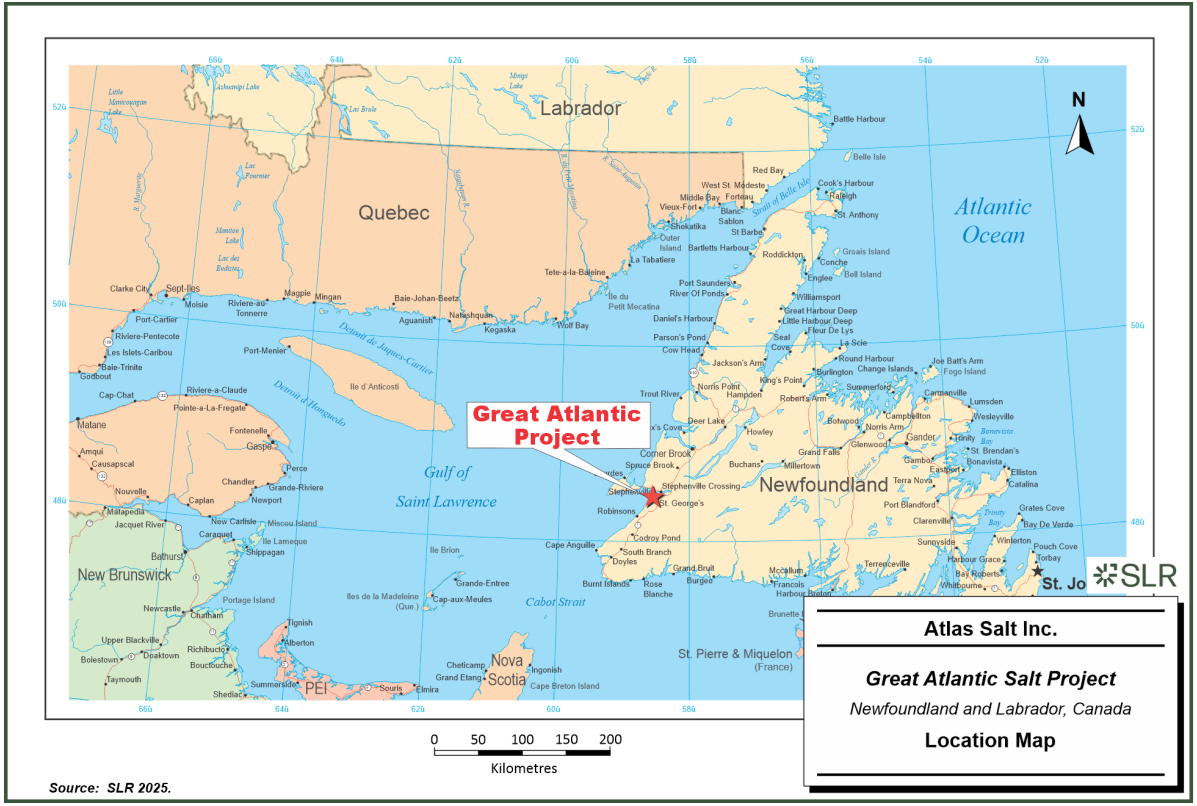
The province’s Atlantic coastline provides direct shipping access to major de-icing markets in the northeastern United States and Eastern Canada. For a bulk commodity such as salt, proximity to marine transport routes can materially influence delivered costs.
Atlas Salt Project Characteristics & Resource Configuration
Atlas Salt is advancing the Great Atlantic project near St. George’s, Newfoundland. The project hosts Proven and Probable reserves of 95.0Mt grading 95.9% sodium chloride, placing it among the higher-purity salt deposits in North America.
The deposit lies at shallow depths of approximately 200 to 250 meters below surface. This geometry enables underground access via a decline rather than a deep vertical shaft. Decline access can reduce pre-production capital and simplify ventilation and hoisting requirements.
The planned mining method is conventional room-and-pillar extraction, a widely used approach in the salt industry. This method produces minimal waste rock and eliminates the need for tailings storage facilities, as processing is limited to crushing, screening, and sizing.
Feasibility Economics & Development Schedule
An updated feasibility study released in September 2025 outlined the project’s financial parameters. The study reported an after-tax Net Present Value at an 8% discount rate of US$920M and an Internal Rate of Return of 21.3%. The projected payback period is approximately 4.2 years.
The mine plan is based on a 4Mt per annum production rate over a 24.3-year mine life. These metrics place the project within the range of capital-efficient industrial mineral developments, particularly given its long reserve base and high-purity product.
Environmental assessment approval was granted in April 2024. This milestone removes a significant regulatory hurdle and reduces permitting risk relative to earlier-stage projects.
Early works are targeted for 2026, with initial production expected around 2030 and full ramp-up in the early 2030s.
Ownership Structure & Alignment Considerations
Atlas Salt reports insider ownership exceeding 40%, indicating substantial alignment between management and shareholders. High insider participation can influence capital allocation decisions and support a longer-term development strategy.
The Great Atlantic project is positioned as potential replacement capacity in a market that has seen limited new underground salt mine development over the past three decades. Its Atlantic coast location provides logistical proximity to high-consumption markets in Eastern Canada and the northeastern United States.
The Investment Thesis for Atlas Salt
- Atlas Salt is advancing North America’s first new underground salt mine in nearly three decades, positioning the company to supply replacement capacity into a mature, infrastructure-driven market.
- The Great Atlantic project’s after-tax Net Present Value of US$920M and 21.3% internal rate of return indicate strong capital efficiency relative to development-stage industrial mineral peers.
- Shallow deposit geometry at approximately 200 to 250 meters depth enables decline access, reducing technical complexity and lowering pre-production capital intensity.
- A projected 4.2-year payback period and 24.3-year mine life support long-duration, infrastructure-linked cash flow potential once in production.
- Environmental assessment approval granted in April 2024 materially reduces permitting risk and advances the project toward construction readiness.
- Insider ownership exceeding 40% aligns management and shareholders, supporting disciplined capital allocation and long-term project execution.
Development-stage mining projects carry inherent risks. Construction cost inflation and access to financing will influence project timelines and capital structure. Schedule adherence will be critical, as delays could affect projected returns and payback periods.
Salt demand remains weather-dependent, and mild winters can reduce procurement volumes in a given year. Operational performance during ramp-up, including cost control and logistics execution, will also influence project outcomes.
North America’s de-icing salt market combines stable, infrastructure-linked demand with limited new supply. Aging operations and logistical constraints are shaping regional supply conditions, particularly in Eastern markets.
Within this context, Atlas Salt’s Great Atlantic project represents potential new capacity aligned with long-term infrastructure demand. Its feasibility-stage economics, shallow underground configuration, and coastal logistics position the company within a defensive industrial mineral segment.
The primary consideration remains execution. If Atlas Salt advances the project through construction and into production on schedule, it may offer exposure to predictable cash flow within a structurally stable, contract-driven commodity market.
TL;DR
Atlas Salt is advancing the Great Atlantic project in Newfoundland as North America’s first new underground salt mine in nearly three decades, targeting 4Mtpa production into a US$2.6B de-icing market constrained by aging supply. The project outlines feasibility-stage economics of US$920M after-tax NPV8, a 21.3% internal rate of return, and a 4.2-year payback, supported by shallow, high-purity reserves and environmental approval granted in 2024. With more than 40% insider ownership and coastal logistics positioning the operation close to Eastern Canadian and U.S. Northeast demand centers, Atlas Salt offers development-stage exposure to a defensive, infrastructure-linked commodity where new replacement capacity may be required as legacy mines mature.
FAQs (AI Generated)
The Great Atlantic Salt Project is an underground salt development located near St. George’s, Newfoundland and Labrador. It hosts Proven and Probable reserves of 95.0 million tonnes grading 95.9% sodium chloride. The project is designed to produce 4 million tonnes per annum over a 24.3-year mine life, targeting the North American de-icing market.
North America’s de-icing salt market is valued at approximately US$2.6 billion annually and is largely supplied by aging underground mines. Few greenfield projects have been developed over the past three decades, while some legacy operations face reserve depletion, increasing depths, and higher operating costs. This creates a need for replacement capacity, particularly in Eastern North America.
The September 2025 feasibility study reported an after-tax Net Present Value at an 8% discount rate of US$920 million and an internal rate of return of 21.3%. The project is expected to achieve payback in approximately 4.2 years, based on a 4 million tonne per annum production rate and a 24.3-year mine life.
The deposit is located at shallow depths of approximately 200 to 250 meters, allowing access through a decline rather than a deep shaft, which reduces capital intensity and technical complexity. The project also received environmental assessment approval in April 2024, clearing a major regulatory milestone and advancing it toward construction readiness.
The project is located on Newfoundland’s Atlantic coast, providing shipping access to high-consumption markets in Eastern Canada and the northeastern United States. Its proximity to these regions may reduce transportation costs compared with imported salt. Additionally, insider ownership exceeding 40% aligns management and shareholders around long-term project execution.
Analyst's Notes





Subscribe to Our Channel




Stay Informed


