




North American Salt Supply Under Stress: Ontario’s Shortage as a Real-Time Market Signal


Ontario’s 2026 salt shortage reveals inelastic demand, supply constraints, and logistics bottlenecks reshaping North American salt investment dynamics.
- Ontario’s 2026 salt shortage underscores the structurally inelastic nature of road salt demand, where municipal safety mandates override price sensitivity during peak winter stress.
- Salt’s low short-term supply elasticity, driven by underground mining constraints and multi-year expansion timelines, limits rapid output response to price spikes.
- Integrated Canada-US trade flows amplified the shortage, as elevated US Northeast demand tightened domestic Canadian availability.
- Logistics, not geology alone, proved decisive: ice exposure, port congestion, and transport bottlenecks drove spot prices from ~$70 to nearly $300 per tonne.
- Development-stage assets with shallow deposits and year-round, ice-free port access, such as Atlas Salt’s Great Atlantic Project, illustrate how logistics-advantaged capacity could capture structural premiums in future supply stress cycles.
Weather Volatility as a Structural Demand Driver for Salt
The Ontario salt shortage of 2026 is not a localized winter anomaly but a real-time stress test of North American salt demand elasticity. Road salt demand is effectively non-discretionary: unlike metals, there is no meaningful substitution, recycling, or deferral mechanism, and municipal safety mandates combined with legal liability frameworks require application regardless of price. When the cost of untreated roads exceeds marginal price increases, price sensitivity approaches zero, reinforcing salt’s role as a critical infrastructure input rather than a cyclical commodity.
Eastern Ontario's unusually heavy and early snowfall season, marked by a high volume of storm events, has accelerated salt application rates and rapidly depleted municipal inventories beyond what fixed procurement contracts anticipate. Repeated freeze-thaw cycles compounded the drawdown in some municipalities, increasing re-application frequency further. Lanark County’s drawdown to roughly 500 tonnes after consuming more than 8,000 tonnes demonstrates how quickly stockpiles can erode under frequent, smaller weather events - conditions that disrupt supply chains more than traditional single-storm models. For investors, this highlights a structurally inelastic demand profile tied to municipal budgets and climate volatility, where private markets bear the full impact during peak shortage windows.
Supply Elasticity Limits: Why Capacity Cannot Scale Quickly
The Ontario shortage reinforces a core mining reality: salt production is capital-intensive and inherently slow to expand. Unlike oil or shale, where output can be increased by drilling additional wells, underground salt mines are constrained by fixed extraction faces, hoisting systems, crushing circuits, and shipping infrastructure that impose hard throughput ceilings. Expanding capacity through new shafts or lateral drifts requires years of engineering, permitting, and construction.
Salt, therefore, exhibits low short-term supply elasticity similar to uranium or potash, where physical production constraints define output ceilings more than price signals. Unlike gold or copper, which benefit from globally traded above-ground inventories and exchange-traded stocks that can cushion price spikes, salt inventories are localized, seasonal, and dependent on physical logistics corridors. When those corridors tighten, spot prices adjust sharply.
Cross-Border Trade Flows & the US Demand Vacuum
The North American salt market is deeply integrated across Canada and the United States. Recent major snowstorm events across the US Northeast created unprecedented demand for Canadian salt, pulling production south at precisely the moment when Ontario municipalities were drawing down their own reserves. The structural tension here is straightforward: Canadian production capacity serves both domestic and export demand, and when the US market applies pressure, domestic availability tightens.
From an investor standpoint, this dynamic reinforces the view that salt behaves as a continental commodity rather than a strictly domestic one. Integrated North American markets amplify regional shortages through cross-border arbitrage. When US demand is elevated, and logistics favor export loading, domestic private-market buyers face compounded scarcity. This structural reality is unlikely to diminish as climate volatility increases the frequency of synchronous winter weather events across the continent.
Logistics as the True Bottleneck
Salt mining is not purely a geological business; it is fundamentally a logistics business. The Ontario shortage highlights that proximity to end markets, year-round port access, and multi-modal transport flexibility can be as decisive as reserve size or operating cost structure in determining which assets capture demand during shortages. In the 2025–2026 winter season, ice narrowed shipping windows across the Great Lakes and St. Lawrence Seaway, while vessel prioritization for export contracts extended truck-loading queues and disrupted private contractors serving residential and commercial accounts. Port congestion further constrained throughput as capacity was concentrated on large vessel loading rather than distributed local delivery. The pricing impact on private contractors was severe: according to Joe Salemi, Executive Director of Landscape Ontario, the price of one tonne of rock salt jumped from approximately $70 to nearly $300 in Ontario during the 2026 shortage - a greater than 300% increase driven entirely by constrained physical availability rather than any change in underlying production cost.
Traditional mining evaluation metrics: reserve life, operating cost (All-In Sustaining Costs equivalent), and strip ratio, where relevant, are insufficient on their own in the salt sector. Investors must also assess port access, ice exposure, rail and barge integration, and seasonal throughput risk. Assets with structural logistics advantages, particularly year-round, ice-free deep-water port access, warrant a strategic premium that is not fully reflected in conventional reserve-based valuation frameworks.
Development Pipeline: Atlas Salt & the Case for Logistics-Advantaged Capacity
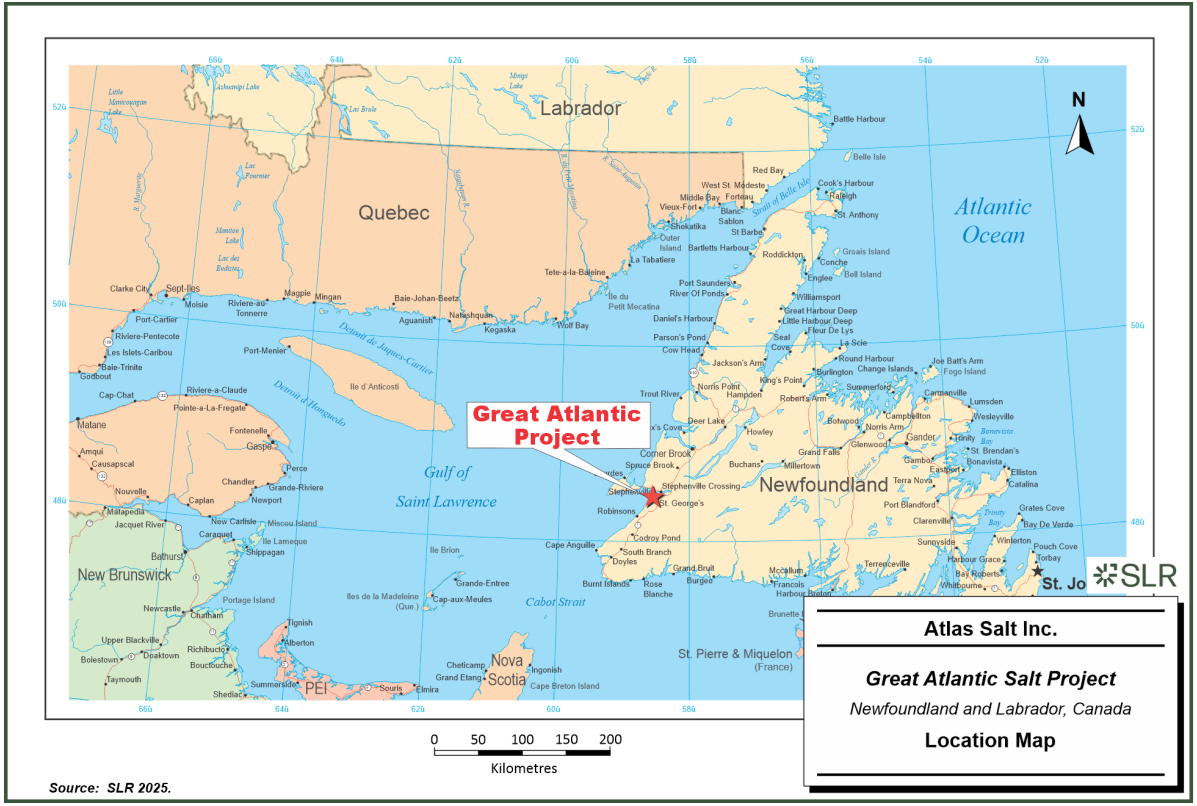
Atlas Salt's Great Atlantic Salt Project, located in Newfoundland on Canada's Atlantic coast, represents an instructive example of how development-stage assets can be positioned to address the structural logistics constraints that defined the 2026 Ontario shortage. The project offers a set of geological and logistical characteristics that differentiate it from the majority of existing North American underground salt operations.
The deposit sits at approximately 200 meters depth, compared to the 500-to-600 meter depth typical of most existing underground mines in North America. This shallower geometry enables ramp access rather than a vertical shaft, reducing both capital intensity during development and operating complexity over the mine life.
Chief Executive Officer of Atlas Salt, Nolan Peterson, describes the geological and infrastructure differentiation of the Great Atlantic Project relative to existing North American operations:
“We call this a world-class resource. One of the key differentiators is shallowness. Most of the existing mines in North America, that are underground, tend to be very deep - about 500 to 600 meters. We would start at about 200 meters deep. Instead of a vertical shaft for a deep mine, we can have access to our deposit via a horizontal drift, a shallower drift, which is faster to develop and lower cost in both the capital and operating period. Our project and deposit do not sit under a lake, which many of the existing mines in North America operate. That creates environmental liabilities, challenges, and operating cost issues that they need to account for which we do not have to worry about."
The logistics differentiation is equally relevant in the context of the Ontario shortage. The project is located near Turf Point, a deep-water port on the west coast of Newfoundland that operates year-round with no seasonal ice closure, is fully permitted, and can accommodate 50,000-tonne vessels. In a supply environment where Great Lakes ice was narrowing shipping windows and port congestion was compounding domestic shortages, year-round ice-free port access carries material strategic value.
Peterson underscores the port access advantage as a defining logistics differentiator for the project:
"What we have is proximity to a deep-water port on the west coast of Newfoundland called Turf Point. This is a port that is open year-round, ice-free, operates right now, is fully permitted, and can move 50,000-tonne vessels."
The project’s feasibility study outlines an after-taxNet Present Value (NPV) of approximately CAD $1 billion, average annual free cash flow of roughly CAD $188 million, and a 25-year reserve life, with a 100% battery-electric design that removes diesel exposure and lowers operating cost volatility and carbon intensity, factors increasingly relevant to institutional capital allocation.
Near-term catalysts are clear and time-bound: construction has commenced, and the company is working with Endeavor Financial to secure a debt package to fund at least 60% of the initial capital requirements, with updates expected by summer. The capital structure remains clean, with fewer than 110 million shares outstanding, over 40% insider ownership, no warrants, and a debt-free balance sheet - factors typically viewed by institutional investors as supporting aligned incentives and unencumbered equity upside.
Risk Factors & Investment Controls
Weather normalization is the most immediate cyclical risk: a mild winter following the 2026 shortage would reduce spot pricing pressure and compress margins in private-market channels, requiring investors to model Internal Rate of Return (IRR) sensitivity under price reversion scenarios. For development-stage assets, risks include debt financing execution, interest rate conditions, feasibility study bankability, construction cost inflation, CAD-denominated capex versus potential USD revenues, and permitting or regulatory timeline shifts that could affect schedules.
Offsetting these risks are structural demand supports. Road salt consumption is tied to infrastructure density and climate patterns rather than industrial cycles, with climate science pointing to more frequent freeze-thaw events across key North American regions. Import dependence of roughly 40% of total consumption persists irrespective of a single mild season, requiring investors to balance cyclical variability against long-term supply constraints and asset-specific execution risk.
The Investment Thesis for Salt
- Exposure to structurally inelastic infrastructure demand, where municipal safety mandates and liability frameworks drive non-discretionary consumption largely independent of short-term price movements.
- Leverage to increasing climate volatility, particularly more frequent freeze-thaw cycles across North America, which accelerate inventory drawdowns and amplify peak-season pricing pressure.
- Participation in a commodity with low short-term supply elasticity, where underground mining constraints and multi-year development timelines limit rapid output expansion and enhance pricing power during stress periods.
- Strategic positioning within an integrated North American market that remains approximately 40% import-dependent, reinforcing the long-term value of new domestic capacity and logistics-advantaged assets.
- Asset-level differentiation through year-round, ice-free port access, shallow deposit geometry, and electrified mine design, which support competitive cost structures, ESG alignment, and potential valuation rerating relative to established sector multiples.
The Ontario shortage is best understood as a forward indicator of how climate volatility, logistics constraints, and cross-border integration can converge to stress essential commodity supply chains. Salt demonstrates the characteristics of a strategically important infrastructure material with embedded pricing optionality during peak demand windows. For investors, the convergence of inelastic demand, limited supply responsiveness, and differentiated logistics positioning elevates North American salt assets as a credible real-asset allocation theme within the broader mining sector.
TL;DR
Ontario’s 2026 salt shortage was not a one-off weather event but a structural stress test of North America’s salt market, highlighting inelastic municipal demand, limited short-term supply responsiveness, and logistics bottlenecks amplified by cross-border trade flows. With spot prices surging over 300% due to physical scarcity rather than cost inflation, investors are increasingly viewing salt as a critical infrastructure commodity where assets with year-round, ice-free port access and scalable logistics infrastructure may command strategic premiums.
FAQs (AI-Generated)
Road salt demand is driven by municipal safety mandates and legal liability frameworks, making it non-discretionary. Unlike industrial commodities, consumption cannot be deferred, substituted, or meaningfully recycled during winter weather events.
Underground salt mines operate with fixed extraction faces, hoisting systems, and crushing infrastructure that cap throughput. Expanding capacity requires years of engineering, permitting, and capital investment, limiting short-term supply elasticity.
The North American salt market is highly integrated. Elevated snowstorms in the US Northeast pulled Canadian production south, tightening domestic availability in Ontario at the same time municipal inventories were being depleted.
Salt is a bulk, low-value-per-tonne commodity where transport efficiency determines margin capture. Year-round port access, ice exposure, rail connectivity, and vessel capacity often drive realized pricing and supply reliability more than geology alone.
The project combines shallow deposit geometry, ramp access development, 100% battery-electric design, and year-round ice-free deep-water port access. These features potentially lower capital intensity, reduce operating risk, and position the asset to benefit during supply stress cycles.
Analyst's Notes





Subscribe to Our Channel


.jpg)




Stay Informed


