Atomic Eagle Expands Chisebuka Uranium Footprint as Multi-Target Drill Campaign Advances Across Muntanga



Atomic Eagle expands Chisebuka uranium zones to 900m x 600m and 830m x 400m as RC drilling, Muntanga North maiden drill & Namakande surveys advance in 2026.
- Resource extension drilling at Chisebuka has expanded the northern higher-grade zone to 900 metres x 600 metres and the south-west zone to 830 metres x 400 metres, with mineralisation extending below 100 metres depth down-plunge to the south-east.
- A total of 42 holes for 4,209 metres have now been drilled at Chisebuka in the 2026 programme, with recent holes confirming continuity of mineralisation between the south-west higher-grade zone and the existing resource area.
- A reverse circulation (RC) drill programme of 12 holes for approximately 900 metres is expected to commence at Chisebuka later this month to confirm grades estimated by gamma logging, followed by a diamond drilling programme in the Fourth Quarter of 2026.
- Two drill rigs have been mobilised to Muntanga North, where ground radiometric surveys across 6 of 8 target areas have identified new exploration targets that have not previously been drilled.
- Access clearance to Namakande 1 and Namakande 2 has been completed, with ground radiometric surveys to precede drill testing in the Third Quarter of 2026.
Company Overview
Atomic Eagle Limited (ASX: AEU | OTCQX: AEUXF) is an ASX-listed mineral resource company focused on the exploration and development of uranium assets in Africa. Its core asset is the 100%-owned, district-scale Muntanga Uranium Project in Zambia, spanning 4 mining licences and 2 exploration licences over a 146-kilometre strike length, covering 1,136 square kilometres adjacent to Lake Kariba. The project hosts a Measured and Indicated Resource of 50.4 million tonnes (Mt) at 359 parts per million (ppm) uranium oxide and an Inferred Resource of 35.8 Mt at 238 ppm uranium oxide, for a combined total of 58.8 million pounds (Mlb) uranium oxide at 309 ppm.
Chisebuka Footprint Continues to Grow
Atomic Eagle's 2026 resource extension drill programme at Chisebuka targets mineralisation outside the existing Inferred Mineral Resource of 19.9 million tonnes at 220 ppm uranium oxide, for 9.7 million pounds of uranium oxide, announced earlier this year. Following an initial 13-hole phase reported in May 2026, a further 29 holes have been completed, bringing the total 2026 programme to 42 holes for 4,209 metres.
The northern higher-grade zone has now been defined at a surface projection of 900 metres x 600 metres, with mineralisation extending from the surface in the north-west to more than 100 metres depth in the south-east and up to 80 metres thick in the core. The south-west (SW) zone now measures 830 metres x 400 metres, with mineralisation starting near-surface and extending below 100 metres depth down-plunge to the south-east, reaching up to 60 metres in thickness in its core. Crucially, recent drilling has also confirmed continuity of mineralisation between the SW higher-grade zone and the existing resource area. Select headline intercepts include 12.8 metres at 237 ppm equivalent uranium oxide from 40.9 metres, 10.3 metres at 210 ppm uranium oxide from 81.4 metres, 7.3 metres at 284 ppm uranium oxide from 47.2 metres, and 5.4 metres at 422 ppm uranium oxide from 47.0 metres.
Chief Executive Officer of Atomic Eagle, Phil Hoskins, commented on the significance of the programme to date:
"The first phase of the 2026 exploration program has been a success, extending the boundaries of the previously defined resource at Chisebuka and defining an additional higher-grade zone to the south-west. Subject to further studies, Chisebuka is demonstrating the potential to be a major contributor towards the Company's target of a larger scale mine."
Grade Methodology
Uranium grades at Chisebuka have been determined using gamma logging with a Mt Sopris natural gamma sonde equipped with a sodium iodide crystal, calibrated at the Grand Junction calibration facility in Colorado in 2024. The tool converts radioactivity emitted by uranium decay daughter products into an equivalent uranium oxide grade in ppm, applying a K factor, dead time correction, and other environmental correction factors, and is run weekly in a lined test hole to verify repeatability.
Atomic Eagle has applied an additional calibration factor to align its gamma results with data collected by logging contractors over the previous 4 years, ensuring consistency with the historical dataset.
Muntanga North & Namakande: Survey & Drill Programmes Advance
Ground radiometric surveys have been completed across 6 of the 8 target areas at Muntanga North, and 2 drill rigs have now been mobilised to commence wide-spaced maiden exploration drilling.
Hoskins noted the broader significance of the parallel survey programme:
"In addition to the ongoing drill program, ground radiometric surveys at other exploration targets have been continuing. This program has been highly promising as it has refined a number of new exploration targets that have not been drilled historically, including at Muntanga North, where drilling will shortly commence."
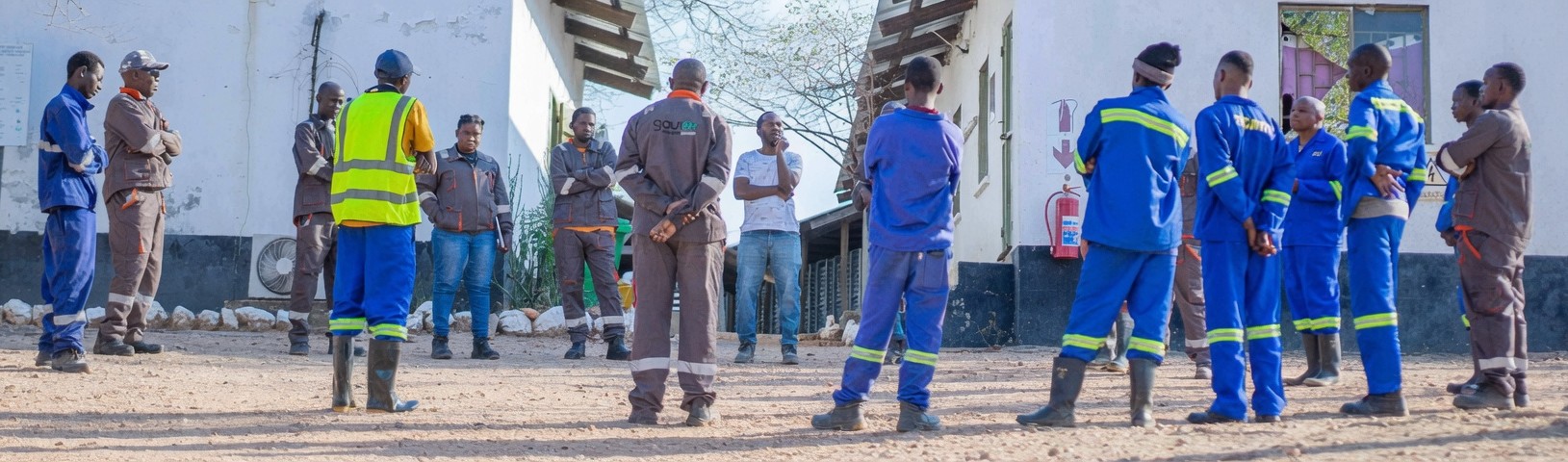
Access clearance has been completed at both the Namakande 1 and Namakande 2 exploration targets, where a bulldozer was used to prepare access for ground radiometric surveys.
Next Steps & Upcoming Catalysts
At Chisebuka, an RC drill programme of 12 holes for approximately 900 metres is expected to commence later this month, designed to provide grade confirmation of the gamma-derived estimates across the higher-grade zones. A diamond drill programme is subsequently planned for the Fourth Quarter of 2026, targeting further grade confirmation and the collection of core for metallurgical testwork.
At Muntanga North, maiden wide-spaced exploration drilling is now underway across targets refined by ground radiometric surveys, with results anticipated in the coming weeks. At Namakande 1 and 2, ground radiometric surveys are expected to commence following access preparation, with drill testing of both targets scheduled for the Third Quarter of 2026.
FAQs (AI-Generated)
Analyst's Notes





Subscribe to Our Channel






Stay Informed