Uranium Term Prices Hold Near 14-Year High Despite Fund Outflows: Lasting Supply Tightness or Short-Term Market Pressure?



Uranium term prices remain near a 14-year high despite fund outflows as utility demand, supply constraints, and fuel-cycle bottlenecks test the market outlook.
- Uranium term contract pricing sits near a 14-year high at approximately $93 per pound, even as spot prices have remained range-bound around $85 to $86 per pound, highlighting a gap between what utilities are willing to pay for long-term supply and current spot market pricing.
- Sprott Physical Uranium Trust posted a 2.5% net asset value gain in the first quarter of 2026 alongside $562 million in net redemptions, reversing the accumulation trend seen in 2025 and highlighting a growing disconnect between physical uranium fund flows and utility contracting.
- The International Energy Agency's Global Critical Minerals Outlook 2026 identifies conversion and enrichment, rather than mine supply, as uranium's primary bottleneck, with the top three countries controlling close to 70% of global conversion and enrichment capacity.
- Niger's stranded 1,800-tonne stockpile from the nationalized SOMAÏR joint venture and the unresolved outcome of the US Section 232 critical minerals review introduce two policy-driven sources of supply uncertainty, limiting available material and leaving future trade rules unresolved.
- Producers, developers, and explorers are responding to the projected uranium supply shortfall by diversifying across stable jurisdictions, advancing projects in stages, and expanding downstream exposure, strategies that reduce execution risk while increasing leverage to higher long-term uranium demand.
Fed Policy & Utility Contracting: Why Uranium's Long-Term Supply Deficit Still Drives Prices
The Fed held its benchmark rate at 3.50% to 3.75% in July, with three policymakers dissenting in favor of a rate hike, reinforcing expectations that borrowing costs will remain elevated. Higher interest rates are weighing on financial demand for uranium by increasing the opportunity cost of holding non-yielding uranium and raising financing costs for explorers, but long-term utility procurement remains resilient. TradeTech's long-term uranium price indicator has climbed to nearly $93 per pound, its highest level in 14 years, even as spot prices remain around $85 to $86 per pound and the Sprott Physical Uranium Trust reported $562 million in first-quarter net redemptions, highlighting the gap between short-term fund flows and sustained utility contracting.
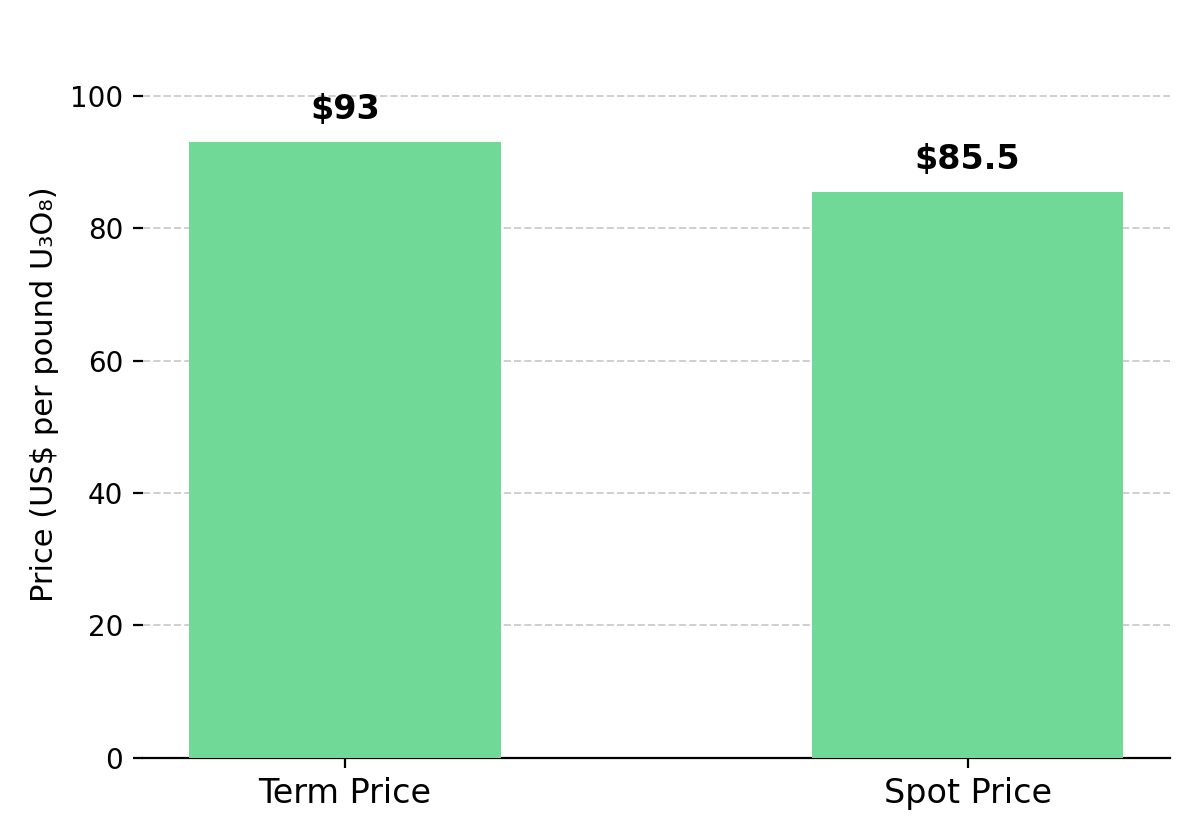
The difference does not necessarily indicate a weaker uranium supply deficit. Instead, it may reflect different buying horizons, with utilities continuing to secure long-term fuel contracts while physical uranium funds respond to changing interest rate expectations.
Phil Williams, Chief Executive Officer of IsoEnergy, a uranium developer, argues that the long-term uranium supply deficit remains the primary investment driver despite uncertainty around AI-related electricity demand:
“All of the noise around AI doesn't really impact the work that we've done on the fundamental thesis: there's a supply deficit. Exactly how much it is and when it really is, we can debate about that, but the deficit is real, and it's going to come and expand irrespective of how much new power comes in for what AI does and what data centers do."
Growing Reactor Demand & Declining Mine Supply: Why New Uranium Projects Are Becoming More Critical
Beyond short-term fund flows, the uranium market faces a widening gap between mine supply and reactor fuel demand over the next 15 years as production declines and reactor capacity expands. Current global mine production falls short of annual reactor fuel demand, and the gap is projected to widen as existing mines deplete and new reactors enter service. The shortfall is driven by existing reactor commitments rather than speculative demand, as reactors already operating or under construction require more contracted fuel than current mine supply can provide.

Phil Hoskins, Chief Executive Officer of Atomic Eagle, a developer advancing its Muntanga project in Zambia, argues that the projected gap between uranium supply and demand will require significant new mine production:
"Everyone talks about a very obvious supply-demand imbalance that's opening up, and it's an imbalance that's going to continue over time. Roughly 150 million pounds is being produced at the moment on the supply side and 200 million pounds is being consumed by the nuclear utilities, and by 2040 that supply of 150 is going to drop to 50 based on current production, and demand will double to 400 million pounds."
Hyperscaler-backed nuclear power purchase agreements add new uranium demand, but reactor fleet expansion and existing utility fuel contracts continue to account for most of the projected supply shortfall. Projects targeting first production before 2030 to 2031 are attracting greater attention because both the IEA and uranium producers identify that period as the point when existing mine supply begins to fall short of contracted reactor demand.
Niger's Supply Disruption & Mine Concentration: Why Stable Jurisdictions Are Attracting Capital
Global uranium supply remains concentrated, with Kazakhstan producing about 39% of global output and much of the remaining supply exposed to political risk rather than geological constraints. Niger's 2025 nationalization of the SOMAÏR joint venture removed one of the country's largest uranium operations from Orano's control, while an unresolved legal dispute has kept about 1,800 tonnes of yellowcake off the market. The disruption highlights why explorers in politically stable jurisdictions are attracting capital despite being at an early stage, with ATHA Energy raising C$63 million in the first quarter of 2026 to fund at least 24 months of exploration across its Nunavut and Saskatchewan projects, the latter located in a jurisdiction ranked third globally in the Fraser Institute's 2025 Investment Attractiveness Survey.
Troy Boisjoli, Chief Executive Officer of ATHA Energy, frames the strategy around where the broader uranium market is heading rather than around any single deposit.
"If we go back three years to when we were listed, our objective was quite simple… to maximize our exposure to the best uranium jurisdictions in Canada."
China's Acid Export Curbs & Enrichment Bottlenecks: Why Fuel Processing Is Becoming More Strategic
The International Energy Agency's Global Critical Minerals Outlook 2026 identifies conversion and enrichment, rather than uranium mining, as the main constraint in the nuclear fuel supply chain because the top three countries control nearly three-quarters of global uranium production and about 70% of conversion and enrichment capacity. As reactor demand grows faster than downstream processing capacity, fuel supply can remain constrained even if mine output is stable. That concentration is also increasing costs, with China's May 2026 sulfuric acid export restrictions raising reagent prices for in-situ recovery mines in Kazakhstan and other producing regions, while the US ban on Russian low-enriched uranium imports, effective since August 2024, requires Western enrichers to replace capacity that previously accounted for about 44% of global enrichment and nearly one-quarter of US utility fuel before the remaining waiver authority expires on January 1, 2028.
Section 232 Uncertainty & Federal Permitting Progress: Why US Uranium Projects Continue Advancing
US uranium trade policy remains unresolved, leaving producers and enrichers without clarity on future import rules. A January 2026 proclamation directed the Department of Commerce and the US Trade Representative to negotiate critical minerals agreements, including uranium, and report within 180 days on whether minimum import prices or other trade restrictions were warranted. The July 13, 2026 deadline passed without a public decision, leaving North American producers and enrichers uncertain whether future policy will tighten domestic sourcing requirements or maintain existing import rules. Separately, the US approved a civil nuclear cooperation agreement with Saudi Arabia that permits domestic uranium enrichment, expanding the long-term reactor pipeline while increasing the strategic importance of enrichment capacity and nuclear fuel security.
Higher uranium prices are allowing producers to generate stronger cash flow and reinvest in downstream expansion while reducing development risk. Energy Fuels produced more than 1.5 million pounds of uranium oxide in the first half of 2026 and is targeting 1.5 million to 2.5 million pounds for the full year, with its White Mesa Mill's byproduct rare earth and vanadium output adding a secondary revenue stream as the company diversifies beyond uranium. Meanwhile, enCore Energy is reducing project risk by advancing permitting ahead of construction, with its Dewey Burdock project securing a 20-year renewal of its federal Source Materials Licence under the FAST-41 program, leaving state permitting as the final approval before construction.
Project Validation & Permitting Progress: Why Developers Are Reducing Execution Risk
Developers without current production are reducing execution risk by completing technical studies and permitting before committing capital to a restart or first construction decision. IsoEnergy is applying that approach at its Tony M project in Utah, where beneficiation test work retained more than 90% of contained uranium while removing approximately 75% of processed volume. The company is incorporating those results into a preliminary economic assessment targeted for later in 2026 before making a restart decision. The sector is placing greater emphasis on validating project economics and metallurgical performance before committing capital, reducing execution risk ahead of construction or restart decisions.
Atomic Eagle is reducing jurisdictional and permitting risk before construction, rather than focusing on metallurgical optimization. The company has secured environmental and social impact assessment approval and a resettlement action plan sign-off for Muntanga, completing the principal permitting milestones required before a construction decision. It has also secured an option over the neighboring Sitwe project, expanding its Zambian land position by 38%. Both companies are reducing different project risks before committing additional capital. IsoEnergy is focused on metallurgical performance in Utah, while Atomic Eagle has prioritized permitting and jurisdictional readiness in Zambia.
Term Uranium Prices & Spot Market Weakness: Why Long-Term Fundamentals Still Support the Sector
Current uranium market indicators present mixed signals because long-term supply fundamentals and short-term financial market conditions are moving in different directions.
Term uranium prices near a 14-year high, limited conversion and enrichment capacity, policy-driven supply constraints in Niger, and a widening gap between reactor fuel demand and mine supply through 2040 all support continued pressure on long-term uranium supply. At the same time, Sprott's net redemptions, spot uranium prices that have remained range-bound for several weeks, and higher interest rates that increase discount rates for long-duration mining projects support a more cautious near-term outlook.
Both sets of evidence describe different parts of the uranium market: utilities secure physical fuel supplies over decades, while investment funds adjust capital allocation over much shorter time horizons.
The Investment Thesis for Uranium
- Term uranium prices near a 14-year high reflect sustained utility contracting, making them a stronger indicator of long-term demand than spot prices or fund flows.
- Limited conversion and enrichment capacity, rather than mine supply, has become the main bottleneck in the nuclear fuel cycle.
- Policy disruptions, particularly in Niger, have widened the uranium supply gap by keeping material off the market.
- Politically stable jurisdictions are attracting exploration funding by reducing political and permitting risk.
- Developers are lowering execution risk by completing technical and permitting work before construction.
- US federal permitting progress is reducing project risk despite unresolved Section 232 trade policy.
- Existing producers are using strong cash flow to expand downstream and geographically ahead of projected supply tightening around 2030 to 2031.
- Producers offer near-term cash flow, while developers and explorers provide greater upside to a widening uranium supply deficit.
The next several weeks should clarify whether recent uranium market trends reflect lasting changes in supply and demand or short-term market sentiment. Evidence supporting the long-term supply tightening thesis would include renewed buying by physical uranium funds, a Section 232 decision that strengthens domestic uranium sourcing without disrupting existing fuel supplies, and producer guidance confirming strong long-term contracting. Evidence against that thesis would include continued fund redemptions, a Section 232 decision that increases policy certainty without strengthening domestic demand, or producer commentary indicating weaker-than-expected contracting. Together, these developments will determine whether uranium equities continue to track near-term fund flows or long-term supply fundamentals.
TL;DR
Uranium markets are showing conflicting signals as term contract prices approach a 14-year high near $93 per pound while physical uranium funds experience significant outflows. The divergence reflects different market participants operating on different timelines, with utilities securing long-term fuel supply while funds respond to higher interest rates and short-term financial conditions. The long-term supply outlook remains supported by a widening gap between reactor demand and mine supply, limited conversion and enrichment capacity, and policy-driven disruptions such as Niger's stranded uranium stockpile. Companies across the uranium sector are responding by expanding in stable jurisdictions, advancing projects through technical validation, and investing in downstream capabilities to capture future demand growth.
FAQs (AI-Generated)
Analyst's Notes





Subscribe to Our Channel














Stay Informed