




Getchell Gold's 21% Resource Growth at Fondaway Canyon: $265 Million to Build, $1 Billion NPV


%20(1).jpg)
Getchell Gold's 2026 PEA puts Fondaway Canyon's NPV near $1 billion at $3,200 gold, with a 58.8% IRR and $265M capex - against a $46M market cap.
- The 2026 PEA delivers a pre-tax NPV8% of $1.0 billion and after-tax NPV8% of $905 million at a $3,200/oz gold price, against a market capitalisation of roughly CA$46 million.
- Just ten 2025 drill holes lifted the global mineral resource estimate by 21%, with indicated resources up 54% and inferred resources up 8% versus 2024.
- The PEA contemplates a 12,000 tonne-per-day mill producing an average of 150,000 ounces per year over a 10.1-year mine life.
- Total initial capital cost is estimated at $265.3 million, supporting a 1.5-year pre-tax payback period.
- Management points to an unresolved third-party claims dispute as a key factor weighing on the share price relative to the project's underlying value.
Gold's run to record prices has re-rated resource inventories across Nevada, but few juniors show the gap between market cap and headline project value as starkly as Getchell Gold Corp. The company's 2026 Preliminary Economic Assessment (PEA) on its flagship Fondaway Canyon Gold Project puts a pre-tax net present value of roughly $1 billion against a market capitalisation of around CA$46 million on 202.6 million shares outstanding - a discrepancy president Mike Sieb attributes partly to an unresolved third-party claims dispute rather than the underlying economics.
Fondaway Canyon sits 170 kilometres (105 miles) east of Reno in a jurisdiction consistently ranked among the best in the world for mining investment, home to 22 major producing gold mines and roughly 4 million ounces of annual production. The company describes the PEA as "fairly remarkable" and says it is now advancing the project toward a prefeasibility study ("PFS"), with the broader goal of derisking Fondaway Canyon on the way to feasibility, permitting, and eventual development.
A Resource Built on Just Ten Drill Holes
The 2026 MRE reflects a 21% global increase in mineral resources according to the company's own comparison table, driven almost entirely by a focused 2025 drill programme of only ten holes.The updated estimate now stands at 999,000 ounces indicated (22.1 million tonnes at 1.40 g/t Au) and 1.812 million ounces inferred (45.6 million tonnes at 1.24 g/t Au), versus the 2024 estimate, a 54% increase in the indicated category and an 8% increase in inferred. Within that total, 88% of resources are hosted in the Central Pit, with 9% in other open-pit zones and 3% underground; 8% of the global resource is classified as oxide.
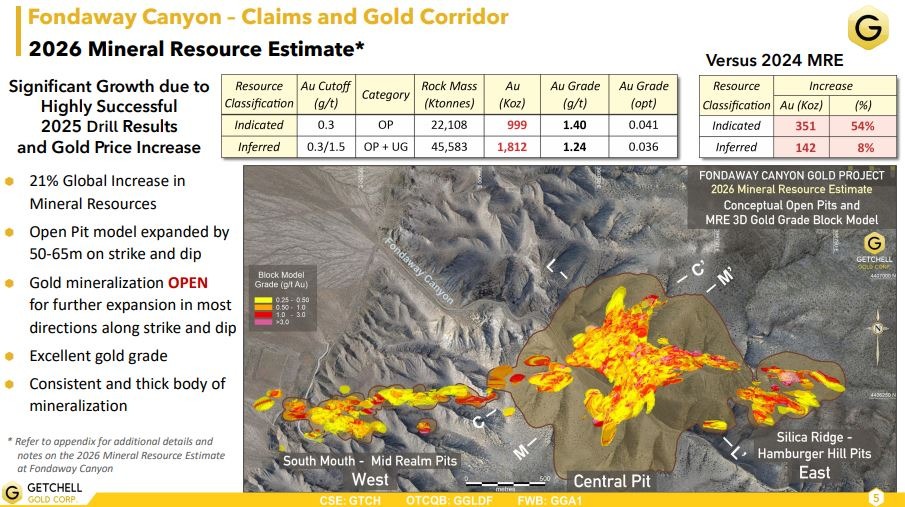
From 2025 drilling results, mineralisation remains open along strike and dip across the Colorado SW, Mid-Central, and Longitudinal sections, with the open pit model extended 60-65 metres down dip in 2025 alone, across a gold corridor that runs approximately four kilometres in length.
Sieb described the drilling's impact on the underlying economics directly:
"We picked $3,200 an ounce as our base case valuation, and that is still conservative to the robust gold market we find ourselves in. When you look at our PEA and the net present value at a discount rate of 8%, it's a billion-dollar net present value at $3,200/oz gold which is still conservative to today's market."
PEA Economics: Scale, Sensitivity, and Capital Intensity
The PEA contemplates conventional open-pit mining and a 12,000 tonne-per-day milling operation over an initial 10.1-year mine life. This translates to average annual production of 150,000 ounces at an 80% post-processing gold recovery rate, which management notes would rank Fondaway Canyon among the top ten gold-producing operations in Nevada. At the $3,200/oz base case, the project delivers a pre-tax NPV8% of $1.004 billion and after-tax NPV8% of $905 million, with a pre-tax IRR of 58.8% (53.1% after-tax) and payback of 1.5 years pre-tax (2.0 years after-tax).
A $4,000/oz high case lifts pre-tax NPV8% to $1.7 billion with a 99.1% IRR and one-year payback. Total initial capital cost is estimated at $265.3 million, comprising $100.0 million of process capital, $57.0 million of preproduction and facilities costs, and a $31.4 million (20%) construction contingency, plus $76.9 million of capitalised stripping spread over four years.
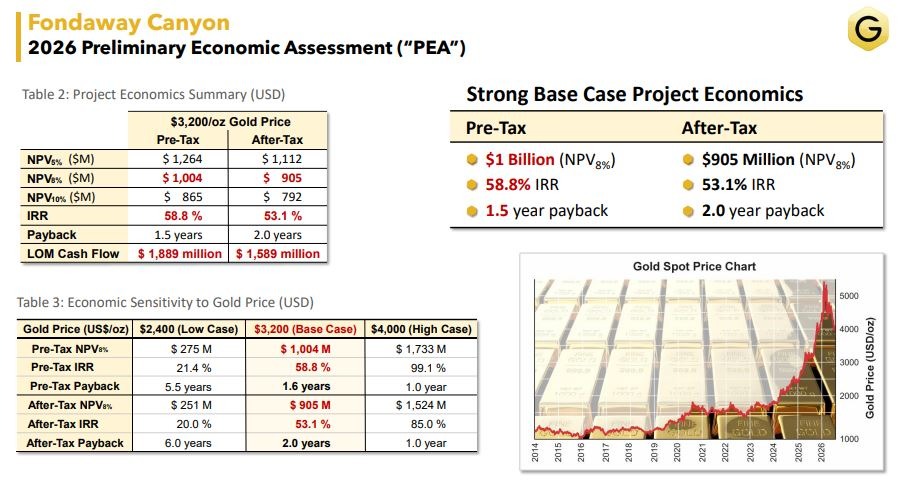
Management also moved its discount rate assumption from 10% to 8%, a change Sieb attributed to the added confidence that comes with a larger indicated resource base, and life-of-mine average cash costs are put at $1,740 per ounce: $1,373/oz of operating costs (mining, processing, and site G&A) plus $273/oz of transportation and refining and $94/oz of royalties. Sieb explained the reasoning behind the lower discount rate:
"One [reason is] because of the additional drilling. We also increased the amount of indicated resources in the mineral resource estimate, and that provides us with a higher confidence on the continuity and consistency of the mineralisation on the grade... if you look at comparative projects out there and their reports, most companies are using a 5% discount rate, so 8% in my opinion is still a highly conservative number."
The Claims Dispute Overhang
Getchell's roughly CA$46 million market cap sits well below what the PEA's headline economics would imply, and Sieb links much of that gap to an ongoing legal dispute over title to some of the company's claims. Getchell's core claims and those of its predecessors dating back to the company's 2020 acquisition of the project have been valid and in good standing, based on Bureau of Land Management and county filings for 70-75 years.
Sieb was direct about the connection between the litigation and the valuation gap, framing it as both a headwind and, in his view, an opportunity. The market capitalisation reflects the overhang rather than a rejection of the project's economics, and he suggested that investors comfortable with the litigation risk are effectively being offered the asset at a discount to its underlying value while the dispute plays out through the legal process.
Interview with Mike Sieb, President & Director of Getchell Gold
Financing the Path to Feasibility
Advancing from PEA to Pre-Feasibility will require continued drilling primarily converting inferred resources currently within the conceptual pit to indicated alongside further resource expansion, metallurgical test work, hydrogeological and geotechnical studies, and continued permitting activity over a timeline Sieb estimated at roughly two years. Sieb pointed to Getchell's capital structure: roughly 50.9 million warrants outstanding which management expects could bring in $2-10 million over the next 12 months on a largely non-dilutive basis.
He also cited meaningful insider ownership of 20% on a partially diluted basis as a source of continued support, alongside a broader market he characterised as wholly supportive of financing for attractive projects, noting that peer companies have raised tens to hundreds of millions of dollars over the past year. Sieb acknowledged that some dilution is inevitable when raising capital but said the prefeasibility budget itself is not a huge nut relative to the company's financing capacity, and that any dilution would fall within normal expectations for a project at this stage.
Concentrate Marketing and Development Optionality
Metallurgical test work over the past year has indicated a marketable, high-grade concentrate, produced via a conventional flow sheet of primary crushing, ball milling, rougher flotation, three stages of cleaner flotation, and gravity concentration ahead of thickening and filtering. The project's proximity to Interstate 80 and multiple local refineries gives Getchell several potential offtake routes, and Sieb noted that under current gold price conditions, shipping represents a relatively small share of total production cost, potentially widening the pool of buyers beyond local refineries if needed.
On the question of a strategic partner versus self-funded development, Sieb pointed to the project's comparatively low capital intensity - $265 million including contingency, not "a billion dollars to build a mine" - as giving the company flexibility either way: the capacity to fund and develop the project itself over time, or to entertain outside interest given what he expects will be a "highly coveted asset" in a region already seeing significant renewed investment and restart activity across the Great Basin. He described that optionality as putting the company in a strong position to decide what is best for shareholders as the project advances through prefeasibility, detailed engineering, and eventually toward a construction decision.
The Investment Thesis for Getchell Gold
- Fondaway Canyon's 2026 PEA shows a pre-tax NPV8% of roughly $1 billion and a 58.8% pre-tax IRR at a conservative $3,200/oz gold assumption, against a market cap near CA$46 million - a valuation gap investors should watch as the claims dispute resolves.
- The 2025 drill programme demonstrated strong per-hole leverage, lifting indicated resources 54% from just ten holes; continued drilling should keep converting inferred ounces and expanding the resource along strike and dip.
- Total initial capex of $265.3 million is modest relative to headline project value, supporting either a self-funded path or a strategic partnership without requiring outsized dilution.
- The unresolved title dispute over overstaked claims is the single largest identifiable overhang on the share price; resolution (or continued ambiguity) is a key catalyst/risk to monitor.
- Warrant exercises could bring $2.5-10 million into the treasury over the next 12 months with limited incremental dilution.
- Monitor the planned Plan of Operations filing with the Bureau of Land Management, targeted for year-end 2026, as the next major permitting milestone.
- A prefeasibility study is targeted within roughly two years; investors will watch for the pace of inferred-to-indicated conversion and any change in mine plan scale as that work progresses.
Macro Thematic Analysis
Gold's climb toward record levels has re-rated resource-stage projects across top-tier jurisdictions faster than it has re-rated the juniors that hold them. Nevada remains a magnet for that repricing: 22 major producing gold mines, roughly 4 million ounces of annual production worth close to $18 billion at current prices, and a jurisdiction consistently ranked among the best in the world by the Fraser Institute's annual survey. Against that backdrop, projects like Fondaway Canyon - with a billion-dollar NPV, a sub-11-year mine life, and proximity to existing infrastructure along the I-80 corridor - illustrate how much latent value can sit in junior-stage companies whose share prices have not kept pace with either gold's rally or their own resource growth. Sieb pointed to a broader wave of renewed activity across the region, describing multiple project restarts during a recent three-week tour of the Great Basin and a growing flow of capital into Nevada as the state "really starts to motor again." As he put it when discussing the market's reaction to the PEA:
"Everybody we've talked to, the minute you show them the numbers they perceive it and they understand it almost immediately. There's true clarity to the valuation that not only we see but everybody else who looks at this project sees."
The disconnect between that clarity and the share price is, in Getchell's case, tied to a specific and identifiable legal overhang rather than a broader market inefficiency - which is itself a distinguishing feature for investors trying to separate genuinely mispriced assets from those simply lagging the gold price.
TL;DR
Getchell Gold's new PEA on its Fondaway Canyon project in Nevada shows a pre-tax NPV8% of roughly $1 billion, a 58.8% IRR, and 1.5-year payback at a conservative $3,200/oz gold price, built on a resource base that grew 21% from just ten 2025 drill holes. Initial capex is $265.3 million for a 12,000 tpd operation producing 150,000 oz/year over 10.1 years. Despite the economics, Getchell's market cap sits near CA$46 million, a gap management attributes largely to an unresolved third-party claims dispute. A Plan of Operations filing is targeted for year-end 2026, with a prefeasibility study expected within roughly two years.
FAQ (AI Generated)
Analyst's Notes





Subscribe to Our Channel




.jpg)
Stay Informed






















