




Atomic Eagle Maps Muntanga to 2031 Production Through a 2027 Resource Update


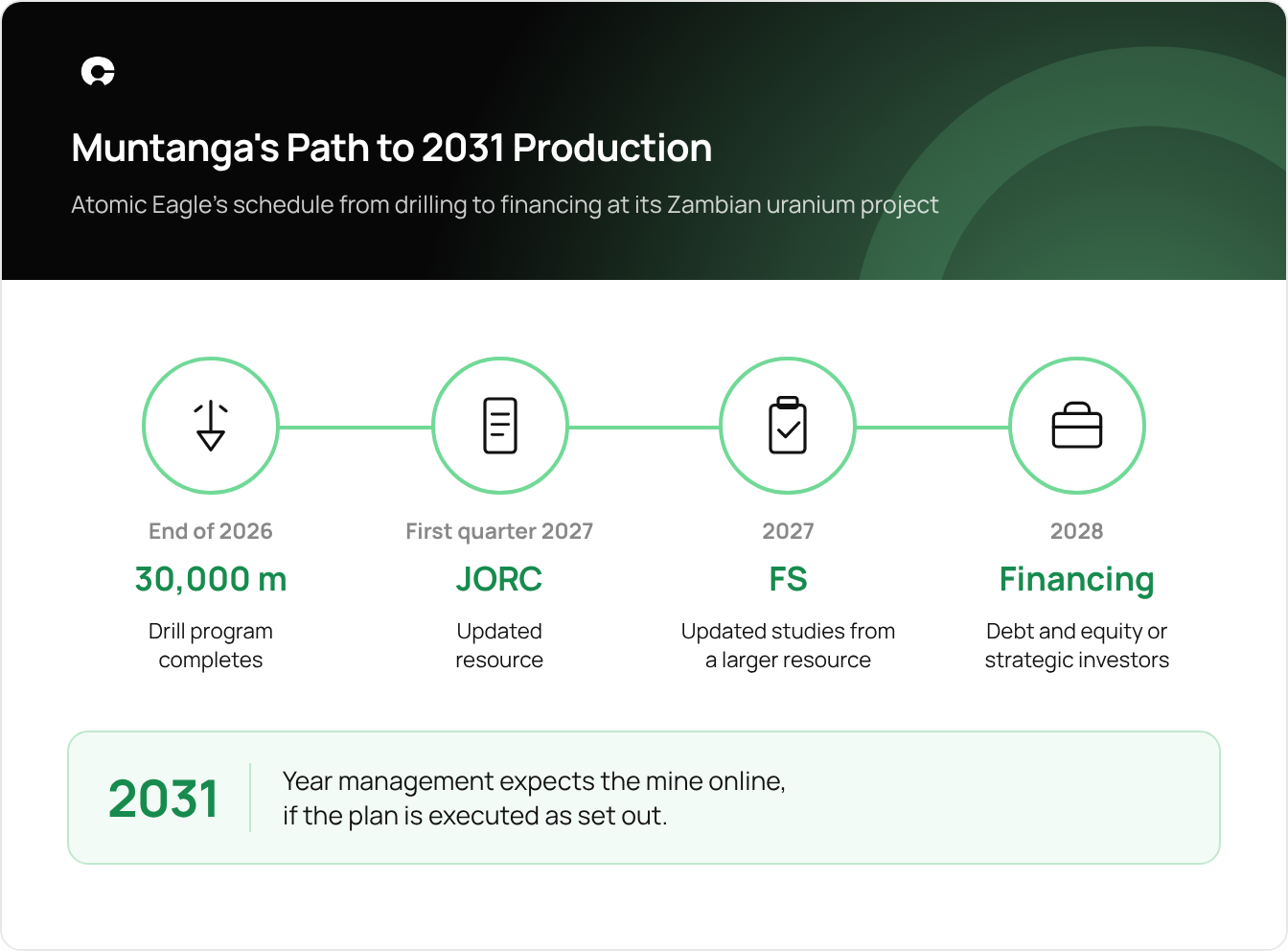
Atomic Eagle plans to drill Muntanga through 2026, update its resource in early 2027, and finance in 2028, with production expected by 2031.
- Atomic Eagle plans to drill Muntanga through the end of 2026, with an updated JORC resource in the first quarter of 2027.
- Updated studies run through 2027, followed by financing in 2028 and production by 2031 under management's current plan.
- The 2025 feasibility study (FS) outlined a mine producing about 2.2 million pounds (lb) per year for about 12 years.
- The 2025 FS left out 44% of Muntanga's 58.8 million lb JORC resource.
- Management does not want to choose the operation's scale until drilling has tested much of the exploration potential.
Atomic Eagle (ASX: AEU | OTCQX: AEUXF) has laid out a dated path from drilling to production at its 100%-owned Muntanga Uranium Project in Zambia. Drilling runs through the end of 2026, an updated JORC resource follows in the first quarter of 2027, and updated studies run through 2027. Financing comes in 2028, and management expects it to bring the mine online by 2031 if the plan is executed as set out. Muntanga is the company's flagship and its development asset, with a JORC resource of 58.8 million pounds (lb) of uranium oxide at 309 parts per million (ppm).
A 2025 Study Built on a Smaller Resource
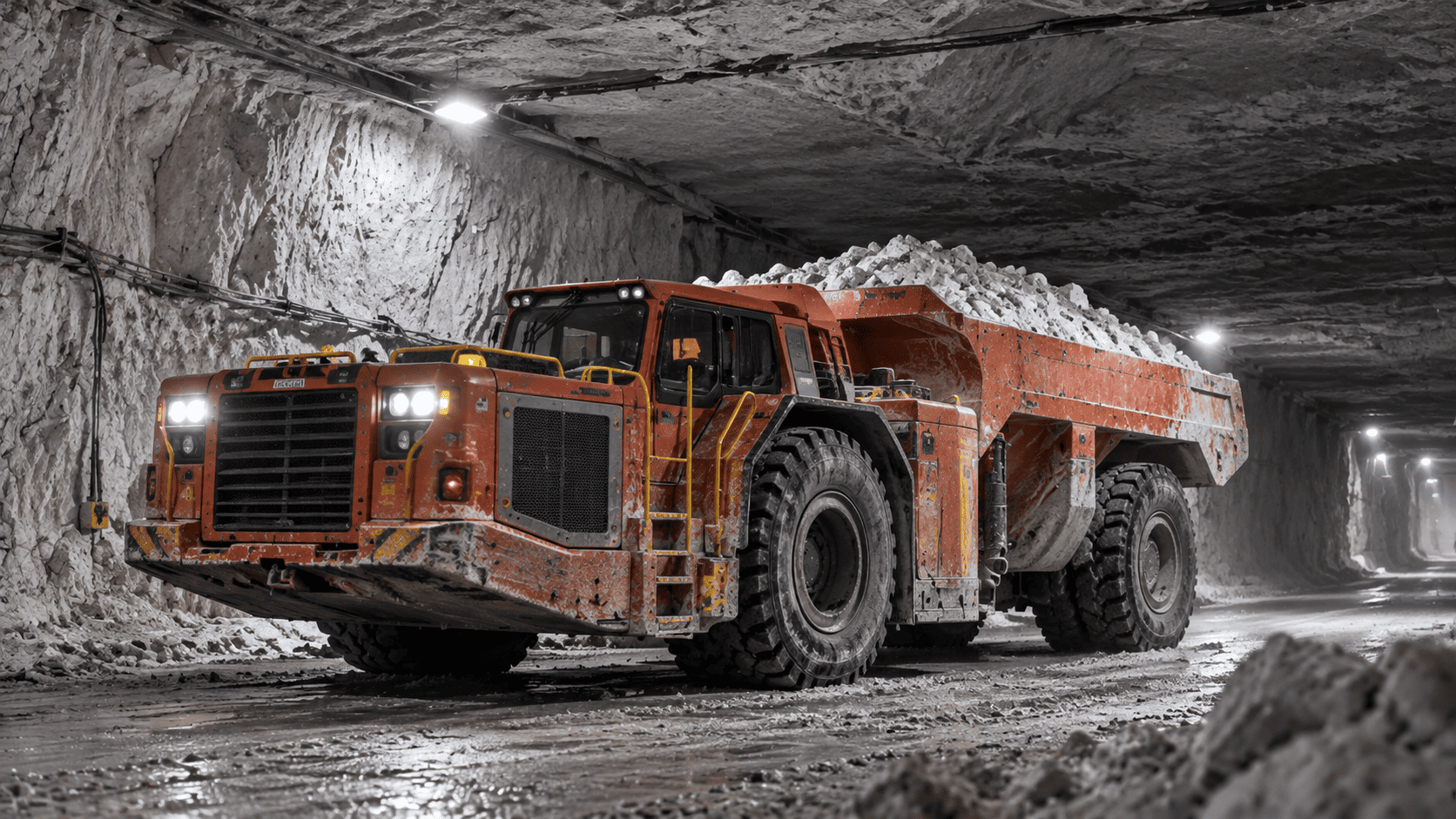
The 2025 feasibility study (FS), completed under the previous owner, GoviEx Uranium, outlined low-strip open-pit mining feeding a heap leach plant, in which an acid solution percolates through crushed ore stacked on a lined pad. It described a mine life of about 12 years at 3.5 million tonnes per annum, producing 25.3 million lb of uranium oxide at an average of 2.2 million lb a year. Pre-production capital was US$282 million, and operating costs were US$32.20/lb. Recoveries topped 90% over the mine life, and acid consumption averaged 20 kilograms per tonne of ore treated.
That study drew on 32 million lb of resources. Muntanga's resource grew 24% after the maiden drill program. The 2025 study stays in use as a technical baseline. Its strip ratio, the waste moved for each unit of ore, is 1.2 to 1 at Muntanga and just over 3 to 1 at Dibbwi East.
Chief Executive Officer of Atomic Eagle, Phil Hoskins, measures the 2025 operation against what a lender would fund:
"So a 12-year mine life at 2.2 million pounds per annum, in our opinion, was a bit premature to be coming out with studies and probably a little bit too small a scale for the economics to be financeable."
The next FS starts from that larger resource and from any growth this year's drilling adds.
Pounds Already Outside the Mine Plan
The 2025 FS left out 44% of Muntanga's current JORC resource. That share comprises 8.7 million lb in satellite deposits that showed positive cash flow and 6.0 million lb of inferred resources at Muntanga and Dibbwi East, excluded under NI 43-101 rules. It also includes 11.4 million lb of inferred resources from the 2026 upgrade. Infill drilling, which tightens hole spacing to firm up a resource, and technical studies will seek to convert those pounds into ore feed. Management considers the existing resource large enough to support updated studies and, in time, a development plan for an economic operation at today's uranium price.
Heap leach operations add scale at low capital intensity, and Atomic Eagle intends to increase throughput, a step management sees as having a disproportionately large impact on the economics.
Test work on the recently discovered Muntanga East uranium deposit recovered between about 81% and 86% of its uranium, using about 3 kilograms of acid per tonne during extraction. Those results will be incorporated into the ongoing technical studies for the project.
Drilling Through the End of 2026
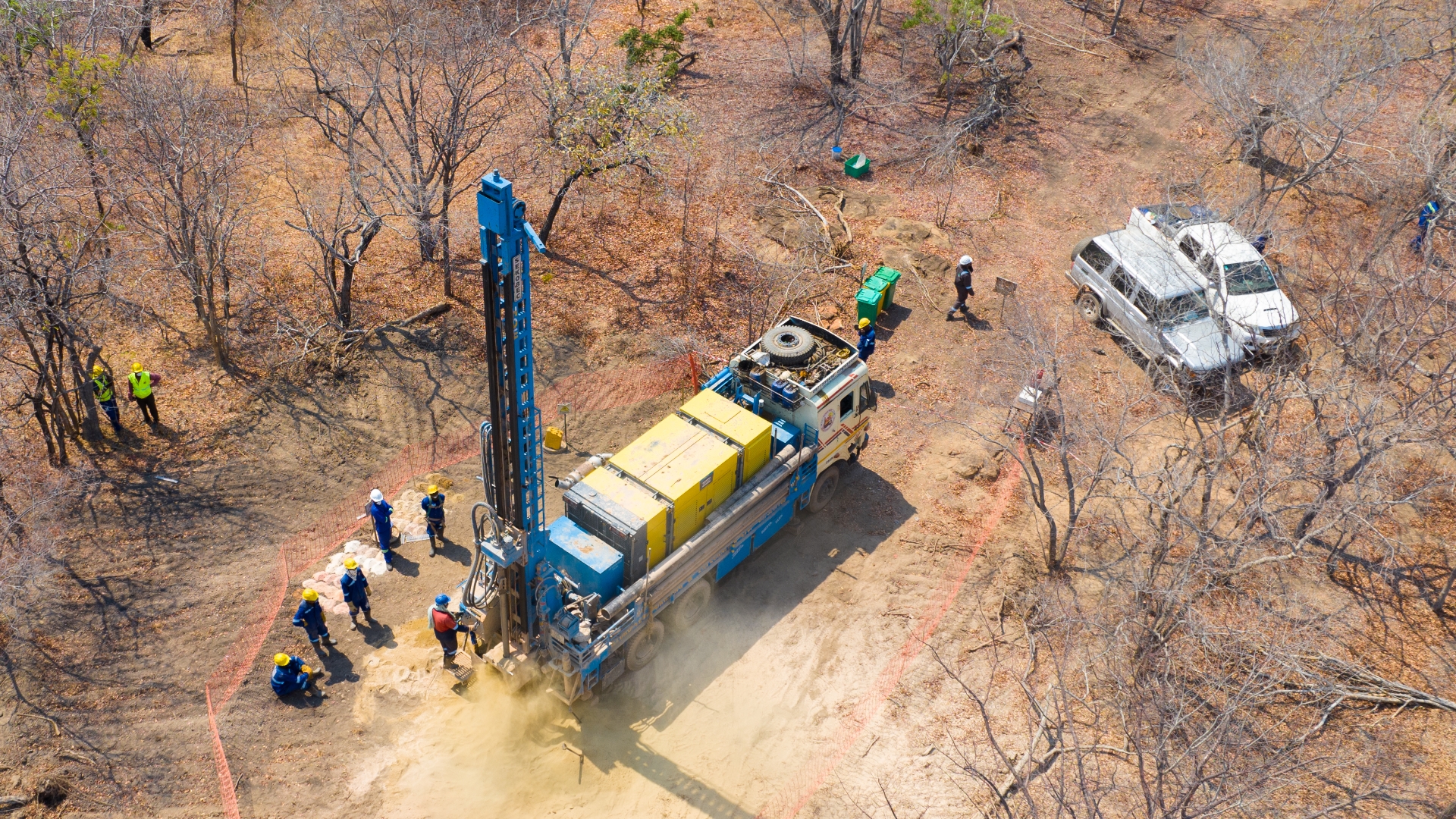
The size of the future operation depends on a 30,000-meter drill program that runs through the end of 2026. It pairs drilling to extend the known resource at Chisebuka with wide-spaced drilling targeting discoveries at Muntanga North and Namakande, with targets guided by historical soil sampling and natural radiation surveys.
Chisebuka was the largest addition in the 2026 resource upgrade, at 9.7 million lb at 220 ppm over an area of 800 meters (m) by 600 m, and is now Muntanga's second-largest deposit. Drilling this year has confirmed a higher-grade southwest zone of 830 m by 400 m, with drill intersections outside the resource including 12.7 m at 673 ppm.
Hoskins ties the size of the operation to the drilling still underway this year:
"We don't want to select that scale and go down that path until we're comfortable that we've tested a lot of the exploration potential. And that's what we're doing through the end of this calendar year."
Results from the new targets at Muntanga North and Namakande will continue to arrive through the end of the calendar year, ahead of the first-quarter 2027 resource.
Studies in 2027, Financing in 2028, Production by 2031
Muntanga goes into its 2027 studies with its permits in place. Muntanga's resources are held under granted mining licenses, and the project received environmental approval and approval of its Resettlement Action Plan in June. Zambia is the world's 7th-largest copper producer and places 3rd in Africa on an independent measure of investment attractiveness. Atomic Eagle is funded to complete its milestones over the next 12 months.
Asked when Muntanga would reach production if the plan holds, Hoskins puts a year on it:
"I think 2028 would be financing, which would see you online by 2031."
All types of financing will be available for Muntanga, management expects, whether traditional debt and equity or strategic investors like the one Bannerman brought in through CNNC's strategic investment. Atomic Eagle plans to keep several financing options open at once and will advance traditional debt and equity sources for all its assets.
Atomic Eagle also holds 60% of the Madaouela Uranium Project in Niger. Management sees potential for a partnering and financing process there to return money that could help fund Zambia in part or in whole.
What the 2031 Date Depends On
Management's 2031 production date depends on a sequence that starts with this year's drilling. Drilling through the end of 2026 feeds the first-quarter 2027 resource update, which in turn feeds the 2027 studies, and the studies precede financing in 2028. The year-end drill results and the 2027 resource are the next dated points on Muntanga's schedule.
FAQs (AI-Generated)
Analyst's Notes





Subscribe to Our Channel





Stay Informed


