Existing Mill Advantage Cuts the Capital Cost of New Gold and Silver Output


Toll milling, mill upgrades, and shared plants let gold and silver miners increase output with less capital, with signed deals turning savings into value.
- Gold and silver miners are turning to mills already built as a lower-cost route to new output, through toll milling, small plant purchases, circuit upgrades and shared plants.
- Developers with access to a nearby mill can exclude the plant, tailings facility, and much of the site infrastructure from their construction budgets.
- Toll fees, capacity priority, and recovery terms determine how much of the avoided plant cost a developer keeps and how much passes to the mill owner.
- Ore grade and metallurgy set how far feed can travel to a mill and which plants can recover the incoming metal.
- Producers owning mills are lifting recovery and freeing capacity for their own mines through circuit conversions, dedicated plants, and flotation redesigns, while adjacent deposits that share one plant avoid building a second.
Toll Milling Cuts a Gold Developer's Build Budget
Toll milling sends ore to a plant owned by another company, which processes it for a fee. The developer avoids funding a mill, tailings facility and much of the site infrastructure, and the plant owner fills the capacity its own mines no longer use. In Québec's Abitibi region, Agnico Eagle's past-producing Lapa mine sent its underground ore to the company's LaRonde mill.
Radisson Mining Resources, a gold explorer in Québec, built its July 9, 2025 preliminary economic assessment (PEA) for the O'Brien project around toll milling at IAMGOLD's Doyon mill, 21 kilometers by road. The plan carries no mill, tailings facility or camp on site, and estimates C$175 million in initial capital and an after-tax net present value (NPV) of C$532 million at a 5% discount rate and US$2,550/oz gold.
Doyon processes about 1,000 tonnes per day (tpd) from the Westwood mine and 2,000 tpd from the Grand Duc open pit, which is scheduled to finish in early 2027. The PEA assumes up to 2,000 tpd becomes available for O'Brien under a non-binding, non-exclusive memorandum of understanding with no commercial terms. Matt Manson, President and Chief Executive Officer, sees the most value in mining near existing infrastructure:
"If you're thinking, how is the best value extracted from that rock? It's always going to be via the existing shafts and mills and tailings facilities that are right on your doorstep."
Toll charges, escalation clauses, minimum deliveries, recovery accounting, and priority during plant outages determine how avoided capital is split between the deposit owner and the mill owner over the mine life. Plant owners weigh outside feed against their own ore, tailings consumption and equipment wear, and the fee prices that the owner could otherwise reserve.
Ore Grade & Metallurgy Set Which Deposits Profit From Nearby Mills
A nearby mill serves deposits close enough, and rich enough, to cover the cost of hauling ore to it, and only ore that its circuit can treat.
Each tonne trucked to a mill must carry enough recoverable gold to cover mining, haulage, processing and royalties. Grade, measured in grams of gold per tonne (g/t), determines how far ore can travel, while road conditions, seasonal load limits, and diesel prices widen or narrow the range.
Maple Gold Mines, a gold explorer in Québec, is evaluating a central mill at Douay blended with higher-grade feed from Joutel. Its June 11, 2026 technical report outlines 731,000 ounces indicated at 1.31 g/t in Douay's open pits, against 4.53 g/t indicated and 4.11 g/t inferred in Joutel's underground resource.
Mill Upgrades Emerge as a Low-Cost Growth Catalyst for Producers
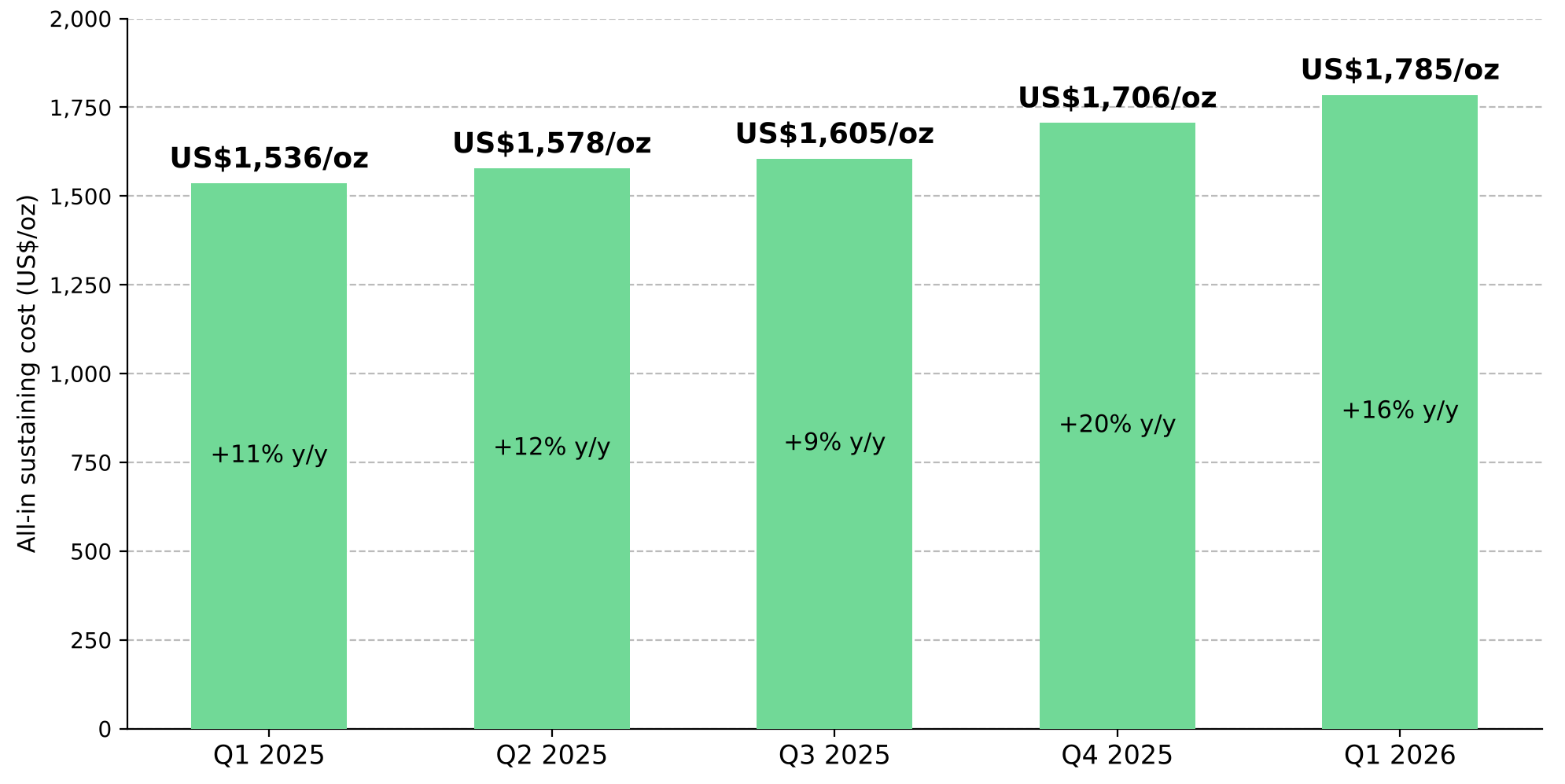
The costs of operating gold mines are rising. The industry’s average all-in sustaining cost (AISC), covering mining, processing, royalties and the sustaining capital needed to keep existing operations running, reached a record US$1,785/oz in the first quarter of 2026, up 16% year over year, according to the World Gold Council.
Producers already owning mills are adding output through circuit conversions, small plant purchases and flotation redesigns, spending capital on plants already built and running. Each project targets recovery, throughput or capacity allocation at a plant with an operating record and tailings facility in place.
New Found Gold declared commercial production at its Hammerdown gold mine in Newfoundland in September 2026, processing ore at its 700 tpd Pine Cove mill. The company is converting Pine Cove to gravity carbon-in-leach (CIL) for completion in Q4 2027, which it expects to lift Hammerdown recoveries from 87.7% to about 92%.
The expansion makes room for about 700 tpd of pre-concentrated feed from Queensway Phase 1, targeted for Q4 2027, at an initial capital cost of C$155 million in the 2025 PEA.
Mill Purchases Free Plant Capacity for Producers’ Own Mines
Santacruz Silver Mining, a silver-zinc producer in Bolivia and Mexico, processes ore purchased through its San Lucas business at its Don Diego, Bolivar and Porco plants, which run near full capacity. It bought a 500 tpd Bolivian mill with two flotation circuits for San Lucas ore, at a total investment of about US$14 million, targeting commercial production by year-end 2026.
Arturo Préstamo Elizondo, Executive Chairman and Chief Executive Officer, explains how the new mill frees room for the company’s mines to grow:
"We finally got the right mill in the appropriate area at the center of the Potosi district that will allow us to release 500 tons [more] per day on average… Our mines will be able to keep growing."
The US$14 million comprises a US$9.2 million purchase price and US$4.8 million for upgrades and working capital, for a plant about 5 kilometers from the company's Reserva mine. Porco's own plant has a capacity of 1,200 tpd. San Lucas produced 753,000 ounces of silver and 14,800 tonnes of zinc in the first half of 2026, about as much silver as Zimapan, the company's largest-producing mine.
Plant Redesigns Target Gold & Silver in Older Base-Metal Mills
Many older processing plants were built to recover base metals such as zinc, copper and lead, with flotation circuits tuned to produce base-metal concentrates. In such circuits, gold and silver, held in fine particles or bound to other minerals, often pass through to the tailings, leaving precious-metal value behind in the already-mined ore.
Luca Mining, a polymetallic producer in Mexico, is redesigning the 2,400 tpd plant at its Campo Morado mine, designed in 2009 as a zinc operation with low gold and silver recoveries. Phase 1 replaces sequential flotation with bulk flotation and a finer grind to target higher recoveries and throughput, with commissioning planned for 2028. Phase 2 adds cyanide leaching to produce gold-silver doré.
Campo Morado's 2017 resource estimate contains about 909,000 ounces of gold and 66 million ounces of silver in measured and indicated resources, while the mine produced 8,735 ounces of gold and 1.01 million ounces of silver in 2025. An updated technical report on the expansion is expected in the second half of 2026, with Phase 2 commissioning planned for 2029.
Consolidating Adjacent Deposits Around One Mill Cuts Millions in Capital
Adjacent deposits under a single owner can share a single processing plant, tailings facility, and power supply, removing the largest source of duplication from the combined capital plan.
G Mining Ventures, a gold producer in Brazil building the Oko West mine in Guyana, acquired neighboring G2 Goldfields in July 2026. The company estimates about C$850 million in avoided capital costs, chiefly for a second mill and tailings facility. First gold at Oko West is targeted for H2 2027. Louis-Pierre Gignac, President and Chief Executive Officer, explains why the expansion costs less on a shared site:
"We're looking at adding another 2 million tonnes of processing capacity, and that's going to be a pretty low capex because we don't need all the bells and whistles of supporting infrastructure to support that. It's already there as part of what we're building."
The Investment Thesis for Existing Mill Advantage
- Toll-milling plans resting on non-binding agreements carry their full value only once a signed, binding contract sets fees, minimum deliveries and capacity priority.
- Capacity freed as a host company’s own pits close opens a limited window, so satellite deposits with permitting and financing ready to match the host’s closure schedule stand to secure the best access.
- Mill purchases near existing operations release capacity at a producer’s main plants for its own ore, with commercial production on the stated schedule as the milestone confirming the gain.
- Gold and silver left in tailings by older base-metal circuits are upside within resources already defined, and technical reports quantifying recovery and throughput targets mark the first confirmation of a redesign’s value.
- Updated feasibility studies confirming combined throughput and avoided capital mark the re-rating point for adjacent deposits consolidated around one plant.
Mills already built have become a lower-cost route to new gold and silver output. Developers truck ore to a neighbor’s plant, producers buy small mills to free room for their own mines, and older circuits are redesigned to recover metal once sent to tailings. The avoided capital reaches shareholders as processing agreements are signed, conversions are commissioned, and studies confirm the assumed recoveries and throughput. Companies that turn mill access, upgrades, and consolidation into signed terms and delivered tonnes on schedule hold the strongest claim to the existing mill advantage. Companies relying on non-binding agreements or untested recoveries still carry the full execution risk.
TL;DR
Producers sending ore to a nearby plant can leave the mill, tailings facility and much of the site infrastructure out of their budgets, while higher-grade ore can travel farther to a central mill. Projects are converting circuits to lift recoveries, buying small plants to free capacity for their own mines and redesigning older base-metal circuits to recover more gold and silver. Owners of adjacent deposits are feeding both through one plant to avoid building a second. Toll terms, ore compatibility and capacity priority decide how much of the savings reaches shareholders, with signed contracts, timely commissioning and updated studies confirming the gains.
FAQs (AI-Generated)
Analyst's Notes





Subscribe to Our Channel










Stay Informed