Atomic Eagle's $202 Million Enterprise Value Now Sits Against 116.5Mlb at 1,282 ppm


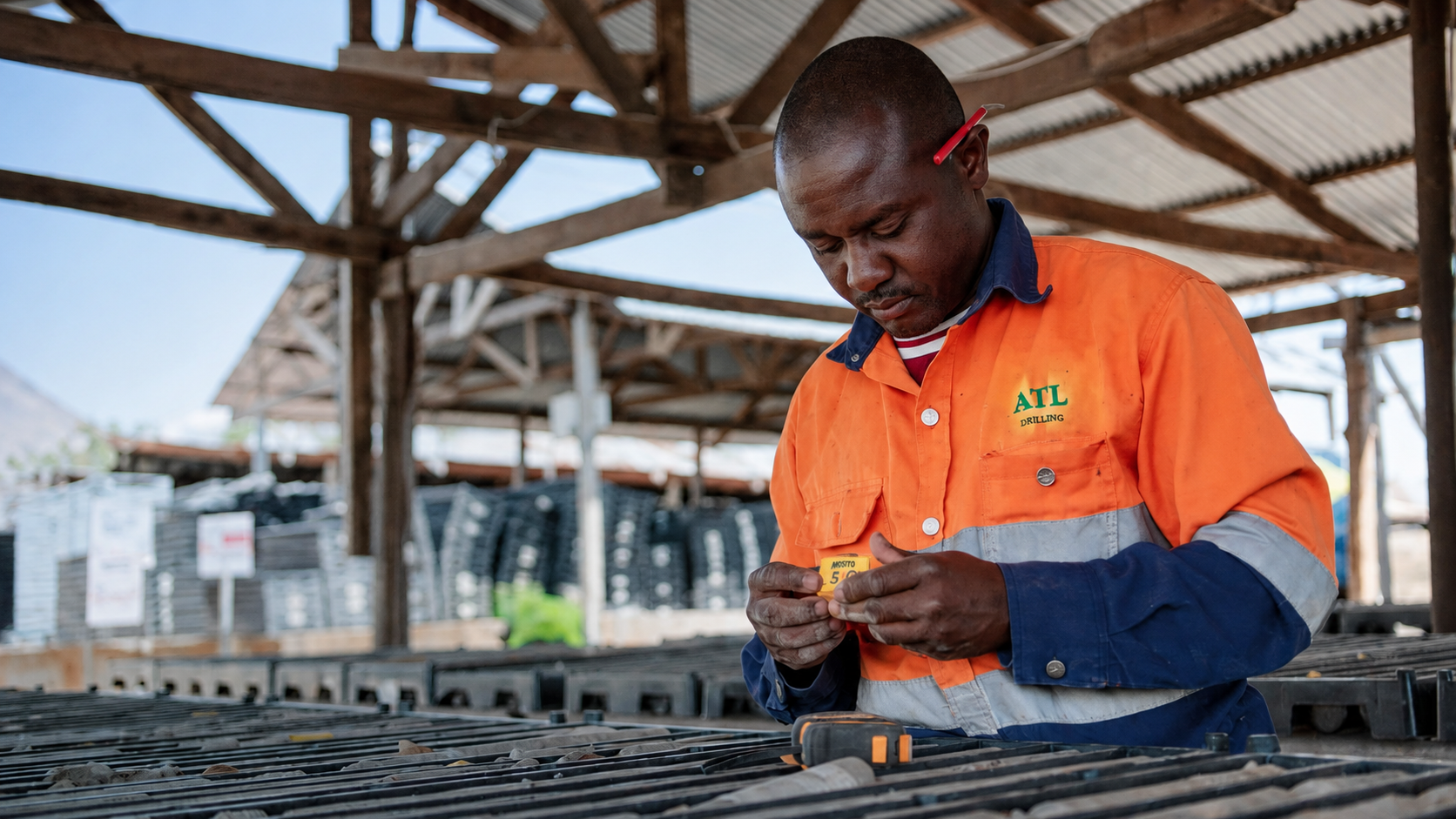
Atomic Eagle's $202M enterprise value is backed by 175 Mlb of uranium resources across Zambia and Niger, with Madaouela's high-grade driving near-term value.
- Atomic Eagle Limited's enterprise value stands at $202 million, against a $216 million market capitalization, $14 million cash position, and 392 million shares on issue at $0.55, per the company's August 2026 corporate presentation.
- Madaouela's reacquired foreign estimate runs 116.5 million pounds of uranium oxide at 1,282 parts per million (ppm), the highest grade among the development-stage peers Atomic Eagle cites.
- Muntanga's existing 58.8 million-pound Zambian resource still has 44% of its JORC-classified pounds excluded from the 2025 Feasibility Study (FS), a scale-up path that requires no new discovery.
- Converting Madaouela's foreign estimate to a JORC-compliant Mineral Resource Estimate (MRE) is Chief Executive Officer Phil Hoskins' immediate priority, targeted for the fourth quarter of 2026.
- Atomic Eagle frames its investment case around 4 value drivers: Muntanga resource growth, Muntanga development, Madaouela development, and strategic financing tied to the uranium market, not a single catalyst.
On August 24, 2026, Atomic Eagle Limited (ASX: AEU | OTCQX: AEUXF) confirmed the return of its Madaouela Uranium Project in Niger and published a foreign resource estimate to accompany it. The company's corporate presentation weighed that resource against the balance sheet behind it: 392 million shares on issue, a $216 million market capitalization, $14 million in cash, and a $202 million enterprise value.
The Balance Sheet Behind the Deal
That enterprise value now sits behind 2 advanced uranium assets rather than one. Atomic Eagle holds a 100% interest in Muntanga's JORC-compliant 58.8 million-pound Zambian resource. Alongside it sits the newly restored 60% interest in Madaouela's 116.5 million-pound foreign estimate in Niger. The presentation lists both assets as the basis for its enterprise value, rather than treating Madaouela as separate optionality sitting outside the core valuation.
Cash on hand corroborates a figure management gave separately: the company closed June with around $14 million. The company also pointed to approximately 50 million options and warrants held by strategic shareholders, including a Zambian pension fund, current director Govind Friedland, and former director Eric Krafft, that could raise a further $16 million if exercised early. Those options were the final tranche from GoviEx Uranium's last capital raise before Atomic Eagle's reverse takeover, meaning their exercise price and timing were set well before Madaouela's return was on the table.
Grade Sets Madaouela Apart in the Peer Set
Madaouela's average grade of 1,282 parts per million (ppm) carries the comparison. Atomic Eagle points to a set of uranium projects across Africa and Australia, split between development- and advanced-exploration-stage companies, and among the development-stage peers in that set, Madaouela's grade is the highest. Two advanced exploration projects carry higher grades: Alligator River at 10,900 ppm and Angela at 1,310 ppm, both with resources exceeding 20 million pounds, though neither has yet reached the development stage. In the closer development-stage comparison, Salamanca (514 ppm) sits well below Madaouela, while Tumas (255 ppm, 112.3 million pounds) remains the project most frequently cited as Madaouela's closest scale-comparable.
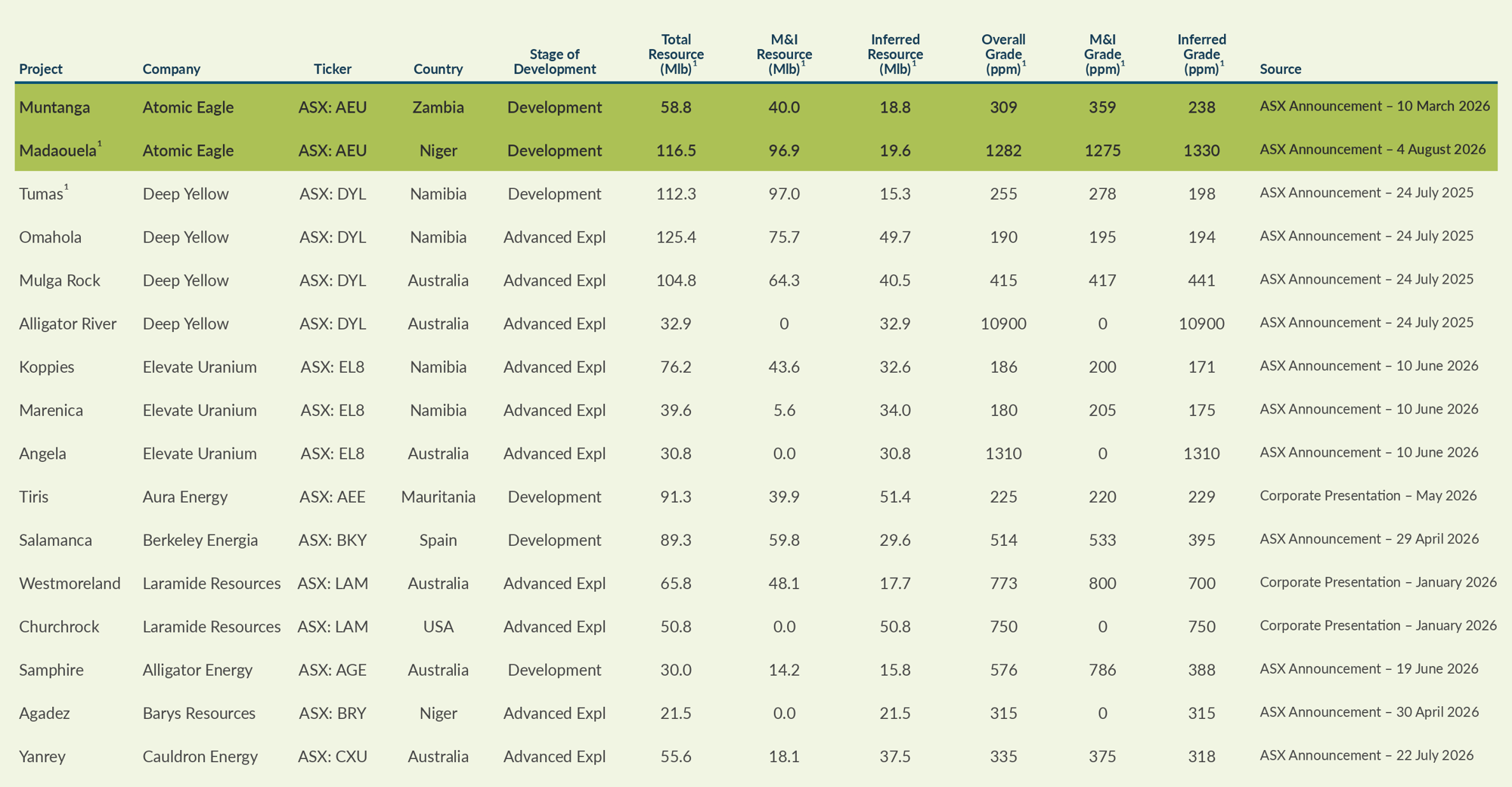
The measured and indicated portion of Madaouela totals 96.9 million pounds at 1,275 ppm, against a total resource of 116.5 million pounds. Tumas carries a similarly weighted split, with 97.0 of its 112.3 million pounds classified as measured and indicated, keeping both projects toward the higher-confidence end of the peer set. The company's own framing is Tumas-like scale with a higher-grade, smaller-tonnage profile.
Not 1 Value Driver, but 4
Atomic Eagle does not build its investment case around Madaouela alone. It lists 4 separate value drivers: Muntanga resource growth from an active 30,000-meter drill program; Muntanga's own development path toward an expanded Feasibility Study (FS); Madaouela's development advancement now that a mining convention is in place; and strategic financing tied to structural uranium supply deficits.
Chief Executive Officer Phil Hoskins described the next steps for converting the resource:
"We'll be looking to convert that resource from a foreign estimate, as it was originally released under NI 43-101. We'll convert that into a JORC resource in the back part of this year. We'll kick off the feasibility study process, where we genuinely believe there are a lot of opportunities to optimize this project, particularly around the approach to mining."
That conversion to a Mineral Resource Estimate (MRE) under the JORC Code, targeted for the fourth quarter of 2026, sits alongside a separate, smaller catalyst: a binding option over the 429-square-kilometer Sitwe project in Zambia, exercisable for US$400,000 after an initial US$200,000 exploration commitment. Neither event moves the enterprise value on its own. Together with Muntanga's ongoing drill results, the JORC conversion, and the Sitwe option decision, investors have a defined sequence of near-term technical and legal milestones. The test is whether the $202 million enterprise value still reflects a single-asset Zambian developer, or a company that has become a 2-country, 2-grade-profile uranium platform.
FAQs (AI-Generated)
Analyst's Notes





Subscribe to Our Channel

.jpg)





Stay Informed