A 3.4-Kilometer Uranium Trend Shows Why Continuity Comes Before Resources


Uranium resource categories turn on drill spacing. A 3.4-kilometer trend, linked in 2026, shows how explorers establish continuity before any resource estimate.
- Inferred resources assume geological and grade continuity, while indicated resources need drill holes spaced closely enough for that continuity to be reasonably assumed.
- As of October 5, 2026, 4 uranium developers had enterprise values ranging from C$765 million to C$8,539 million, and 7 exploration companies had enterprise values ranging from C$12 million to C$350 million.
- Few properties that are explored are developed into economically viable operating mines.
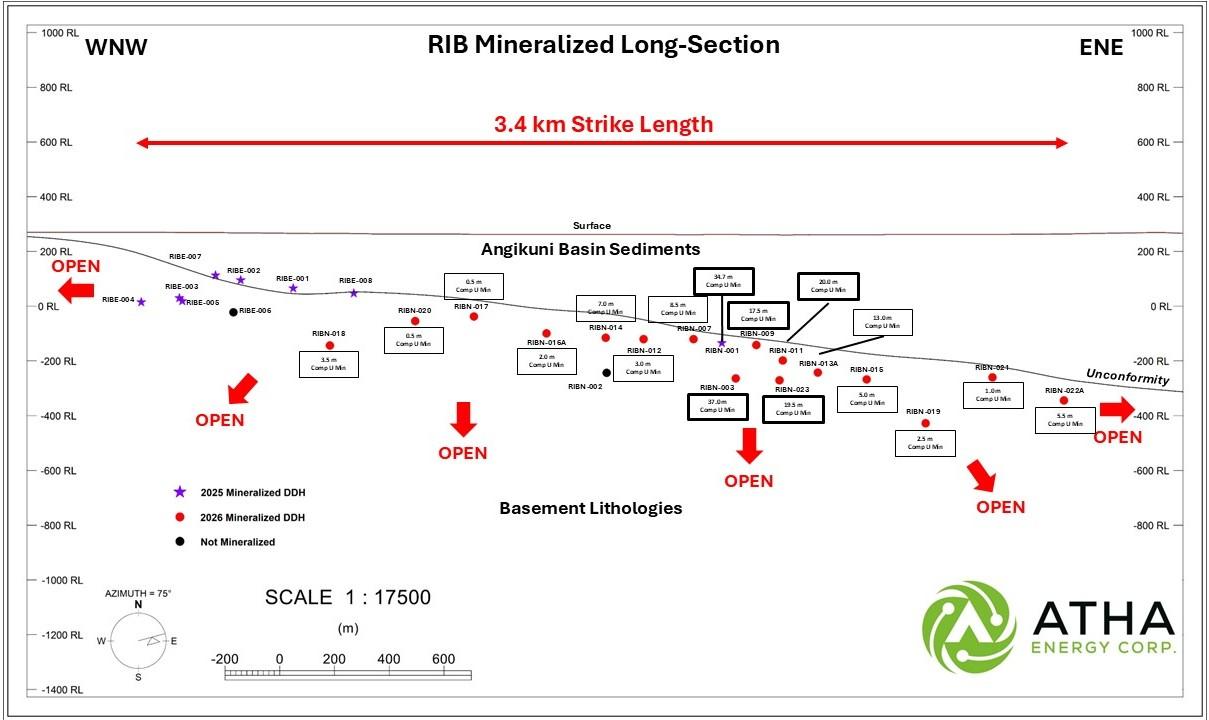
- ATHA Energy's 2026 drilling at Angilak connected the RIB North and RIB East discoveries over a distance of 3.4 kilometers (km), with 21 of 23 holes intersecting uranium mineralization.
- ATHA Energy has no current mineral resources at Angilak, and assay samples from the 2026 holes have been submitted to the Saskatchewan Research Council.
Introduction
A uranium discovery hole confirms mineralization at a single point in the ground. It does not show how far that mineralization extends, how it behaves between holes, or whether it is continuous enough to be estimated as a mineral resource. Under the definitions of the Canadian Institute of Mining, Metallurgy and Petroleum, those questions are answered by sampling and by how closely drill holes are spaced.
A mining project moves through concept, exploration, discovery, feasibility, development, startup, and depletion. Between discovery and a first resource estimate, an explorer needs enough drilling for geological and grade continuity between separate intersections to be reasonably assumed. Step-out drilling places new holes at distances from earlier intersections, in the direction the mineralized structure runs across the ground, known as its strike, to test whether mineralization extends between them.
Industry Context
The uranium industry is small compared to other commodity and energy industries. Demand is international, but supply comes from a relatively small number of companies operating in only a few countries. Primary production is concentrated among a limited number of producers and in specific geographic areas.
Enterprise value is the market value of a company's equity plus its debt, less its cash. As of October 5, 2026, the uranium developers NexGen had an enterprise value of C$8,539 million, Paladin C$4,229 million, Denison C$3,617 million, and IsoEnergy C$765 million. The 7 exploration companies in the same comparison ranged from C$12 million to C$350 million.
Uranium is used mainly as fuel for nuclear power plants, and nuclear power competes with oil, natural gas, coal, hydroelectricity, and renewable energy. Growth in the industry depends on continued and increased acceptance of nuclear technology as a source of base-load electricity.
Emerging Practices & Industry Progress
Mineral resources are divided, in order of increasing geological confidence, into inferred, indicated, and measured categories. An inferred resource is estimated from geological evidence and limited sampling, with geological and grade continuity reasonably assumed but not verified.
An indicated resource requires detailed, reliable information from drill holes spaced closely enough to reasonably assume continuity of geology and grade. Its confidence is high enough to support mine planning and an evaluation of economic viability. A measured resource needs holes spaced closely enough to confirm both geological and grade continuity, so each step up the categories calls for denser drilling and more sampling.
Remaining Challenges
Few properties that are explored are developed into economically viable operating mines, and even preliminary due diligence can show adverse results that lead to a project being abandoned. Whether a deposit is commercially viable can turn on its size and grade, unexpected geological formations and metallurgy, proximity to infrastructure, financing costs, and metal prices.
The uranium price has historically exhibited volatility and large short-term movements. A decline can force a reassessment of a project's feasibility and delay its progress. Upgrading resources to reserves, confirming reserves are sufficient to mine, and obtaining environmental approvals and permits each require time and expense.
The uranium exploration and mining business is competitive in all phases of exploration, development, and production. Exploration and development projects also face operational risks, including equipment breakdowns, accidents, labor disputes, and the inability to obtain property access rights.
Company or Project Examples
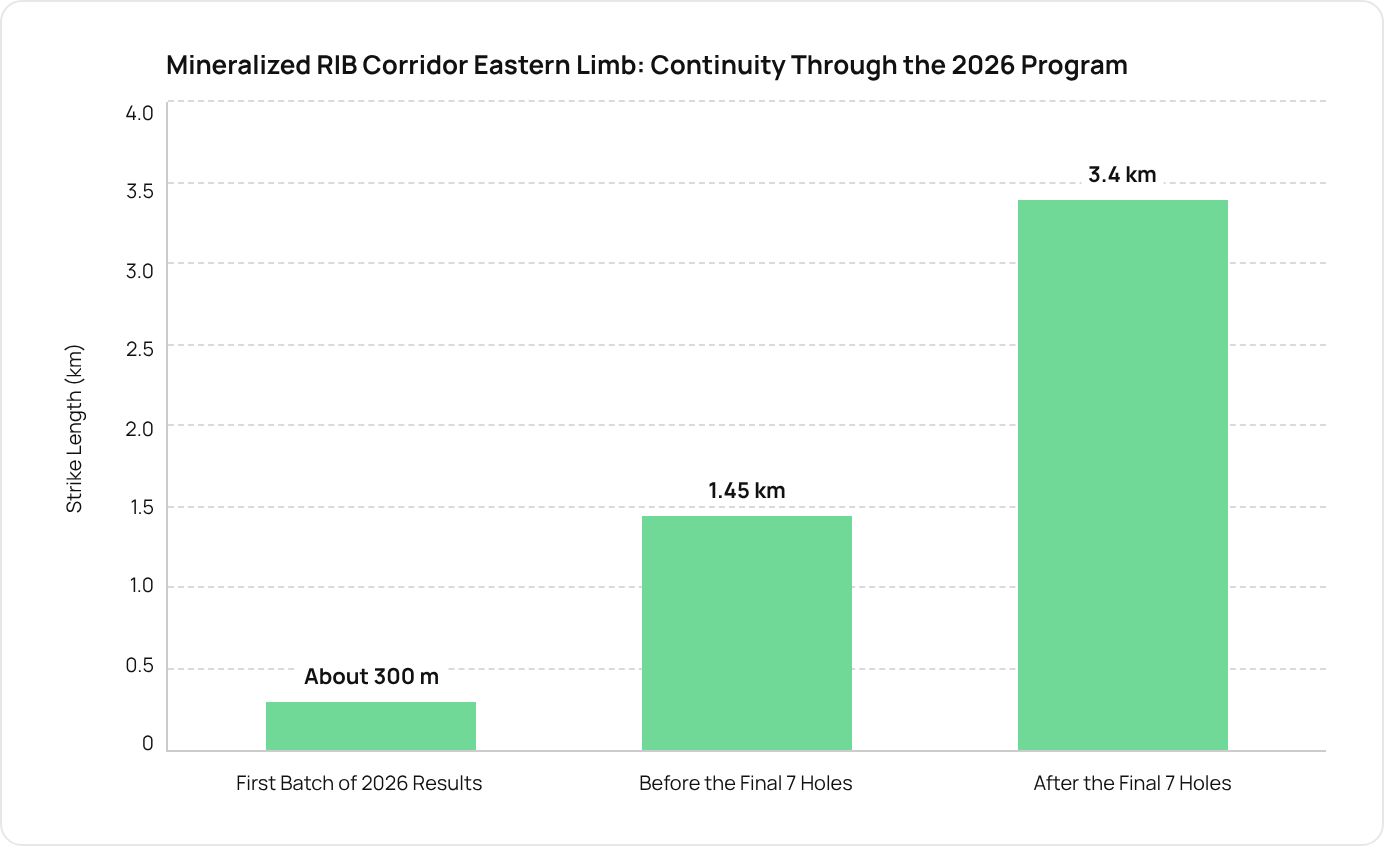
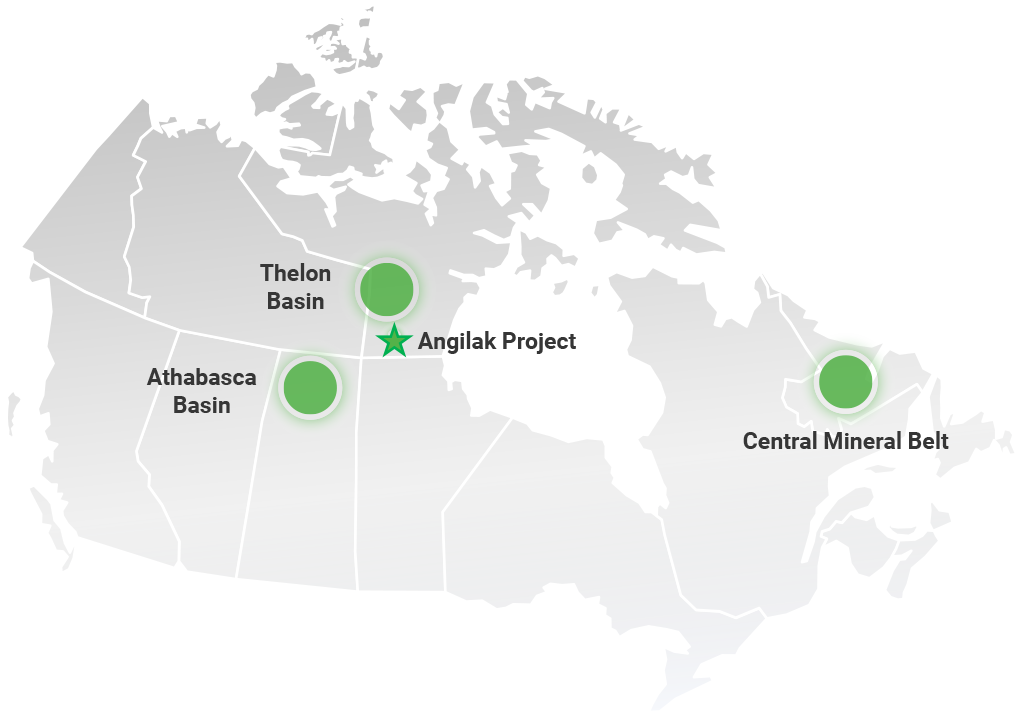
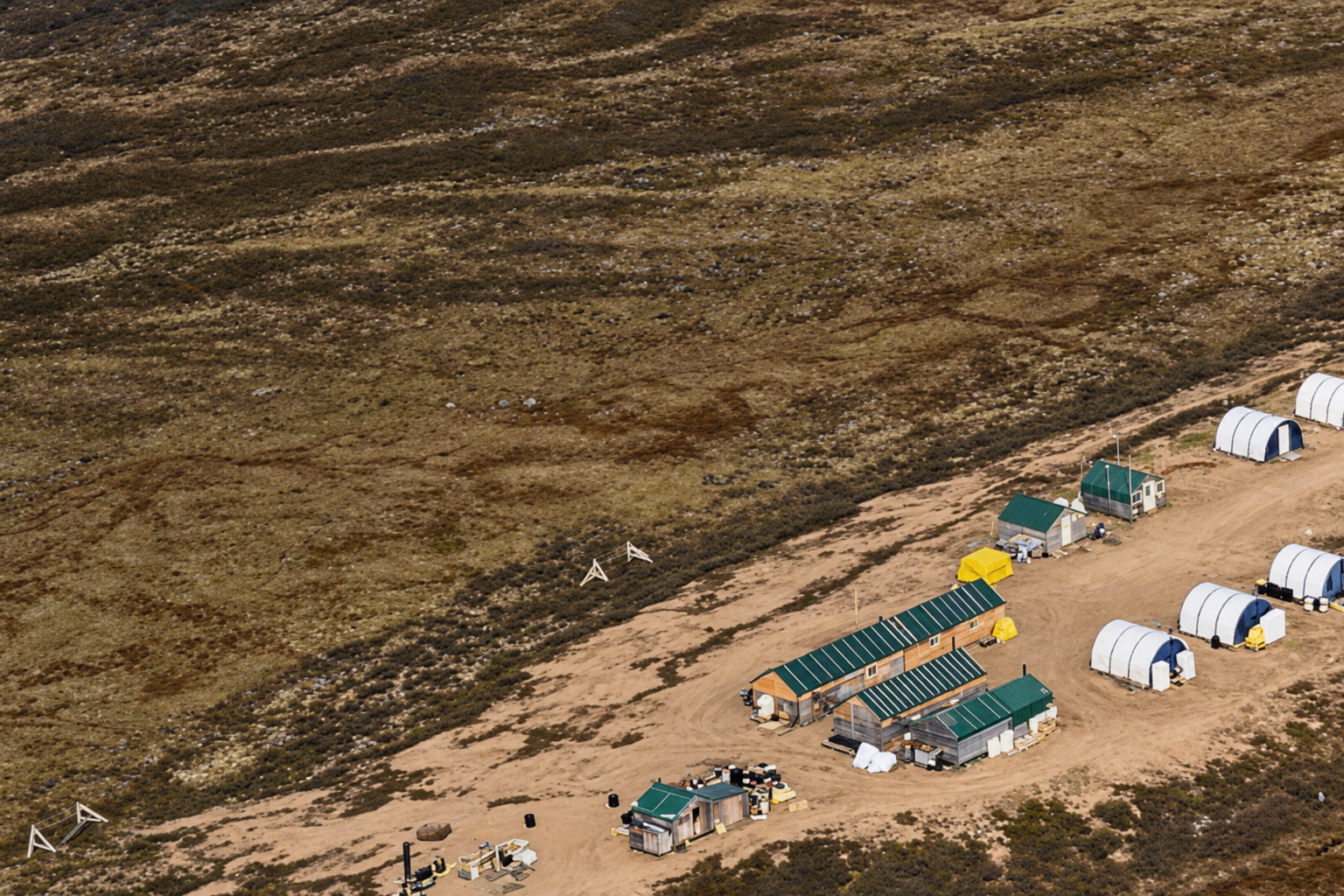
ATHA Energy (TSXV: SASK | FRA: X5U | OTCQX: SASKF) completed its 2026 drilling on the Mineralized RIB Corridor at its 100%-owned Angilak Uranium Project in Nunavut, with 21 of 23 diamond drill holes intersecting uranium mineralization. The program connected the RIB North and RIB East discoveries, expanding mineralized strike length on the corridor's Eastern Limb from 1.45 kilometers (km) to 3.4 km. The Eastern Limb remains open and unconstrained, and the hole at its northeast extent returned 5.5 meters (m) of mineralization across 6 zones. Mineralization occurs on 2 separate horizons, or separate mineralized zones, and the secondary Western Limb horizon has been traced over about 220 m. Early indications are that it may connect with the RIB West discovery over a possible strike length of about 3.0 km.
Chief Executive Officer of ATHA Energy, Troy Boisjoli, ties the 2026 program to the spacing of its 2025 discovery holes left behind:
"We had holes as widely spaced as 2 km, a km and a half apart. Well, you can't go from 2 km to delineation space drilling."
Management says that spacing could not support delineation drilling with a high degree of confidence, that 2024 and 2025 went to addressing discovery risk, and that the 2026 objective was to define continuity. The corridor's 4 discoveries, RIB North, RIB East, RIB West, and RIB South, were identified across a 12-km strike during the 2025 program. ATHA Energy says the first batch of 2026 results covered about 300 m, and that the holes that had defined continuity by September were spaced 125 to 300 m apart. Continuity had reached 1.45 km before the final 7 holes of the program extended the connected limb to 3.4 km. All 7 of those holes intersected uranium mineralization, and a step-out about 850 m northeast of the discovery hole recorded a peak radioactivity reading of 78,785 counts per second over 0.1 m.
Speaking in September, Boisjoli described how the results to that point had sharpened the team's read on targets:
"Our understanding's evolving rapidly, our ability to hone in on targets and convert targets to mineralized intersections, the predictability's increasing. And in turn, the confidence is increasing."
He gives 2026 and the year after it different jobs:
"So, this year it's about outlining continuity. Next year, then that sets up for maturing a portion of this."
ATHA Energy has no current mineral resources, inferred or indicated, at Angilak or any of its other properties. On the Eastern Limb, the 2026 holes outlined an open, higher-grade, thicker sub-zone measuring about 300 m along-strike and 300 m down-dip, or down the slope of the structure, near the 2025 discovery hole. Five holes in the sub-zone returned 17.5 m to 37.5 m of total composite mineralization, the summed length of a hole's mineralized intervals, with the 34.7 m figure based on assays. The other widths come from preliminary downhole gamma-probe readings of radioactivity, and intervals above 300 counts per second are considered mineralized because 2024 and 2025 assays showed that such readings typically return grades above 0.01% uranium oxide. All widths are measured along the drill core; the true thickness of the zones is yet to be determined, and assay samples have been submitted to the Saskatchewan Research Council.
Regional or Jurisdictional Perspective
The Athabasca Basin has produced over 900 million pounds of uranium oxide and holds known resources of 606,600 tonnes of uranium oxide. Canada's highest uranium mine grades reach 16.36%, against 2.64% in Niger, 0.75% in Kazakhstan, 0.06% in Australia, and 0.05% in Namibia.
The Athabasca Basin is home to the largest and highest-grade uranium deposits in the world, and the Central Mineral Belt in Labrador is home to the Michelin Deposit, among the largest in North America. Saskatchewan was ranked 3rd in the world for mining investment attractiveness, and Newfoundland and Labrador 14th. Nunavut hosts Orano's Kiggavik deposit and the Angikuni Basin, which hosts Angilak and has only recently been explored for uranium.
Industry Outlook
Inferred resources, the lowest-confidence category, are not mineral reserves and lack demonstrated economic viability. Moving beyond that category takes the closer drilling and detailed, reliable sampling that the higher categories require.
For investors following uranium explorers, the inferred, indicated, and measured categories give a common yardstick across projects. A discovery's progress toward a resource can be read from how closely its holes are spaced and whether assays and true thickness have caught up with its gamma-probe widths.
FAQs (AI-Generated)
Analyst's Notes





Subscribe to Our Channel




Stay Informed