




Bayan Mining & Minerals: A New US Rare Earth Story Commencing 2026 Drilling Program


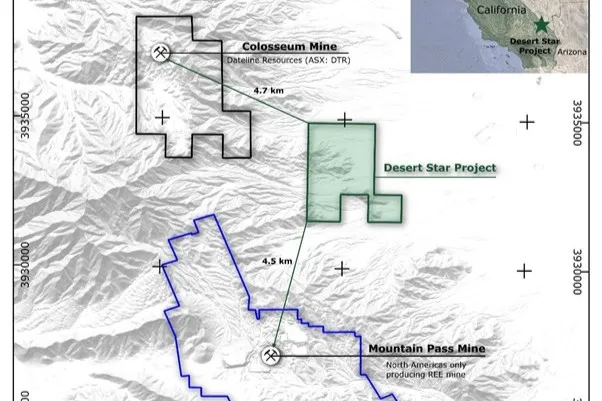
Bayan Mining advances Desert Star rare earths 4.5km from Mountain Pass, June drilling tests 6.68% TREO samples, exclusive processing patents target US govt funding
- Bayan Mining's Desert Star asset shows surface samples of up to 6.68% total rare earth oxides and strong geological analogues to the producing operation in nearby Mountain Pass which is the only US producing rare earth mine.
- Maiden 1,000-meter RC drilling program scheduled for June 2026, targeting high-grade surface anomalies and deeper extensions (100-300m depth), with results expected July-August and flexibility to expand based on success
- Exclusive licensing of four rare earth processing patents from Colorado School of Mines, including single-stage HCl leach technology that could improve recoveries from 50-60% to 90%, positioning for US government funding opportunities
- Company positioned to benefit from US government push for domestic critical minerals supply chain, with access to Department of War and Department of Energy non-dilutive funding as Australian-based friendly nation
- $2.8 million cash reserves sufficient for multiple drill programs, backed by 62 Capital, with secondary Bayan Springs gold-silver project in Nevada's Carlin Trend providing portfolio optionality
Bayan Mining and Minerals (ASX:BMM) is positioning itself at the intersection of US critical minerals policy and geological opportunity. With rare earth projects in California and gold-silver assets in Nevada, the company has emerged during a pivotal moment for American supply chain security. Following Chinese export restrictions on rare earth elements, the US government has accelerated efforts to establish domestic production capabilities, creating both strategic imperative and commercial opportunity for developers with credible projects on American soil.
Desert Star: Geological Model
Bayan Mining's flagship Desert Star rare earth project sits 4.5 kilometers from Mountain Pass, the only operating rare earth mine in the United States. This proximity is more than geographic convenience as it represents geological validation and infrastructure access that could materially reduce development risk compared to greenfield projects in unproven terrains.
The Desert Star project comprises 117 lode claims acquired through greenfield staking in California. Surface sampling has returned grades up to 6.68% total rare earth oxides (TREO), with mineralogy indicating the presence of monazite, allanite, and xenotime which are key rare earth-bearing minerals associated with light rare earth magnet production. The geophysical signatures including heavy gravity anomalies, low magnetic signatures, and radiometric indicators mirror those observed at Mountain Pass, suggesting the presence of a similar geological system beneath Bayan's tenure.
The company's geological model proposes a dual mineralisation scenario of potential carbonatite system at depths 100-300 meters overlain by monazite mineralisation near surface. The interpretation derived from magnetic and gravity inversions combined with surface mineralogy and petrology will be tested in the upcoming drilling campaign.
Maiden Drilling Program: June 2026 Catalyst
The imminent drilling program represents the first subsurface testing in this area and carries significant news flow potential for shareholders. The company has designed a targeted 1,000-meter reverse circulation (RC) program focused on three high-priority target areas identified through integration of geochemistry, radiometrics, and structural interpretation.
The decision to commence with RC rather than diamond drilling reflects a pragmatic focus on efficiently testing intersection widths and grades at depth. CEO Nathan Kong explained the signitifacne of understanding TREO intersection:
"The drilling is our primary driver to understand. We've done a lot of the early early work. We're going to be testing on the field as well as additional surface sampling whilst we are running the field program. It's multitude of geological activities that will be running in the next few months to generate so we can prove our understanding of what we know at Desert Star."
Importantly, Bayan has secured permitting capacity to expand the program substantially if initial holes deliver encouraging results. This flexibility backed by sufficient treasury to fund multiple drill campaigns positions the company to capitalise on discovery without requiring a pause to raise additional capital at potentially disadvantageous terms. Results are anticipated in July or August with a successful program leading directly into Phase 2 expansion drilling.
Rare Earth Technology Patents
Beyond exploration, Bayan has secured exclusive licensing rights to four rare earth processing technology patents from the Colorado School of Mines, developed by Dr. Corby Anderson. These patents span the value chain from beneficiation through to yttrium upgrading, addressing key bottlenecks in rare earth processing economics.
The most commercially significant patent involves a single-stage hydrochloric acid leach process that eliminates the caustic crack step, traditionally a major cost and environmental challenge in rare earth processing. At limited bench scale, this technology has demonstrated the potential to increase recoveries from the 50-60% range achieved at Mountain Pass to approximately 90%. If validated at pilot scale, this technology could materially improve project economics across the North American rare earth sector.
The yttrium upgrade patent addresses another strategic gap. By producing a highly enriched yttrium stream, the technology could significantly reduce the capital expenditure required to establish domestic yttrium oxide production in the United States. Given yttrium's defense applications and current supply chain vulnerabilities, this patent has attracted interest from government partners seeking to establish strategic stockpiles and processing capabilities.
Nathan emphasised that these patents position Bayan differently from pure exploration companies:
"We're in active discussions with various governments, various industry and research partners to deliver commercial solutions for these rare earth technology patents."
The company's strategy involves advancing these technologies from bench scale to pilot scale, then commercialising them as a toolkit for Western-aligned rare earth developers. This dual approach of developing its own resources while licensing enabling technologies to the broader sector creates multiple pathways to value creation and potentially accelerates access to government funding programs.
Interview with Nathan Kong, CEO of Bayan Mining & Minerals
Rare Earth Basket and Processing
Early mineralogical work indicates a rare earth distribution weighted toward light rare earth elements, with approximately 20-25% neodymium-praseodymium (NdPr) content. This basket composition, typical of monazite-hosted deposits, aligns with magnet rare earth demand but carries lower heavy rare earth content than xenotime-dominated systems. The presence of some xenotime in the mineral assemblage suggests potential for upgrading the heavy rare earth contribution, though this remains to be confirmed through systematic drilling.
Monazite mineralisation typically carries elevated thorium and uranium, which has implications for permitting, processing costs, and waste management. Nathan acknowledged this reality but noted that thorium levels in released surface samples, while elevated, fall within the expected range for monazite deposits and should not materially impact drilling costs or regulatory approvals.
The company has not yet conducted metallurgical test work on its samples, awaiting drill core from successful intersections to guide this phase of technical de-risking. This sequencing reflects appropriate capital discipline for an early-stage explorer, though investors should recognise that metallurgical recovery remains a key unknown that could materially impact project economics once addressed.
Bayan Springs Gold-Silver Portfolio Optionality
While rare earths command current strategic focus, Bayan's portfolio includes the Bayan Springs gold-silver project in Nevada's Carlin Trend, a prolific gold belt hosting 150 million ounces of endowed gold. Surface sampling has returned up to 8.25 grams per tonne gold, and the project sits near Kinross's operating Bald Mountain heap leach operation.
The company has engaged the former district geologist from Barrick Gold to inform targeting work and is progressing drill permitting through the forestry department, with approvals expected by late April or early May. However, Nathan made clear that capital allocation will prioritise the rare earth opportunity given current thematic tailwinds and government support. The gold-silver project functions as portfolio optionality, a valuable insurance but not the primary value driver in the current macro environment.
US Government Funding Landscape
Following Chinese export restrictions on critical minerals, the US government has implemented multiple policy responses including price floors for domestically produced rare earths, Department of War funding for supply chain resilience, and Department of Energy programs supporting critical mineral development.
As an Australian-based company, Bayan has full access to these funding mechanisms, unlike companies based in jurisdictions outside the allied network. The company has assembled strategic advisors based in the United States to navigate government agencies and identify solicitation opportunities. With both upstream assets and downstream processing technologies, Bayan can potentially access funding across multiple program categories.
Nathan framed this opportunity clearly:
"We're one of the few ASX companies operating with rare earths in the United States, there's probably a handful of us. And I think we're well positioned to get on this supply chain crunch that the US is facing."
The potential for non-dilutive government funding represents a significant differentiator from typical junior resource development, where shareholder dilution through successive capital raises typically erodes early investor returns. If Bayan successfully secures government partnerships or grants, it could materially accelerate development while preserving shareholder equity.
Financial Position and Shareholder Support
With $2.8 million in cash as of December 31, Bayan has sufficient treasury to execute multiple drill programs without immediate capital pressure. The company is backed by 62 Capital providing both financial support and strategic guidance as the rare earth and technology programs advance. The runway provides operational flexibility and negotiating leverage when engaging potential government partners or commercial collaborators on the technology licensing front.
The coming months will test both the geological model at Desert Star and the commercial model around technology partnerships. Success on either front could catalyse significant re-rating; success on both would position Bayan as a uniquely integrated participant in the emerging US critical minerals ecosystem.
The Investment Thesis for Bayan Mining and Minerals
- Near-term newsflow catalyst: Maiden drill program at Desert Star scheduled for June 2026, with results expected July-August, testing high-grade surface samples (up to 6.68% TREO) and deeper extensions in a geological setting analogous to the Mountain Pass producing mine
- Strategic asset location: Project sits 4.5km from America's only producing rare earth mine, providing geological validation, infrastructure proximity, and potential off-take optionality while operating in a jurisdiction actively seeking to secure domestic critical mineral supply
- Technology differentiation: Exclusive licensing of four Colorado School of Mines patents addresses key processing bottlenecks, with single-stage HCl leach technology potentially improving recoveries from 50-60% to 90%, creating dual revenue pathways through both resource development and technology licensing
- Government funding access: As an Australian-based company, Bayan has full access to US Department of War and Department of Energy non-dilutive funding programs unavailable to non-allied entities, potentially reducing shareholder dilution during development phase
- Portfolio optionality: Bayan Springs gold-silver project in Nevada's Carlin Trend (up to 8.25 g/t gold surface samples) provides downside protection and alternative value pathway if rare earth program underperforms
- Adequate financial runway: $2.8 million cash position sufficient for multiple drill programs eliminates near-term capital raising pressure and provides flexibility to expand successful drilling without funding gap
- Clear success metrics: Management has defined specific targets (20m at 2.5-3% TREO intersections) and maintains permitting flexibility to rapidly expand program upon encountering significant mineralisation
- Favorable macro timing: Chinese export restrictions, US price floors for domestic rare earths, and heightened government focus on supply chain security create supportive policy environment for projects demonstrating credible development pathway
Macro Thematic Analysis
The United States faces an acute strategic vulnerability in critical minerals supply chains, particularly for rare earth elements essential to defense systems, electric vehicles, and renewable energy infrastructure. Chinese dominance across rare earth processing - controlling approximately 90% of global refining capacity - creates dependencies that recent export restrictions have rendered untenable from a national security perspective.
The US government has responded with policy mechanisms including domestic price floors, Department of War funding programs, and regulatory fast-tracking for critical mineral projects. Companies like Bayan Mining, with credible projects on US soil and processing technologies addressing bottleneck economics, occupy a privileged position in this strategic realignment. As Nathan observed,
"We're at a pivotal moment. They're like, where do we get new supply? And we're answering the call."
This convergence of geological opportunity, technology differentiation, and government support creates conditions for potentially exceptional shareholder returns if execution aligns with thesis.
TL;DR: Executive Summary
Bayan Mining is advancing the Desert Star rare earth project in California, located 4.5km from the Mountain Pass producing mine, with maiden drilling scheduled for June 2026 targeting high-grade surface samples (up to 6.68% TREO) and deeper extensions. The company's exclusive licensing of four rare earth processing patents from Colorado School of Mines - including technology potentially improving recoveries from 50-60% to 90% - creates differentiated positioning for US government funding access amid heightened focus on domestic critical minerals supply chain security. Results expected July-August represent a significant near-term catalyst with $2.8M cash providing runway for expansion drilling upon success.
FAQs (AI Generated)
RC drilling efficiently tests intersection widths and TREO grades at depth - the primary economic drivers - in a cost-effective manner. Diamond drilling will follow successful RC results to enable detailed metallurgical characterisation and structural understanding.
Capital allocation prioritises Desert Star rare earths given current US government support and strategic tailwinds. Bayan Springs gold-silver provides portfolio optionality but advances at measured pace with permitting progressing while rare earth program leads.
The single-stage HCl leach eliminates caustic cracking, potentially increasing recoveries from 50-60% to 90% at bench scale. Yttrium upgrade technology could significantly reduce capital expenditure for domestic yttrium oxide production, addressing strategic supply gaps.
Australia's friendly nation status provides full access to Department of Defense and Department of Energy solicitations unavailable to non-allied entities. This creates potential for non-dilutive funding that could materially accelerate development timelines.
Target intersections of 20 meters at 2.5-3% TREO would represent significant success, though even narrower high-grade zones provide valuable vectoring data. The company maintains permitting flexibility to expand programs upon encountering significant mineralisation immediately.
Analyst's Notes





Subscribe to Our Channel











Stay Informed



