




Cabral Gold Drills High-Grade Intercept & Secures Key Mining Licence: 7 Things You Need to Know


Cabral Gold secures key Brazilian licence and reports 87.4 g/t intercept at Cuiú Cuiú, implications for project risk and economics.
- Cabral Gold has been granted the Licença Prévia (LP) for a full mining licence at its Cuiú Cuiú gold district in northern Brazil, completing the most complex and time-intensive stage of the Brazilian permitting process after a process that began in 2018.
- Recent drilling at the Jerimum Cima target returned 9.5 metres (m) at 87.4 grams per tonne (g/t) gold, including 2.9m at 285.5 g/t gold, the highest-grade hole drilled at Cuiú Cuiú.
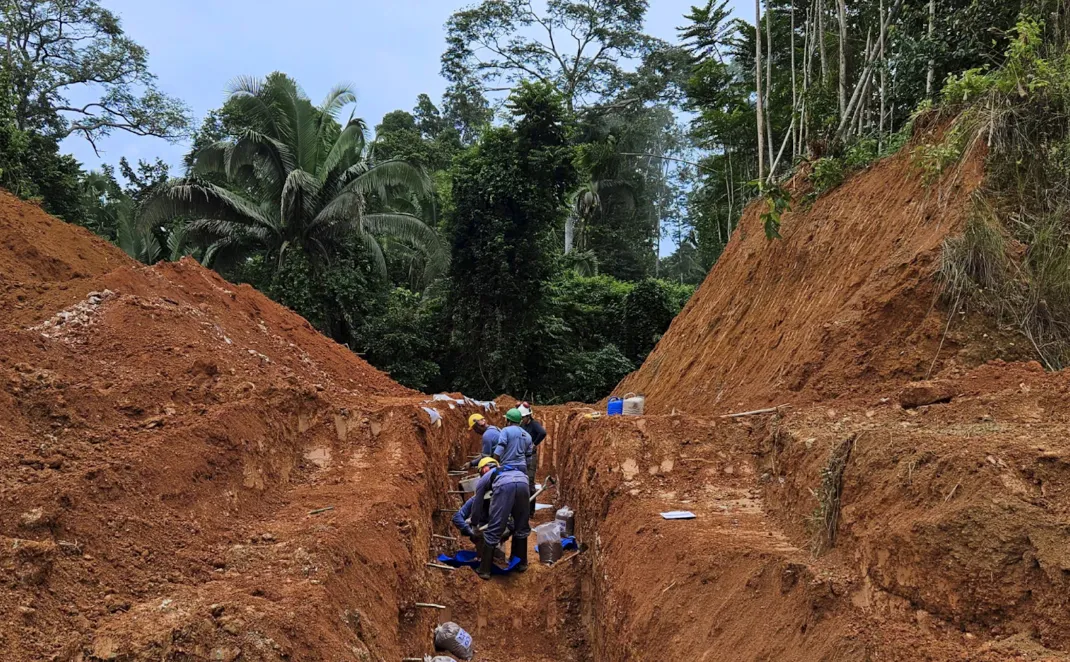
- Phase 1 construction of a 3,000-tonnes-per-day gold-in-oxide heap leach operation is 54% complete, on time and on budget, with first production targeted for the fourth quarter of 2026.
- A July 2025 pre-feasibility study (PFS) returned an after-tax internal rate of return (IRR) of 78%, a net present value (NPV5%) of US$73.9 million, and an all-in sustaining cost (AISC) of US$1,210 per ounce.
- Phase 1 cash flow is designed to self-fund district-wide exploration without further equity dilution; three drill rigs are currently active, with a fourth under consideration.
- The Cuiú Cuiú district hosts more than 50 exploration targets across a 10x15 km area, underlain by the same Tocantinzinho lineament that controls Brazil's third largest gold mine.
Three Catalysts in 10 Days
Within the span of ten days in March 2026, Cabral Gold delivered three material updates at its Cuiú Cuiú gold district in northern Brazil: a construction progress report confirming Phase 1 is 54% complete and on schedule, the granting of its full mining licence, and a drill result of 9.5m at 87.4 grams per tonne (g/t) gold, the highest-grade intercept in the project's history.
Taken together, these developments indicate a transition in the company's risk profile. Cabral is transitioning from an exploration-stage developer toward a near-term producer, with first gold pour targeted for the fourth quarter of 2026. With gold prices currently above the pre-feasibility study (PFS) base case of US$2,500 per ounce, each of these catalysts carries increased economic weight. Here is what investors need to understand.
1. The Mining Licence Removes the Project's Biggest Binary Risk
The Licença Prévia (LP) granted on 10 March 2026 removes one of the most consequential permitting uncertainties in Brazilian mine development and its scope covers not just Phase 1, but the entire Cuiú Cuiú district.
In Brazil, the LP is the first and most complex of three required operational licences. It requires engagement with multiple government agencies, public hearings, environmental impact assessments, and hydrological studies. Cabral initiated this process in 2018 and submitted its environmental impact assessment report in 2020. The remaining steps, the Licença de Instalação (LI, or construction licence) and Licença de Operação (LO, or operating licence),are comparatively faster and less technically demanding.
President and Chief Executive Officer of Cabral Gold, Alan Carter, described the significance of the approval:
"If you're trying to get a mine into production in Brazil it is the most important step to getting that LP."
The LP's scope extends beyond the Phase 1 oxide operation to the larger Phase 2 hard rock development, removing a significant overhang from investors assessing the district's long-term development potential. Expansion beyond Phase 1 will still require the LI and LO, but the most complex regulatory milestone is now cleared.
2. The Jerimum Cima Intercept Is the Highest-Grade Hole Drilled at Cuiú Cuiú
Recent drilling returned 9.5m at 87.4 g/t gold from 173.8m depth, including 2.9m at 285.5 g/t gold, equivalent to 830 gram-metres, and supported by adjacent results that confirm the zone is not isolated.
Jerimum Cima is located 3 kilometres (km) east-northeast of the Central gold deposit and is one of four new hard rock discoveries made since the last NI 43-101 resource update in 2022. Adjacent holes have returned 39m at 5.1 g/t gold and 9.5m at 5.74 g/t gold, with the high-grade zone remaining open along strike and at depth. The zone's geometry, a high-grade vein core surrounded by a lower-grade stockwork envelope, is consistent with the structural style observed across other Cuiú Cuiú deposits. At the MG gold deposit, high-grade zones of comparable style have been traced for hundreds of metres along strike. The company considers this drill result to represent a structural intersection that may define the core of the mineralised system at Jerimum Cima. Continued drilling is required to establish strike extent, depth continuity, and whether additional high-grade zones exist within the broader low-grade envelope.
Carter put the result in context:
"It's not every day you drill a hole,let's say it again, 9.5m of 87.4 grams per tonne. That also included 2.9 metres at 285 grams per tonne."
3. Phase 1 Economics Are Robust & Strengthen Materially at Current Gold Prices
The July 2025 PFS returned an after-tax internal rate of return (IRR) of 78% and net present value at a 5% discount rate (NPV5%) of US$73.9 million at a US$2,500 per ounce (/oz) base case; at US$3,500/oz, those figures rose to 151% and US$150 million respectively.
The PFS, authored by Ausenco Brasil, covers a 3,000 tonnes per day heap leach operation targeting near-surface gold-in-oxide material. At the US$2,500/oz base case, the study returned an after-tax internal rate of return (IRR) of 78% and an after-tax NPV5% of US$73.9 million, against pre-production capital expenditure (capex) of US$37.7 million, an NPV to capex ratio of 2.0x with a 10-month payback period. Over a 6.2-year mine life, the operation is projected to produce 113,155 oz of gold, with initial annual production of approximately 25,000 oz in the first two years. Life-of-mine (LOM) all-in sustaining costs (AISC) are estimated at US$1,210/oz, with LOM EBITDA of US$154.4 million.
At US$3,500/oz, the after-tax IRR increases to 151%, the after-tax NPV5% rises to US$150 million, and the payback period compresses to 6 months. The operation's simple processing route underpins the low capital intensity and favourable cost structure.
4. The Gold Loan Structure Eliminates Construction-Phase Dilution
Phase 1 is fully funded through a US$45 million gold loan closed in November 2025, avoiding equity issuance.
The loan was closed with the Precious Metals Yield Fund (PMYF), an affiliate of the Phoenix Gold Fund, Cabral's largest institutional shareholder. It carries a 39-month term at 10% interest, with principal repayments of 39 kilograms of gold per quarter commencing 31 March 2027. The gold loan structure means construction proceeds without share issuance, preserving per-share exposure to Phase 1 production and Phase 2 upside. Once in production, Phase 1 is designed to generate operating cash flow at a site operating cost of US$1,000/oz LOM average, with that margin intended to fund district-wide exploration and the development path toward Phase 2.
Carter described the strategic rationale underpinning the approach:
“Most exploration companies depend on raising capital by diluting their capital structure, so they issue shares and they raise money. The problem with that is that you don't have any control over your cost of capital, and most companies fail because they don't make a discovery. We wanted to get off that, what I said to you in the past is like a hamster wheel.”
5. Construction Is 54% Complete, on Time, & on Budget
With 71% of project costs committed under contract and equipment procurement over 90% complete, Phase 1 has passed the point where the majority of execution risk resides in procurement and engineering.
As of 5 March 2026, Phase 1 construction is 54% complete. Long lead items, including the adsorption/desorption and recovery (ADR) plant being manufactured by Como Engineering in Perth, have been ordered. The project remains on schedule for commissioning in the third quarter 2026 and commercial production in the fourth quarter of 2026. The operation is based on earthmoving and heap leach processing of saprolite material without crushing or grinding, which contributed to the low initial capex of US$37.7 million. Metallurgical column leach tests at the MG deposit returned gold recoveries of 92% to 93%. Approximately 300 people are currently on site focused solely on construction.
6. The District Is Larger Than the Current Resource Reflects
Cuiú Cuiú has six known deposits, more than 50 exploration targets, and a historical placer gold output 10 times larger than the adjacent Tocantinzinho gold mine - yet the last formal resource update was in 2022.
The current NI 43-101 resource base stands at Indicated resources of 12.29 million tonnes (Mt) at 1.14 g/t gold in primary material and 13.56 Mt at 0.50 g/t gold in oxide material, plus Inferred resources of 13.63 Mt at 1.04 g/t gold in primary and 6.40 Mt at 0.34 g/t gold in oxide. This estimate does not include four discoveries made since 2022: PDM, Machichie Main, Jerimum Cima, and Machichie NE, each of which has returned drill results but carry no maiden resource. Cuiú Cuiú sits on the same NW-trending Tocantinzinho (TZ) lineament as GMining Ventures' Tocantinzinho mine, now Brazil's third largest gold mine, and historically produced an estimated 10 times more placer gold. An updated global resource incorporating the post-2022 discoveries is expected in 2026.
7. Near-Term Catalysts That Define the Investment Timeline
Four developments over the next 12-18 months will validate the company’s self-funded development model and how the market prices the district's scale potential.
The most immediate milestone is Phase 1 commissioning in third quarter 2026 and first gold pour in the fourth quarter of 2026. On-time delivery validates the non-dilutive funding model and triggers the cash flow that underpins all Phase 2 planning. Running in parallel, continued drilling at Jerimum Cima will determine whether the 87.4 g/t intercept is a repeatable and scalable zone. Later in 2026, an updated global NI 43-101 resource estimate incorporating the four discoveries made since 2022 will provide the first formal quantification of district growth.
A preliminary economic assessment (PEA) on the larger Phase 2 hard rock operation is planned for 2027, which will provide the first economic framework for the spoke-hub processing model and allow investors to assess Phase 2 scale relative to Phase 1.
For Investors: Key Takeaways
- Permitting de-risked at the district level: the Licença Prévia granted in March 2026 applies to both Phase 1 and the larger Phase 2 hard rock development, covering the most time-intensive element of the Brazilian permitting sequence.
- Phase 1 economics are supported by a recent pre-feasibility study with an after-tax internal rate of return of 78% and a net present value of US$73.9 million at a US$2,500 per ounce gold price base case, with the internal rate of return rising to 151% at US$3,500 per ounce.
- Low capital intensity relative to project scale: US$37.7 million in pre-production capital expenditure for a heap leach operation with a 2.0x net present value to capital expenditure ratio and a 10-month payback at base case.
- Construction is funded through a non-dilutive gold loan structure; the company reports Phase 1 construction at 54% complete, on time, and on budget for fourth quarter 2026 first production.
- Exploration upside is substantial and active: more than 50 targets across the Cuiú Cuiú district remain untested, with recent drill results at Jerimum Cima and Machichie NE demonstrating high-grade continuity beyond the existing resource base.
- Phase 1 cash flow is intended to fund Phase 2 resource expansion without further equity issuance, providing a development structure that reduces reliance on capital markets.
The near-term focus is on Phase 1 execution. Construction delivery on schedule in the third quarter of 2026 and first gold pour in the fourth quarter 2026 will be the primary test of whether the self-funded model can be sustained through to Phase 2.
FAQs (AI-Generated)
The LP is the first and most complex of three required mining licences in Brazil. It involves environmental impact assessments, public consultations, and multi-agency government review. With the LP granted, the remaining construction and operating licences are procedurally simpler. Cabral's LP covers both Phase 1 oxide operations and the planned Phase 2 hard rock development.
Heap leaching is a low-cost gold extraction method that uses a leach solution to dissolve gold from ore stacked on lined pads. At Cuiú Cuiú, the near-surface saprolite requires no crushing or grinding, making it well suited to a simple, low-capex heap leach circuit. Metallurgical tests at the MG deposit returned gold recoveries of 92-93%.
As of the 2022 NI 43-101 estimate, Cuiú Cuiú holds Indicated resources of 12.29 million tonnes (Mt) at 1.14 g/t gold in primary material and 13.56 Mt at 0.50 g/t gold in oxide material, plus Inferred resources of 13.63 Mt at 1.04 g/t gold in primary and 6.40 Mt at 0.34 g/t gold in oxide. The estimate does not yet incorporate four discoveries made since 2022. An updated resource estimate is expected in 2026.
Phase 1 is funded through a US$45 million gold loan closed in November 2025 with the Precious Metals Yield Fund, an affiliate of Cabral's largest institutional shareholder, Phoenix Gold Fund. The structure avoids equity dilution during construction.
Phase 2 refers to a larger hard rock mining operation targeting the primary gold deposits and new discoveries across the Cuiú Cuiú district on a spoke-hub processing model. A preliminary economic assessment on Phase 2 is planned for 2027, to be funded by Phase 1 cash flow.
Analyst's Notes





Subscribe to Our Channel



.png)

Stay Informed






















