




West Red Lake Gold Mines: Rowan Drilling Completion Enables Integrated Prefeasibility Study


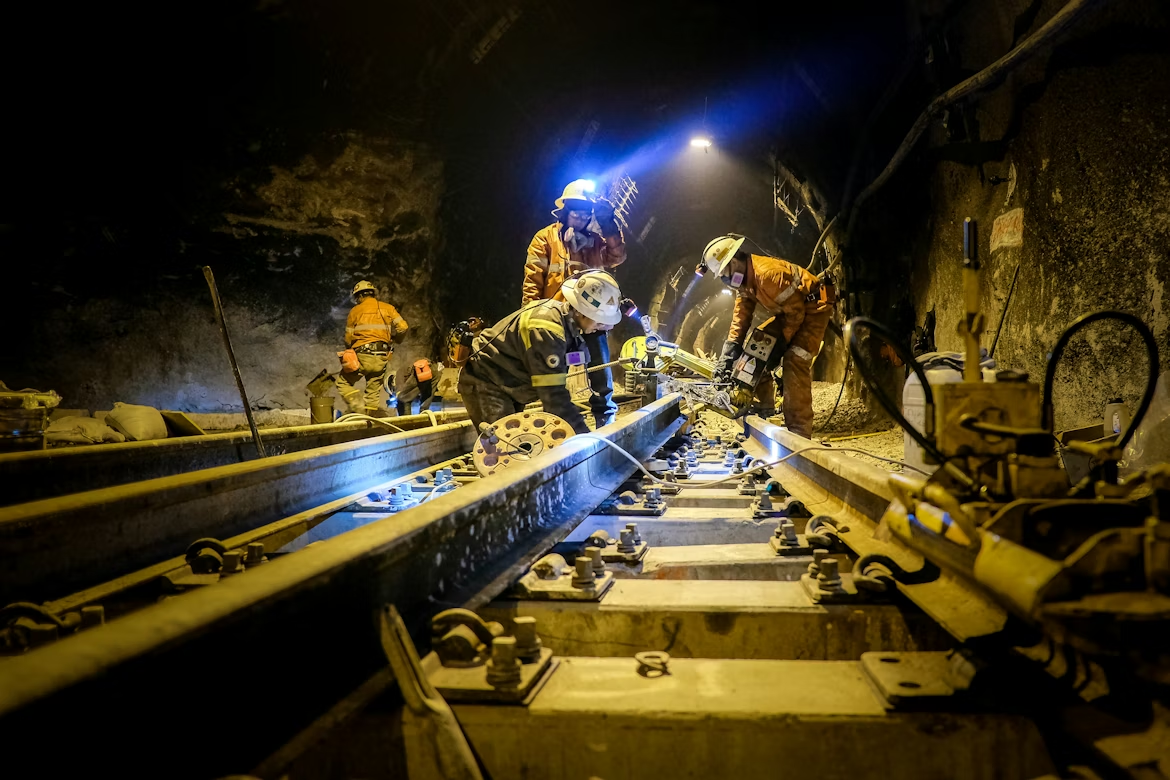
West Red Lake Gold completes Rowan drilling, closing the data gap that limited the mine plan, with a joint Madsen-Rowan Prefeasibility Study due in Q3 2026.
- West Red Lake Gold Mines completed a 37-hole, approximately 6,300-metre drilling programme at the Rowan deposit designed to convert inferred resources to the indicated category on two of the deposit's veins, and to supply the infill data required to incorporate two additional veins into a Pre-Feasibility Study (PFS) mine plan for the first time.
- The standalone Preliminary Economic Assessment (PEA), based on toll milling, returned a net present value (NPV) of $125 million and an internal rate of return of 42%, but excluded the deposit's third-largest contributing vein due to insufficient historical sampling continuity in its drill data.
- Because the PEA evaluated Rowan as a toll milling underground mine that required no new mill or tailings facility, the project carried a low estimated capital expenditure (capex) of $70 million.
- The joint Madsen-Rowan PFS, due in the third quarter of 2026, will evaluate the potential inclusion of two previously excluded veins into the mine plan for the first time; both sit closer to the access portal than those in the prior plan, which could advance the projected start of ore extraction by approximately six months.
- Management identifies a combined production path of 120,000 ounces of gold per year with Rowan integrated, and a regional pathway to 150,000 ounces in Red Lake.
The Rowan deposit has carried an incomplete economic characterisation since the Preliminary Economic Assessment (PEA) was published in mid-2025, not because the deposit is under-endowed, but because the study was built on the only basis the available data permitted. West Red Lake Gold Mines (TSXV: WRLG | OTCQB: WRLGF | FSE: UJ0) has now completed the 37-hole drilling programme that closes that data gap. The joint Madsen-Rowan Prefeasibility Study (PFS), scheduled for delivery in the third quarter of 2026, will produce the first integrated economics for a mine plan that the standalone study was structurally unable to evaluate.
The Rowan Drilling Programme
The completed drilling programme was designed to satisfy a primary requirement: deliver the data quality necessary to incorporate previously excluded high-grade veins into a newly integrated PFS mine plan at Rowan. While primarily focused on resource conversion and infill drilling to support mine design, the program also successfully extended known zones and intersected unmodeled veins.
West Red Lake Gold Mines completed 37 HQ-diameter core holes across approximately 6,300 metres, with final results released in April 2026. The programme operated on two concurrent tracks. For two veins, the objective was to convert inferred resources to the indicated category, using the classification threshold required for PFS-level mine planning and reserve conversion. On two further veins, the scope was targeted infill drilling to establish the sampling continuity that had prevented either from appearing in the prior mine plan. The veins were geologically understood; the programme addressed data coverage gaps that had blocked PFS-level classification.
Drill results confirmed grade continuity across targets that historical records had left undercharacterised. The top intercept returned 471 grams per tonne gold over 1 metre. Additional intercepts from the two infill targets included 10.84 grams per tonne over 3 metres, 6.88 grams per tonne over 2.5 metres, and 4.38 grams per tonne over 2.5 metres. A third vein contributed 19.46 grams per tonne over 1 metre and 7.29 grams per tonne over 1.5 metres. The new drill data have been integrated into an updated vein model to support a revised Mineral Resource Estimate.
The PEA's Scope & Structural Limits
The PEA reflects a mine plan built on an incomplete vein inventory, a constraint imposed by the drilling data available at the time, not by the deposit itself.
Rowan holds a current resource comprising an indicated component of 196,747 ounces at 12.78 grams per tonne gold and an inferred component of 118,155 ounces at 8.73 grams per tonne gold, characterised by high-grade material in the 10 to 12 grams per tonne range. The PEA, structured as a standalone toll-milling underground operation, returned a net present value (NPV) of $125 million and an internal rate of return of 42%, against a $70 million capital expenditure (capex) requirement, a 5-year mine life, and average annual production of 35,230 ounces. At 8.0 grams per tonne, the mine plan grade is 4.78 grams per tonne below the indicated resource average of 12.78 grams per tonne, reflecting veins included, not the deposit's grade ceiling. The 400-tonne-per-day throughput assumption was similarly a product of the available mine plan, not a design ceiling.
The third-largest contributing vein was absent from the PEA mine plan because its historical drill data lacked the sampling continuity the study required for inclusion.
Madsen's Surface & Underground Infrastructure
The Madsen mine hosts a fully operational production-scale surface and underground complex: a permitted 800-tonne-per-day mill, a recently completed 4-metre tailings dam lift, a new primary crusher, a 114-person on-site camp, a mine dry and operations facility, a refurbished timbered shaft, and a 1.4-kilometre underground connection drift. As of early in the second quarter of 2026, the mill was averaging 685 tonnes per day. The mill's permitted capacity of 800 tonnes per day, which it previously operated at 86% of in late 2025, exceeds the 400-tonne-per-day rate in the Rowan PEA. This leaves ample room for satellite integration, meaning additional feed from Rowan would represent a utilisation gain on existing infrastructure rather than a capital commitment.
Rowan is located 80 road kilometres from the Madsen mine. At the grade profile characterised across the resource, the high-grade nature of the ore means haulage over that distance functions as an operating cost item rather than a capital one: the value concentration per tonne at 10 to 12 grams per tonne gold is sufficient to make transport to a distant, already-permitted mill economically viable. The infrastructure already in place at Madsen is what makes the satellite mine configuration viable rather than theoretical.
Capital Avoidance & Infrastructure Mechanics
The $70 million capex figure is a direct product of the toll-milling assumption; it reflects the cost of a Rowan that routes ore to an existing facility, not one that builds its own. Without that assumption, neither the capital figure nor the NPV it underwrites holds.
President and Chief Executive Officer of West Red Lake Gold, Shane Williams, identifies the mill access condition that makes satellite mine economics viable for sub-scale deposits:
"None of them is big enough probably to support a full mine tailings, full permitting process, but if you have a mill already and you have the facilities that can be expanded, then you have the opportunity to bring these satellite deposits into your mill to grow."
Rowan fits that profile: the deposit's grade supports underground mining economics, and Madsen's permitted mill resolves the capital constraint that would otherwise limit its standalone viability.
PFS Scope & Integrated Mine Design
The joint PFS produces the first mine plan capable of evaluating additional high-grade veins from Rowan's inventory alongside Madsen production under shared infrastructure. First, it evaluates the potential inclusion of the two previously excluded veins into the mine plan. Because both veins are closer to the access portal, their inclusion could allow ore extraction at Rowan to commence approximately six months earlier than the prior plan would have permitted. Second, the study evaluates Rowan as a satellite mine feeding high-grade ore to the Madsen mill alongside a Madsen longhole mine design assessed at a gold price of US$2,600 per ounce, a structural configuration that allocates infrastructure costs across the combined asset base rather than embedding them entirely within the Rowan economics.
West Red Lake Gold Mines held C$48 million in cash, including gold receivables, as of December 2025, positioning the company to fund the PFS and sustain Madsen operations through the scheduled delivery of the study in the third quarter of 2026.
Williams outlines the production targets the integrated mine plan is designed to reach:
"We see a path from where we are today, with Rowan coming in to 120,000 ounces a year and potentially higher with other deposits as we look in the region of what other deposits are there. So I can see a pathway to 150,000 ounces in Red Lake over the next number of years."
The Investment Thesis for West Red Lake Gold Mines Ltd.
- Rowan's high-grade resource, 196,747 indicated ounces at 12.78 grams per tonne and 118,155 inferred ounces at 8.73 grams per tonne, provides the value concentration per tonne that makes 80-kilometre haulage to Madsen economically viable rather than cost-prohibitive.
- The completed drilling programme expands the Pre-Feasibility Study mine plan's accessible ore inventory to its most complete basis to date, supplying both the indicated-category classification required for reserve conversion and infill coverage on two previously excluded veins.
- Routing Rowan ore to Madsen's existing permitted infrastructure produces a capital intensity across the combined mine plan that a standalone Rowan configuration could not match, and it is that avoided capital, not the deposit's grade alone, that underlies the Preliminary Economic Assessment's 42% internal rate of return.
- Evaluating the potential inclusion of two previously excluded veins, both closer to the access portal than those in the prior mine plan, could advance the start of ore extraction by approximately six months, potentially accelerating cash flow relative to the Preliminary Economic Assessment timeline.
- The joint Madsen-Rowan Prefeasibility Study, due in the third quarter of 2026, evaluates the combined asset base under shared infrastructure and an integrated mine plan at a gold price of US$2,600 per ounce, and is the first study capable of quantifying the full economic benefit of the satellite mine configuration.
- West Red Lake Gold Mines held C$48 million in cash, including gold receivables, as of December 2025, providing balance sheet coverage through the Prefeasibility Study delivery period without immediate recourse to external capital.
The completed Rowan drilling programme closes the key data gap that constrained the prior mine plan and enables a fully integrated Madsen-Rowan PFS incorporating previously excluded veins. The third-quarter 2026 study will test a satellite mine model tied to existing Madsen milling capacity and high-grade feed, defining the scale at which the resource can be converted into a production profile.
TL;DR
West Red Lake Gold Mines holds a combined asset base, including Rowan, a high-grade deposit with an indicated resource of 196,747 ounces at 12.78 grams per tonne gold and an inferred resource of 118,155 ounces at 8.73 grams per tonne gold, positioned to operate as a satellite feed source for the Madsen mine's permitted 800-tonne-per-day mill, 80 road kilometres away. The completed 37-hole drilling programme provides the data required to evaluate, for the first time, the potential inclusion of two previously excluded veins into a joint PFS mine plan, and both veins' proximity to the access portal could bring forward the start of ore extraction by approximately 6 months. The joint study is scheduled for delivery in the third quarter of 2026.
FAQs (AI-Generated)
Analyst's Notes





Subscribe to Our Channel







.jpg)
Stay Informed






















