




Cabral Gold Targets Q4 2026 Production as Jerimum Discovery Expands: Execution Now Determines Whether Exploration Converts to Cash Flow


Cabral Gold advances a fully funded oxide starter mine toward Q4 2026 production, backed by a $45M gold loan, strong economics, and high-grade drilling.
- Cabral Gold is advancing a fully funded oxide starter mine at Cuiú Cuiú, with commissioning targeted for Q3 2026 and commercial production expected in Q4 2026.
- A $45 million non-dilutive gold loan funds construction without equity issuance, linking the balance sheet directly to operational delivery.
- Phase One targets 18,000 to 20,000 ounces per year at projected cash costs of about $1,200 per ounce, with a PFS IRR of 78% at $2,500 gold.
- High-grade drilling at the Jerimum Cima discovery has extended mineralization to roughly 750 metres of strike, adding potential scale to a future hard-rock phase.
- The investment case is now driven primarily by construction execution, commissioning performance, and the 2026 resource update rather than exploration headlines alone.
The Junior Developer Transition: Execution Now Matters More Than Discovery
The investment narrative for junior gold developers follows a recognizable arc. Capital flows into exploration stories during the discovery phase, rewarding drilling results and resource announcements. As projects approach construction, the basis for valuation shifts: market participants begin assigning credibility to cash flow timelines, not just geological potential. The re-rating that developers seek, the point at which exploration optionality converts to production-stage multiples, typically arrives in stages. Financing security is the first gate. Construction milestones are the second. The first gold poured is the third.
With financing secured and construction underway at Cuiú Cuiú in Pará state, northern Brazil,Cabral Gold is no longer purely an exploration-stage investment. The question facing investors is not whether the deposit is real, but whether Cabral can deliver on schedule, manage cost inputs through commissioning, and convert its resource base into bankable production. These are execution risks that sit outside the geological domain.
Management’s strategy reflects that shift from exploration to cash-flow credibility. As Chief Executive Officer Alan Carter explained when outlining the decision to begin with oxide material:
"We think the best way to fund all that work that needs to be done is not by continually diluting the capital structure and doing private placement after private placement and ending up with a massive number of shares issued and outstanding. We think there’s a better way of doing it. That is to start with a relatively modest stage one operation to mine the oxides and use that cash to then fund the drilling of the much larger hard rock resources."
Cuiu Cuiu's Two-Stage Development Model
Cuiú Cuiú follows a staged development strategy that reflects both the deposit’s geology and the capital realities facing junior producers. The oxide-rich upper zones enable a lower-cost first phase, while the deeper, more capital-intensive hard-rock resource underpins a longer-term expansion. Structuring the project this way reduces upfront risk without sacrificing district-scale upside.
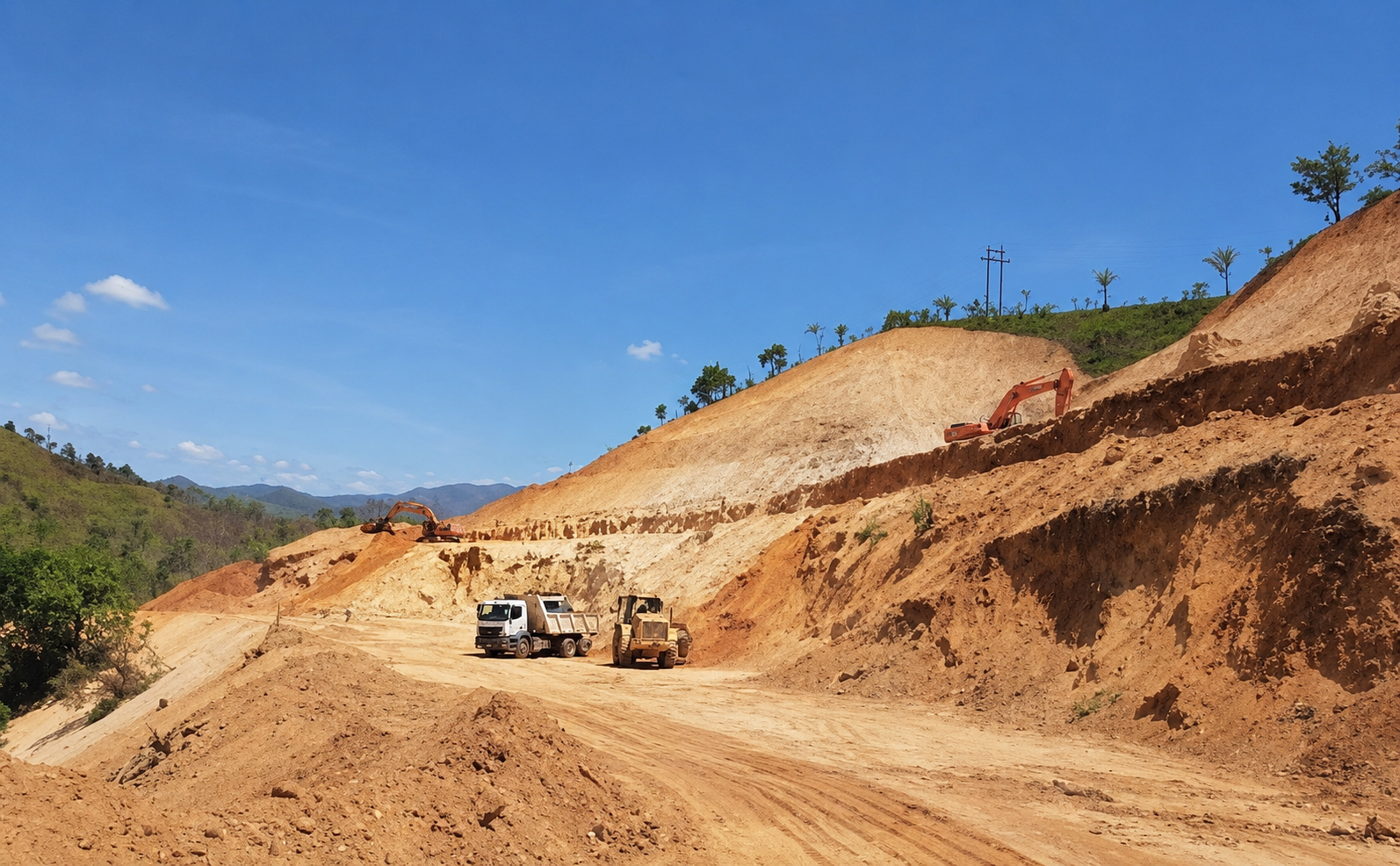
Phase One targets near-surface oxide material extending to roughly 60 metres depth. The weathered profile allows free-dig mining without drilling and blasting, lowering both capital requirements and operational complexity. Processing is simplified, with the oxide material suited to heap-leach recovery. The planned production rate for this phase is approximately 18,000 to 20,000 ounces per year.
PFS metrics highlight the economics of the starter operation. At a $2,500 per ounce gold price, the project delivers a 78% after-tax IRR and a payback period of about 10 months, with projected cash operating costs near $1,200 per ounce. These parameters frame Phase One as a capital-efficient path to first production rather than a large, front-loaded build.
Management attributes this approach directly to the unusual weathering profile across the district. As CEO Alan Carter explained:
“The gold deposits we have so far found at Cuiú Cuiú are very deeply weathered, down to about 60 metres on average. That means there’s a lot of material there which is free digging, and that’s opened up this opportunity to pursue a two-stage strategy to develop the district.”
Phase Two involves a transition to hard-rock mining and a materially larger operation. The existing non-oxide resource provides the foundation for this phase, though development will depend on further resource growth, supportive gold prices, and access to larger capital. The current strategy positions Phase Two as a beneficiary of cash flow from the oxide starter mine.
Trial mining licenses allow throughput of up to 1,500 tonnes per day. Expanding to the planned 3,000 tonnes per day will require the full mining license, which the company expects to secure ahead of the mid-2027 requirement.
Financing Structure: Dilution Reduction & Delivery Pressure
Cabral secured $45 million through a gold loan provided by an institutional shareholder, notably without issuing new equity. In a market where junior developers are often penalized for dilution, avoiding a private placement preserves per-share exposure to upside. Under the loan terms, roughly 14% of life-of-mine gold production is allocated to debt service.
The trade-off is clear. While the structure protects the equity base, it introduces a fixed production obligation. Unlike equity, the loan must be repaid through physical gold deliveries, tying the balance sheet directly to operational performance. Any delays in commissioning, throughput, or grade reconciliation during the early years could affect the company’s ability to service the loan.
Management has emphasized that the financing was deliberately structured to avoid equity dilution. As CEO Alan Carter noted:
“We borrowed $45 million US in gold and we’ll have to repay that with interest. So, there was no equity raise as part of that, which I think surprised a lot of people.”
For investors, this creates a direct link between execution and shareholder value. Strong delivery preserves the clean capital structure and equity upside; underperformance increases pressure on early production.
Jerimum Cima: Exploration Upside Within a Construction Story
Cabral’s exploration program at Cuiú Cuiú has continued to deliver results alongside construction activity. The Jerimum Cima target, one of four discoveries made since the 2022 resource estimate, is emerging as a key indicator of the district’s longer-term scale potential. The company currently operates three drill rigs across the property.
Recent drilling at Jerimum Cima has returned intercepts including 9.5 metres at 5.74 grams per tonne gold (g/t Au) and 3.8 metres at 10.8 g/t Au, the latter including a 0.5-metre interval grading 80.5 g/t Au. These results have extended the known strike length of the system to approximately 750 metres. The presence of high-grade core intervals is particularly relevant in the context of cut-off grade economics for a future hard-rock development.
As CEO Alan Carter noted:
“We’ve made four new discoveries since we last updated the resource estimate in 2022… we’ve got three drill rigs that are working on the exploration side and they’re coming up with some fantastic results… we’ve got a drill rig on Jerimum Cima and we’re getting some great results coming out of Jerimum Cima.”
Jerimum Cima comprises three parallel mineralized structures, a geometry that increases the potential scale of the system beyond what a single vein or shear zone would support. The weathering profile extends to roughly 70 metres depth, introducing the possibility of additional oxide feed that could supplement Phase One throughput or extend mine life. Any oxide inventory from Jerimum would benefit from the same processing cost advantages as the starter mine, though this potential remains contingent on further drilling and resource delineation.
Execution Strengths: What Has Already Been De-Risked
Several risks that typically challenge junior developers at this stage have already been addressed at Cuiú Cuiú. Financing is in place through a $45 million gold loan, providing sufficient capital for the Phase One starter mine without requiring additional equity under current assumptions. Construction is reported to be on schedule, with more than 140 workers on site, and the mine access road has been upgraded to full operating standard.
The oxide mining configuration is also inherently simpler than hard-rock operations. Free-digging material eliminates blasting, reducing costs and mechanical complexity. Oxide processing requires less comminution than sulphide circuits, making early commissioning more straightforward.
The district benefits from the presence of an adjacent producing mine, which supports confidence in regional metallurgy, infrastructure, and logistics. An existing resource base of roughly 1.2 million ounces provides a foundation for mine planning and underpins the production timeline.
Management capability is another factor. The owners’ team is led by Luis Salaro, who has experience constructing multiple mines in Brazil, adding local operational and permitting expertise to the build.
Where Execution Risk Still Sits
The de-risked elements at Cuiú Cuiú do not remove execution risk; they concentrate it into a smaller set of measurable variables that investors should track through specific milestones.
The Q4 2026 production target depends on successful commissioning in Q3 2026. Junior construction schedules often face delays from equipment delivery, contractor availability, weather, or permitting steps. Even if construction stays on track, commissioning carries its own risks. Metallurgical recoveries may differ from feasibility assumptions, grade reconciliation can vary in early mining, and throughput ramp-up usually lags nameplate capacity.
Resource growth is another dependency. The latest NI 43-101 estimate dates from 2022, before four new discoveries, including Jerimum Cima. A revised estimate expected in 2026 will clarify both the oxide inventory supporting Phase One and the hard-rock resource needed for Phase Two. Converting recent discoveries into indicated or measured categories will be central to the expansion case.
Phase Two also carries higher capital intensity and external sensitivity. Hard-rock mining will require additional processing infrastructure and the full mining license to expand throughput to 3,000 tonnes per day. Its viability will depend on resource scale, access to capital, and the gold price environment.
Critical Path to First Gold: What Investors Should Track
As Cabral moves from exploration toward production, the key metrics shift from geology to execution. Near-term investor focus should center on operational milestones rather than drilling headlines.
Construction updates will indicate whether the build remains on track for the Q3 2026 commissioning target. Any changes to the commissioning timeline will directly affect the planned Q4 2026 commercial production date. The 2026 resource estimate is likely the most important medium-term catalyst, as it will update the oxide inventory for Phase One and begin to quantify the hard-rock potential for Phase Two.
Early production reconciliation, particularly grade and recovery performance, will test whether PFS assumptions hold in practice. Ongoing drilling at Jerimum Cima and other targets will add resource optionality and could influence the timing and scale of a Phase Two expansion.
The Investment Thesis for Cabral Gold
- Oxide starter projects with simplified processing configurations can materially reduce financing risk and accelerate the timeline to cash flow generation relative to conventional hard rock development models, providing early capital returns that can fund subsequent phases without additional equity dilution.
- Non-dilutive financing structures, such as gold-linked debt instruments, preserve per-share equity upside for existing shareholders while imposing a production delivery discipline that aligns lender and operator incentives around operational performance rather than capital market conditions.
- High-grade discoveries situated within established infrastructure corridors, where road access, regional power, and permitting precedent already exist, can materially extend mine life at incremental capital cost relative to greenfield development in undeveloped districts.
- Companies in active transition from developer to producer status historically exhibit valuation re-ratings when construction milestones are met consistently, as market participants reassign probability weights from execution risk to cash flow certainty.
- Cabral Gold's asset configuration combines near-term production through a funded, partially constructed oxide operation with district-scale exploration upside across a property with a 1.2-million-ounce resource base and four discoveries not yet included in the formal resource estimate.
Cabral Gold's investment story has entered a new phase, one defined by construction delivery rather than exploration announcement. The oxide starter mine at Cuiu Cuiu provides a clear and relatively low-complexity path to cash flow. The Jerimum Cima discovery and the four targets added in 2022 maintain the district's exploration optionality. The non-dilutive financing structure preserves equity value for shareholders who have accompanied the company through the exploration phase.
The next 12 to 18 months will determine whether construction execution, commissioning performance, and resource conversion can sustain the re-rating that typically accompanies first gold production. For investors positioned in junior gold developers, Cabral's progression from geological discovery to funded production represents both the opportunity and the test that defines this category.
TL;DR
Cabral Gold is transitioning from an exploration story to a construction-stage developer, with its fully funded oxide starter mine at Cuiú Cuiú targeting commissioning in Q3 2026 and first gold in Q4 2026. The project is financed through a $45 million non-dilutive gold loan, which preserves equity upside but ties repayment directly to operational performance. Phase One is designed to produce 18,000 to 20,000 ounces per year at roughly $1,200 per ounce cash cost, with strong PFS economics. At the same time, high-grade drilling at the Jerimum Cima discovery has extended mineralization to about 750 metres, supporting longer-term hard-rock expansion potential. Over the next 12 to 18 months, the investment case will depend less on exploration headlines and more on construction progress, commissioning results, and a 2026 resource update.
FAQs (AI-Generated)
The primary near-term catalyst is construction progress toward commissioning in Q3 2026 and commercial production in Q4 2026. Meeting these milestones on schedule is typically the point where junior developers see valuation re-ratings.
The $45 million gold loan allowed Cabral to fund construction without issuing new shares, preserving per-share upside. However, the structure requires repayment through physical gold deliveries, which ties financial performance directly to operational success.
Jerimum Cima provides exploration upside within a construction-stage story. High-grade intercepts and a 750m strike length suggest potential for resource growth, which could extend mine life or support a larger Phase Two hard-rock development.
The main risks are construction delays, commissioning performance, and grade or recovery shortfalls during early operations. The 2026 resource update is also critical, as it will define both the oxide inventory for Phase One and the scale of the Phase Two hard-rock expansion.
Key triggers include staying on schedule during construction, successful commissioning, the first gold pour, and a larger updated resource estimate in 2026. These milestones reduce execution risk and increase market confidence in future cash flow.
Analyst's Notes





Subscribe to Our Channel






Stay Informed






















