




Madsen as a Mill Hub: West Red Lake’s Path to 120,000 oz/year


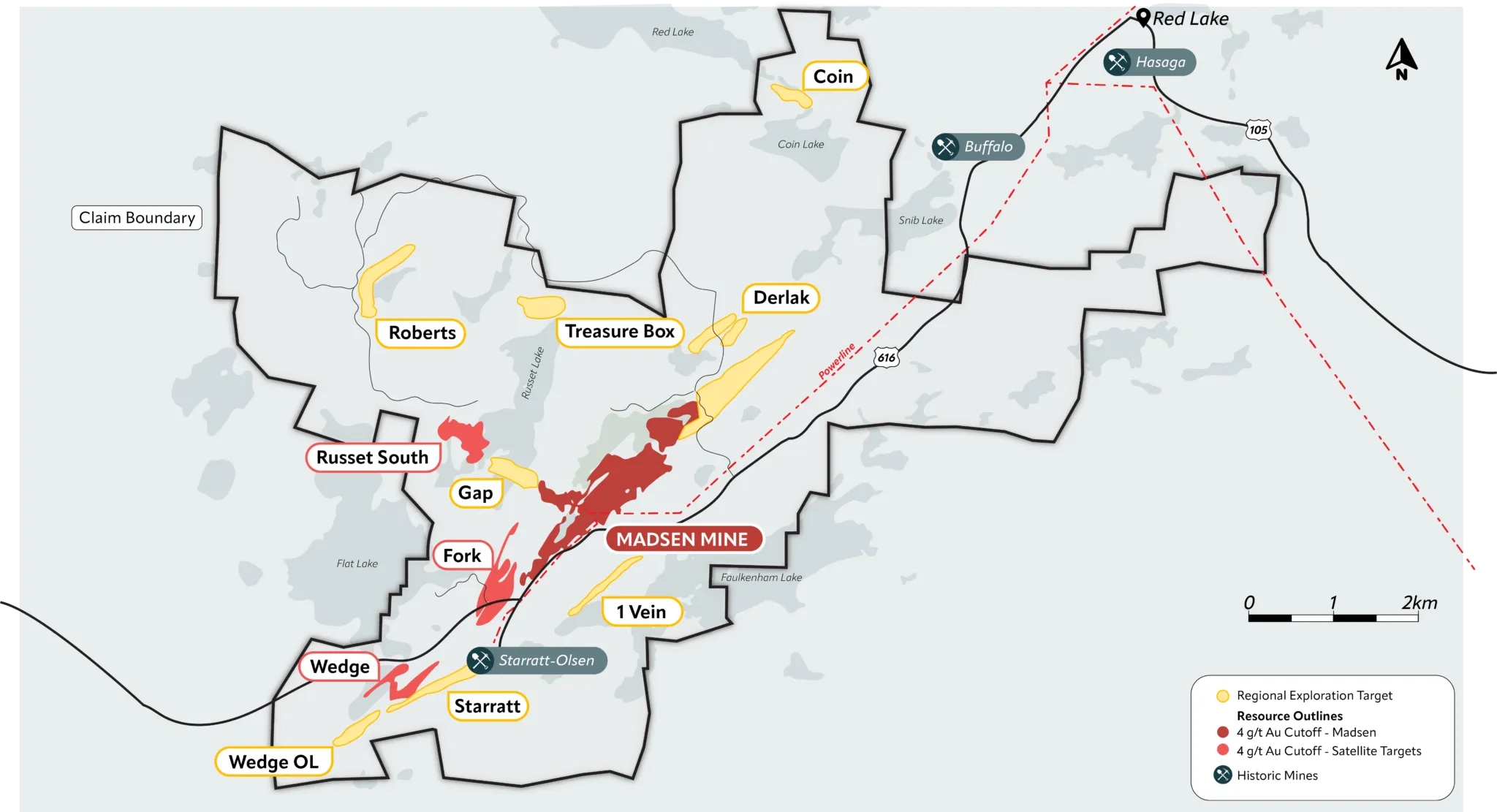
West Red Lake Gold Mines is turning Madsen into a regional processing hub, integrating Rowan and Fork satellites to drive district-scale growth.
- Madsen reached commercial production in January 2026 after a seven-month restart ramp-up.
- Existing infrastructure at Madsen is now central to a broader regional production strategy.
- Rowan is being advanced as the first satellite feed source for the Madsen mill.
- Fork could provide additional near-mine production tied directly into existing underground infrastructure.
- West Red Lake is positioning itself as a multi-deposit Red Lake production platform rather than a single-asset operator.
What Has Happened
West Red Lake Gold Mines (TSXV: WRLG | OTCQB: WRLGF | FSE: UJO)restarted the Madsen Mine in June 2025 following remediation work completed after the company’s 2023 acquisition of the asset. Commercial production was declared in January 2026 after the operation sustained more than 65% of the permitted mill throughput for 30 consecutive days.
The ramp-up from bulk sample operations to commercial production took seven months. In 2025, the operation produced approximately 20,000 ounces of gold as the company transitioned from remediation and commissioning to steady-state mining and milling.
Management has guided gold production for 2026 to 35,000 to 45,000 ounces, with approximately 60% of the targeted annual output anticipated in the second half of the year. That production profile marks a shift away from the operational recovery phase that defined the company following the acquisition of Madsen.
Madsen Infrastructure & Operating Base
The Madsen Mine increasingly functions as the operational foundation for West Red Lake’s broader regional plans. In December 2025, the mill processed 21,389 tonnes, reaching 86% of permitted daily capacity as the operation continued its production ramp-up.
The restart programme included substantial infrastructure rehabilitation and expansion. Work completed since acquisition includes more than 1,400 metres of underground development, a 1.4-kilometre connection drift, installation of a new crusher, construction of a 114-person camp, and a tailings dam lift. The mine has also been dewatered to Level 17 and equipped with 23 major underground machines. The company has also refurbished the shaft system, which is expected to move 350 tonnes per day at around 10% of the cost of trucking. Management estimates that approximately $500 million has been invested in the project historically, including roughly $150 million since the acquisition.
President and Chief Executive Officer of West Red Lake Gold, Shane Williams, frames the shift in simple operational terms when explaining the rationale behind the asset:
“The reason we picked this asset in Red Lake is that there are a lot of high-grade deposits around the region. None of them is big enough, probably, to support a full mine tailings and full permitting process. But if you already have a mill and facilities that can be expanded, you have the opportunity to bring these satellite deposits into your mill to grow.”
Rowan as the First Satellite Integration
The Rowan Deposit is positioned as the first external feed source for the Madsen processing hub. Located approximately 80 road kilometres from the Madsen mill, Rowan is being evaluated as a high-grade satellite underground operation capable of supplying material to existing infrastructure.
Current resource estimates for Rowan include 196,747 ounces of gold in the Indicated category, grading 12.78 grams per tonne, and 118,155 ounces in the Inferred category, grading 8.73 grams per tonne. A 5,000-metre drill programme, which infilled Vein 006b and met geotechnical and metallurgical requirements for the Pre-Feasibility Study (PFS), has been completed. The preliminary economic assessment (PEA) outlines average annual production of 35,200 ounces over a five-year mine life.
Williams describes Rowan’s role within the satellite model:
“Rowan is a classic example of that. Rowan has over 600,000 ounces of gold in it at the moment, the high-grade 10 to 12 gram material. And so we can bring that material from Rowan, a small underground mine, and transport that material to Madsen.”
Development at Rowan is expected to commence in 2028, with production anticipated in 2029, using trucking and centralised milling rather than standalone processing infrastructure.
Fork & Near-Mine Feed Expansion
The Fork Deposit represents a second layer of feed expansion within the district model. Unlike Rowan, Fork sits within 250 metres of existing underground workings at Madsen, positioning it as a near-mine integration opportunity. The exploration target ranges from 130,000 to 150,000 tonnes grading 8 to 9 grams per tonne gold, representing 33,000 to 43,000 ounces. A 3,000-metre drill programme has recently been completed.
Its proximity to existing infrastructure supports potential development through a direct underground connection rather than an independent mine build-out. A development decision remains pending, with the presentation timeline indicating a potential start in the second quarter of 2026 and mining from Fork expected to begin in the first half of 2027.
Fork, therefore, serves as a complementary feedstock alongside Rowan, strengthening the broader hub-and-spoke production framework.
From Single Mine to District Platform
The production profile at Madsen is now being shaped as a base for multi-asset growth across the Red Lake district. Management has outlined a pathway toward 100,000 to 120,000 ounces annually through the integration of Rowan and Fork with the core operation.
Williams frames the longer-term direction:
“We see a path from where we are today, with Rowan coming in, to 120,000 ounces a year and potentially higher with other deposits in the region. I can see a pathway to 150,000 ounces in Red Lake over the next number of years.”
The strategy reflects a shift in corporate identity toward a regional production platform anchored by Madsen rather than a single-asset restart operation.
Exploration Pipeline & Regional Optionality
Exploration activity across the district supports the longer-term expansion framework. Near-mine work focuses on the 4447 and 904 high-grade complexes, while deeper drilling continues to assess extensions to the existing system.
Mineralisation at Madsen extends to approximately 1.2 to 1.3 kilometres depth, while other Red Lake deposits extend beyond 3 kilometres, leaving additional potential under evaluation.
Regional targets include Upper 8, identified as a shallower analogue to the historic 8 Zone, and North Shore, which has returned broad alteration zones and geochemical signatures.
Permitting, Studies & Execution Milestones
Several technical and regulatory milestones will shape the transition toward a district-scale operating model. An updated Rowan resource estimate is targeted for the second quarter. A combined Madsen-Rowan PFS is scheduled for the third quarter of 2026 to evaluate integrated mine planning, shared infrastructure, and combined processing economics. Rowan consultation is set to begin in the third quarter of 2026, with permit applications targeted for the fourth quarter.
The Red Lake district contains multiple high-grade deposits that are often too small to support standalone processing infrastructure. This creates conditions where centralised milling capacity can influence development pathways.
Madsen’s permitted mill and expanded infrastructure position it as a potential processing hub within this structure. Satellite deposits can therefore be assessed based on transport and integration potential rather than standalone development requirements.
What to Watch Next
Key milestones include the Rowan resource update, the integrated Madsen-Rowan PFS in the third quarter of 2026, and progress through Rowan’s permitting pathway. The Fork development decision remains a near-term indicator of how quickly near-mine feed sources are brought into the production plan. Ongoing exploration results and additional regional targets will continue to define the scale of the district model over time.
FAQs (AI-Generated)
Analyst's Notes





Subscribe to Our Channel





Stay Informed






















