




Cabral Gold's Latest Drill Results: 7 Things You Need To Know


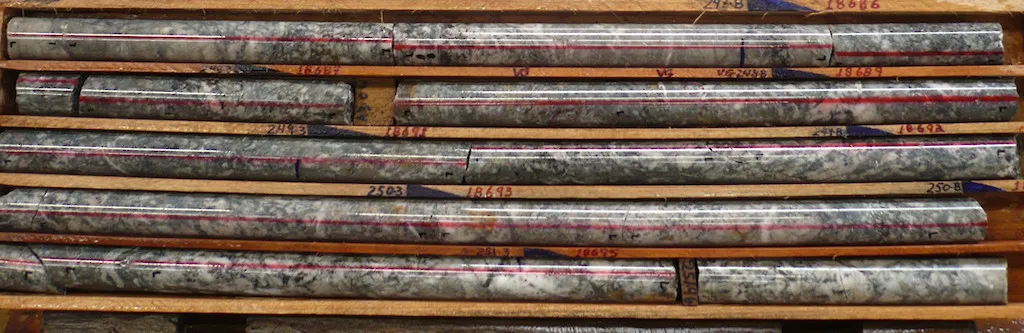
Cabral Gold's Jerimum Cima drilling hits 9.5m @ 5.74 g/t gold and bonanza-grade 80.51 g/t. Discovery expands to 750m strike, emerging as Cuiú Cuiú's sixth deposit.
- Cabral Gold reported exceptional drill results from its Jerimum Cima discovery in Brazil, including 9.5m @ 5.74 g/t gold and a bonanza-grade intercept of 0.5m @ 80.51 g/t gold
- The main mineralized zone now extends 750 meters along strike (expanded by 175 meters eastward) and remains open in both directions, with multiple parallel high-grade zones discovered 125-250 meters south of the main trend
- Jerimum Cima features deep weathering to 70 meters depth - the deepest oxide profile at Cuiú Cuiú - creating a substantial near-surface gold blanket that could significantly enhance the company's Phase 1 heap leach operation currently under construction
- The discovery is emerging as the sixth major gold deposit at Cuiú Cuiú, positioned within a major east-west fault zone comparable to the MG deposit and Machichie Main discovery
- Multiple previously unrecognized high-grade structures spanning 600 meters along strike suggest significant resource expansion potential as infill drilling progresses toward an initial resource estimate
Cuiú Cuiú Project Overview
The Cuiú Cuiú gold district is a 100%-owned property located in the Tapajós Region of Pará state in northern Brazil. This region hosted Brazil's largest historical gold rush between 1978 and 1995, producing an estimated 30-50 million ounces of placer gold according to Brazil's National Mining Agency. Cuiú Cuiú itself was the largest placer gold area in the Tapajós, contributing approximately 2 million ounces historically.
Cabral has systematically explored this district since acquisition, defining five NI 43-101 compliant gold deposits: Central, MG, Jerimum Baixo (JB), Machichie Main, and PDM. Current resources total 450,200 ounces of indicated gold in fresh basement rock at 1.14 g/t, plus 216,182 ounces in oxide material at 0.50 g/t, with additional inferred resources bringing the total inventory to over 1.1 million ounces.
The company is currently constructing a Phase 1 oxide heap leach operation designed to process near-surface weathered material, with production expected to commence in the near term. The Jerimum Cima discovery, located 3 kilometers east-northeast of the Central deposit, is emerging as the sixth major deposit in the district.
1. The Numbers: Drill Result Highlights
The latest results from six diamond drill holes at Jerimum Cima delivered multiple high-grade gold intercepts that significantly expand the discovery. To understand these results, drill intercepts are reported as thickness (in meters) and grade (grams of gold per tonne of rock). For context, anything above 1 g/t gold is generally considered economic, while grades above 5 g/t are considered high-grade.
The standout hole was DDH359, drilled at the eastern edge of the known mineralization. This single hole returned three separate gold zones: 9.5 meters grading 5.74 g/t gold (including a higher-grade core of 3.6 meters at 13.92 g/t), 14.4 meters at 0.62 g/t gold, and 15.1 meters at 1.04 g/t gold. All three intercepts occurred in fresh, unweathered rock, demonstrating the deposit extends well below the oxidized surface material. This hole extended the main mineralized zone an additional 175 meters eastward, bringing the total strike length to 750 meters.
DDH365 delivered the most spectacular single intercept: 0.5 meters grading 80.51 g/t gold (approximately 2.6 ounces per tonne) - what geologists call "bonanza grade." This hole was drilled 250 meters southeast of the main zone as a reconnaissance test and discovered a completely new high-grade structure. The broader intercept around this bonanza grade was 3.8 meters at 10.80 g/t gold, demonstrating substantial width at exceptional grades.
DDH355, testing the western boundary, returned 2.0 meters at 15.29 g/t gold in near-surface weathered rock (saprolite). This intercept is significant because high grades in oxidized material can be processed immediately using simple, low-cost heap leaching with no grinding or complex metallurgy required.
DDH356 intersected multiple narrow, very high-grade zones including 0.5 meters at 34.87 g/t gold and 0.6 meters at 68.04 g/t gold (approximately 2.2 ounces per tonne). While these intercepts are narrow, such extreme grades often indicate the presence of high-grade shoots that can widen along strike or down-dip, making them priority targets for follow-up drilling.
DDH360, drilled 75 meters east of DDH359, intersected a broader, lower-grade zone of 45.1 meters at 0.30 g/t gold with several higher-grade intervals up to 5.80 g/t gold. While 0.30 g/t might seem low, this thickness at that grade confirms mineralization continuity and could contribute significant ounces when calculated across the full intercept width.
Collectively, these results demonstrate three critical characteristics: consistent high grades across multiple holes, substantial intercept widths (up to 45 meters), and mineralization continuity along the expanding 750-meter strike length.
2. Discovery Expansion: Growing the Footprint

The Jerimum Cima discovery is rapidly expanding in multiple directions. The main east-west mineralized zone now measures 750 meters along strike, up from 575 meters before these latest results. Importantly, the zone remains completely open to both the east and west, with no drilling yet testing the ultimate boundaries.
The discovery of multiple high-grade structures south of the main zone adds a crucial new dimension. DDH356 and DDH365 were drilled 600 meters apart, yet both intersected previously unrecognized high-grade mineralization 125-250 meters south of the main trend. This suggests at least two and possibly three parallel mineralized zones spanning the full 750-meter strike length.
The width of the overall mineralized corridor appears substantial, with the major fault zone hosting mineralization measuring at least 200 meters wide in places. This creates a large target area for systematic infill drilling to define tonnage and grade.
Gold-in-soil geochemistry supports significant scale potential. The target is characterized by a strong +100 parts per billion gold anomaly covering 900 meters by 1,000 meters, which is comparable to the geochemical signatures above the established MG and Central deposits, both hosting substantial resources.
3. Deep Weathering: The Oxide Opportunity
One of Jerimum Cima's most significant attributes is its exceptionally deep weathering profile extending to 70 meters depth - the deepest oxide zone encountered anywhere at Cuiú Cuiú to date. This has major implications for near-term production.
Weathered material (saprolite and blanket zones) is much cheaper to process than fresh rock. It requires no grinding, can be heap leached with simple cyanide solution, and typically achieves higher gold recoveries. The presence of 70 meters of oxidized material at Jerimum Cima creates a substantial near-surface gold blanket amenable to low-cost extraction.
Previous trench sampling of this oxide zone returned excellent grades including 14m @ 1.6 g/t gold, 20m @ 1.2 g/t gold, 10m @ 1.3 g/t gold, 24m @ 0.7 g/t gold, and 18m @ 1.9 g/t gold. These results confirm that gold grades remain robust in the weathered material, not just in the underlying fresh rock.
For Cabral's Phase 1 heap leach operation currently under construction, Jerimum Cima could provide a significant boost. The oxide blanket could substantially increase both throughput and mine life for the initial operation, allowing the company to generate cash flow while continuing to define the underlying hard rock resource.
The combination of near-surface oxide material for immediate production potential and deeper fresh rock mineralization for longer-term development creates optionality and extends the project's economic life.
4. Geological Setting: Understanding the Controls
Jerimum Cima's mineralization is centered on a major east-west trending fault zone that forms a splay off the regional-scale Tocantinzinho fault system. This structural setting is essentially identical to both the MG deposit and the Machichie Main discovery, two of the highest-grade zones at Cuiú Cuiú.
The east-west structural control is significant because it represents a different orientation than some other deposits in the district, suggesting Jerimum Cima taps into a separate hydrothermal fluid pathway. Major fault zones act as conduits for mineralizing fluids and create structural dilations where gold precipitates.
Mineralization is hosted within intrusive rocks that have been extensively altered by hydrothermal fluids. The gold occurs primarily as fine particles associated with quartz veining and disseminated pyrite throughout the host rock. Multiple intrusive phases appear to be present, creating complexity but also multiple targets for mineralization.
High-resolution drone magnetic surveys currently underway are expected to provide crucial insights into structural controls. Similar work in the Central-Mutum-PDM area delivered "stunning insights" according to management, and the same methodology applied at Jerimum Cima should help identify additional drill targets and clarify the relationship between parallel mineralized zones.
The eastern end of the discovery is particularly prospective because the controlling structure takes a major bend heading into the TZ fault - a geological setting that often creates zones of enhanced dilation and gold concentration.
5. Parallel Zones: Multiple Targets Emerging
Perhaps the most exciting aspect of the latest results is the recognition that Jerimum Cima comprises not one but potentially three parallel mineralized zones spanning at least 750 meters along strike.
The main zone, defined by holes including DDH359 with 9.5m @ 5.74 g/t gold, represents the primary target that has been traced continuously along strike. This zone occurs within a major east-west fault corridor and appears to be the largest and most continuous of the mineralized structures.
A second parallel zone located approximately 125 meters south of the main trend was intersected by DDH356, which returned narrow high-grade intervals of 0.5m @ 34.87 g/t and 0.6m @ 68.04 g/t gold. These spectacular grades in narrow structures suggest high-grade shoot controls that could host significant tonnage if the structures widen or multiple shoots are present.
A third potential zone 250 meters southeast of the main trend was discovered in DDH365, which returned 3.8m @ 10.80 g/t gold including 0.5m @ 80.51 g/t gold. The 80.51 g/t gold intercept (approximately 2.6 ounces per tonne) represents bonanza-grade mineralization rarely encountered in exploration drilling.
The fact that DDH356 and DDH365 were drilled 600 meters apart as widely-spaced reconnaissance holes, yet both intersected high-grade mineralization south of the main zone, strongly suggests these parallel structures are not isolated pods but rather continuous features requiring systematic follow-up.
Each of these parallel zones now requires dedicated drilling to define geometry, continuity, and grade distribution. This multiplies the total drilling requirement but also significantly expanding the ultimate resource potential.
6. Current Drilling: Expanding the Program
Cabral is currently drilling at Jerimum Cima with plans to bring in a second rig to accelerate the program. The immediate priorities include extending the main zone further eastward where it remains completely open, testing the western boundary, and systematically drilling the newly recognized parallel zones.
Infill drilling within the known 750-meter strike length is also required to upgrade geological confidence and support an initial resource estimate. Current drill spacing is too wide for resource classification, with holes ranging from 75 to 175 meters apart along strike.
The combination of extensional drilling (testing boundaries) and infill drilling (defining tonnage and grade) will likely require 30-50 additional holes to adequately test the discovery. This represents 6-12 months of sustained drilling depending on rig availability and productivity.
Management has indicated that an initial resource estimate is a near-term objective once sufficient infill drilling is completed. Given the 750-meter strike length, 200+ meter width, and multiple mineralized zones with thicknesses ranging from 2-45 meters, the tonnage potential appears substantial.
The parallel drone magnetic survey work currently in progress should help optimize drill targeting by identifying structural controls and potential high-grade shoot positions along the controlling faults.
7. District Context: The Sixth Deposit
Jerimum Cima is emerging as the sixth major gold deposit at Cuiú Cuiú, joining Central, MG, Jerimum Baixo, Machichie Main, and PDM. Management has indicated it is likely to become "one of the most important" deposits in the district - a significant statement given the existing resource base.
The discovery sits within a 3-kilometer radius of multiple established deposits, creating potential for a single centralized processing facility to service ore from multiple pits. This hub-and-spoke model significantly improves project economics by sharing infrastructure costs across multiple ore sources.
Cuiú Cuiú's total land package covers a large district-scale footprint with additional exploration targets beyond the six known deposits. The property is largely underexplored using modern techniques, with systematic drilling having been conducted only since Cabral's acquisition.
The district's historical placer gold production of approximately 2 million ounces from Jerimum Cima's immediate area suggests very substantial primary hard rock sources feeding those placer deposits. Much of that primary source material likely remains unmined and could represent significant discovery potential.
Cabral's systematic approach of defining multiple deposits rather than focusing exclusively on a single large resource creates optionality for mine planning, allows selective high-grading, and reduces execution risk by not depending on a single ore source.
For Investors: Key Takeaways
- High-grade discovery expanding rapidly: 9.5m @ 5.74 g/t gold and bonanza-grade 0.5m @ 80.51 g/t intercepts from wide-spaced reconnaissance drilling demonstrate robust grades, while 750-meter strike length (open in both directions) confirms significant scale potential
- Multiple parallel zones multiply resource potential: Discovery of at least three mineralized zones spanning 600+ meters indicates the system is much larger than initially recognized, significantly increasing total tonnage potential
- Deepest oxide profile creates near-term value: 70-meter weathering depth at Jerimum Cima is exceptional for the district and could substantially enhance Phase 1 heap leach throughput and mine life, accelerating cash flow generation
- Similar geology to highest-grade deposits: East-west structural control and fault-hosted setting mirrors MG deposit and Machichie Main - the district's highest-grade zones - suggesting similar grade potential as drilling advances
- Path to sixth district deposit: Management expects Jerimum Cima to become one of the most important deposits at Cuiú Cuiú, with initial resource estimate expected following infill drilling over the next 6-12 months
- Leveraged to gold price strength: With gold trading at $4,941/oz (well above typical Brazilian production costs of $800-1,200/oz), new discoveries like Jerimum Cima benefit from exceptional margin potential in the current environment
- Production catalyst approaching: Phase 1 heap leach operation under construction provides near-term cash flow pathway while resource definition continues at Jerimum Cima and other targets, creating dual-track value creation
Bottom Line
Cabral Gold has delivered exceptional drill results that transform Jerimum Cima from an early-stage target into an emerging district-scale discovery. The combination of high grades (including bonanza-grade intercepts up to 80.51 g/t gold), expanding strike length (750 meters and open in both directions), multiple parallel zones, and exceptionally deep oxide weathering creates a compelling value proposition.
For investors seeking exposure to a high-grade gold discovery in a prolific district with near-term production catalysts, Cabral offers an attractive risk-reward profile. The company is transitioning from pure exploration to development with its Phase 1 heap leach operation under construction, while simultaneously expanding its resource base through discoveries like Jerimum Cima. The district-scale land position in a historically productive gold region, combined with multiple deposits providing mine planning optionality, positions Cabral as an emerging mid-tier producer in one of Brazil's premier gold districts.
Analyst's Notes





Subscribe to Our Channel






Stay Informed






















