




Copper Mine Supply Peaks in 2030 Even as Prices Set Records


Copper mine supply expected to peak by 2030 as falling ore grades, long project lead times and AI-driven demand widen the deficit despite record prices.
- BHP's 18 August 2026 results show Escondida producing an average of 900,000 to 1,000,000 tonnes a year from FY28 to FY31, around 25% below the 1,261,000 tonnes produced in FY26.
- Escondida concentrator feed falls from 0.90% in FY26 to around 0.70% in FY27, and the replacement concentrator is not targeted to deliver first copper until CY31-32.
- S&P Global's 8 January 2026 study puts global mine production peaking at 33 million tonnes in 2030 against 42 million tonnes of demand by 2040. The IEA puts the shortfall at 30% by 2035.
- Copper traded at $14,373 per tonne on 4 September 2026, a tenth straight weekly gain, but the US tariff decision is undated and unpriced, leaving position size rather than timing as the controllable variable.
- Global mine production reaching 25 million tonnes before 2029, per the ICSG monthly bulletin, would falsify the deficit case.
Ore Grade Decline Cuts Guided Mine Output While Copper Trades Near Record Highs
BHP published results for the year ended 30 June 2026 on 18 August 2026. Escondida, the world's largest copper mine, produced 1,261,000 tonnes, down 3% year on year. FY27 guidance is 1,000,000 to 1,100,000 tonnes, and medium-term guidance is an average of 900,000 to 1,000,000 tonnes a year across FY28 to FY31, on an assumed USD/CLP 890. The 950,000 tonne midpoint sits 25% below the FY26 outcome.
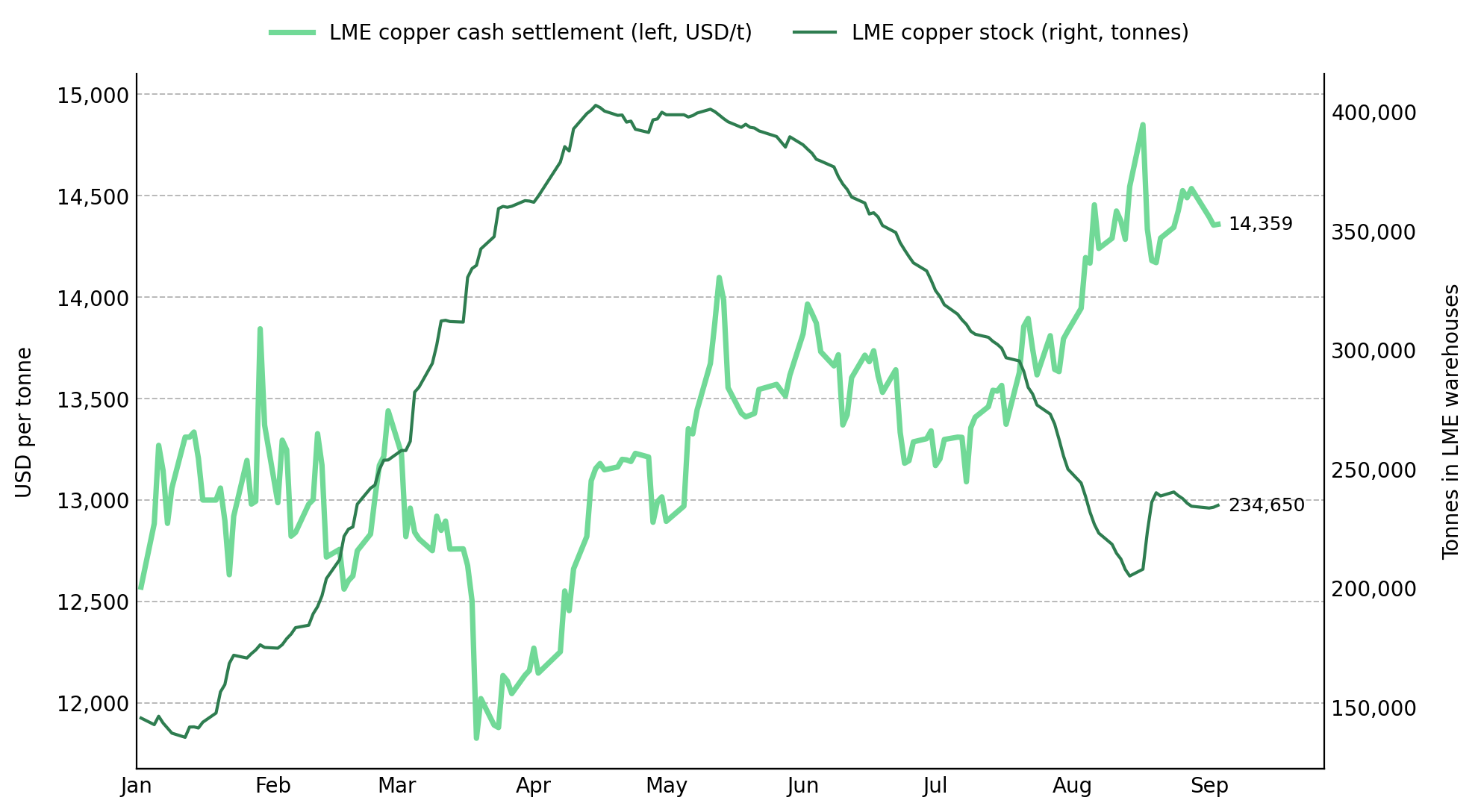
The price is moving the other way. Three-month copper on the London Metal Exchange traded at $14,373 per tonne on 4 September, a tenth consecutive weekly gain and within reach of the all-time peak of $14,527.50, according to Reuters. The largest single source of mined copper is guiding roughly 300,000 tonnes a year out of the market during the strongest price run copper has recorded.
Falling Ore Grades & Long Lead Times Cap The Copper Supply Response To 2035
The mechanism is ore grade, and it is arithmetic rather than management. BHP guided Escondida concentrator feed grade down from 0.90% in FY26 to around 0.70% in FY27, stripping contained metal out of the same tonnage moved. The IEA commentary of 2 March 2026 puts the average global mine grade 40% below its 1991 level. Replacement capacity runs on a decade-long clock: the Escondida New Concentrator is costed at $5.4 billion to $6.3 billion, with first production targeted for CY31-32.
The pipeline behind it is thinner than the price implies. The IEA records that only 5% of the copper deposits found in the last 35 years were discovered in the last decade, and that discovery to production runs around 17 years. A deposit found in 2026 delivers metal after 2040. The midstream is separately strained: the annual treatment and refining benchmark, the fee smelters earn for converting concentrate into metal, settled at $0 per tonne in January 2026.
Electrification & AI Demand Raise Copper Consumption 50% As Mine Output Peaks
BHP's own remedy is dated well beyond the current price cycle. Chief Executive Officer Brandon Craig set out the timeline alongside the 18 August 2026 results, describing a pipeline across Chile, Australia and Argentina that "can potentially lift copper production by around 40% by FY35."
If that pipeline and its peers convert on schedule, S&P Global's 8 January 2026 study Copper in the Age of AI, still has global mine production peaking at 33 million tonnes in 2030 against demand of 42 million tonnes by 2040, a 10 million tonne annual shortfall equal to 24% of demand, even after recycled scrap more than doubles from 4 million to 10 million tonnes. If it slips, the IEA's 2 March 2026 assessment of the announced project base points to a 30% deficit by 2035.
The releases separating the two are the International Copper Study Group monthly bulletin and Cochilco's monthly Chilean production series.
Record Prices Squeeze Fabricator Margins While Smelter Fees Settle At Zero
Margin compression lands first on processors. Custom smelters, which buy concentrate on the open market rather than from affiliated mines, earn no processing income at a $0 benchmark and rely on gold, silver and acid credits. Fabricators buying cathode on an exchange-plus-premium basis absorb the price within one quarter wherever contracts reprice quarterly.
The limit on acting is the US tariff decision, which is binary, undated and unpriced. Reuters reported on 25 August 2026 that COMEX inventories had run for 46 straight days to a record 675,185 tonnes, turning CRU's projected 639,000 tonne surplus for 2026 into a balanced market at best. Nobody outside the White House knows the answer or the date, leaving position size rather than timing as the variable a retail holder of single-name copper equity controls, with equity drawdowns on resolution running wider than the metal's.
What Will Dictate Copper Value
The durable lesson is that in a mature, grade-declining commodity, price rations existing metal rather than signaling new supply. The interval between an incentive price and a delivered tonne is set by geology, permitting and construction, none of which respond to the forward curve. The same holds wherever the largest producing assets were commissioned decades ago.
What changes is where the marginal tonne comes from. The assumption that today's giants carry the supply base through the 2030s no longer holds, moving value toward junior potential. That argues for repositioning up the development curve rather than avoiding the sector: producing equities carry peak-cycle multiples, while grade and permitting status belong inside a valuation, not a risk footnote.
Analyst's Notes





Subscribe to Our Channel



.png)
Stay Informed


