




Crude’s 8.7% Drop Widens Refining Margins as Diesel Stocks Hit 2003 Lows



With 20% of refining capacity at risk of closure, complex operators could capture a larger share of margins as demand rises toward its projected 2032 peak.
- Brent for January settlement traded at $95.13 a barrel on November 5, after falling 8.7% in the previous session following a Democratic sweep of Congress.
- US distillate stocks fell 3.6 million barrels to about 99.2 million in the week ended October 30, their lowest since 2003 and 13% below the five-year average.
- Wood Mackenzie projected global refined product demand to peak at 108 million b/d in 2032 and identified about 20% of refining capacity at risk of closure.
- The diesel crack spread over Brent stood at $87.40 a barrel on November 4, within a 12-month range of $26 to $115, implying roughly 70% downside if the spread returns to its low.
- A rise in US distillate stocks above 106.4 million barrels, the five-year range's lower bound, would eliminate the scarcity premium.
Midterm Sweep Sends Brent Down 8.7%
Brent for January settlement traded at $95.13 a barrel after falling 8.7% in the previous session, while December West Texas Intermediate (WTI) declined 8.3% to $88.05 and the S&P Energy index fell 4.77% to 979.18. Brent fell nearly 20% for the week as traders viewed a Democratic sweep of both chambers of the US Congress as accelerating an end to the Iran war.
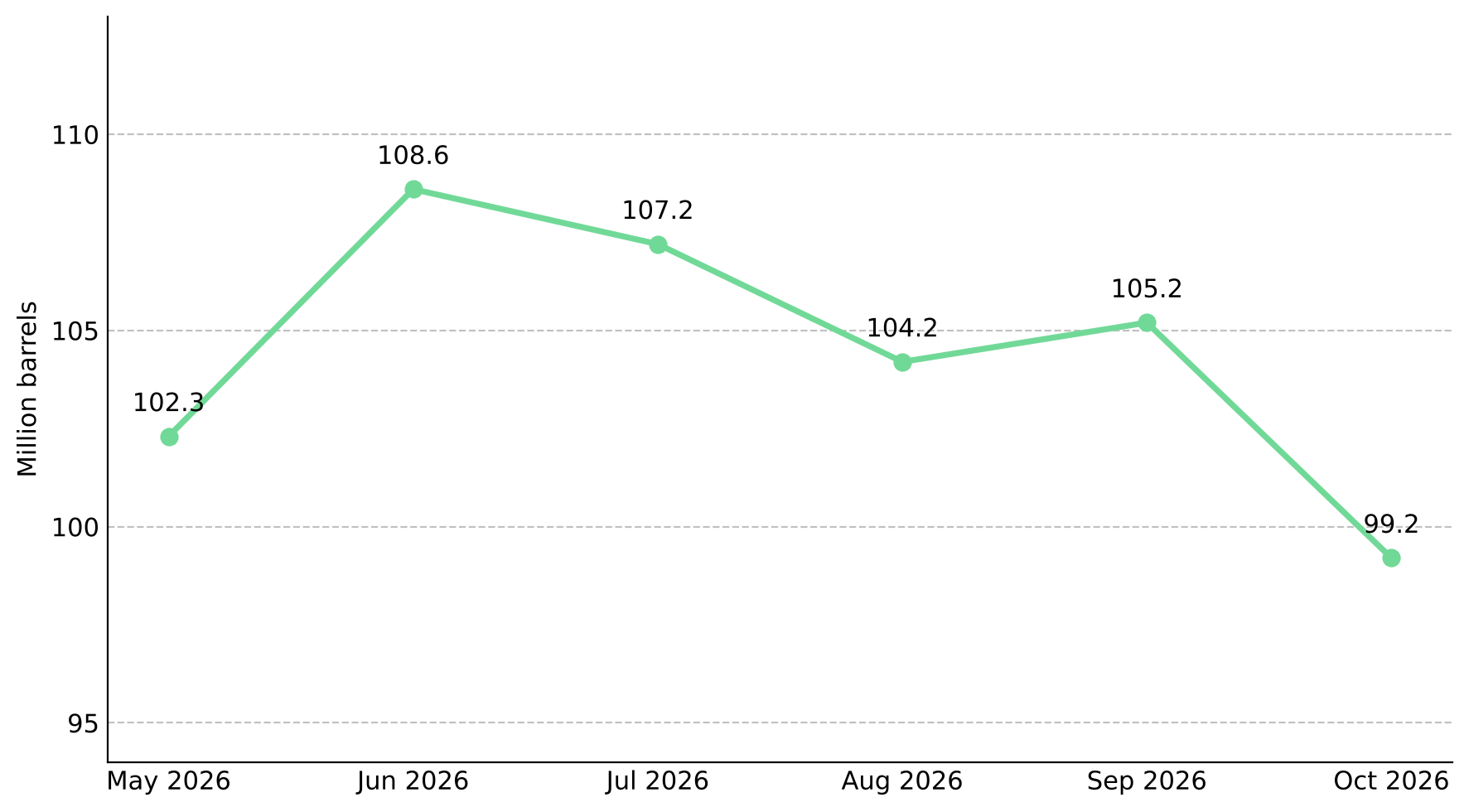
While crude prices fell, US distillate stocks declined 3.6 million barrels to about 99.2 million in the week ended October 30, their lowest level since 2003 and 13% below the five-year average.
Hormuz Disruption Sustains $87.40 Diesel Crack Spread
US refineries processed 16.7 million b/d at 94.5% utilization in the week ended October 30, yet distillate output fell to 5.2 million b/d. Four-week average distillate demand rose 8.7% year over year to 4.2 million b/d, while total commercial petroleum inventories declined 8.2 million barrels.
Wood Mackenzie attributes elevated refining margins to the Middle East conflict and damage to Russian refineries. Gulf crude exports averaged 17.1 million b/d in October, down from September, while ANZ saw no end in sight to Iran's control of the Strait of Hormuz. Crude cargoes can reroute within weeks, but hydrocracking capacity cannot be replaced as quickly, prolonging the refining shortage.
2032 Demand Peak Narrows Window for Refinery Upgrades
Global distillation capacity stood at about 103.3 million b/d in January 2026, with annual net additions of just over 400,000 b/d. S&P Global Energy projects European capacity falling from about 14 million b/d around 2000 to just over 9 million b/d by 2035, with roughly 500,000 b/d closed in 2025.
Wood Mackenzie projects global refined product demand rising from 105 million b/d in 2025 to a peak of 108 million b/d in 2032. It also identifies roughly 20% of refining capacity across more than 700 refineries at risk of closure, with India accounting for 40% of capacity additions through 2030.
With only three to four refinery turnaround cycles before 2040, the window for approving upgrades is open now. Alan Gelder, Senior Vice President of Refining, Chemicals and Oil Markets at Wood Mackenzie, described the current pressures as different in kind, not just degree.
Lower Crude Costs Favor Complex Refiners
Brent's 8.7% decline reduced upstream producers' revenue per barrel while lowering feedstock costs for refiners. Wood Mackenzie notes that refining margins track crack spreads rather than crude prices, with the diesel crack at $87.40 a barrel.
Wood Mackenzie links refinery competitiveness to facility type, location, and ownership, ranking large, complex, chemical-integrated sites as most competitive and smaller, less complex facilities as dependent on subsidies.
With ceasefire timing uncertain, the diesel crack spread's 12-month range of $26 to $115 a barrel leaves roughly 70% downside from $87.40 if it returns to its low. The $63 12-month average provides an alternative basis for sizing refining exposure without forecasting the ceasefire.
Why Could Refinery Closures Benefit Survivors
Brent fell nearly 20% for the week following the US midterm election result, while refining margins remained elevated as the political shift added no conversion capacity.
Complex refiners focused on distillates derive value from crack spreads rather than crude prices. Wood Mackenzie finds that refineries earn lower returns on capital than upstream operations, making upgrades harder to finance and warranting consideration in refinery valuations.
Refinery closures could benefit surviving operators by concentrating refining margins among fewer facilities as demand rises toward its projected 2032 peak. Limited investment in capacity upgrades could prolong the shortage into the next decade, supporting margins for remaining refiners.
Analyst's Notes





Subscribe to Our Channel








Stay Informed


