




Record 3% LNG Contraction Hands Winter Pricing Power to Flexible Cargoes


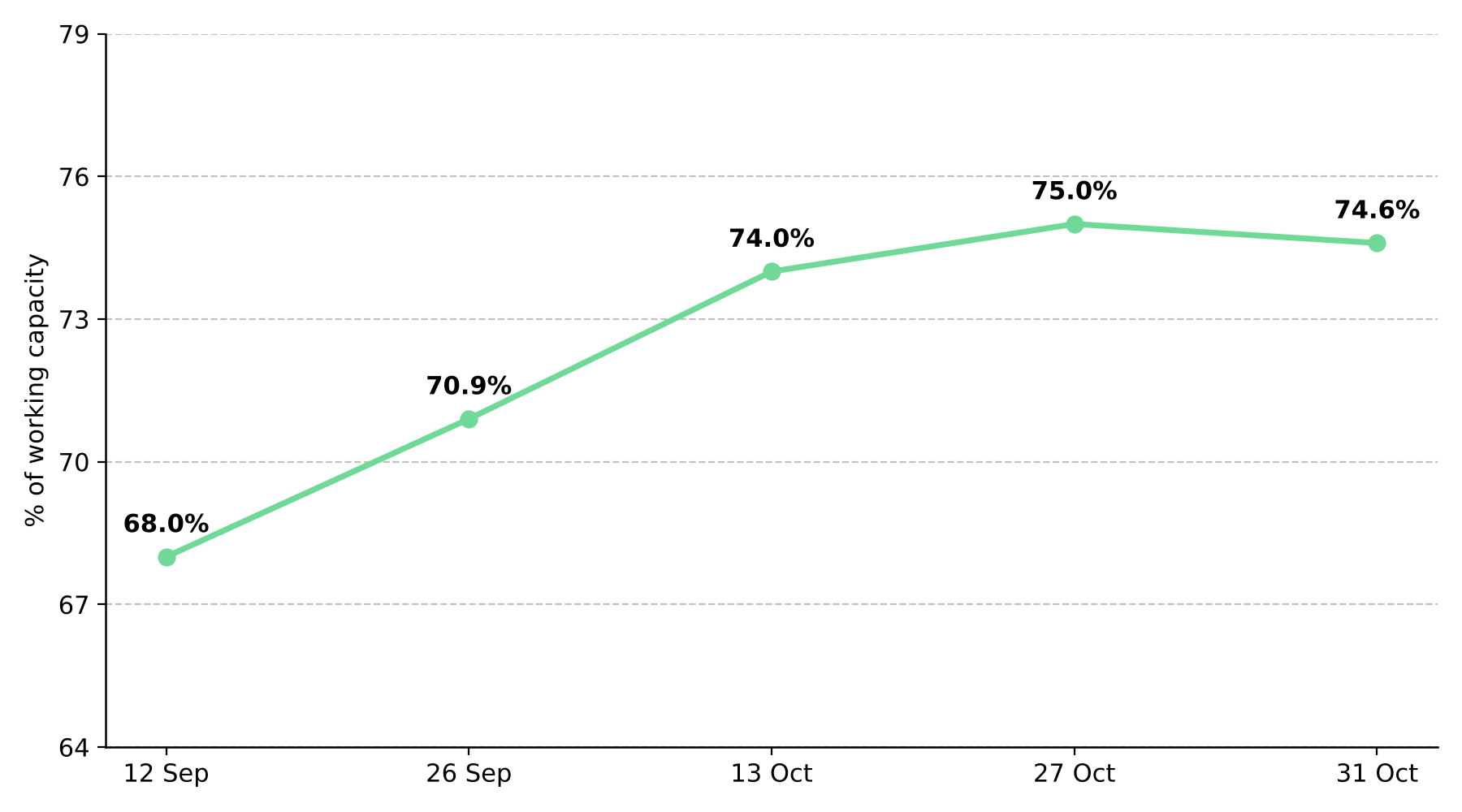
Europe’s gas storage closed at 74.6% versus an 89.8% five-year average, potentially sustaining demand for LNG supply during the 2027 refill season.
- The International Energy Agency’s (IEA) Global Gas Security Review 2026, published November 3, reports a record 3% annual decline in global liquefied natural gas (LNG) supply, supporting winter pricing power for flexible cargoes.
- EU gas storage closed the injection season on October 31 at 74.6% of working capacity, versus a five-year average of 89.8%, according to Gas Infrastructure Europe’s Aggregated Gas Storage Inventory (AGSI).
- Qatari and Emirati LNG shipments fell by more than 60 billion cubic meters on an annualized basis from March to October 2026, while production outside the Persian Gulf rose 14%, offsetting only two-thirds of the loss.
- The US Energy Information Administration (EIA) projects LNG exports near 17.3 billion cubic feet per day in the second half of 2026, rising to 18.7 billion in the first half of 2027, leaving prices to balance winter demand.
- Reopening the Strait of Hormuz to LNG carriers and recovering more than half of the roughly 54 billion cubic meters in 2026 Qatari and Emirati supply shortfalls would weaken winter pricing power for flexible LNG cargoes.
Iran Diplomacy Drives Nearly 9% Gas Futures Drop Despite LNG Decline
The IEA’s Global Gas Security Review 2026 reports a record 3% decline in global LNG supply, nearly 20 billion cubic meters, tightening winter cargo availability. Crude and European gas sold off on Iran diplomacy, but Brent’s January contract rebounded 1.9% to $106.74 a barrel after falling 7.6% the previous day.
European gas futures fell almost 9% on Monday, despite a 6% decline in global LNG production from March to October 2026 compared with the same period in 2025. Europe’s below-average gas storage supports winter pricing power for flexible LNG cargoes despite the futures selloff.
Hormuz Disruption Cuts Gulf Shipments, Leaving EU Storage at 74.6%
Iranian attacks on regional infrastructure and shipping disruption in the Strait of Hormuz, which carried around 20% of global LNG flows before the war, contributed to a decline of more than 60 billion cubic meters in annualized Qatari and Emirati LNG shipments from March to October 2026. Production outside the Persian Gulf rose 14%, or more than 40 billion cubic meters, offsetting roughly two-thirds of the loss, while inventories covered the remaining third.
EU gas storage ended the injection season at 74.6% of working capacity, below the five-year average of 89.8% and the previous year's 82.8%. This also fell short of the 90% November 1 target under the 2022 Storage Regulation. With Hormuz trade flows assumed largely disrupted through year-end, Europe's reduced reserves increase its reliance on flexible LNG cargoes during winter.
Winter Withdrawals Delay Reserve Recovery Until Spring
Diplomatic progress may precede the return of disrupted LNG shipments. Even if a December settlement restores shipments, European gas storage will already be drawing down for winter, limiting reserve replenishment until spring. Fatih Birol, Executive Director of the IEA, warned that Europe would face difficult conditions in both 2026 and 2027.
Limited Flexible Cargo Supply Favors Spot-Exposed US Exporters
US Gulf Coast LNG exporters with spot-exposed or self-marketed cargoes can benefit from higher winter prices, alongside gas-weighted producers supplying them. Conversely, higher gas costs squeeze margins for European industrial buyers without hedges and utilities that sold winter power in advance without securing fuel.
Fixed-fee LNG exporters receive the same liquefaction payment whether Dutch Title Transfer Facility (TTF) gas trades at $12 or $20 per million British thermal units (MMBtu).
US LNG exports averaged 17.4 billion cubic feet per day in the first half of 2026, are projected at 17.3 in the second half, and rise to 18.7 only in the first half of 2027, limiting additional winter supply. However, uncertain winter weather requires careful position sizing, as a mild winter could reverse spot-price premiums.
Why Could 2027 Storage Refill Support Prices
Europe’s winter gas withdrawals will determine how much supply it needs to replenish reserves in spring. With LNG availability already reduced, deeper withdrawals would increase the volume required to rebuild storage during the next injection season.
In a tight LNG market, flexible cargoes set the clearing price. Europe is projected to enter the 2027 injection season with its lowest starting storage level since 2013, potentially sustaining higher prices for flexible LNG supply during the refill period.
Analyst's Notes





Subscribe to Our Channel






Stay Informed


