




Selkirk Copper's Structural Model Points Minto Restart Toward Higher Grade


Selkirk Copper's latest Minto drilling supports a structural model targeting higher-grade mineralization, with results feeding a 2027 resource estimate and feasibility study.
What Has Happened
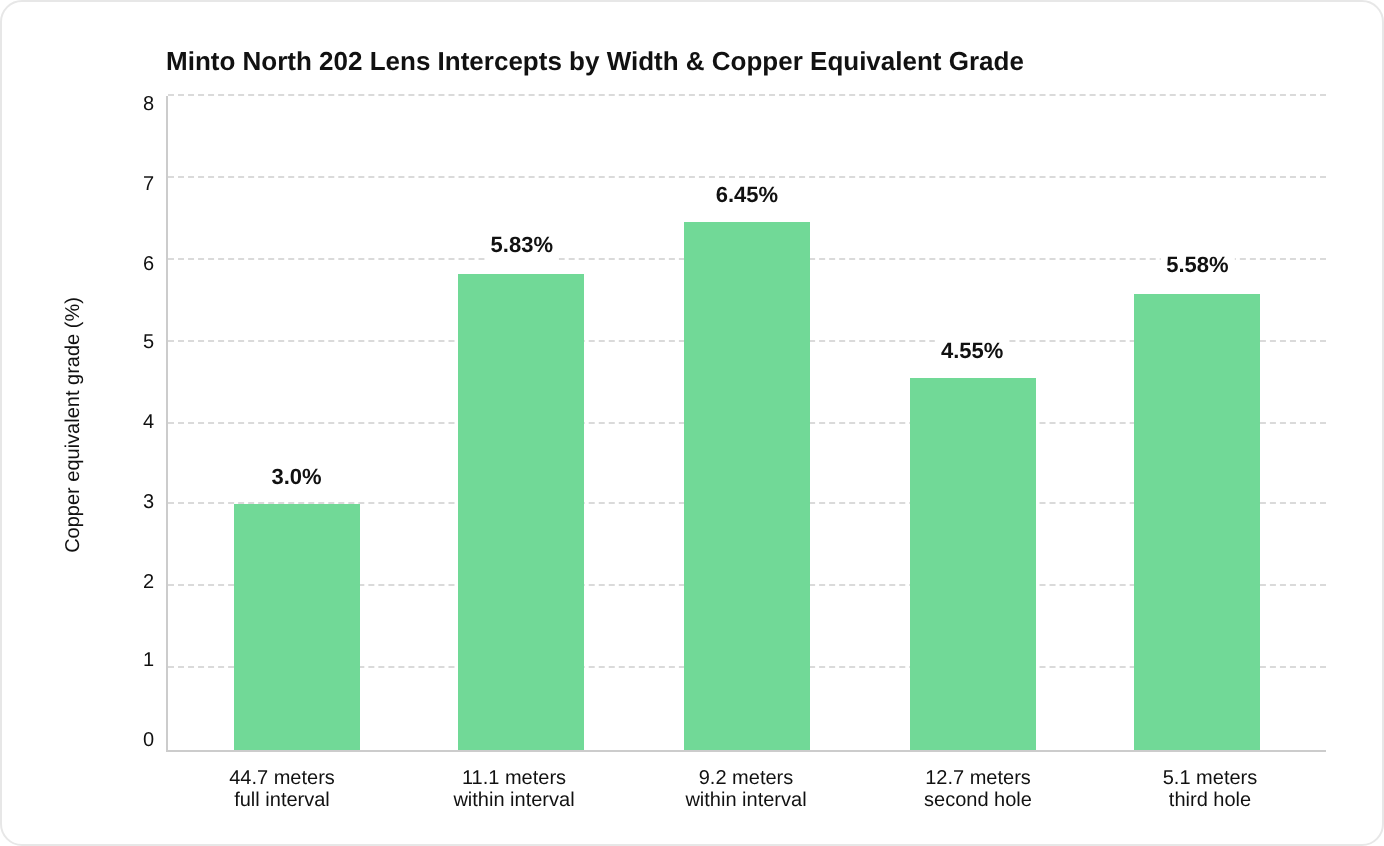
Selkirk Copper Mines (TSXV: SCMI | OTCQX: SKRKF | FRA: IO20) reported a new set of Phase 2 drill results from the Minto Project on October 15, 2026. Minto is the former copper-gold-silver mine in central Yukon that the company is working to restart. The widest result came from the 202 Lens at Minto North: 44.7 meters grading 2.12% copper, 1.16 grams per tonne gold and 10.7 grams per tonne silver, for 3.0% copper equivalent. Inside that interval, 11.1 meters returned 5.83% copper equivalent and 9.2 meters returned 6.45% copper equivalent.
2 further Minto North holes returned shorter, higher-grade intervals: 12.7 meters at 2.94% copper, 2.09 grams per tonne gold and 15.0 grams per tonne silver (4.55% copper equivalent), and 5.1 meters at 3.72% copper, 2.45 grams per tonne gold and 17.4 grams per tonne silver (5.58% copper equivalent). Estimated true widths are 80% to 90% of the reported core lengths.
All 3 holes were infill holes drilled to test a single geological idea: that a north-northwest structural trend controls where the highest grades occur within the 202 Lens. The company states that the results support that hypothesis and that the same trend may be an important control elsewhere in the deposit area.
Why a Structural Model Is New at Minto
The structural framework Selkirk Copper inherited with Minto was relatively simple and focused on brittle faults in the Copper Keel and Minto East underground mining areas. It lacked a robust structural model for Minto North, Area 118 and Ridgetop. The exploration team has been building one through 2025 and 2026 using oriented core logging, structural mapping, drone photogrammetry, and an updated 3-dimensional fault model. The model separates 2 structural types. Ductile structures, meaning foliation and migmatite banding, run parallel to mineralization and define how the lenses fold and dip. Brittle faults are typically small and offset mineralization by 10 to 50 meters. The mineralized lenses at Minto dip gently, measure 5 to 50 meters thick, and extend 100 to 1,000 meters in length.
Grade follows deformation. In the company's drill-core classification, weakly foliated rock carries less than 0.1% copper, moderately foliated rock 0.1% to 0.5%, strongly foliated rock 0.5% to 1%, migmatite 1% to 2%, and semi-massive sulfides 2% to 10%. Bornite and gold both increase toward the high-grade end, and the widest Minto North interval cut folioform to semi-massive bornite and chalcopyrite in migmatite host rock, the upper end of that scale.
What the Minto North Results Mean for Mine Planning
The Minto North results will improve updated resource modeling and support higher-grade mine planning. The 202 Lens has already grown: contained Indicated copper in the lens expanded by 238% between the 2025 and 2026 resource estimates. A structural trend that predicts where the highest grades concentrate gives the next resource model a geological basis for grade, in addition to drill spacing alone.
The widest interval also contains an internal waste section grading less than 0.1% copper equivalent. The company describes this as atypical, noting that none appeared in the previous 45 holes drilled into the 202 Lens. It reported the result as a single interval because either bulk or selective underground mining methods could apply. Detailed mining method and stope design work is planned for the Feasibility Study (FS).
The 2026 Preliminary Economic Assessment (PEA) outlines underground mining at Minto North by long-hole open stoping in an upper-cut retreat sequence with rib pillars. The FS will decide whether to mine the high-grade sub-intervals selectively or as part of a bulk stope, and that choice will set the grade delivered to the mill. The 202 Lens remains open to the northwest and southeast, and further results are pending.
How Phase 2 Feeds the Feasibility Study
Phase 2 started in May 2026 with a 50,000-meter plan and had reached 54,711 meters in 223 holes by October 14, 2026, or 109% of plan. The program focuses on expansion, infill, and data collection for the FS, and none of that drilling is in the PEA mine plan. The PEA outlines a 13-year operation at 4,100 tonnes per day, with initial capital of C$186million. At planning prices of US$5.00 per pound of copper and US$50 per ounce of silver, it yields an after-tax net present value (NPV7%) of C$494 million.
The company's FS objectives include upgrading Indicated and Inferred resources to Measured and Indicated, focusing on grade improvement; raising mining and milling rates to 4,500 to 4,900 tonnes per day; and lifting copper recovery by 3% to 4% through metallurgical testwork.
Minto North has its own master composite and 10 geometallurgical variability samples in that testwork. The company classifies Minto North material as hypogene and bornite-dominant with gold. The company associates copper oxides with lower copper recovery; the supergene and transition composites from Ridgetop and Copper Keel represent them.
President and Chief Executive Officer of Selkirk Copper, Colin Joudrie, tied the targeting work directly to the study:
"The structural model and refined targeting methodology, combined with a focused infill drill program, are providing us the information we need to advance Feasibility Study work in the next phase of restart development at the Minto Project."
Broader Context Across the Mine Site
The same release returned results from 3 other zones. At Copper Keel, a hole drilled into a 90-meter gap between earlier holes returned 12.4 meters at 2.02% copper, 0.65 grams per tonne gold and 4.8 grams per tonne silver (2.41% copper equivalent). The grade was higher than expected and confirms the continuity of the geological model there. 2 holes also tested the new 302 Lens, identified through 2026 modeling, which is open to the east and south at about 50 to 70 meters below surface.
At Area 118, a 50-meter step-out returned 8.7 meters at 2.14% copper, 1.61 grams per tonne gold and 10.1 grams per tonne silver (3.38% copper equivalent) in the 301 Lens. The 301 Lens is a Phase 1 discovery within 150 meters of existing underground development and is open to the north and west. A second Area 118 hole intersected 14.9 meters at 1.22% copper equivalent and 10.2 meters at 1.05% copper equivalent in the 120 and 160 lenses, within 200 meters of underground development.
Minto Main returned 27 meters at 1.42% copper, 0.58 grams per tonne gold and 3.4 grams per tonne silver (1.79% copper equivalent) from an infill hole, with higher grade open to the north. The company has started a geological review of structural controls on high-grade mineralization there, which is the same question tested at Minto North. The findings will guide modeling and future targeting.
What to Watch Next
Phase 2 drilling was scheduled to finish by October 20, 2026, with logging, core cutting and sample shipping complete by early November. Assays take about 8 weeks, so results will continue through fall and winter 2026, including further intervals from the 202 Lens and the 302 Lens.
The updated mineral resource estimate in the first quarter of 2027 is the first point at which the north-northwest control can show up in modeled tonnes and grade at Minto North. Metallurgical results from the Phase 2 composites are expected this fall to inform an updated recovery formula for the 2027 FS, and the study itself will set the mining method for the 202 Lens.
On funding, Selkirk Copper held C$36.9 million in cash as of July 30, 2026. It estimates C$20 million to C$25 million in pre-capital costs before the restart decision, covering underground dewatering and rehabilitation, water treatment, and generator refurbishment. The company is targeting restart capital of about C$200 million in the FS.
FAQs (AI-Generated)
Analyst's Notes





Subscribe to Our Channel






Stay Informed


