




Selkirk Copper's Phase 2 Drilling Feeds Into Minto's 2027 Resource Update: 7 Things You Need to Know


Selkirk Copper's Phase 2 drilling at Minto reached 109% of plan, with Minto North, Copper Keel & Area 118 results feeding a 2027 resource update.
Phase 2 Drilling Moves From the Rig to the Resource Model
Selkirk Copper Mines (TSXV: SCMI | OTCQX: SKRKF) has drilled beyond its Phase 2 target at the Minto copper-gold-silver project in central Yukon, and the latest batch of assays defines grade continuity and tests extensions of the modeled mineralization. Results from 4 areas returned 2 types of information: infill holes that test grade and continuity inside lenses already in the resource, and step-outs that test lenses beyond the current model.
None of this drilling is in the 2026 preliminary economic assessment (PEA) mine plan. The company is targeting another updated mineral resource estimate (MRE) in the first quarter of 2027, the first point at which Phase 2 meters can enter the resource base that the feasibility study (FS) will draw on.
1. Phase 2 Has Reached 109% of Its 50,000-Meter Plan
As of October 14, 2026, Selkirk had completed 54,711 meters across 223 holes since the program began in May 2026, representing 109% of the planned 50,000 meters. Drilling is targeted to finish around October 20, 2026, with logging, core cutting, and sample shipping targeted for completion by early November 2026.
Assay turnaround runs about 8 weeks, and this batch covers holes drilled in July 2026. Further results are expected to be released in fall and winter 2026.
The Phase 1 program of 52,288 meters increased contained copper and gold in Measured & Indicated (M&I) resources by 182% and 184%, respectively. The company describes Phase 2 as focused on the FS's data collection needs and largely on expansion and infill, with initial results expanding known zones in the central mine area.
2. Minto North Returned One of the Best Grade-by-Width Results of Phases 1 & 2
Infill drilling at the 202 Lens returned 44.7 meters grading 2.12% copper, 1.16 grams per tonne gold and 10.7 grams per tonne silver, or 3.0% copper equivalent. That interval includes 11.1 meters at 5.83% copper equivalent and 9.2 meters at 6.45% copper equivalent. Reported intercepts represent drill-core lengths; the company estimates true widths at approximately 80% to 90% of the core lengths.
The company ranks the 44.7-meter result among the best grade-by-width intercepts across Phase 1 and Phase 2 combined. 2 further infill holes returned 12.7 meters at 4.55% copper equivalent (2.94% copper, 2.09 grams per tonne gold and 15.0 grams per tonne silver) and 5.1 meters at 5.58% copper equivalent (3.72% copper, 2.45 grams per tonne gold and 17.4 grams per tonne silver). All 3 holes tested a north-northwest structural trend interpreted to control high-grade mineralization.
The 202 Lens posted a 238% expansion of contained Indicated copper in the 2026 resource estimate, and it remains open to the northwest and southeast. More than 202 Lens results are pending, and the focus is on whether those holes extend the high-grade trend further along strike in both directions.
3. Internal Waste Leaves the Mining Method Choice to the Feasibility Study
Selkirk reported the Minto North result as a single 44.7-meter interval, which includes an internal waste interval grading less than 0.1% copper equivalent. The company notes that this waste is atypical, as it does not match the previous 45 holes drilled into the 202 Lens.
The internal waste interval distinguishes between reporting the full mineralized interval and selecting higher-grade material for potential mining. Single-interval reporting reflects the possibility of bulk or selective mining methods, and the FS will assess how the lens's geometry and grade distribution affect mine design and the choice between the 2 approaches.
4. Copper Keel Infill Confirmed the Modeled Geometry, & a New Lens Is Open Nearby
Selkirk drilled 5 holes at Copper Keel, of which 4 intersected significant mineralization; 1 was abandoned above the target depth due to poor ground conditions. In the eastern portion of the 101 Lens, a hole designed to test a 90-meter gap between earlier holes returned 12.4 meters of material grading 2.02% copper, 0.65 grams per tonne gold, and 4.8 grams per tonne silver, or 2.41% copper equivalent.
The grade came in higher than expected, and the company states that the result confirms the continuity of the modeled geometry. Copper Keel is 1 of 4 deposits, alongside Minto North, Minto East and Area 118, where the PEA plans underground mining, and the updated resource estimate will establish how this infill data affects the reported resource.
2 other holes tested the newly identified 302 Lens, where mineralization is open to the east and south at 50 to 70 meters below surface.
5. Area 118 Step-Outs Extended Lenses Close to Existing Underground Development
A 50-meter step-out on the 301 Lens, discovered earlier in 2026 during Phase 1, returned 8.7 meters grading 2.14% copper, 1.61 grams per tonne gold and 10.1 grams per tonne silver, or 3.38% copper equivalent. The intercept lies within 150 meters of underground development, and the lens remains open to the north and west.
A second step-out tested the 120 and 160 lenses and returned 14.9 meters at 1.22% copper equivalent and 10.2 meters at 1.05% copper equivalent, within 200 meters of underground development. Mineralization there is open in several directions, and the company has proposed follow-up drilling.
Area 118's 301 and 304 lenses contributed 65,740,000 pounds of newly defined Inferred copper to the 2026 resource estimate. Proximity to existing underground development is relevant to future access, but it does not by itself establish that a step-out is mineable; the follow-up program and the updated resource estimate will test the extent of these lenses.
6. Minto Main Returned a Thicker, Higher-Grade Interval Than Nearby Drilling
Infill drilling across the 114 and 117 lenses at Minto Main returned 27 meters grading 1.42% copper, 0.58 grams per tonne gold and 3.4 grams per tonne silver, or 1.79% copper equivalent. The interval is thicker and higher grade than nearby intercepts, and the higher-grade area is open to the north.
The 117 Lens was a discovery in the 2026 resource estimate, with newly defined M&I resources of 49,770,000 pounds of copper. A geological review of structural controls at Minto Main is in progress, and further results are pending.
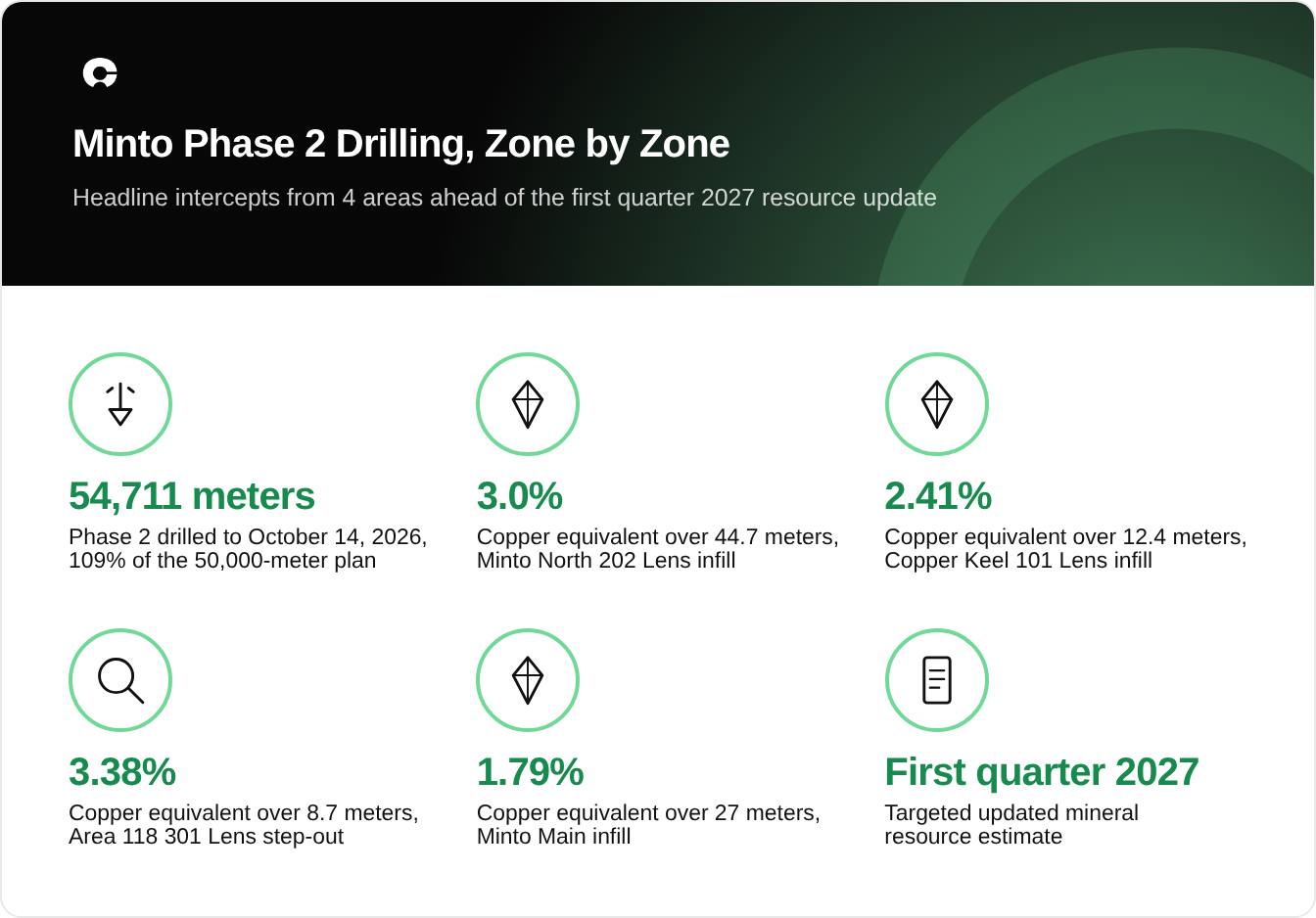
7. The First Quarter 2027 Resource Estimate Brings Phase 2 Into the Plan
The current resource, effective June 10, 2026, contains 940 million pounds of copper, 530,000 ounces of gold and 4,969,000 ounces of silver in the M&I categories. The PEA mine plan excludes all Phase 2 drilling.
Chief Executive Officer Colin Joudrie tied the latest intercepts directly to the next round of resource modeling:
"These results, notably the high grade and thick intercepts at Minto North, Copper Keel, and Area 118, underpin our confidence in the continuity and grade within the zones of mineralization that will improve the quality of our updated mineral resource modeling."
The company's FS objectives include upgrading Indicated & Inferred resources to M&I, maintaining the 13-year mine life while increasing resource conversion in the mine plans, and increasing mine and mill throughput from 4,100 to 4,500-4,900 tonnes per day. The company is also targeting about 30,000 tonnes per year of copper equivalent in concentrate, compared with peak production of 27,200 tonnes per year of copper equivalent in the PEA. These are company targets; the updated resource estimate and the FS will determine whether the Phase 2 data supports them.
Key Takeaways for Investors
Phase 2 drilling reached 54,711 meters across 223 holes, 109% of the 50,000-meter plan, with further results targeted through fall and winter 2026. Infill drilling at the Minto North 202 Lens and the Copper Keel 101 Lens supported grade and continuity. It was led by 44.7 meters of core length at 3.0% copper equivalent at Minto North. Step-out drilling at Area 118 and the new 302 Lens at Copper Keel extended mineralization, with the Area 118 intercepts lying within 150 to 200 meters of existing underground development.
The PEA mine plan excludes all Phase 2 drilling, and the company is targeting an updated mineral resource estimate in the first quarter of 2027. The company’s FS targets include mine and mill throughput of 4,500 to 4,900 tonnes per day and about 30,000 tonnes per year of copper equivalent in concentrate, while holding a 13-year mine life.
Bottom Line
Phase 2 has delivered additional evidence on grade continuity and the extent of mineralization across several areas at Minto, but the results are not yet reflected in the current PEA mine plan. The next test is whether the updated resource estimate in the first quarter of 2027 supports the FS resource conversion, throughput, and production objectives.
Analyst's Notes





Subscribe to Our Channel



Stay Informed


