AI Growth Lifts Gold Electronics Demand 5%, Supporting Future Mine Supply



As AI investment supports advanced chip demand, lower recycling and rising exploration budgets reinforce the importance of economically viable gold projects.
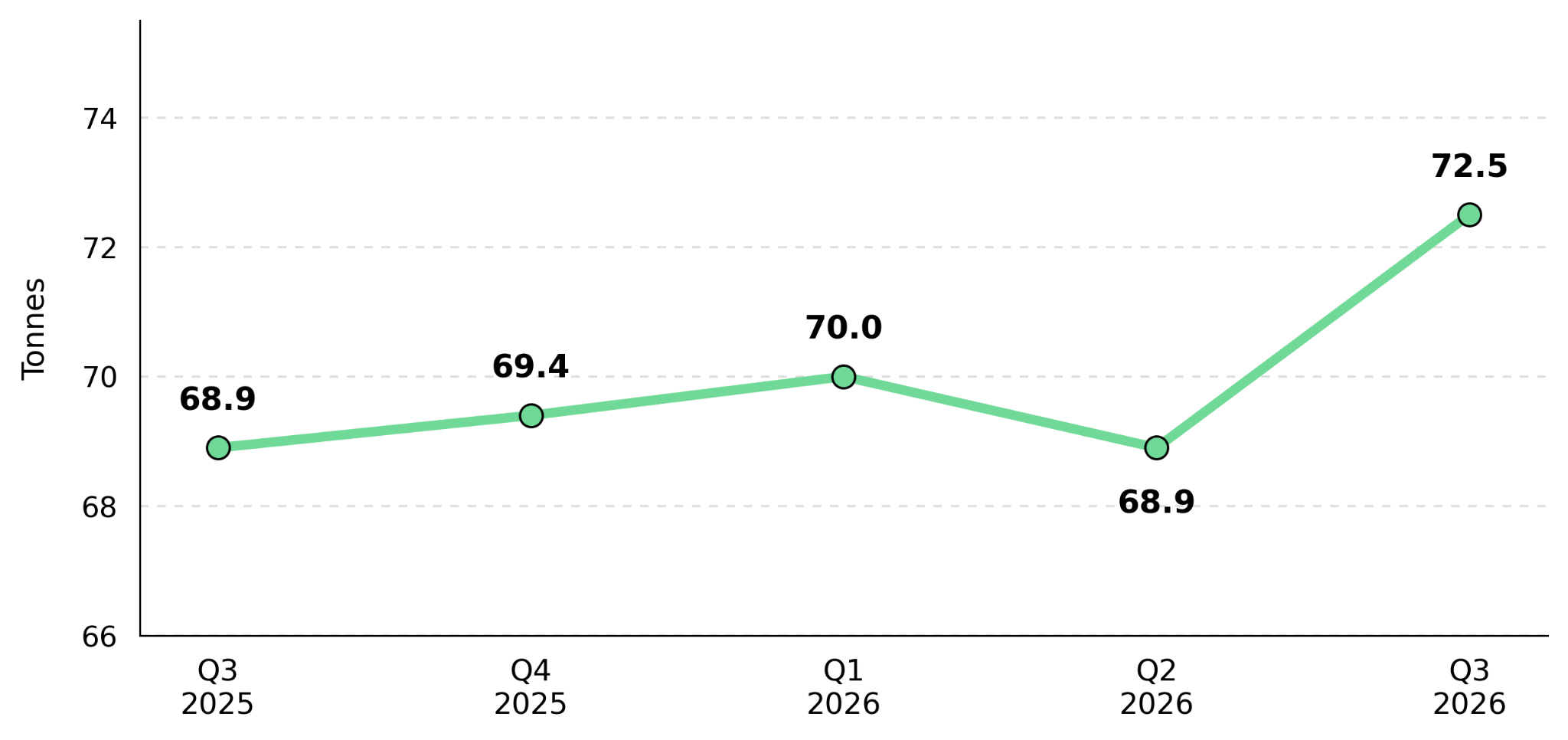
- World Gold Council (WGC) reports that gold electronics demand increased 5% year over year to 72.5 tonnes in the third quarter of 2026, its highest quarterly level since the fourth quarter of 2017.
- The International Energy Agency (IEA) projects electricity consumption at AI-focused data centers to triple between 2025 and 2030, signaling greater demand for advanced electronics containing gold.
- Global semiconductor sales reached US$517.7 billion in the third quarter of 2026, up 24.1% from the previous quarter, underscoring the scale of an industry that uses gold in advanced electronic components.
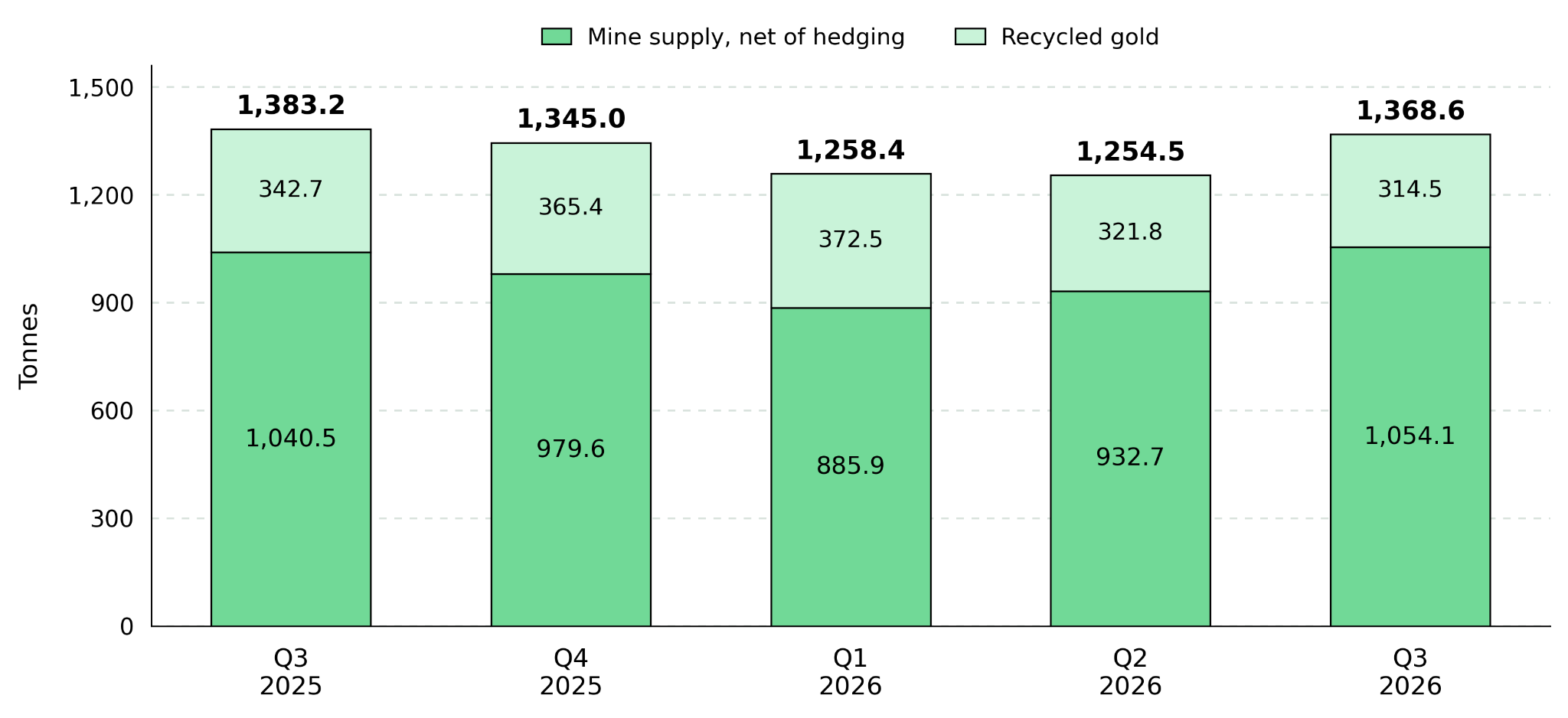
- Gold mine production rose 3% year over year to a third-quarter record of 1,071 tonnes in 2026, but an 8% decline in recycling contributed to a 1% reduction in total gold supply.
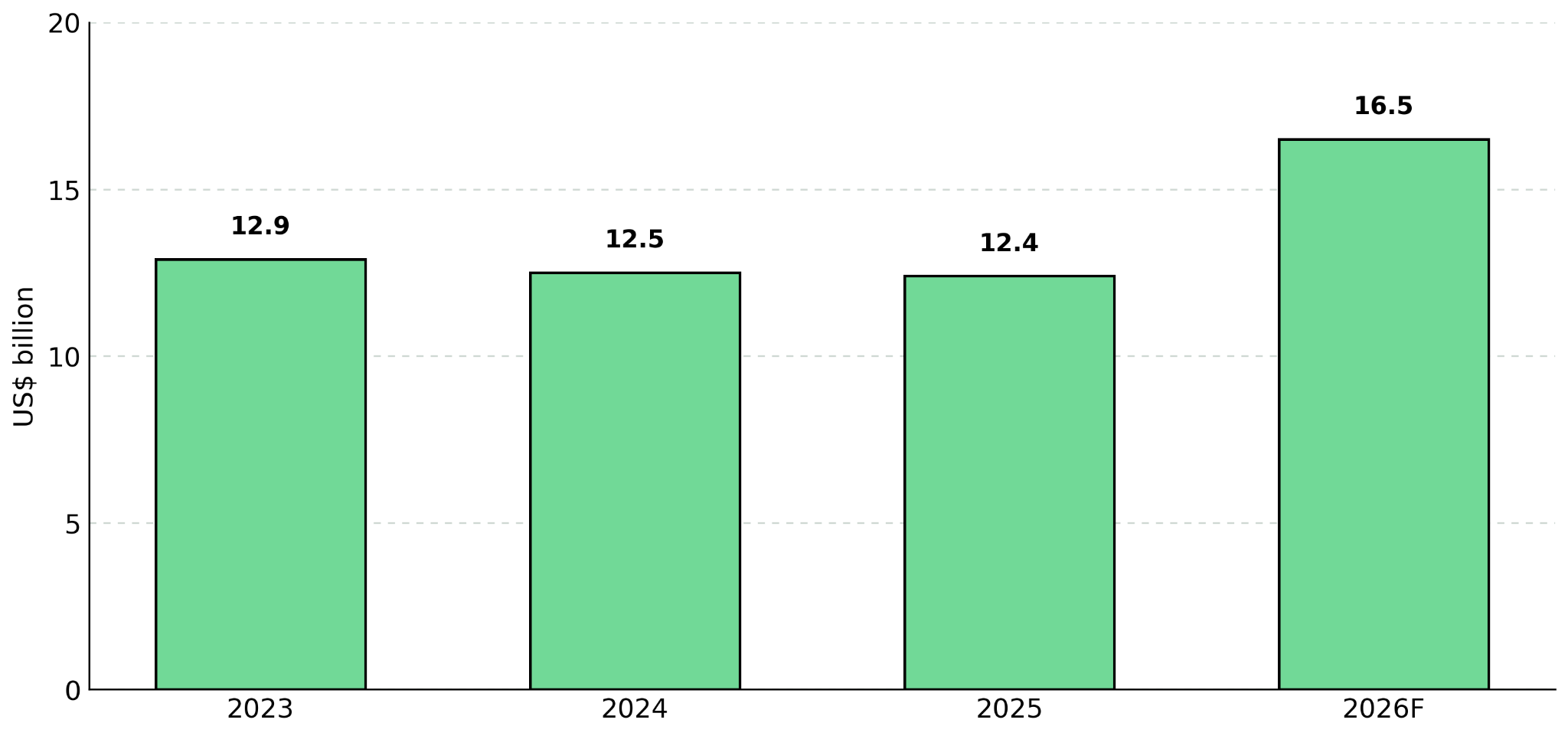
- Global nonferrous exploration budgets are projected to rise from US$12.4 billion in 2025 to US$16.5 billion in 2026, with gold and copper leading the increase.
9-Year High in Gold Electronics Demand Reflects AI Infrastructure Growth
WGC reports that gold electronics demand reached 72.5 tonnes in the third quarter of 2026, up 5% from 68.9 tonnes a year earlier. This marked its highest quarterly level since the fourth quarter of 2017, with AI infrastructure investment and advanced semiconductor manufacturing contributing to the increase. Total technology demand rose 3% to 84.8 tonnes, supported by gold consumption in advanced memory, high-performance processors, and printed circuit boards used in AI servers and networking equipment.
IEA projects global data center electricity consumption to rise from 485 terawatt-hours in 2025 to 950 terawatt-hours by 2030, with electricity use at AI-focused facilities projected to triple over the same period following a 50% increase in 2025. Capital expenditure among major technology companies exceeded US$400 billion in 2025, with the IEA projecting a further 75% increase in 2026. This spending supports demand for advanced processors, high-bandwidth memory, and communications equipment containing gold in selected components.
The Semiconductor Industry Association reported global semiconductor sales of US$517.7 billion in the third quarter of 2026, up 24.1% from the preceding quarter, while World Semiconductor Trade Statistics reported a 305% year-over-year increase in memory semiconductor revenue during the first half of 2026. Gold's conductivity and corrosion resistance support its use in semiconductor packaging, high-frequency electronics, and optical communications. WGC also identifies co-packaged optics, which integrate optical connections closer to processors, as a potential application for gold in advanced computing systems requiring faster data transmission.
Gold Supply Declines Despite Record Third-Quarter Mine Output
Global gold mine production rose 3% year over year to a third-quarter record of 1,070.9 tonnes in 2026. Recycled gold supply fell 8% to 314.5 tonnes, its lowest quarterly level since the fourth quarter of 2023. Producer net de-hedging reduced reported supply by approximately 17 tonnes, contributing to a 1% decline in total gold supply to 1,368.6 tonnes.
WGC reports that gold mine production increased 22% year over year in Canada and 19% in Chile during the third quarter of 2026, with newly commissioned mines contributing to both increases. These gains demonstrate how completed mine developments can expand gold supply, reinforcing the importance of advancing economically viable projects through feasibility studies, permitting, and construction.
Permitted Gold Projects Offer Potential for Mining Portfolio Growth
Expanding industrial gold demand reinforces the importance of development projects with defined production plans and economic returns. Feasibility studies establish potential mine output, capital requirements, and profitability, while permitting and financing progress provide clearer measures of readiness for construction.
U.S. Gold Corp. has secured all major permits for its CK Gold Project in Wyoming, with engineering advancing toward construction. Its March 2026 feasibility study outlines an 11-year mine life averaging approximately 85,000 gold-equivalent ounces annually, with an after-tax net present value at a 5% discount rate (NPV5%) of US$632 million and a 27% internal rate of return (IRR), based on a gold price of US$3,250 per ounce. With initial capital estimated at US$394 million, the company is evaluating financing options to advance its planned production.
George Bee, President and Chief Executive Officer of U.S. Gold Corp., highlights why portfolio growth matters across mining companies:
"We see that there are lots of junior, mid-tier companies that really need to add to their portfolio. If you don't grow, you die."
Underground Studies Assess Large Gold Resources
As industrial gold demand expands, large undeveloped deposits offer potential sources of future mine supply. Underground economic studies assess how higher-grade resources could support mine development, helping establish potential production capacity and capital requirements.
Tudor Gold is advancing its 80%-owned Treaty Creek Project in British Columbia, where the Goldstorm Deposit contains 24.9 million indicated ounces of gold. An underground preliminary economic assessment is being finalized to evaluate the project's development potential, while drilling at Perfectstorm has extended gold mineralization approximately 480 meters beyond previous results. These developments strengthen the project's path toward defining a potential underground mining operation while creating additional opportunities for resource growth.
Higher Exploration Budgets Expand the Future Gold Resource Pipeline
S&P Global projects global nonferrous exploration budgets to increase from US$12.4 billion in 2025 to US$16.5 billion in 2026, with gold and copper leading the growth. This increased investment supports drilling and resource expansion, advancing additional gold deposits toward economic evaluation and potential mine development.
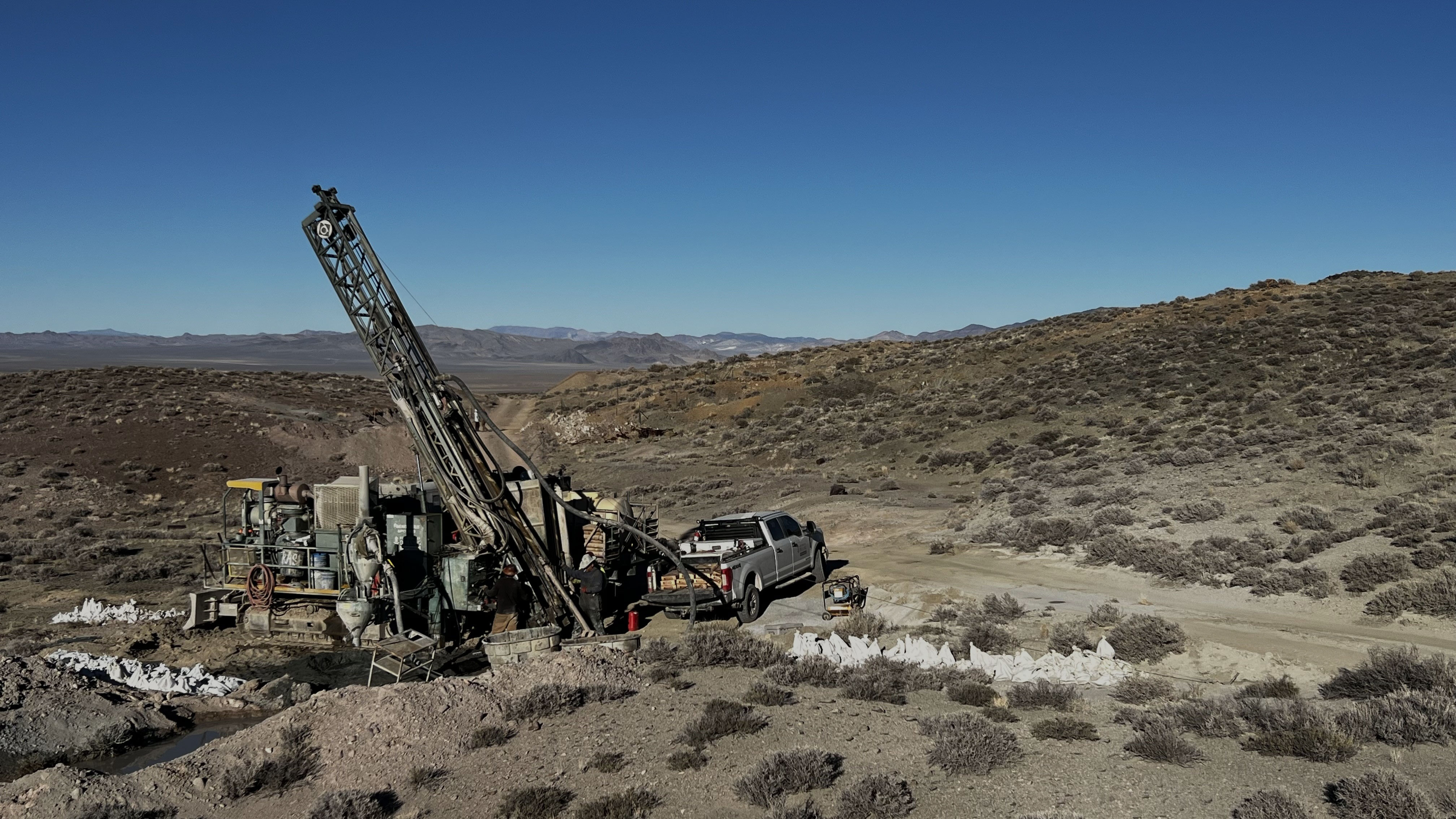
P2 Gold has expanded gold-copper mineralization at its Gabbs Project in Nevada, extending the Lucky Strike Zone along its southern and southwestern margins. Following 114 completed drill holes since October 2025, the company is targeting an updated mineral resource estimate in the fourth quarter of 2026 and a feasibility study in the first quarter of 2027. These milestones could establish a clearer picture of the project's resource potential and economic viability, supporting its advancement toward future mine development.
Joseph Ovsenek, President and Chief Executive Officer of P2 Gold, outlines how exploration supports larger potential gold output:
"We've been working on our infill and expansion drill program. It's getting bigger and bigger... Now we're targeting 150,000 ounces of gold a year and 50 million pounds of copper."
AI Electronics Growth Raises Importance of Future Mine Supply
AI infrastructure investment is supporting demand for advanced processors, memory chips, and networking equipment that use gold in specialized components, adding another source of industrial gold consumption. With AI-focused data center expansion projected through 2030, this demand channel connects continued technology investment with the longer-term outlook for physical gold supply.
Mine production remains the principal potential source of additional gold supply, while higher exploration spending supports the development of future resources. With recycling contributing less to recent supply, expanding electronics demand reinforces the importance of economically viable gold projects capable of adding production over time.
The Investment Thesis for Gold
- AI-driven industrial demand adds another source of gold consumption as advanced computing infrastructure expands, strengthening the long-term relevance of future mine supply.
- Developers with established project economics and permitting progress offer clearer visibility into potential production capacity, strengthening their position as new gold supply opportunities.
- Explorers with expanding mineral resources offer potential for additional gold discoveries and larger deposits, creating opportunities for future project development.
- Resource quality and project economics determine how effectively gold deposits can support profitable operations, with higher grades, strong recoveries, and competitive costs improving potential returns.
- Jurisdictional quality and infrastructure access influence development costs and execution certainty, making established regulatory frameworks and accessible infrastructure important considerations for future gold projects.
- Financing readiness and capital discipline strengthen development prospects by supporting construction funding while helping preserve project economics and shareholder value.
AI infrastructure expansion is adding a new source of industrial demand to gold's established investment and jewelry markets. As advanced electronics manufacturing expands, future mine supply gains importance in meeting a broader range of gold consumption needs. This growing industrial demand reinforces the long-term significance of economically viable gold resources and the role of new mine capacity in supporting the global gold market.
TL;DR
AI infrastructure expansion is supporting gold consumption in advanced semiconductors, memory chips, and networking equipment, with electronics demand reaching its highest quarterly level since 2017. Projected growth in AI-focused data centers and semiconductor investment strengthens the outlook for industrial gold applications. Meanwhile, record mine production has not translated into higher total supply, as declining recycling and producer de-hedging offset production gains. Rising exploration budgets and continued progress across feasibility studies, resource assessments, and permitting support the pipeline of potential new gold supply. Together, these developments reinforce the long-term importance of economically viable gold deposits as industrial consumption expands.
FAQs (AI-Generated)
Analyst's Notes





Subscribe to Our Channel










Stay Informed