DRDGOLD Channels Soaring Cash Flow Into R10bn 'Vision 2028'


DRDGOLD CEO Niël Pretorius explains how high gold-price margins fund Vision 2028, after FY2026 headline earnings rose 89% on flat production.
- DRDGOLD grew FY2026 headline earnings 89% to R4.25 billion even though production was essentially flat at 4,839kg.
- Management now ranks reclamation sites by margin at different gold prices, not just by unit cost.
- The R10 billion Vision 2028 programme targets about 25% more output, 40% more throughput and close to 20 years of additional life of mine.
- Near-term catalysts include DP2 plant completion, Libanon start-up by April and RTSF beneficial occupation approval by the end of 2026.
Gold producers gathered at the Mining Forum Americas this month with the gold price far above the levels most had budgeted for. Yet the wave of mergers and acquisitions many attendees expected has been slow to arrive. For DRDGOLD Limited (JSE:DRD, NYSE:DRD), the South African specialist in recovering gold from historic mine tailings, the priority is not deal-making. It is turning a margin windfall into permanent processing and storage capacity.
Chief Executive Officer Niël Pretorius spoke to Crux Investor in Colorado Springs about funding the company's Vision 2028 growth programme from cash flow, and why margin rather than ounces now shapes its planning. He said valuations are hard to judge while prices move this quickly. That caution runs through DRDGOLD's strategy.
Record Earnings on Flat Production
DRDGOLD's financial year to 30 June 2026 (FY2026) shows how much a higher gold price can do for a business with steady volumes. Gold production was 4,839kg, roughly 155,600 ounces, up just 0.2%. Throughput fell 2% to 25.1 million tonnes. Yet the average Rand gold price received rose 40% to R2,289,250/kg.
Revenue climbed 42% to R11.16 billion. Operating profit rose 83% to R6.45 billion. Headline earnings increased 89% to R4.25 billion. When the interview suggested earnings were up around 40%, Pretorius corrected the figure, saying the increase was closer to 100%.
Margins widened through the year. The group operating margin reached 61.2% in the second half, up from 41.5% in the first half of FY2025. Costs did rise. All-in sustaining costs (AISC) increased 8% to R1,078,068/kg, and cash operating cost per tonne rose 10% to R188/t.
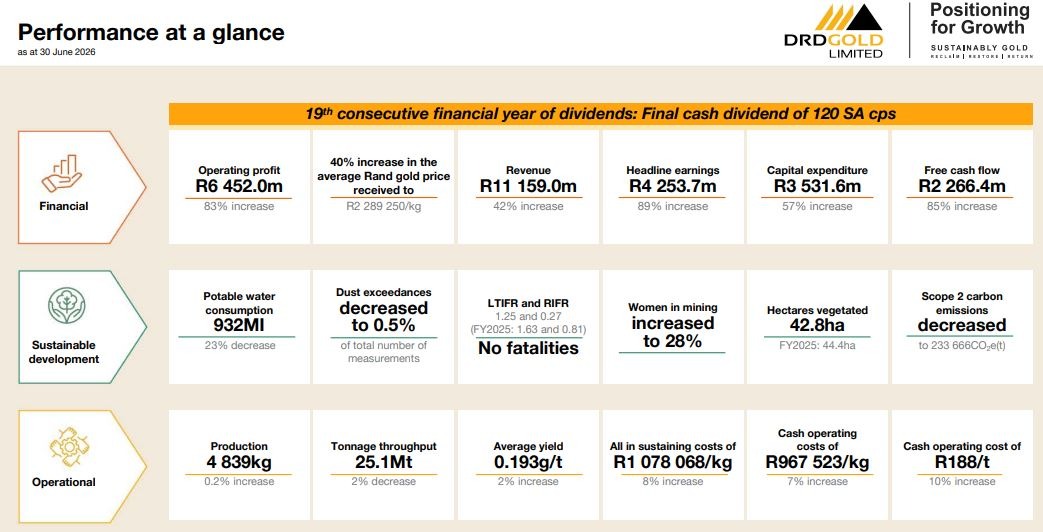
The balance sheet strengthened alongside earnings. Cash and cash equivalents more than doubled to R2.77 billion, and the current ratio improved to 3.6 from 2.3. Free cash flow rose 85% to R2.27 billion. DRDGOLD declared a final cash dividend of 120 South African cents per share, its 19th consecutive year of dividends. Pretorius described the year's dividend as the company's largest yet. He added that it was paid without drawing on the company's funding facilities.
Margin as a Planning Tool
The most distinctive part of Pretorius's message was how DRDGOLD now plans its reclamation sites. Mining companies traditionally rank projects by unit cost. DRDGOLD has added margin at different gold price levels as a second test.
"We obsess in our industry, as we should, over unit costs. But at the moment, because of where the margins are, you actually have to bring margin into your planning matrix as well... maybe the cost per ton and the cost per ounce of this particular resource will be higher, but if we don't mine it now... then we're sacrificing margin or we're losing out on the opportunity to actually mine this particular resource."
Pretorius gave an illustrative example. A site that must be trucked might cost closer to R230 per tonne to reclaim, against a target of around R155 per tonne. The board is shown what the margin looks like at that higher cost, and it has backed this more flexible approach. The aim is to avoid treating the start-of-year budget as a rigid ceiling while prices remain elevated.
Interview with Niël Pretorius, CEO of DRDGOLD Limited
Vision 2028: Where the Capital Is Going
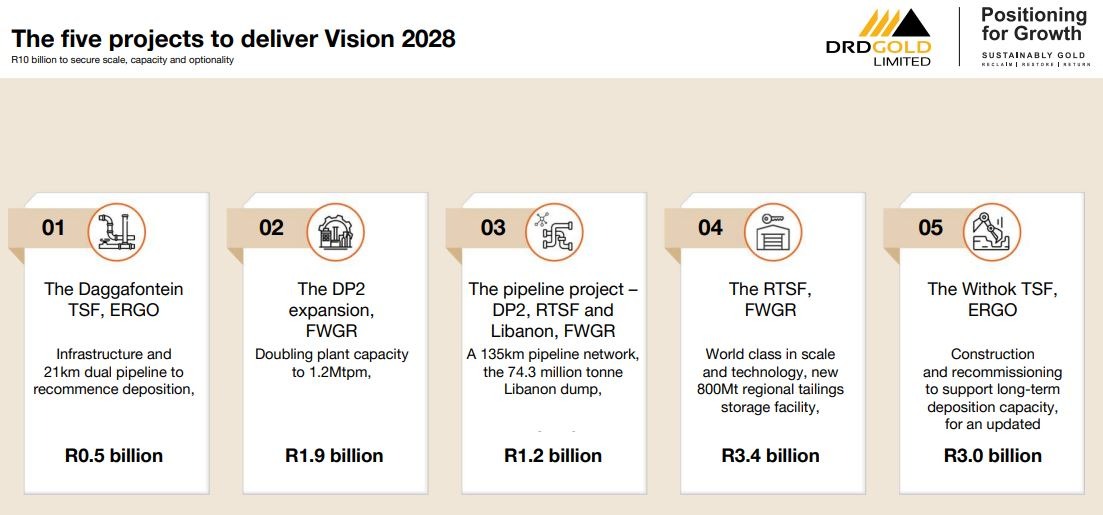
Vision 2028 is a R10 billion, five-project programme. Its purpose is to avoid closing operations prematurely and to treat as much of the resource base as possible. Pretorius said the plan should lift gold output by about 25% and throughput by about 40%. It should also extend life of mine by the better part of 20 years.
At Far West Gold Recoveries (FWGR), the expansion was planned from the day DRDGOLD bought the asset in 2018. The company started with a modest plant processing 500,000 tonnes per month to reach cash flow quickly. The goal was always 1.2 million tonnes per month. The smelthouse and elution circuit of the expanded DP2 plant were commissioned on 14 July 2026. The remainder of the plant is scheduled for commissioning by the end of Q1 FY2027.
The Libanon reclamation site will supply the additional 600,000 tonnes per month. It is under construction, and Pretorius hopes to have it running by April. The 135km pipeline network linking DP2, Libanon and the regional tailings storage facility (RTSF) was 95% complete at 30 June.
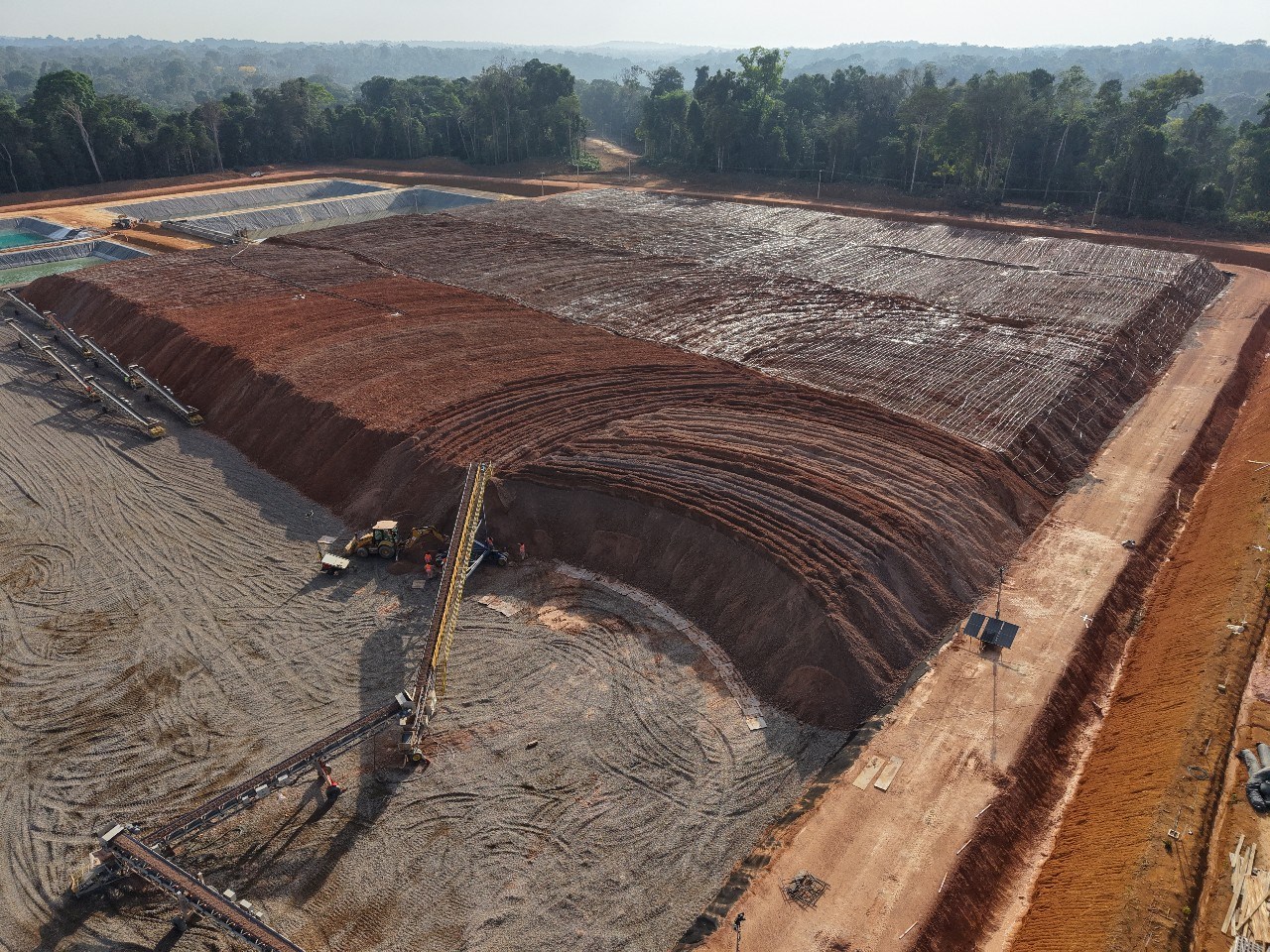
The RTSF is an 800-hectare, fully lined facility and was 67% complete at 30 June. DRDGOLD is preparing its application to the Department of Water and Sanitation for beneficial occupation by the end of October. Pretorius hopes to receive that permission by the end of the calendar year. The target is for the RTSF to receive 1.2 million tonnes per month from the start of FY2028.
Ergo tells a different story. When DRDGOLD acquired it around 2008, the operation was expected to last about 12 years. By 2020, a higher gold price had turned previously uneconomic material into paying resources. The plant was large enough, but storage capacity at the existing Brakpan facility was running thin.
The first answer is the Daggafontein tailings storage facility (TSF), which received its first tailings in July 2026 and adds 120 million tonnes of capacity. The second is the Withok TSF, adjacent to Brakpan, which Pretorius said adds around 310 million tonnes. Withok's footprint sits over a dolomitic feature that must be grouted under pressure to seal it. That work is taking longer than planned. The company targets approvals by December 2026 and completion of construction during 2029.
Withok matters for life of mine as much as volume. Ergo currently runs at around 1.65 million tonnes per month, and Withok will add 150,000 tonnes per month. More importantly, Ergo's current deposition capacity is significantly diminished by 2030. A 60-megawatt solar farm is intended to flatten Ergo's forward cost profile.
Pretorius said the group is running at 150,000 to 155,000 ounces per annum under current throughput limits, a rate that should rise as each component comes online. FY2027 guidance is for 160,000 to 170,000 ounces, at a cash operating cost of R1,099,000/kg and AISC of R1,230,000/kg. Planned capital investment for the year is R3 billion, following R3.53 billion in FY2026. The longer-term aim is to get as close as possible to 200,000 ounces per annum.
Beyond 2028: Acquisitions and the Price of Tailings
The RTSF is being built to receive 2.4 million tonnes per month, double the near-term target. That leaves room for further expansion at FWGR. It will, however, require tailings from surrounding areas, including dumps DRDGOLD does not yet own.
Pretorius was frank that seller expectations are currently high. He pointed to how sensitive the business is to grade. The combined recovery grade is around 0.192 grams per tonne. In his estimate, a drop of just 0.001g/t would have an impact measured in hundreds of millions per year. Paying up for material simply because the gold price is high is therefore a real risk.
The environmental remediation angle can help, because a seller avoids future rehabilitation and closure costs. However, Pretorius noted that owners no longer see dumps as waste but as income-generating assets. Some of the relevant dumps sit within the Sibanye-Stillwater group. The recent transfer of the Kloof 2 dump from Sibanye-Stillwater added 67.36 million tonnes and 0.52 million ounces to reserves, extending FWGR's life of mine by four years. Group Mineral Reserves now stand at 6.22 million ounces at 0.29g/t. The company's outlook also includes exploring growth opportunities beyond South Africa.
Competitive Positioning
Pretorius described the business as mega volume with nano extraction. At grades this low, the barrier to entry is capital. A rival could build a plant handling 300,000 tonnes per month and make money today. Once margins shrink, that plant would prove too small to sustain the throughput needed to stay profitable. For owners of primary orebodies, the question becomes where to allocate capital. DRDGOLD's pitch is that its infrastructure already exists.
The company also draws on institutional knowledge stretching back to Crown Mines in the 1980s. Pretorius rejected the notion that tailings retreatment is simply normal mining at a larger scale. Plants must be set up proactively to specific parameters, because once material is in the circuit there is little room to adjust.
Investment Thesis for DRDGOLD
- DRDGOLD is converting a high gold price into margin rather than volume, with FY2026 headline earnings up 89% on production that was essentially flat.
- The R10 billion Vision 2028 programme targets about 25% more output and 40% more throughput, and is being funded largely from operating cash flow.
- FWGR's expansion from 500,000 to 1.2 million tonnes per month is the main near-term volume driver, with the RTSF designed for 2.4 million tonnes per month.
- R2.77 billion in cash, a current ratio of 3.6 and 19 consecutive years of dividends support both the build-out and shareholder returns.
- Investors should monitor RTSF beneficial occupation approval, targeted by the end of 2026, and Libanon reclamation start-up, targeted for April.
- Withok approvals, targeted by December 2026, are critical to Ergo's life of mine beyond 2030.
- Key risks include gold price and Rand exposure, AISC guidance about 14% above the FY2026 outcome, regulatory timing and high sensitivity to small changes in recovery grade.
Macro Thematic Analysis
The gold market has moved into territory few producers anticipated. Pretorius recalled that at last year's Denver Gold Forum the mood was euphoric, as DRDGOLD's market capitalisation passed $2 billion for the first time and it became a mid-cap. Since then, the gold price has climbed well above $5,000 per ounce. The tone this year is more cautious, with geopolitical uncertainty clouding the outlook.
Commentators remain divided on whether the rally reflects momentum or fundamentals. Some argue the price should retreat towards what they see as structural support. Pretorius does not claim to know where that level lies. He draws a clear line between an investor's view and an operator's view.
"What I'm experiencing as an operator, not as an analyst or... a market person, [is] that the gold price where it currently is is very very good. It's [an] opportunity to take advantage of margin."
This distinction matters for how investors assess producers in a high-price cycle. Share prices respond to where gold might go next. An operator can only capture the benefit of where it is today. DRDGOLD's response is to spend the windfall on long-life infrastructure while margins are wide, rather than chase acquisitions at uncertain valuations. Pretorius was clear that margins always shrink eventually, and the build-out is designed to leave the business positioned for that moment.
Tailings retreatment occupies a distinctive corner of the gold sector. It reprocesses waste left by past mining, so it needs no new underground development and addresses legacy environmental liabilities. That gives it relevance to sustainability-focused investors as well as those seeking gold exposure. Its economics, however, depend heavily on scale, recovery efficiency and price.
TL;DR:
DRDGOLD reported FY2026 headline earnings up 89% to R4.25 billion on essentially flat production of about 155,600oz, driven by a 40% rise in the Rand gold price received. CEO Niël Pretorius now plans reclamation sites around margin as well as unit cost. Surplus cash is going into the R10 billion Vision 2028 programme. That programme targets about 25% more output, 40% more throughput and close to 20 extra years of mine life. FWGR's expansion to 1.2Mtpm is the main near-term driver. RTSF approval is hoped for by year-end, and Libanon is targeted for April. FY2027 guidance is 160,000 to 170,000oz. Pretorius warns that grade sensitivity makes overpaying for new tailings a real risk.
FAQ (AI-generated)
Analyst's Notes





Subscribe to Our Channel


%20(1)%20(1).jpg)
.jpg)
Stay Informed