




Electra Battery Secures Government Backing, Nears Mechanical Completion on North America's Sole Cobalt Refinery


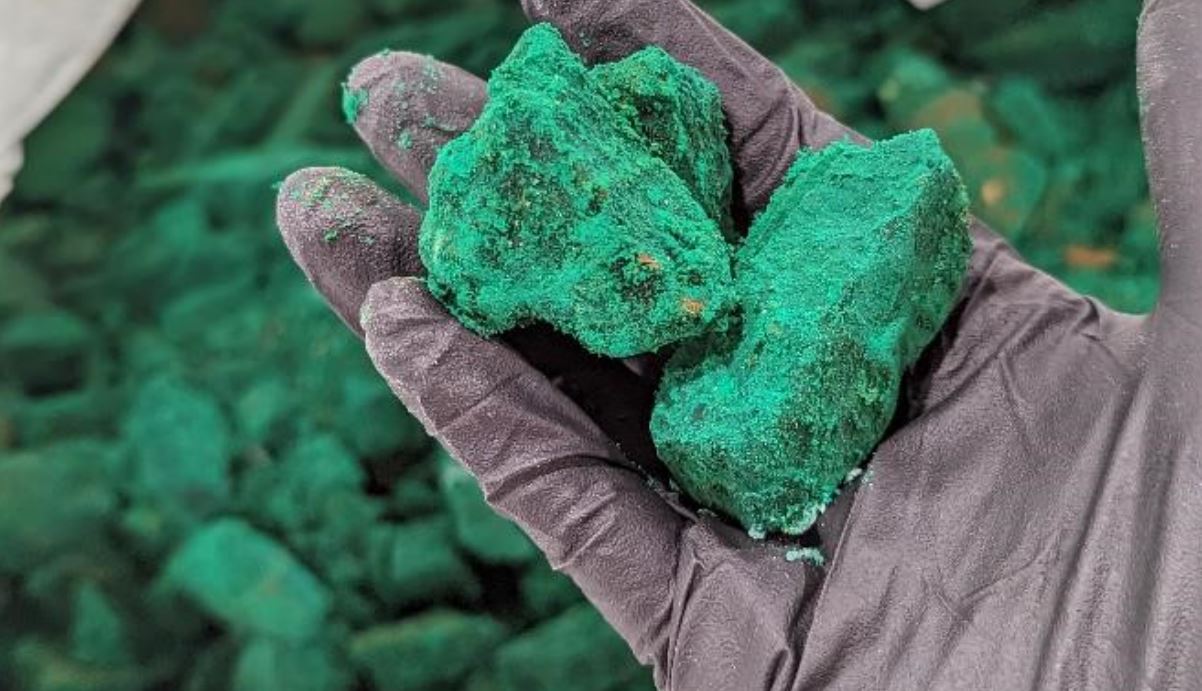
Electra Battery Materials advances North America's only cobalt sulfate refinery toward 2027 production, backed by $84M in financing and an LG offtake deal.
- Electra has secured $84 million in financing, including $48 million in government support, to fund construction through mechanical completion in Q2 2027.
- LG Energy Solution's tolling agreement covers 60% of Electra's initial production and includes a price collar that protects margins on both sides.
- The remaining 40% of production capacity is not yet contracted, and reported expressions of interest already run at roughly 2-3x the refinery's initial nameplate capacity.
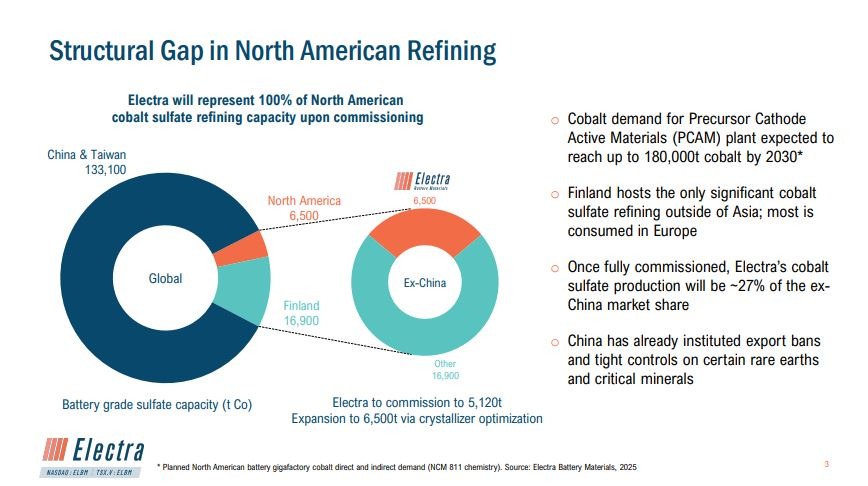
- Once commissioned, Electra will represent 100% of North American battery-grade cobalt sulfate refining capacity.
- Beyond cobalt, Electra is studying a southeastern U.S. nickel sulfate refinery, advancing black mass recycling, and holds cobalt-copper exploration assets in Idaho.
For decades, virtually all of the world's battery-grade cobalt sulfate has been refined in China, with a single facility in Finland serving as the only meaningful counterweight. That leaves North American automakers, electronics manufacturers and defence contractors dependent on a supply chain they don't control. Electra Battery Materials (NASDAQ:ELBM; TSXV:ELBM) is building the fix: the only cobalt sulfate refinery under construction on the continent, backed by three governments and eight months from mechanical completion.
Heather Smiles, Vice President of External Affairs and Corporate Development, provided updates on where the Temiskaming Shores, Ontario project stands.
ConstructionOn Schedule, Financing Locked In
Electra raised a total of $84 million to fund the refinery's remaining construction, including $48 million in government support: a $20 million grant from the U.S. Department of War, C$20 million from the Canadian federal government (a C$5 million grant plus a C$15 million low-cost loan), and C$17.5 million from the Ontario government as a further loan. A $34 million equity raise rounded out the package. That capital, Smiles said, is sufficient to fund all remaining construction activity through mechanical completion, though additional working capital and ramp-up costs will need to be addressed separately in 2027.
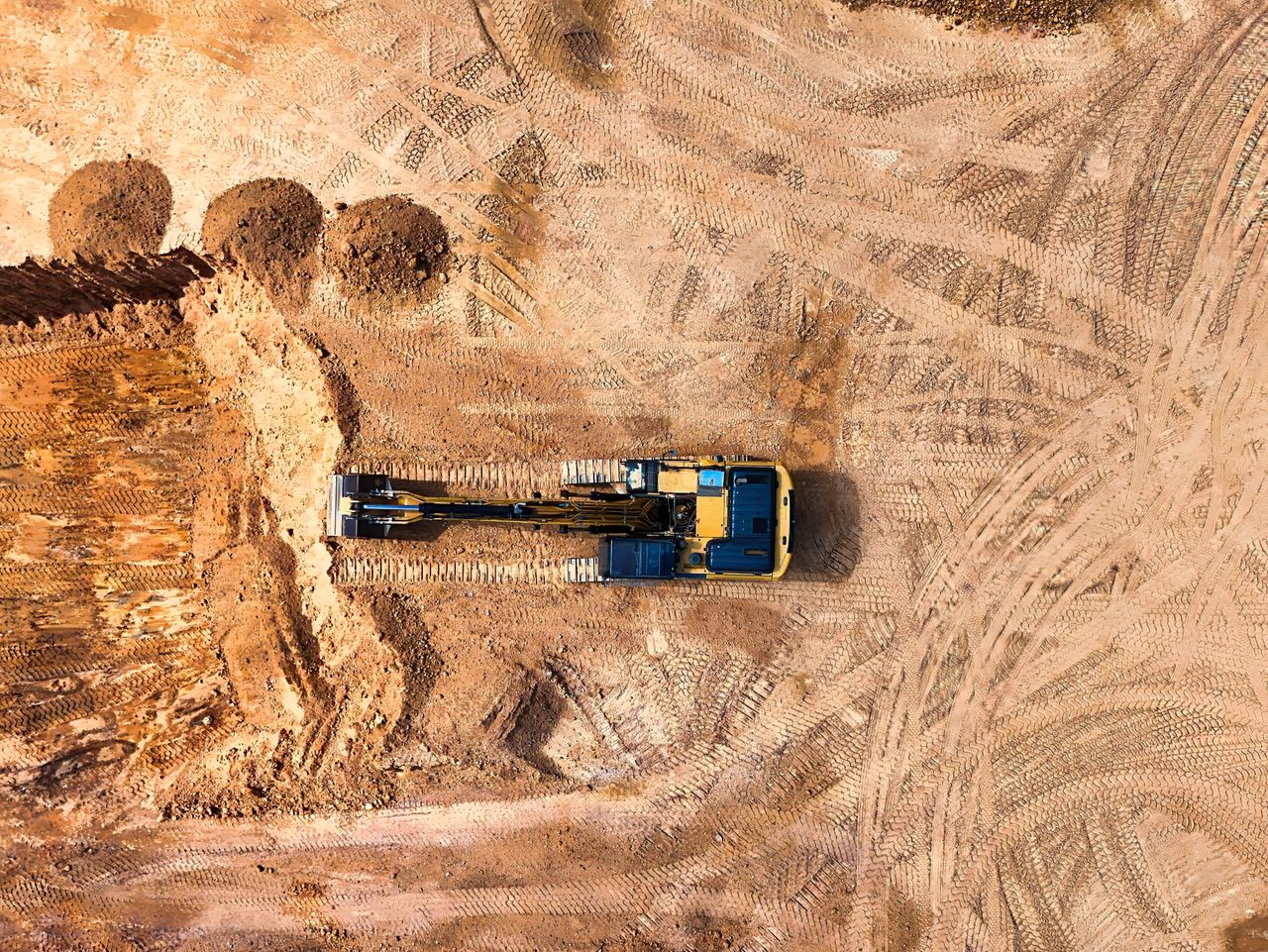
Construction has been underway since late last year and is focused on tanks, piping, electrical instrumentation and mechanical works. Mechanical completion is targeted for Q2 2027, with commissioning of specific circuits beginning as early as the end of this year. As Smiles put it:
"If you're sort of waiting for us to get going, going is already been and gone. We're well underway."
A Tolling Structure Built for Stability
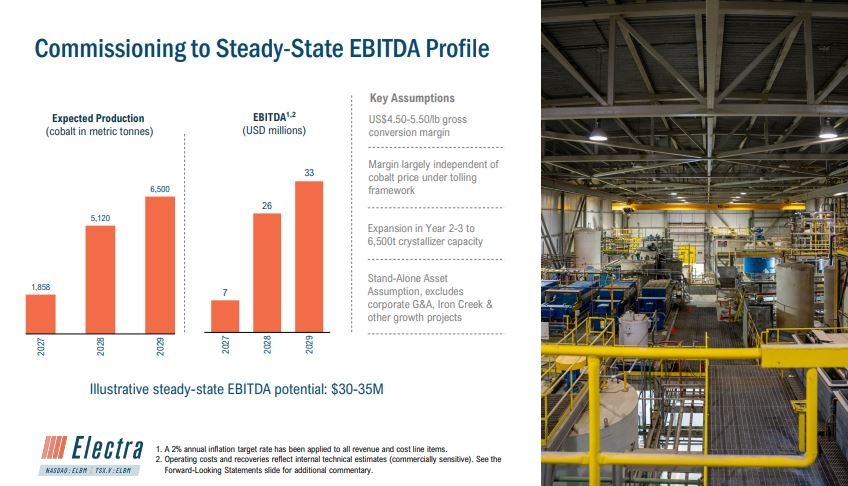
Electra's initial operating permit covers 5,100 tonnes of cobalt sulfate annually, with the crystallizer already sized to expand that to 6,500 tonnes which is roughly 4% of the global cobalt sulfate market. LG Energy Solution has a binding offtake agreement for 60% of that production, structured as a three-year term with a three-year extension option. The arrangement uses a collar-style tolling structure: a floor that protects Electra if cobalt prices fall, and a ceiling that keeps LG from overpaying if prices spike. At full run-rate, Smiles said the tolling model alone should generate roughly $30-32 million a year in EBITDA (earnings before interest, tax, depreciation and amortisation).
The remaining 40% of production is not yet contracted. Electra is weighing how much of that volume to keep market-facing rather than locking it into further tolling deals, a decision that carries more upside in strong cobalt markets but more risk if prices fall.
Feedstock and Government Backing
Feedstock supply agreements with Glencore and Eurasian Resources Group cover the roughly 80% of global cobalt that originates in the Democratic Republic of Congo, with Electra emphasising a vetted, traceable supply chain built with partners it has worked to select carefully. Smiles noted that shipment reliability out of the DRC varies significantly by company, with some material moving more easily than others depending on the relationships in place - a dynamic that makes Electra's supply chain optionality, rather than just its sourcing ethics, a selling point to customers who have been burned by less transparent counterparties.
On the government side, all three levels of government involved, U.S., Canadian federal and Ontario, have taken direct financial stakes in the project, reflecting what Smiles described as a broader shift toward governments backstopping strategic midstream infrastructure rather than leaving it to private capital alone. Unlike a mine, whose location is fixed by geology, a refinery can be sited deliberately - which is why governments are increasingly interested in where these facilities are built, with an eye toward eventually co-locating precursor cathode active material (PCAM) manufacturing and the rest of the downstream supply chain around them.
Interview with Heather Smiles, VP, Electra Battery Materials
Market Backdrop and Policy Tailwinds
Cobalt demand for lithium-ion batteries grew roughly 30% in 2025, driven primarily by electric vehicle demand outside North America, with consumer electronics and a growing defence-sector use case (drones, radios, satellites) as the next-largest growth drivers. Smiles was candid that much of the volatility in cobalt pricing traces back to Chinese market dynamics rather than underlying supply and demand, drawing a parallel to how China has previously restricted rare earth exports during periods of geopolitical friction - a precedent that has sharpened Western governments' focus on supply chain sovereignty for cobalt as well.
A new U.S. policy requiring domestically produced black mass to stay in the country for one year, aimed at curbing the practice of Chinese buyers acquiring and reprocessing U.S. black mass, then reselling it back to American refiners at a premium - is, in Smiles' words, an early signal rather than a complete fix, with exemption mechanisms still being tested and industry feedback actively being gathered. She also pointed to tariffs as a potential complementary tool under discussion, though she cautioned that policy alone won't compress years of midstream capacity-building into a single year, calling the black mass rule "a shot across the bow" rather than a finished solution.
Beyond Cobalt: Nickel, Recycling and Idaho
Electra has started an engineering study for a nickel sulfate refinery in the southeastern United States, addressing another gap in the North American battery supply chain: like cobalt sulfate, nickel sulfate currently has no domestic production capacity, despite being an essential input to the same PCAM supply chain. Smiles framed this as a natural extension of the expertise and construction experience the team is building on the cobalt refinery, rather than a separate venture - the plan is to bring the same playbook to a second critical mineral once the Ontario facility is running.
The company is also advancing black mass recycling, aiming to recover lithium, nickel and cobalt from end-of-life batteries rather than relying solely on primary feedstock, and holds cobalt-copper exploration assets in Idaho's Cobalt Belt through its Iron Creek project, one of the largest unmined cobalt resource positions in the United States. Idaho is positioned as longer-term optionality rather than near-term feedstock: further drilling and permitting work would be required before it could feed the refinery, and management has indicated it is still weighing the best way to monetise or develop the asset.
Investment Thesis
- Electra will represent 100% of North American battery-grade cobalt sulfate refining capacity once commissioned, a structural monopoly position rather than a competitive one.
- The LG Energy Solution tolling agreement covers 60% of initial production with built-in price protection, reducing near-term exposure to cobalt price volatility.
- $84 million in secured financing, including $48 million in multi-government backing, funds the project through mechanical completion, targeted for Q2 2027.
- The remaining 40% of production capacity is uncommitted, giving Electra optionality to negotiate additional offtake or take on market exposure as commissioning nears.
- Expressions of interest reportedly run at roughly 2-3x initial nameplate capacity, suggesting a seller's market once commissioning is complete.
- Nickel sulfate refining and black mass recycling represent adjacent growth vectors that could extend Electra's role in the North American battery supply chain beyond cobalt.
- Monitor Q4 2026 early circuit commissioning and the resolution of the remaining 40% offtake decision as near-term catalysts.
Macro Thematic Analysis
The structural gap in North American critical minerals refining has been discussed for years, but capital has been slow to follow. Part of that is technical: hydrometallurgical refining expertise takes time to build, and Electra's team has been doing it longer than most of its would-be competitors. Part of it is capital intensity: China's refining capacity was built with access to effectively unlimited, cheap state-backed capital, an advantage neither the U.S. nor Canadian equity markets can easily replicate for infrastructure of this scale. That gap is precisely why governments have stepped in directly, as investors rather than merely as policy-setters, across all three jurisdictions involved in Electra's refinery.
As Smiles framed the broader stakes:
"The reality is we need to diversify the supply chain and part of that is ensuring that we have some sovereignty."
That sovereignty argument extends beyond cobalt. The same midstream gap exists in nickel sulfate, and Electra's decision to launch a southeastern U.S. engineering study signals an attempt to replicate its Ontario playbook in a second critical mineral before competitors establish a foothold. The defence sector's growing appetite for lithium-ion batteries in drones, radios and other equipment adds a further dimension: a supply chain dependent on potential geopolitical rivals is increasingly viewed as a direct national security exposure, not just a commercial inefficiency. Investors weighing exposure to the critical minerals refining theme should watch whether policy tools like the new black mass rule evolve from symbolic first steps into structural incentives capable of drawing in private capital at scale.
TL;DR:
Electra Battery Materials is building the only cobalt sulfate refinery under construction in North America, with $84 million in financing (including $48 million in government support) secured through mechanical completion, targeted for Q2 2027. A tolling agreement with LG Energy Solution covers 60% of initial 5,100-6,500 tonne annual capacity with built-in price protection, while the remaining 40% stays uncommitted. Growth optionality includes a southeastern U.S. nickel sulfate study, black mass recycling, and Idaho cobalt-copper exploration assets.
FAQ (AI-generated)
Analyst's Notes





Subscribe to Our Channel






Stay Informed


